
Quick Summary
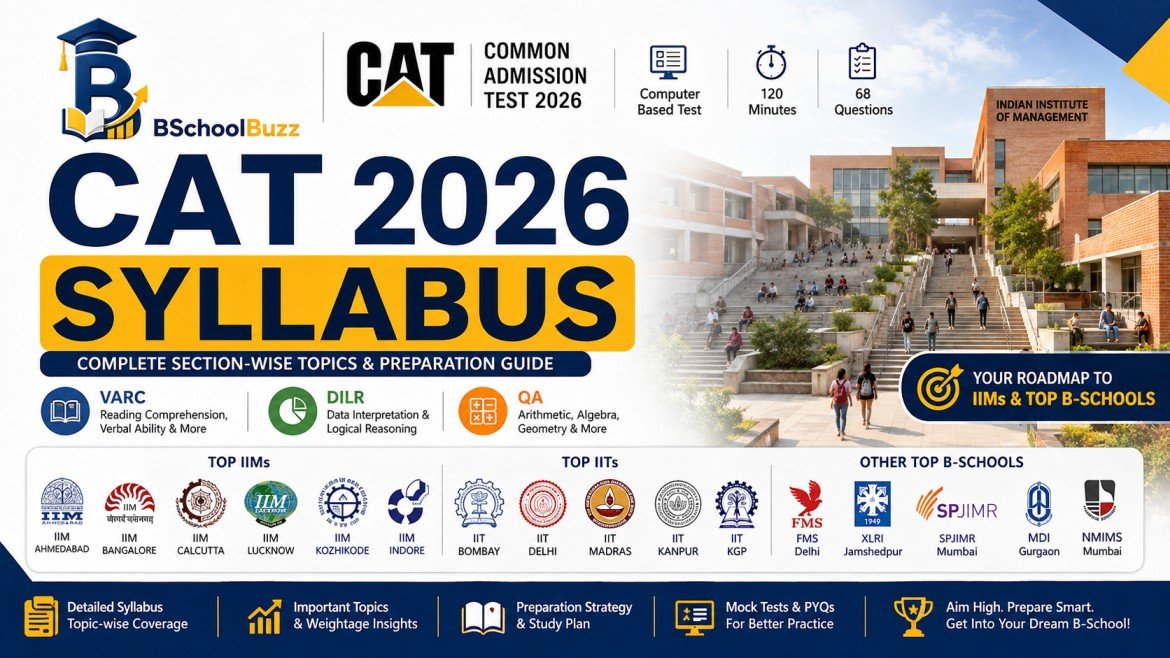
- The CAT 2026 Syllabus covers three sections—VARC, DILR, and Quantitative Aptitude (QA)—with topics ranging from Reading Comprehension and Verbal Ability to Data Interpretation, Logical Reasoning, Arithmetic, Algebra, Geometry, and Number System. This guide covers the complete topic-wise syllabus, exam pattern, important chapters, preparation strategy, and practical tips to help aspirants plan their CAT 2026 preparation effectively.
If you are preparing for CAT 2026, understanding the syllabus is one of the first things you should do before building a study plan. The CAT 2026 Syllabus covers three broad areas: Verbal Ability and Reading Comprehension (VARC), Data Interpretation and Logical Reasoning (DILR), and Quantitative Aptitude (QA).
However, there is an important point that many CAT aspirants miss: the Indian Institutes of Management do not publish a chapter-by-chapter official syllabus in the same way that many school or university examinations do. The detailed topic list generally used by students and coaching institutes is derived from previous CAT papers, the recurring concepts tested in the examination, and the established structure of the three sections.
For CAT 2026, the official examination notification has confirmed the examination date as November 29, 2026. Registration began on August 3, 2026, and the official registration deadline is September 15, 2026, at 5 PM. The exam is scheduled to be conducted in three sessions.
The examination continues to test candidates through VARC, DILR and QA. The current pattern has 68 questions to be attempted within 120 minutes, with 40 minutes allotted to each section. Candidates cannot move between sections during the examination.
This article explains the CAT 2026 Syllabus in practical terms: what to study, which chapters fall under each section, how to prioritise topics, how the syllabus connects with the actual examination pattern, and how to convert the syllabus into a preparation plan.
CAT 2026 Syllabus at a Glance
Before going into individual chapters, it helps to understand the overall structure of the examination.
| Section | Full Form | Questions | Time |
|---|---|---|---|
| VARC | Verbal Ability & Reading Comprehension | 24 | 40 minutes |
| DILR | Data Interpretation & Logical Reasoning | 22 | 40 minutes |
| QA | Quantitative Aptitude | 22 | 40 minutes |
| Total | — | 68 | 120 minutes |
The current CAT pattern uses both Multiple Choice Questions (MCQs) and Type in the Answer (TITA) questions. A correct answer carries three marks. Wrong MCQ answers attract a one-mark penalty, while TITA questions do not carry negative marking for an incorrect response.
The most important takeaway is that CAT is not a traditional chapter-completion examination. Knowing the CAT 2026 Syllabus is necessary, but it is not sufficient. The examination rewards candidates who can identify the right questions, manage time, interpret information quickly and maintain accuracy under pressure.
Table of Contents
What Is the CAT 2026 Syllabus?
CAT 2026 Exam Pattern
CAT 2026 Syllabus for VARC
Reading Comprehension in CAT
Verbal Ability Topics
CAT 2026 Syllabus for DILR
Data Interpretation Topics
Logical Reasoning Topics
CAT 2026 Syllabus for Quantitative Aptitude
Arithmetic Topics
Algebra Topics
Geometry and Mensuration Topics
Number System Topics
Modern Mathematics Topics
CAT 2026 Important Topics
CAT 2026 Syllabus and Topic Priority
What Is Not Part of the CAT Syllabus?
How Difficult Is the CAT 2026 Syllabus?
How to Prepare the CAT 2026 Syllabus
CAT Preparation Strategy for Beginners
CAT Preparation Strategy for Working Professionals
How to Complete the Syllabus in 3 Months
How to Complete the Syllabus in 6 Months
How to Use Previous Year Questions
How to Use Mock Tests
Common Mistakes While Preparing the Syllabus
CAT 2026 Syllabus FAQs
Conclusion
Search Keywords
Long-Tail & Short-Tail Searches
What Is the CAT 2026 Syllabus?
The CAT 2026 Syllabus is broadly divided into three sections:
Verbal Ability and Reading Comprehension (VARC) tests reading comprehension, verbal reasoning and the ability to understand the structure and meaning of written passages.
Data Interpretation and Logical Reasoning (DILR) tests how effectively you can interpret information, identify relationships, organise data and solve logical problems.
Quantitative Aptitude (QA) tests mathematical concepts and numerical reasoning, particularly topics commonly studied through school-level mathematics.
Unlike an academic examination where the syllabus may specify every chapter and subtopic, CAT does not provide a fixed official chapter list. This means that a preparation syllabus should be treated as a practical framework rather than a promise that every listed chapter will appear in exactly the same form in CAT 2026.
This distinction matters.
For example, Arithmetic is consistently important for CAT preparation, but that does not mean a candidate will receive a fixed number of questions from percentages, another fixed number from profit and loss, and another fixed number from time and work. The actual paper can change from year to year and from slot to slot.
The safest approach is therefore to prepare the recurring concepts thoroughly and use previous CAT papers to understand how those concepts are tested.
CAT 2026 Exam Pattern
The CAT 2026 examination is structured around three sections: VARC, DILR and QA. The current notified structure has 68 questions and a total examination duration of two hours, with 40 minutes for each section.
Section-wise CAT 2026 Pattern
| Section | Questions | Time | Main Skill Tested |
|---|---|---|---|
| VARC | 24 | 40 minutes | Reading, comprehension and verbal reasoning |
| DILR | 22 | 40 minutes | Data interpretation and logical reasoning |
| QA | 22 | 40 minutes | Mathematical reasoning and problem solving |
The sectional time limit makes CAT different from many other entrance examinations. You cannot compensate for a weak section simply by spending more time on it. Once the time allotted to one section ends, the examination moves to the next section.
This is why preparation for the CAT 2026 Syllabus should include both topic preparation and sectional time management.
CAT 2026 Marking Scheme
The standard marking structure includes:
+3 marks for a correct response
-1 mark for an incorrect MCQ
No negative marking for an incorrect TITA response
No marks for an unanswered question
The exact mix of MCQ and TITA questions can vary, so students should not build their preparation around assumptions about a fixed question-type distribution.
CAT 2026 Syllabus for VARC
VARC stands for Verbal Ability and Reading Comprehension. It contains 24 questions in the current examination structure and is generally divided into two broad components:
Reading Comprehension
Verbal Ability
For many students, VARC initially appears easier than QA because it does not require extensive mathematical formulas. In practice, however, the section can be highly demanding because the difficulty often comes from interpretation, inference, close reading and answer-option elimination.
A candidate can know English grammar and vocabulary well and still struggle with CAT VARC.
The reason is simple: CAT does not primarily test whether you can speak or write impressive English. It tests whether you can understand an argument, identify the author's intention, distinguish between strong and weak inferences and select the answer that is best supported by the passage or question.
Reading Comprehension in CAT 2026
Reading Comprehension is one of the most important parts of the CAT 2026 Syllabus.
The passages can come from a wide range of subjects. Previous CAT papers have included themes connected with philosophy, economics, psychology, science, history, culture, literature, social issues and other academic or intellectual areas.
You do not need to be an expert in these subjects.
The passage normally contains enough information to answer the questions. Your job is to understand the argument and use the information presented in the passage rather than relying on outside knowledge.
Important Reading Comprehension Skills
Prepare for:
Main idea
Central argument
Author's viewpoint
Tone
Inference
Logical implication
Supporting evidence
Contradiction
Passage structure
Purpose of a paragraph
Meaning in context
Application of an argument
Strengthening or weakening an argument
Comparison between viewpoints
Fact versus inference
Author's intention
Types of RC Questions
A CAT RC question may ask you to identify:
The main idea: What is the passage primarily about?
The author's purpose: Why has the author written the passage?
Inference: What can reasonably be concluded from the passage?
Tone: Is the author critical, analytical, skeptical, appreciative, neutral, argumentative or something else?
Specific information: What does the passage say about a particular idea?
Application: Which situation is most consistent with the argument presented?
Structure: How does the author develop the argument?
The most important RC habit is to avoid selecting an answer merely because it sounds reasonable. The correct answer must be supported by the passage.
How to Improve RC Performance
Read regularly, but do not turn reading into a passive activity.
When reading an editorial, essay or long-form article, ask yourself:
What is the author trying to establish?
What is the central argument?
Which evidence supports the argument?
Is the author agreeing with or challenging another viewpoint?
Why has a particular example been included?
What assumptions does the argument make?
How does each paragraph connect to the next?
This type of active reading is much more useful for CAT than simply reading a large number of articles every day.
Verbal Ability Topics in CAT 2026
The Verbal Ability part of the CAT 2026 Syllabus commonly includes:
Para Jumbles
Para Summary
Odd Sentence Out
Sentence Placement
Paragraph Completion
Logical sequence of sentences
Paragraph structure
Sentence arrangement
Context-based verbal reasoning
The exact combination of question types can vary across CAT papers, so candidates should practise the established VA formats rather than assuming that every listed format will necessarily appear.
Para Jumbles
Para Jumbles provide a set of sentences that need to be arranged into a logical paragraph.
The challenge is not simply identifying the first sentence. You need to understand how sentences connect.
Look for:
Opening statements
Pronoun references
Repeated concepts
Cause-and-effect relationships
Chronological order
Examples following general statements
Conclusions
Contrast words
Transition words
Para Summary
A paragraph is presented along with answer choices. You need to identify the option that best represents the central idea.
A good summary should capture the main argument without adding an unrelated claim or changing the author's position.
Odd Sentence Out
Several sentences form a coherent paragraph, while one sentence does not fit logically.
The sentence may be grammatically correct and related to the broad topic but still be the odd one out because it breaks the logical flow.
Sentence Placement
These questions require you to determine where a sentence best fits within a paragraph.
The clues can include pronouns, transitions, references to previously mentioned ideas and logical development.
CAT 2026 Syllabus for DILR
DILR stands for Data Interpretation and Logical Reasoning.
The section combines two different but related skill sets:
Data Interpretation
Logical Reasoning
The biggest difference between DILR and the other CAT sections is that questions are often organised into sets.
You may see a table, chart, arrangement, game, schedule or network followed by multiple questions.
This means DILR preparation should not focus only on solving individual questions. You also need to develop the ability to identify which set is worth attempting.
Data Interpretation Topics
The Data Interpretation portion of the CAT 2026 Syllabus can include:
Tables
Bar graphs
Line graphs
Pie charts
Caselets
Data comparison
Data aggregation
Percentages
Ratios
Averages
Growth rates
Data sufficiency
Combination of multiple data formats
Missing data
Conditional data
Logical interpretation of numerical information
Tables
Tables can contain multiple variables and conditions.
The challenge is often not the arithmetic itself but identifying which information is relevant to the question.
Bar Graphs
Bar graphs can involve comparisons across years, categories, companies, products, regions or other variables.
You should be comfortable calculating:
Differences
Ratios
Percentages
Percentage change
Relative growth
Averages
Line Graphs
Line graphs commonly require you to interpret changes over time.
Do not immediately start calculating every number. First understand what the axes represent and identify the trend.
Pie Charts
Pie charts test your ability to convert proportions into useful calculations.
You should understand:
Fractions
Percentages
Ratios
Sector comparisons
Total-value calculations
Caselets
A caselet provides information in paragraph form instead of presenting everything through a graph or table.
The ability to convert written information into a structured representation is extremely useful here.
Logical Reasoning Topics
The Logical Reasoning portion of the CAT 2026 Syllabus may include:
Arrangements
Seating arrangements
Distribution
Scheduling
Grouping
Selection
Games and tournaments
Routes and networks
Ordering
Ranking
Binary logic
Venn diagrams
Team formation
Assignment problems
Conditional logic
Set-based reasoning
Puzzles
The exact wording and structure of these questions can change significantly.
Arrangements
Arrangement questions may involve people, objects, positions, rooms, days, ranks or other variables.
The first objective should be to translate the conditions into a structured representation.
Scheduling
Scheduling questions involve allocating people, events or activities across days, time slots or other constraints.
Create a table or timeline rather than trying to hold all conditions mentally.
Games and Tournaments
These questions may involve teams, matches, points, rankings, wins, losses or other outcomes.
The challenge is often to combine multiple conditions and identify what must or cannot happen.
Routes and Networks
You may need to determine possible routes, shortest paths, connections or restrictions.
Drawing the information visually can make these sets considerably easier.
Distribution and Grouping
These questions require assigning people or objects to groups while following conditions.
Common constraints include:
At least
At most
Exactly
Cannot be together
Must be together
One of
Either-or
If-then
Understanding the language of constraints is as important as the actual logic.
CAT 2026 Syllabus for Quantitative Aptitude
Quantitative Aptitude is the mathematical component of the CAT 2026 Syllabus.
The major areas are:
Arithmetic
Algebra
Geometry and Mensuration
Number System
Modern Mathematics
QA is often considered intimidating by students from non-engineering backgrounds. However, CAT Quant is not primarily about advanced mathematics. It focuses largely on mathematical concepts, logical application, numerical reasoning and efficient problem solving.
The difficulty often comes from deciding how to approach a problem rather than from the complexity of the underlying formula.
Arithmetic Topics in CAT 2026
Arithmetic is one of the most important areas to prepare thoroughly.
Major topics include:
Percentages
Ratio and Proportion
Averages
Profit and Loss
Simple Interest
Compound Interest
Time and Work
Pipes and Cisterns
Time, Speed and Distance
Boats and Streams
Mixtures and Alligation
Partnership
Successive percentage change
Basic commercial mathematics
Percentages
Percentages are useful not only as a standalone chapter but also across several other topics.
You should understand:
Percentage increase
Percentage decrease
Successive changes
Reverse percentages
Percentage comparison
Percentage-based ratios
Ratio and Proportion
Ratio questions can involve quantities, mixtures, ages, work, speed and other relationships.
A strong understanding of ratios can make many arithmetic questions shorter.
Averages
Average questions may involve:
Simple averages
Weighted averages
Changes in averages
Combined averages
Replacement-based questions
Profit and Loss
Prepare:
Cost price
Selling price
Marked price
Discount
Profit percentage
Loss percentage
Successive discounts
Time and Work
Important concepts include:
Work rates
Combined work
Efficiency
Relative work
Pipes and tanks
Alternate work patterns
Time, Speed and Distance
Prepare:
Basic speed-distance-time relationships
Relative speed
Average speed
Trains
Boats and streams
Circular motion
Meeting and crossing problems
Algebra Topics in CAT 2026
The Algebra component can include:
Linear equations
Quadratic equations
Inequalities
Functions
Polynomials
Progressions
Sequences and series
Logarithms
Algebraic identities
Modulus
Equations involving multiple variables
Linear Equations
You should be comfortable solving systems of equations and translating word problems into algebraic form.
Quadratic Equations
Prepare:
Roots
Nature of roots
Relationships between roots and coefficients
Maximum and minimum concepts
Quadratic inequalities
Inequalities
Inequality questions can involve:
Linear inequalities
Quadratic inequalities
Range-based problems
Number line interpretation
Functions
Understand:
Domain
Range
Function notation
Composition
Basic transformations
Graph interpretation
Progressions
The syllabus commonly includes:
Arithmetic Progression
Geometric Progression
General terms
Sum of terms
Relationships between terms
Logarithms
Understand logarithmic properties and their relationship with exponents.
Geometry and Mensuration
Geometry is another major component of the practical CAT 2026 Syllabus.
Topics include:
Lines and angles
Triangles
Quadrilaterals
Polygons
Circles
Coordinate geometry
Areas
Perimeters
Volumes
Surface areas
Mensuration
Basic trigonometry
Triangles
Prepare:
Angle properties
Similarity
Congruence
Pythagoras theorem
Area relationships
Special triangles
Medians
Altitudes
Angle bisectors
Circles
Important concepts include:
Chords
Tangents
Secants
Angles in a circle
Cyclic quadrilaterals
Arc-related concepts
Coordinate Geometry
Prepare:
Distance formula
Section formula
Slope
Straight lines
Coordinate-based area calculations
Mensuration
Prepare the standard area, perimeter, surface-area and volume relationships for common two-dimensional and three-dimensional figures.
Number System Topics
The Number System portion may include:
Natural numbers
Integers
Rational numbers
Real numbers
Divisibility
Factors
Multiples
Prime numbers
HCF
LCM
Remainders
Unit digits
Last digits
Cyclicity
Base systems
Remainders
Remainder questions often require careful application of modular arithmetic and patterns.
Factors and Multiples
You should understand prime factorisation and how factors relate to HCF, LCM and divisibility.
Number Properties
Questions may test:
Odd and even numbers
Prime numbers
Divisibility
Factor count
Perfect squares
Perfect cubes
Digit properties
Modern Mathematics Topics
Modern Mathematics generally includes:
Permutations
Combinations
Probability
Set Theory
Basic counting principles
These topics may not always dominate the section, but they should not be ignored entirely.
Permutations and Combinations
Understand the difference between arrangements and selections.
Probability
Prepare:
Basic probability
Complementary probability
Independent events
Conditional probability at the required CAT level
Counting-based probability
Set Theory
Prepare:
Union
Intersection
Difference
Complement
Venn diagrams
Two-set problems
Three-set problems
CAT 2026 Important Topics
There is no official list of "most important chapters" released by IIMs. However, past CAT papers and preparation trends make it sensible to prioritise certain areas during preparation.
A practical priority framework is:
High-Priority QA Areas
Percentages
Ratio and Proportion
Averages
Profit and Loss
Time and Work
Time, Speed and Distance
Mixtures and Alligation
Linear Equations
Quadratic Equations
Inequalities
Functions
Geometry
Number System
High-Priority VARC Areas
Reading Comprehension
Main idea
Inference
Author's tone
Passage structure
Para Summary
Para Jumbles
Odd Sentence Out
Sentence Placement
High-Priority DILR Areas
Tables
Caselets
Arrangements
Games
Distribution
Scheduling
Graph-based sets
Venn diagrams
Selection and grouping
Data comparison
This does not mean other chapters can be skipped. It means that if your preparation time is limited, these areas deserve early and repeated practice.
CAT 2026 Syllabus and Topic Priority
A useful way to organise the syllabus is to divide topics into three categories.
Category A: Strong and Frequently Practised
These are topics where you understand the concepts and can solve standard and moderate questions accurately.
Your goal should be to increase speed and reduce careless errors.
Category B: Familiar but Inconsistent
You understand the basic concepts but struggle with:
Time pressure
Difficult variations
Multi-step problems
Accuracy
Question selection
These topics usually offer the greatest opportunity for improvement.
Category C: Weak or Unfamiliar
These are topics where you do not understand the concepts or repeatedly make mistakes.
Do not spend weeks trying to master one difficult chapter while ignoring stronger scoring areas.
A balanced CAT preparation plan should gradually move topics from Category C to B and from B to A.
What Is Not Part of the CAT Syllabus?
CAT aspirants often waste preparation time because they assume the examination requires much more than it actually does.
CAT does not require preparation for subjects such as:
General Knowledge
Current Affairs as a standalone section
Business Awareness as a standalone section
Static GK
Essay writing
General Science as a separate subject
The CAT paper is centred on VARC, DILR and QA.
That said, reading newspapers, magazines and long-form articles can still help improve reading comprehension and awareness of different writing styles. The purpose is not to memorise current affairs for a separate CAT section.
How Difficult Is the CAT 2026 Syllabus?
The difficulty of CAT cannot be measured simply by counting chapters.
A candidate may complete every chapter and still struggle in the examination because CAT requires:
Speed
Accuracy
Selection
Interpretation
Logical thinking
Time management
Pressure management
For example, knowing the formula for average is not enough. You need to recognise when the average concept can solve a problem quickly.
Similarly, knowing how to solve a seating arrangement is not enough in DILR. You need to decide whether the set is worth attempting and how to structure the information efficiently.
In VARC, knowing vocabulary does not guarantee a high score. You must be able to understand an unfamiliar passage and distinguish between closely worded answer options.
Therefore, the difficulty of CAT comes from the combination of concepts and decision-making.
How to Prepare the CAT 2026 Syllabus
The most effective approach is to move through three broad stages:
Concept building → Application → Test-based optimisation
During the first stage, learn the concepts.
During the second stage, solve topic-wise and mixed questions.
During the third stage, use sectional tests and mocks to improve selection, speed and accuracy.
Trying to jump directly to full-length mocks without understanding the fundamentals can make the preparation unnecessarily frustrating.
CAT Preparation Strategy for Beginners
If you are starting from zero, do not try to complete the entire syllabus simultaneously.
Start with fundamentals.
For QA
Begin with:
Percentages
Ratio
Averages
Profit and Loss
Time and Work
Time, Speed and Distance
Then move into:
Algebra
Geometry
Number System
Modern Mathematics
Arithmetic gives beginners a useful foundation because several concepts overlap.
For VARC
Start reading every day.
You do not need to read for several hours. Consistency matters more.
Begin with one RC passage and gradually increase the volume.
For each passage, review:
Why did you select the answer?
Why was your answer wrong?
Which option was the trap?
What did the author actually mean?
Did you rely on outside knowledge?
For DILR
Start with easier sets.
Focus on understanding how to represent information.
Use:
Tables
Grids
Diagrams
Timelines
Charts
Structured notes
The goal initially is not speed. The goal is learning how to convert information into a solvable structure.
CAT Preparation Strategy for Working Professionals
Working professionals usually have a different challenge: limited and unpredictable preparation time.
Instead of setting unrealistic targets such as six or seven hours every weekday, build a schedule that you can actually sustain.
A practical weekday structure could be:
45–60 minutes QA
30–45 minutes VARC
30–45 minutes DILR
On weekends, use longer sessions for:
Topic revision
Sectional tests
Mock tests
Mock analysis
Backlog completion
The exact number of hours is less important than consistency.
If you have only two hours available on a weekday, two focused hours are better than planning five hours and repeatedly failing to follow the schedule.
How to Complete the CAT 2026 Syllabus in 3 Months
Three months is a compressed preparation period, so prioritisation becomes important.
First Month: Foundation
Focus on:
Arithmetic basics
Algebra fundamentals
Basic geometry
RC practice
Para Summary
Para Jumbles
Basic DILR sets
Tables and charts
Do not try to master every difficult variation.
Second Month: Application
Increase the difficulty.
Focus on:
Mixed QA sets
Moderate RCs
Complex DILR sets
Sectional tests
Previous year questions
Start tracking your accuracy.
Third Month: Testing and Revision
At this stage, full-length mocks should become a regular part of preparation.
Your priorities should be:
Mock tests
Sectional tests
Error analysis
Weak topic revision
Question selection
Time management
Do not spend the final month learning every possible new chapter.
How to Complete the CAT 2026 Syllabus in 6 Months
Six months provides more flexibility.
Months 1–2: Build the Base
Complete fundamental concepts across all three sections.
Focus on understanding rather than speed.
Months 3–4: Strengthen Application
Move to:
Mixed questions
Moderate difficulty
Previous year questions
Topic tests
Sectional tests
Start identifying your strongest and weakest areas.
Months 5–6: Exam Simulation
Focus heavily on:
Full-length mocks
Sectional tests
Revision
Error logs
Question selection
Time management
At this stage, you should be spending less time learning new concepts and more time improving your ability to perform under CAT conditions.
How to Study the CAT 2026 Syllabus in the Right Order
There is no compulsory chapter sequence, but a practical order can reduce difficulty for beginners.
QA Sequence
A useful sequence is:
Arithmetic → Algebra → Number System → Geometry → Modern Mathematics
Within Arithmetic:
Percentages → Ratio → Averages → Profit & Loss → Time & Work → Time-Speed-Distance → Mixtures
Within Algebra:
Linear Equations → Quadratic Equations → Inequalities → Functions → Progressions → Logarithms
VARC Sequence
Reading Comprehension should begin immediately rather than being postponed until the end.
A practical sequence is:
RC basics → Main idea → Inference → Tone → Structure → Para Summary → Para Jumbles → Odd Sentence Out → Sentence Placement
DILR Sequence
Start with basic representations:
Tables → Charts → Arrangements → Distribution → Scheduling → Games → Complex caselets → Mixed sets
Again, this is a preparation sequence, not an official CAT syllabus order.
How to Use Previous Year CAT Questions
Previous year questions are among the most valuable resources for understanding the practical CAT 2026 Syllabus.
They show you how concepts are actually tested.
For every PYQ, ask:
What concept was tested?
Was the difficulty conceptual or calculation-based?
Could I have solved it faster?
Was there a shortcut?
Did I choose the right approach?
Did I spend too much time?
Was the question worth attempting?
Do not use PYQs only as a score-generating exercise.
Use them as diagnostic material.
A question that you answer incorrectly can teach you more than a question you solve instantly.
How to Use Mock Tests for CAT 2026
Mock tests become increasingly important as the examination approaches.
However, taking a mock without analysing it wastes much of its value.
After every mock, divide questions into four groups:
Correct and quick: Your strength.
Correct but slow: Concept is fine; speed needs work.
Incorrect despite knowing the concept: Accuracy or decision-making problem.
Not attempted because you did not know the concept: Knowledge gap.
This classification gives you a much clearer picture than simply looking at your percentile.
Why Mock Analysis Matters
Suppose you score poorly in QA.
The solution may not be "study more QA."
You might already know enough concepts but spend too much time on difficult questions.
Similarly, a low DILR score may be caused by poor set selection rather than an inability to solve DILR.
In VARC, low accuracy may come from choosing extreme answer options or relying on assumptions that are not supported by the passage.
Mock analysis helps identify the actual problem.
How to Improve Question Selection
CAT does not require you to solve every question.
The better question is:
Which questions should I solve with the time available?
In QA, quickly identify questions where your conceptual approach is clear.
In DILR, spend time evaluating sets before committing heavily to one.
In VARC, choose RC passages where you can understand the argument and question types comfortably.
Question selection is not about avoiding difficult questions altogether. It is about recognising the difference between a difficult question that is worth solving and a time-consuming question that is unlikely to give you a good return.
How to Improve CAT VARC Score
A strong VARC preparation routine can include:
Daily reading
Regular RC practice
Weekly sectional tests
Para Summary practice
Para Jumble practice
Error analysis
Vocabulary through context
Do not focus excessively on memorising thousands of vocabulary words.
CAT RC performance depends much more on comprehension and reasoning than on memorising isolated word lists.
When reviewing RC questions, pay particular attention to why the wrong options are wrong.
Often, CAT answer choices contain:
Extreme statements
Information not mentioned in the passage
Partially correct statements
Reversed relationships
Over-generalised claims
Statements that sound logical but lack textual support
Learning to identify these traps can significantly improve accuracy.
How to Improve CAT DILR Score
DILR improvement comes primarily through exposure to different set structures.
Do not solve only one type of puzzle repeatedly.
Rotate among:
Arrangements
Games
Tables
Charts
Distribution
Scheduling
Selection
Networks
Caselets
Mixed-data sets
When a set is difficult, do not immediately look at the solution.
Spend some time trying different representations.
Ask:
Can I create a table?
Can I draw the relationships?
Can I use cases?
Can I fix one variable?
Can I identify a maximum or minimum?
Can I eliminate impossible cases?
These habits gradually improve DILR thinking.
How to Improve CAT QA Score
For QA, concept clarity comes first.
If you repeatedly make mistakes in a chapter, go back to fundamentals rather than simply solving more questions.
For example, if percentage questions consistently take too long, revisit percentage relationships and learn to convert the information into ratios.
Similarly, if Time and Work questions feel confusing, make sure you understand work rates before attempting difficult variations.
Maintain a formula and concept notebook, but do not turn it into a collection of formulas without understanding.
For every formula, know:
What it means
When it applies
What assumptions it uses
How it can be derived or reconstructed
This reduces dependence on memorisation.
Common Mistakes While Preparing the CAT 2026 Syllabus
Trying to Finish Every Chapter Before Practising
Do not wait until the syllabus is "100% complete" before solving questions.
Concepts become useful only when you apply them.
Ignoring VARC Because You Are Comfortable With English
Being comfortable with English does not automatically mean you will score well in CAT VARC.
Practice is still necessary.
Solving DILR Without Set Selection
Solving difficult sets for an hour does not necessarily improve your CAT score.
Learn when to leave a set.
Memorising QA Formulas Without Understanding
Formula memorisation can help, but it cannot replace conceptual understanding.
Taking Mocks Without Analysis
A mock score tells you where you stand.
Mock analysis tells you how to improve.
Comparing Your Preparation With Someone Else
A candidate starting from zero and a candidate with six months of preparation should not have the same targets.
Measure progress against your own baseline.
Changing Resources Constantly
Switching books, courses, teachers and test series every few weeks can create unnecessary confusion.
Choose reliable resources and spend more time using them.
Ignoring Accuracy
A high attempt count does not automatically mean a high percentile.
If accuracy is poor, increasing attempts can make the situation worse because of negative marking on incorrect MCQs.
CAT 2026 Syllabus for Non-Mathematics Students
Students from commerce, humanities, arts and other non-engineering backgrounds often worry that CAT QA will be dominated by advanced mathematics.
That fear is not useful.
The practical CAT QA syllabus is largely based on concepts that can be learned with structured preparation.
The important thing is to rebuild your mathematical foundation.
Start with:
Percentages
Ratios
Averages
Profit and Loss
Basic algebra
Equations
Number properties
Geometry fundamentals
Once the fundamentals are comfortable, move to mixed questions.
You do not need to become an advanced mathematician to prepare effectively for CAT.
You need to become comfortable with the type of mathematical reasoning the examination demands.
CAT 2026 Syllabus for Engineering Students
Engineering students often begin with an advantage in QA because they may have stronger mathematical familiarity.
However, that does not guarantee a strong CAT score.
A common problem is overconfidence.
Engineering students should avoid spending disproportionate time on QA while neglecting VARC or DILR.
The CAT score depends on performance across sections, and sectional cutoffs may also matter for IIM selection processes.
A balanced strategy is therefore important even if QA feels like your strongest area.
CAT 2026 Syllabus for Commerce Students
Commerce students may find Arithmetic particularly familiar because of exposure to percentages, profit and loss, ratios, interest and commercial mathematics.
However, Algebra and Geometry may require additional practice depending on the candidate's academic background.
A practical approach is to use familiar Arithmetic concepts as a foundation and gradually strengthen the remaining areas.
CAT 2026 Syllabus for Humanities Students
Humanities students can often develop a strong VARC foundation through regular reading and analytical interpretation.
The biggest challenge may be QA.
Instead of trying to complete the entire mathematics syllabus immediately, begin with Arithmetic and develop confidence through basic-to-moderate questions.
DILR should also be practised from the beginning because it is less dependent on academic background and more dependent on reasoning practice.
Does CAT 2026 Syllabus Change Every Year?
The broad structure of CAT has remained centred on VARC, DILR and QA, but individual question types, difficulty levels, set structures and topic representation can vary.
Therefore, students should not assume that the exact distribution seen in one year's paper will be repeated in CAT 2026.
The safest preparation strategy is to understand the broad syllabus, analyse recent papers and remain comfortable with variations.
The 2026 notification confirms the three-section structure and 68-question format, but the detailed chapter lists used by preparation platforms are still practical interpretations based on past papers rather than an official chapter-wise IIM syllabus.
CAT 2026 Syllabus and Preparation Books
The right book depends on your current level.
Beginners should prioritise books that explain concepts clearly and provide graded practice.
Intermediate students should focus more on:
Previous year questions
Topic-wise problem sets
Sectional tests
Mixed questions
Advanced students should spend more time on:
High-quality mocks
Difficult PYQs
Time-bound practice
Question selection
Error analysis
The objective should not be to collect the maximum number of books.
It should be to solve, review and learn from a manageable set of high-quality questions.
CAT 2026 Preparation Resources
A balanced resource ecosystem can include:
Concept material
Previous year CAT papers
Sectional tests
Full-length mocks
Reading material
Error notebook
Formula and concept notes
Do not treat every online syllabus list as an official IIM document.
When there is a conflict between a coaching article and the official CAT notification, the official CAT notification should take precedence.
The official CAT website is the authoritative place to check application dates, notification updates and examination-related instructions.
CAT 2026 Important Dates
The currently notified CAT 2026 schedule includes the following dates:
| Event | Date |
|---|---|
| CAT 2026 Registration Begins | August 3, 2026 |
| CAT 2026 Registration Deadline | September 15, 2026 |
| Admit Card Availability | November 4, 2026 |
| CAT 2026 Examination | November 29, 2026 |
| Result | Expected in early January 2027 |
The official notification has confirmed August 3 as the registration start date, September 15 as the application deadline and November 29 as the examination date. The admit-card download period begins November 4.
The result timeline should be treated separately from the examination date because the result is expected after the 2026 examination cycle, in 2027.
CAT 2026 Eligibility
Although this article focuses on the CAT 2026 Syllabus, eligibility is important because students often confuse eligibility for appearing in CAT with eligibility for admission to a specific IIM.
Candidates generally need a bachelor's degree with at least 50% marks or equivalent CGPA. For SC, ST and PwD candidates, the minimum requirement is 45%. Final-year bachelor's degree candidates can also apply subject to the conditions in the official notification. Professional degree holders such as CA, CS, ICWA/CMA and FIAI candidates are also covered under the eligibility provisions.
There is no upper age limit for CAT.
However, meeting the minimum CAT eligibility criteria does not guarantee an interview call or admission. Individual IIMs use their own selection criteria, which can consider CAT performance along with academic profile, work experience, diversity factors and other components depending on the institute and programme.
CAT 2026 Registration Fee
The CAT 2026 registration fee has increased compared with the previous cycle.
The notified fee is:
| Category | CAT 2026 Registration Fee |
|---|---|
| General / EWS / NC-OBC | ₹2,700 |
| SC / ST / PwD | ₹1,350 |
The fee is paid during the registration process and is non-refundable. Candidates should verify the payment instructions directly on the official CAT portal before completing their application.
How Much Time Is Enough for the CAT 2026 Syllabus?
There is no universal answer.
A student with strong fundamentals may need less time than someone returning to mathematics after several years.
As a broad preparation framework:
9–12 months: Comfortable for a beginner who wants gradual preparation.
6 months: Enough time for structured preparation with consistent practice.
3–4 months: Possible, but requires strong prioritisation and disciplined execution.
1–2 months: Possible for candidates with a strong existing foundation, but difficult for a beginner starting from scratch.
The important factor is not simply the number of months. It is how effectively you use those months.
How Many Hours Should You Study for CAT 2026?
Do not use a fixed number of hours as your only measure of preparation.
A focused two-hour session can be more useful than an unfocused five-hour session.
A practical routine for a full-time student might include:
QA concept and practice
VARC reading and RC
DILR set practice
Revision
Error analysis
As the examination approaches, more time should shift towards timed practice and mocks.
What Should You Do After Completing the CAT 2026 Syllabus?
Completing the syllabus is not the finish line.
Once you have covered the major concepts, move through:
Topic tests → Sectional tests → Full-length mocks → Detailed analysis → Targeted revision
At this stage, you should identify:
Your strongest section
Your weakest section
Your strongest topics
Your weakest topics
Your average accuracy
Your average time per question
Your question-selection pattern
Your recurring mistakes
This is where preparation becomes personalised.
A Practical Weekly CAT 2026 Study Plan
A student preparing alongside college or work can structure a week like this:
| Day | QA | VARC | DILR |
|---|---|---|---|
| Monday | Arithmetic | RC | LR set |
| Tuesday | Algebra | RC + VA | DI set |
| Wednesday | Arithmetic | RC | LR set |
| Thursday | Geometry | VA | DI set |
| Friday | Mixed QA | RC | Mixed DILR |
| Saturday | QA test | VARC test | DILR test |
| Sunday | Mock / revision | Mock analysis | Weak-area practice |
This is only a framework.
If QA is your weakest area, you may need more QA time. If VARC is your strength, you can maintain it with consistent practice while investing additional time in weaker sections.
A Simple CAT 2026 Error-Log System
Maintain an error notebook or digital tracker with columns such as:
| Field | What to Record |
|---|---|
| Question | Question number or source |
| Section | VARC / DILR / QA |
| Topic | Chapter or skill |
| Result | Correct / Incorrect / Unattempted |
| Reason | Concept / Calculation / Reading / Selection |
| Time Taken | Approximate time |
| Correct Approach | What should have been done |
| Lesson | What to remember |
After several weeks, patterns will emerge.
You may discover that most of your QA mistakes come from calculation errors rather than concepts.
You may discover that your VARC mistakes come from choosing extreme options.
You may discover that your DILR problem is spending too much time on the wrong sets.
That information is much more useful than simply knowing your mock percentile.
Should You Skip Topics in the CAT 2026 Syllabus?
Completely skipping topics is risky.
However, prioritisation is sensible.
If you have limited preparation time, first build strong command over the high-frequency and foundational areas, then expand your coverage.
For example, a beginner should not spend several weeks mastering a highly specialised variation while still struggling with percentages, ratios or basic algebra.
The objective is not to achieve equal mastery of every chapter.
The objective is to build the highest possible overall score from the time available.
Can You Crack CAT 2026 Without Coaching?
Yes, self-preparation is possible.
The requirements are:
Reliable study material
Previous year papers
A good mock series
Consistent practice
Strong self-analysis
A realistic study plan
Coaching can provide structure, mentoring and accountability, but it cannot replace practice.
Similarly, self-study does not mean studying without guidance. You can use books, online lectures, previous year solutions and test analytics while preparing independently.
The important thing is to avoid resource overload.
Can You Crack CAT 2026 While Working Full-Time?
Yes.
Many candidates prepare while working.
The challenge is maintaining consistency.
A working professional should focus on:
Short daily sessions
High-quality practice
Weekend tests
Early syllabus completion
Planned revision
Mock analysis
Avoid designing a timetable that assumes you will have unlimited energy after work.
A sustainable plan is more valuable than an impressive timetable that lasts for one week.
Frequently Asked Questions
What is the CAT 2026 Syllabus?
The CAT 2026 Syllabus broadly covers three sections: Verbal Ability and Reading Comprehension, Data Interpretation and Logical Reasoning, and Quantitative Aptitude. The detailed chapter-wise preparation syllabus is derived primarily from previous CAT papers because IIMs do not publish a conventional exhaustive chapter list.
How many sections are there in CAT 2026?
CAT 2026 has three sections: VARC, DILR and QA.
How many questions are there in CAT 2026?
The current CAT 2026 pattern has 68 questions: 24 in VARC, 22 in DILR and 22 in QA.
What is the duration of CAT 2026?
The examination duration is 120 minutes, with 40 minutes allotted to each section.
Can I move between sections during CAT?
No. CAT uses sectional time limits, so candidates cannot freely switch between VARC, DILR and QA during the examination.
Is there an official CAT 2026 chapter-wise syllabus?
No conventional chapter-by-chapter official syllabus is published by IIMs. The practical CAT syllabus used by students is developed from previous papers and recurring concepts.
Which section is the most difficult in CAT?
There is no universally most difficult section. Difficulty varies according to the candidate and the particular CAT paper. One candidate may find DILR difficult while another may struggle more with QA or VARC.
Which topics are most important in CAT QA?
Arithmetic, Algebra, Geometry, Number System and selected Modern Mathematics topics form the major preparation areas. Arithmetic deserves particular attention because many CAT preparation frameworks and past papers place substantial emphasis on it.
Is Arithmetic important for CAT 2026?
Yes. Arithmetic is an important foundation for CAT QA preparation. Percentages, ratios, averages, profit and loss, time and work, time-speed-distance and mixtures are among the areas candidates should prepare thoroughly.
Is Reading Comprehension important for CAT 2026?
Yes. Reading Comprehension forms a major part of VARC and should be practised consistently throughout preparation.
Is vocabulary a major part of the CAT 2026 Syllabus?
CAT does not have a separate vocabulary section. Vocabulary can still help with comprehension, but preparation should focus primarily on understanding passages, arguments and context.
Is grammar included in CAT 2026?
Grammar knowledge can help with English proficiency, but CAT VARC is not structured as a conventional grammar examination. Candidates should prioritise the actual question types seen in CAT papers.
Is current affairs included in the CAT syllabus?
No separate current-affairs section is part of the CAT examination. Reading current affairs can still improve general reading ability and familiarity with different subjects.
Is mathematics compulsory for CAT preparation?
You need to prepare QA, but you do not need an advanced mathematics background. The section can be prepared systematically through foundational concepts and practice.
Can a non-engineer crack CAT 2026?
Yes. CAT does not require an engineering degree. Candidates from different academic backgrounds can prepare for the examination by strengthening their individual weak areas.
Can a commerce student crack CAT?
Yes. Commerce students may find parts of Arithmetic familiar, although they should prepare Algebra, Geometry, Number System and other areas as required.
Can a humanities student crack CAT?
Yes. Humanities students can build strong VARC and DILR skills while gradually strengthening their QA fundamentals.
How many months are enough for CAT 2026 preparation?
It depends on your starting level. Six months is a practical preparation window for many students, while three months requires stronger prioritisation and discipline.
How many hours should I study for CAT 2026?
There is no fixed number that guarantees success. Consistent, focused study is more important than simply counting hours.
Are CAT previous year questions important?
Yes. PYQs help candidates understand the practical difficulty, question styles, recurring concepts and reasoning patterns used in CAT.
Are CAT mocks necessary?
Mocks are highly useful because they develop time management, question selection and exam temperament. Their value increases when you analyse them carefully after every test.
Should I finish the entire CAT syllabus before taking mocks?
No. You can begin sectional tests and diagnostic mocks before completing every chapter. Testing helps you identify weaknesses early.
Can I skip Geometry for CAT?
You can prioritise topics according to your preparation time, but completely ignoring an entire area can reduce flexibility. It is better to understand the fundamentals before deciding how deeply to study advanced variations.
Can I skip Modern Mathematics?
Candidates with limited preparation time may prioritise foundational areas first, but completely ignoring Modern Mathematics is not recommended without considering your overall strengths and the remaining time.
What is the best way to revise the CAT 2026 Syllabus?
Use short concept notes, previous year questions, sectional tests and error logs. Revision should focus especially on concepts and question types where you repeatedly make mistakes.
When is CAT 2026?
CAT 2026 is scheduled for November 29, 2026.
When does CAT 2026 registration close?
The official registration deadline is September 15, 2026, at 5 PM.
What is the CAT 2026 application fee?
The CAT 2026 registration fee is ₹2,700 for General, EWS and NC-OBC candidates and ₹1,350 for SC, ST and PwD candidates.
Does completing the CAT syllabus guarantee an IIM call?
No. CAT preparation and CAT eligibility are only parts of the overall admission process. IIMs use their individual selection criteria, and meeting the minimum eligibility requirement does not guarantee shortlisting.
Conclusion
The CAT 2026 Syllabus is broad, but it becomes much more manageable when divided into VARC, DILR and QA and then broken down into specific skills and concepts.
For VARC, build the habit of active reading and practise understanding arguments rather than simply memorising vocabulary. For DILR, focus on set selection, representation and logical structure. For QA, strengthen fundamentals first and then build speed through mixed practice.
Most importantly, do not treat the syllabus as a checklist that has to be completed once and forgotten. CAT rewards the ability to apply concepts under time pressure. A chapter is not truly "complete" when you have watched a lecture or read a formula. It is complete when you can recognise the concept, select an appropriate approach, solve questions accurately and perform under a time limit.
The official CAT 2026 examination is scheduled for November 29, 2026, so candidates should use the remaining preparation period to move progressively from concept building to practice, sectional testing and full-length mock analysis.
For the latest examination instructions, registration information and official announcements, candidates should rely on the official CAT website rather than unofficial syllabus lists or social-media updates.
Search Keywords
CAT 2026 Syllabus, CAT syllabus 2026, CAT exam syllabus 2026, CAT 2026 syllabus PDF, CAT syllabus PDF, CAT 2026 syllabus topics, CAT 2026 syllabus section wise, CAT syllabus section wise, CAT 2026 syllabus VARC DILR QA, CAT 2026 VARC syllabus, CAT 2026 DILR syllabus, CAT 2026 QA syllabus, CAT VARC syllabus 2026, CAT DILR syllabus 2026, CAT Quant syllabus 2026, CAT Quantitative Aptitude syllabus 2026, CAT 2026 verbal ability syllabus, CAT 2026 reading comprehension syllabus, CAT 2026 logical reasoning syllabus, CAT 2026 data interpretation syllabus, CAT 2026 important topics, CAT important topics 2026, CAT 2026 important chapters, CAT 2026 chapter wise syllabus, CAT 2026 topic wise syllabus, CAT 2026 exam pattern, CAT exam pattern 2026, CAT 2026 question pattern, CAT 2026 number of questions, CAT 2026 total questions, CAT 2026 exam duration, CAT 2026 marking scheme, CAT 2026 syllabus and exam pattern, CAT 2026 preparation, CAT preparation 2026, CAT 2026 preparation strategy, CAT 2026 study plan, CAT 2026 study material, CAT 2026 preparation books, CAT 2026 previous year papers, CAT 2026 PYQs, CAT 2026 mock test, CAT 2026 sectional test, CAT 2026 VARC topics, CAT 2026 RC topics, CAT 2026 para jumbles, CAT 2026 para summary, CAT 2026 odd one out, CAT 2026 sentence placement, CAT 2026 reading comprehension, CAT 2026 DILR topics, CAT 2026 DI topics, CAT 2026 LR topics, CAT 2026 logical reasoning topics, CAT 2026 data interpretation topics, CAT 2026 arrangements, CAT 2026 seating arrangement, CAT 2026 games and tournaments, CAT 2026 scheduling questions, CAT 2026 distribution questions, CAT 2026 caselets, CAT 2026 tables DI, CAT 2026 charts DI, CAT 2026 QA topics, CAT 2026 arithmetic syllabus, CAT 2026 algebra syllabus, CAT 2026 geometry syllabus, CAT 2026 number system syllabus, CAT 2026 modern maths syllabus, CAT 2026 percentages, CAT 2026 ratio proportion, CAT 2026 averages, CAT 2026 profit loss, CAT 2026 time work, CAT 2026 time speed distance, CAT 2026 mixtures alligation, CAT 2026 simple interest, CAT 2026 compound interest, CAT 2026 linear equations, CAT 2026 quadratic equations, CAT 2026 inequalities, CAT 2026 functions, CAT 2026 logarithms, CAT 2026 progressions, CAT 2026 geometry topics, CAT 2026 triangles, CAT 2026 circles, CAT 2026 mensuration, CAT 2026 coordinate geometry, CAT 2026 number system topics, CAT 2026 divisibility, CAT 2026 remainders, CAT 2026 HCF LCM, CAT 2026 permutations combinations, CAT 2026 probability, CAT 2026 set theory, CAT 2026 syllabus for beginners, CAT 2026 syllabus for non engineers, CAT 2026 syllabus for engineers, CAT 2026 syllabus for commerce students, CAT 2026 syllabus for humanities students, CAT 2026 syllabus for working professionals, CAT syllabus for beginners, CAT syllabus for non maths students, CAT syllabus for arts students, CAT syllabus for commerce students, CAT syllabus for engineering students, CAT preparation without coaching, CAT 2026 self preparation, CAT 2026 three month preparation, CAT 2026 six month preparation, CAT 2026 one year preparation, CAT 2026 study plan for beginners, CAT 2026 daily study plan, CAT 2026 weekly study plan, CAT 2026 syllabus completion strategy, CAT 2026 syllabus coverage, CAT 2026 syllabus weightage, CAT topic weightage 2026, CAT 2026 topic priority, CAT 2026 high weightage topics, CAT 2026 scoring topics, CAT 2026 easy topics, CAT 2026 difficult topics, CAT 2026 syllabus explained, complete CAT 2026 syllabus, CAT exam syllabus explained, CAT syllabus all subjects, CAT syllabus all topics, CAT 2026 syllabus and preparation, CAT 2026 preparation roadmap, CAT 2026 exam preparation strategy, CAT 2026 exam guide, CAT 2026 MBA syllabus, CAT 2026 IIM syllabus, IIM CAT syllabus 2026, IIM CAT 2026 syllabus, Common Admission Test syllabus 2026, Common Admission Test 2026 syllabus, CAT 2026 syllabus latest, latest CAT syllabus 2026, CAT syllabus latest update, CAT 2026 official syllabus, CAT 2026 official notification, CAT 2026 exam date, CAT 2026 registration, CAT 2026 registration date, CAT 2026 application fee, CAT 2026 eligibility, CAT 2026 admit card, CAT 2026 result, CAT 2026 exam preparation tips, CAT 2026 strategy, CAT 2026 study strategy, CAT 2026 preparation timetable, CAT 2026 revision strategy, CAT 2026 mock analysis, CAT 2026 error analysis, CAT 2026 question selection, CAT 2026 time management, CAT 2026 accuracy strategy, CAT 2026 percentile preparation, CAT 99 percentile preparation, CAT 2026 99 percentile strategy
Long-Tail & Short-Tail Searches
what is CAT 2026 syllabus, what is the syllabus of CAT 2026, what are the subjects in CAT 2026, what topics are asked in CAT 2026, what is included in CAT syllabus, how to prepare CAT 2026 syllabus, how to complete CAT 2026 syllabus, how to finish CAT syllabus in 3 months, how to finish CAT syllabus in 6 months, how to study CAT syllabus for beginners, which topics are important for CAT 2026, which QA topics are important for CAT, which VARC topics are important for CAT 2026, which DILR topics are important for CAT 2026, is CAT 2026 syllabus difficult, is CAT syllabus same every year, does CAT have an official syllabus, is there an official CAT 2026 syllabus PDF, where can I find CAT 2026 syllabus, where to download CAT syllabus PDF, CAT 2026 syllabus for beginners, CAT 2026 syllabus for non engineers, CAT 2026 syllabus for working professionals, CAT 2026 syllabus for commerce students, CAT 2026 syllabus for arts students, CAT 2026 syllabus for humanities students, CAT 2026 syllabus for engineering students, CAT 2026 syllabus with important topics, CAT 2026 syllabus with weightage, CAT 2026 syllabus chapter wise, CAT 2026 syllabus topic wise, CAT 2026 syllabus subject wise, CAT 2026 syllabus VARC DILR QA explained, CAT 2026 VARC topics and questions, CAT 2026 DILR topics and questions, CAT 2026 QA topics and questions, CAT 2026 reading comprehension preparation, CAT 2026 para jumbles preparation, CAT 2026 DILR set preparation, CAT 2026 logical reasoning preparation, CAT 2026 data interpretation preparation, CAT 2026 arithmetic preparation, CAT 2026 algebra preparation, CAT 2026 geometry preparation, CAT 2026 number system preparation, CAT 2026 modern mathematics preparation, how many questions are in CAT 2026, how many questions in VARC CAT 2026, how many questions in DILR CAT 2026, how many questions in QA CAT 2026, how much time is given in CAT 2026, what is CAT 2026 marking scheme, does CAT have negative marking, are TITA questions negatively marked, can I switch sections in CAT, CAT 2026 exam pattern and syllabus, CAT 2026 syllabus and preparation plan, CAT 2026 syllabus and study plan, CAT 2026 syllabus for 99 percentile, CAT 2026 syllabus for self preparation, CAT 2026 syllabus without coaching, CAT 2026 syllabus preparation timetable, CAT 2026 syllabus completion plan, CAT 2026 syllabus revision plan, best way to prepare CAT 2026 syllabus, best books for CAT 2026 syllabus, best resources for CAT 2026 preparation, CAT 2026 syllabus previous year questions, CAT 2026 syllabus PYQ analysis, CAT 2026 syllabus mock test strategy, CAT 2026 syllabus sectional preparation, CAT 2026 syllabus time management, CAT 2026 syllabus question selection, CAT 2026 syllabus accuracy improvement, CAT 2026 syllabus preparation for beginners, CAT 2026 syllabus from zero, CAT 2026 preparation from scratch, CAT 2026 preparation in 90 days, CAT 2026 preparation in 180 days, CAT 2026 preparation in one year, CAT 2026 syllabus daily timetable, CAT 2026 study timetable for students, CAT 2026 study timetable for working professionals, CAT 2026 QA syllabus arithmetic algebra geometry, CAT 2026 VARC syllabus RC verbal ability, CAT 2026 DILR syllabus DI LR, CAT 2026 important chapters for QA, CAT 2026 important chapters for VARC, CAT 2026 important chapters for DILR, CAT 2026 high priority topics, CAT 2026 low priority topics, CAT 2026 topic selection strategy, CAT 2026 syllabus mistakes to avoid, CAT 2026 preparation mistakes, CAT 2026 syllabus coverage strategy
Key Takeaways
CAT 2026 covers VARC, DILR, and Quantitative Aptitude.
The syllabus includes important topics across Reading Comprehension, Logical Reasoning, Data Interpretation, Arithmetic, Algebra, Geometry, and Number System.
CAT 2026 has 68 questions to be attempted in 120 minutes.
Each section has a 40-minute sectional time limit.
Previous-year CAT questions are essential for understanding question patterns and difficulty.
Mock tests and regular analysis are important for improving speed, accuracy, and question selection.
A structured study plan helps aspirants complete the syllabus and revise effectively before the exam.
Ask a question
Still confused? Leave your question and our team will help you.