
Quick Summary
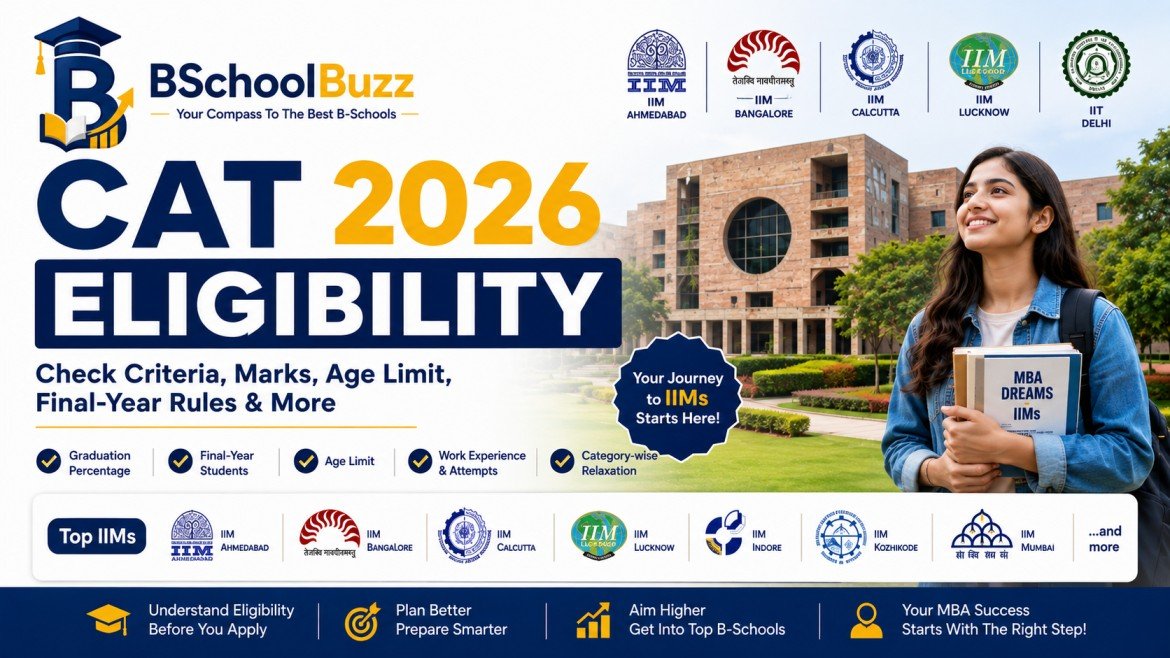
- CAT 2026 Eligibility requires candidates to hold a recognised bachelor’s degree with at least 50% marks or equivalent CGPA for General, EWS and NC-OBC categories, while SC, ST and PwBD candidates need at least 45%. Final-year students and candidates awaiting graduation results can also apply, subject to completion requirements. There is no age limit or mandatory work experience for appearing in CAT 2026.
Meta Title: CAT 2026 Eligibility: Criteria, Marks, Age Limit & FAQs
Meta Description: Check CAT 2026 Eligibility criteria, graduation marks, age limit, final-year rules, professional degrees, reservation, documents and important application details.
CAT 2026 Eligibility: Qualification, Minimum Marks, Age Limit, Final-Year Rules and More
If you are planning to appear for CAT 2026, checking your eligibility should be one of the first things you do before starting the application process. The good news is that the basic CAT 2026 Eligibility rules are straightforward: you generally need a recognised bachelor's degree with the prescribed minimum marks, while final-year undergraduate students and candidates awaiting their graduation results can also apply under the conditions specified by the IIMs. There is no prescribed age limit for appearing in CAT.
For CAT 2026, the official notification has been released, and the registration window is scheduled from August 3, 2026, at 10:00 AM to September 15, 2026, at 5:00 PM. The examination is scheduled for November 29, 2026. The test is being conducted by the Indian Institute of Management Indore.
The minimum academic requirement is 50% marks or equivalent CGPA in a bachelor's degree for candidates belonging to the General, EWS and NC-OBC categories. For SC, ST and PwBD candidates, the minimum requirement is 45%. Candidates with recognised professional qualifications such as CA, CS, CMA/ICWA and Fellow of the Institute of Actuaries of India (FIAI) can also apply if they meet the applicable percentage requirement.
However, meeting the basic CAT 2026 Eligibility criteria does not mean that a candidate will automatically receive an IIM interview call or admission offer. Every IIM has its own admission and shortlisting criteria, and academic performance, CAT performance, interview performance, work experience, academic diversity and other factors may be considered depending on the institute and programme.
This article explains the CAT 2026 Eligibility criteria in detail, including graduation requirements, category-wise marks, final-year candidates, backlogs, CGPA conversion, professional degrees, age limit, work experience, reservation, documents, common mistakes and frequently asked questions.
CAT 2026 Eligibility at a Glance
The easiest way to understand CAT 2026 Eligibility is to start with the basic requirements.
| Eligibility criterion | CAT 2026 requirement |
|---|---|
| Minimum educational qualification | Bachelor's degree or recognised equivalent qualification |
| General category minimum marks | 50% or equivalent CGPA |
| EWS minimum marks | 50% or equivalent CGPA |
| NC-OBC minimum marks | 50% or equivalent CGPA |
| SC minimum marks | 45% or equivalent CGPA |
| ST minimum marks | 45% or equivalent CGPA |
| PwBD minimum marks | 45% or equivalent CGPA |
| Final-year bachelor's students | Eligible |
| Candidates awaiting graduation results | Eligible, subject to conditions |
| Professional qualifications | CA, CS, CMA/ICWA and FIAI candidates can be eligible |
| Age limit | No prescribed age limit |
| Work experience | Not mandatory for appearing in CAT |
| Number of CAT attempts | No prescribed attempt limit |
| Exam date | November 29, 2026 |
| Registration window | August 3 to September 15, 2026 |
| Conducting institute | IIM Indore |
The academic qualification and minimum percentage requirements above are based on the CAT 2026 eligibility information reported from the official notification. Final-year candidates and candidates whose results are awaited can apply, but admission remains subject to completion and verification of their qualifying degree requirements.
What Is CAT 2026 Eligibility?
CAT 2026 Eligibility refers to the minimum academic and other conditions a candidate must satisfy to appear for the Common Admission Test in 2026.
The eligibility rules answer a few basic questions:
Do you have the required educational qualification?
Have you secured the required minimum percentage?
Are you still in the final year of graduation?
Are you waiting for your graduation result?
Do you hold an accepted professional qualification?
Do you satisfy the requirements for the category you are claiming?
Can you provide the required documents when the IIMs ask for them?
The CAT examination itself is a national-level management entrance examination used for admission to postgraduate management programmes offered by the IIMs and is also accepted by numerous other management institutes.
The important distinction is between being eligible to appear for CAT and being eligible for admission to a particular MBA or PGP programme.
A candidate can satisfy CAT 2026 Eligibility and successfully take the examination but still not receive an interview call from a particular IIM. This is because individual IIMs publish their own admission policies and may apply additional academic, CAT percentile, sectional percentile, diversity, work-experience and interview-related criteria.
That distinction is particularly important for students who see the 50% graduation requirement and assume that scoring 50% automatically makes them competitive for the IIMs. It does not.
The 50% or 45% requirement is the minimum eligibility threshold, not an admission cutoff.
Educational Qualification Required for CAT 2026
The primary requirement under CAT 2026 Eligibility is a bachelor's degree or an equivalent qualification recognised under the applicable rules.
A candidate who has completed a bachelor's degree from a recognised university or educational institution can apply if the candidate also meets the required minimum percentage for the applicable category.
The degree may be in any academic discipline. CAT does not restrict applicants to commerce, economics, engineering, mathematics, management or any particular stream.
Therefore, candidates with degrees such as:
BBA
BCom
BA
BSc
BTech
BE
BCA
BPharm
BArch
LLB or integrated recognised programmes
and other recognised bachelor's degrees
can generally apply, provided their qualification satisfies the CAT eligibility requirements.
The important factor is not the name of the undergraduate stream but whether the qualification is recognised and whether the candidate satisfies the applicable marks requirement.
The official CAT 2026 eligibility information states that the bachelor's degree must be awarded by a university or educational institution incorporated by an Act of Parliament or a State Legislature, declared to be a deemed university under Section 3 of the UGC Act, 1956, or otherwise recognised as an equivalent qualification by the Government of India.
CAT 2026 Eligibility: Minimum Graduation Marks
The graduation percentage requirement is one of the most important parts of CAT 2026 Eligibility.
For candidates belonging to the General, EWS and NC-OBC categories, the minimum graduation requirement is:
50% marks or equivalent CGPA.
For candidates belonging to the SC, ST and PwBD categories, the minimum requirement is:
45% marks or equivalent CGPA.
The relaxation is therefore five percentage points for the specified reserved categories.
Category-Wise CAT 2026 Eligibility Marks
| Category | Minimum graduation requirement |
|---|---|
| General | 50% |
| EWS | 50% |
| NC-OBC | 50% |
| SC | 45% |
| ST | 45% |
| PwBD | 45% |
The percentage must be understood as the aggregate/equivalent qualification requirement applicable under the CAT rules. Candidates should not simply assume that one high-scoring semester or one strong year is sufficient.
If your university has an official method for calculating your final percentage, that method should be followed.
Does 12th Percentage Matter for CAT 2026 Eligibility?
Your Class 12 percentage is not the minimum academic qualification for appearing in CAT.
The basic CAT 2026 Eligibility requirement is centred on the bachelor's degree or an accepted equivalent qualification.
This does not mean that Class 12 marks are irrelevant throughout the MBA admission process.
Individual IIMs can consider Class 10 and Class 12 academic performance while shortlisting candidates. Therefore, a candidate with lower school marks may still be eligible to sit for CAT but could have a different shortlisting profile from someone with stronger academic records.
This distinction is crucial:
CAT eligibility is not the same as IIM selection.
For example, suppose two candidates have both completed graduation with more than 50%. Both may satisfy the basic CAT eligibility requirement. However, an IIM's admission policy may assign weight to their Class 10, Class 12, graduation performance, CAT score, work experience or other factors.
Therefore, do not confuse the minimum percentage needed to register for CAT with the profile expected for a particular IIM.
Can Final-Year Students Apply for CAT 2026?
Yes.
Final-year bachelor's degree students are eligible to apply for CAT 2026.
Candidates who are appearing in the final year of their bachelor's degree or equivalent qualification can register for the examination. Candidates who have completed their degree requirements but are awaiting their final results can also apply.
This is particularly important for students graduating in 2026 or 2027 depending on their programme structure and academic calendar.
A final-year candidate does not have to wait for the final degree certificate to become available before taking CAT.
However, there is an important condition.
If a final-year candidate is selected for an IIM programme, admission can remain provisional until the candidate provides the required proof that all requirements for the bachelor's degree have been completed.
The relevant certificate must be issued by the Principal, Registrar or other authorised official of the university or institution, as specified by the concerned IIM. The exact deadline is determined by the respective institute.
What Final-Year Students Should Understand
Being allowed to take CAT does not remove the requirement to complete graduation.
Think of the process in two stages:
Stage 1: You are allowed to appear for CAT while you are in the final year.
Stage 2: If you receive an admission offer, you must complete your bachelor's degree and provide the required documentation within the timeline specified by the IIM.
If you fail to complete the degree requirements or cannot provide the required certificate within the stipulated period, provisional admission can be cancelled.
Therefore, final-year students should keep track of:
Their remaining semesters
Backlogs, if any
University result timelines
Degree completion requirements
Final-year certificate requirements
Original marksheets
Category documents, if applicable
Can Students Awaiting Graduation Results Apply for CAT 2026?
Yes.
Candidates who have completed the requirements of their bachelor's degree but are still waiting for the final results can apply for CAT 2026.
The CAT 2026 eligibility information specifically permits candidates who have completed their degree requirements and are awaiting results to apply. If selected, they may join provisionally subject to submission of the required certificate from their university or institution.
This situation is common because university academic calendars do not always align perfectly with the MBA admission calendar.
For example, a student may complete the final semester examination but receive the consolidated result or degree certificate later. Such a student should not automatically assume that the delay makes them ineligible for CAT.
Instead, the student should check whether all degree requirements have actually been completed and understand the documentation deadline imposed by the IIM offering admission.
CAT 2026 Eligibility for Professional Degree Holders
CAT is not restricted to conventional bachelor's degree holders.
Candidates holding certain recognised professional qualifications can also be eligible.
The CAT 2026 eligibility information specifically includes professional qualifications such as:
Chartered Accountant (CA)
Company Secretary (CS)
Cost and Management Accountant / ICWA (CMA)
Fellow of the Institute of Actuaries of India (FIAI)
Candidates with these qualifications must satisfy the applicable minimum percentage requirement.
This is useful for candidates who have pursued professional qualifications rather than following a conventional undergraduate route.
A CA candidate, for instance, should not assume that CAT is unavailable simply because their academic pathway differs from a typical BCom or BBA graduate.
The important point is to check the exact qualification and percentage requirements stated in the current CAT 2026 information before submitting the application.
Is There Any Age Limit for CAT 2026?
No prescribed age limit applies to CAT 2026.
There is no specified minimum or maximum age restriction for appearing in the examination. Candidates who satisfy the educational eligibility requirements can therefore consider CAT regardless of whether they are fresh graduates or working professionals.
This makes CAT different from some entrance examinations that impose a defined age window.
For example, a candidate who completed graduation several years ago and has been working can still appear for CAT if the person meets the academic eligibility requirements.
Similarly, there is no rule saying that a candidate must immediately pursue an MBA after graduation.
The absence of an age limit does not mean that every IIM programme has identical admission requirements. Executive and specialised programmes can have separate eligibility conditions. The no-age-limit point discussed here relates to appearing for CAT 2026.
Is Work Experience Required for CAT 2026?
No.
Work experience is not mandatory to appear for CAT 2026.
Fresh graduates can apply, and candidates who are currently working can also apply.
This means a student who has completed graduation without working full-time does not become ineligible simply because they are a fresher.
At the same time, work experience can matter later.
Individual IIMs may award weightage to work experience in their selection processes. Some institutes may use work experience as one component of their composite score or profile evaluation. Therefore, two candidates with similar CAT percentiles may not necessarily receive identical outcomes if their academic and professional profiles differ.
So the correct way to understand the rule is:
Work experience is not required for CAT eligibility, but it can influence admission selection at individual IIMs.
Can Freshers Apply for CAT 2026?
Absolutely.
Freshers are eligible for CAT 2026 if they satisfy the academic requirements.
A student who has completed a bachelor's degree with at least 50% marks, where the 50% requirement applies to the candidate's category, can apply without having worked for a company.
Similarly, a final-year undergraduate student can apply without any previous full-time employment.
There is therefore no need to work for one or two years simply to become eligible for CAT.
Whether gaining work experience before an MBA is strategically beneficial is a separate career decision. It depends on the student's goals, profile, opportunity cost and target business schools.
CAT 2026 Eligibility for Working Professionals
Working professionals can apply for CAT 2026 as long as they satisfy the academic eligibility requirements.
There is no rule requiring candidates to leave their jobs before appearing for CAT.
A working professional can prepare for CAT alongside employment and then use the CAT score for the relevant MBA admission cycle.
Work experience should be entered accurately in the application form. Candidates should maintain supporting documents because individual institutes may verify work experience during the admission process.
It is also important to distinguish genuine full-time professional experience from internships, part-time work, training periods or other activities. Different IIM admission policies can define eligible work experience differently, so candidates should check the specific institute's admission criteria rather than assuming that every type of work will receive the same weight.
CAT 2026 Eligibility for Different Academic Streams
CAT does not require candidates to have studied commerce, mathematics, economics or engineering.
Candidates from different educational backgrounds can apply.
Engineering Students
BTech and BE graduates can apply if they satisfy the required graduation marks.
Engineering students often make up a significant portion of the CAT applicant pool, but there is no separate CAT eligibility advantage simply because someone is an engineer.
Commerce Students
BCom, BBA and related graduates can apply if they meet the required qualification and percentage.
Arts and Humanities Students
BA and other recognised humanities graduates are also eligible.
Science Students
BSc and other recognised science graduates can apply.
Law Graduates
Candidates with recognised bachelor's-level qualifications in law can be eligible, subject to the exact qualification structure and recognition requirements.
Design and Other Professional Backgrounds
Students from design, architecture, pharmacy and other disciplines can also apply when their qualification satisfies the applicable recognition and degree requirements.
The practical takeaway is simple: CAT does not belong to one academic stream.
CAT 2026 Eligibility for Candidates With Backlogs
Candidates often worry that an academic backlog automatically prevents them from applying for CAT.
A backlog by itself should not be confused with failure to meet CAT eligibility.
Candidates can apply if they otherwise satisfy the eligibility requirements, including the required graduation qualification and percentage. However, any pending academic requirements must ultimately be cleared if the candidate is to complete the qualifying degree and join an IIM programme.
This becomes especially important for final-year students.
Suppose a student has completed most of the bachelor's degree but still has a supplementary examination. The student may be able to apply for CAT, but the pending requirement cannot simply remain unresolved after receiving an admission offer.
IIMs can verify eligibility at different stages.
Therefore, students with backlogs should check both:
CAT's basic eligibility requirements, and
The academic completion deadlines specified by the IIMs they are targeting.
How Is Graduation Percentage Calculated for CAT 2026?
This is one of the most overlooked parts of CAT 2026 Eligibility.
If your university awards marks directly, your aggregate percentage should be calculated according to the university's prescribed method.
If your university uses CGPA, do not automatically use a generic online CGPA converter.
First check whether your university has an official conversion formula.
The CAT eligibility rules indicate that percentage equivalence should follow the practice certified by the respective university or institution. Where the institution does not provide a conversion scheme, the equivalent percentage can be calculated by dividing the candidate's CGPA by the maximum possible CGPA and multiplying by 100.
For example, if an institution explicitly states that 8.0 CGPA corresponds to 75%, the candidate should use the institution's conversion method.
A student should not independently decide that 8.0 CGPA always means 80%.
The conversion method can differ from university to university.
Why CGPA Conversion Matters
Consider a candidate who has a CGPA that appears to be below or above the 50% threshold.
Using the wrong conversion formula could change the candidate's apparent eligibility.
Therefore:
Use the university's official conversion rule whenever one exists.
If there is no official conversion scheme, follow the method specified by CAT.
Do not rely on a random CGPA-to-percentage website.
Does a Master's Degree Replace the Bachelor's Degree Requirement?
For the standard CAT eligibility route, the qualifying academic requirement is a bachelor's degree or an accepted equivalent qualification.
A master's degree does not mean that a candidate can ignore the bachelor's degree requirement.
For example, a candidate with a master's degree but without a recognised bachelor's qualification should not assume that the master's degree automatically satisfies the standard CAT eligibility route.
On the other hand, a candidate who has both a recognised bachelor's degree and a master's degree can apply, provided the applicable CAT eligibility conditions are met.
Candidates with unusual or integrated academic pathways should check the exact qualification wording in the CAT 2026 Information Bulletin and the admission criteria of their target IIM.
Can Diploma Holders Apply for CAT 2026?
A diploma by itself should not be treated as equivalent to the required bachelor's degree unless it is an officially recognised equivalent qualification under the applicable CAT rules.
CAT is a postgraduate management entrance examination, so the normal eligibility route requires a bachelor's degree.
Students who have completed only Class 12 or a diploma and have not completed a recognised bachelor's-level qualification should not assume that they are eligible simply because the diploma is of long duration.
If a qualification has a specific statutory or government-recognised equivalence to a bachelor's degree, the candidate should verify that recognition before applying.
Can Students Apply for CAT After 12th?
No.
A candidate cannot ordinarily appear for CAT immediately after Class 12 because the CAT 2026 Eligibility requirement is based on a bachelor's degree or an accepted equivalent qualification.
However, a student can start preparing for CAT while studying in college.
For example, a student completing BBA, BCom, BA, BSc, BTech or another recognised undergraduate programme can plan for CAT during the final year and apply once eligible.
This is one reason why many students begin CAT preparation during the second or third year of college.
CAT 2026 Eligibility and Reservation Categories
CAT-linked IIM admissions follow Government of India reservation norms.
The commonly applicable reservation framework includes:
| Category | Reservation |
|---|---|
| NC-OBC | 27% |
| SC | 15% |
| ST | 7.5% |
| EWS | Up to 10% |
| PwD | 5% |
IIM Indore's published admission documents reflect these Government of India reservation norms, including 27% for NC-OBC, 15% for SC, 7.5% for ST, up to 10% for EWS and 5% for PwD.
Reservation is separate from the minimum CAT eligibility percentage.
For example, being an NC-OBC candidate does not reduce the basic graduation requirement from 50% to 45%. The 45% academic threshold applies to SC, ST and PwBD candidates under the CAT eligibility rules. General, EWS and NC-OBC candidates have the 50% requirement.
Candidates claiming reservation must also satisfy the applicable documentary requirements.
CAT 2026 Eligibility for SC and ST Candidates
SC and ST candidates can apply with at least 45% marks or equivalent CGPA in the qualifying degree, subject to the other eligibility requirements.
Candidates should ensure that their category is recognised under the applicable Government of India framework and that the required certificate is available in the prescribed format when requested.
Category claims should not be made casually.
The candidate should verify:
The category status
Whether the relevant caste/tribe appears in the applicable Central Government list
Certificate validity and format
Required signatures and issuing authority
Submission requirements during registration and admission
The CAT process and individual IIM admission processes may require original documents for verification.
CAT 2026 Eligibility for NC-OBC Candidates
NC-OBC candidates must satisfy the applicable eligibility requirement and provide valid documentation for claiming the reservation benefit.
The distinction between OBC and NC-OBC is important.
Being listed as OBC at the state level does not automatically mean that a candidate can claim the NC-OBC reservation benefit in every central admission process.
Candidates should verify their status against the applicable Central Government list and follow the certificate requirements specified by CAT and the concerned IIM.
Do not select a reservation category merely because your family uses the term "OBC" socially or because the category exists in a state list.
The relevant central criteria and documentation apply.
CAT 2026 Eligibility for EWS Candidates
EWS candidates are subject to the applicable Government of India rules and must provide the required EWS documentation.
The EWS category is distinct from the General category and requires an appropriate certificate in the prescribed format.
Candidates should not assume that an old income certificate automatically qualifies as the required EWS certificate for the CAT admission cycle.
Because certificate requirements can be time-sensitive, candidates should check the latest CAT instructions before submitting the application.
CAT 2026 Eligibility for PwBD Candidates
Persons with Benchmark Disabilities can apply under the applicable PwBD provisions if they meet the CAT academic requirements and the relevant disability certification requirements.
The PwBD reservation framework is linked to the Rights of Persons with Disabilities Act, 2016. A person with benchmark disability is generally defined around a specified disability meeting the applicable 40% threshold as certified by the competent authority.
Candidates seeking PwBD-related benefits should carefully review the prescribed forms, certification requirements and facilities available during the examination.
Do not wait until the last date of registration to start arranging disability documentation.
Is Work Experience Needed for IIM Admission?
This requires a more careful answer.
No work experience is required to appear for CAT 2026.
However, some IIMs may consider work experience while shortlisting or selecting candidates.
Therefore, a candidate can be eligible for CAT as a fresher but may still see work experience affecting the final admission evaluation at a particular institute.
The same applies to academic diversity and other profile factors.
For example, one IIM may assign points for professional experience while another may use a different methodology.
This is why CAT 2026 Eligibility should be treated as the first checkpoint, not the entire admission process.
CAT Eligibility vs IIM Admission Eligibility
This is perhaps the most important distinction in the entire article.
CAT eligibility asks:
"Can I appear for CAT?"
IIM admission criteria ask:
"After considering my CAT performance and profile, should I be shortlisted and eventually admitted?"
These are not the same question.
A candidate can have:
50% graduation marks
No work experience
A recognised bachelor's degree
No age restriction issue
and still not receive an IIM call.
Why?
Because IIM selection policies are much more detailed than basic examination eligibility.
Individual IIMs can consider CAT percentile, sectional performance, Class 10 marks, Class 12 marks, graduation marks, work experience, academic diversity, gender diversity, interview performance and other factors.
The official CAT eligibility information itself makes it clear that fulfilling the minimum eligibility conditions does not guarantee consideration for shortlisting by the IIMs.
What Percentile Is Required After Meeting CAT Eligibility?
There is no single CAT percentile that guarantees admission to every IIM.
The minimum academic eligibility requirement and the CAT percentile needed for a competitive application are two completely different things.
For example, meeting the 50% graduation requirement only makes a candidate academically eligible to apply. It does not mean that a 50% graduation score or a particular CAT percentile will produce an IIM call.
Each IIM publishes its own shortlisting and selection criteria.
Therefore, students should avoid statements such as:
"50% graduation means IIM eligible, so I will get a call."
The correct interpretation is:
"50% graduation may satisfy the basic CAT academic eligibility requirement for the applicable category; the actual shortlisting outcome depends on the individual IIM's admission policy and the candidate's overall profile."
Does CAT 2026 Eligibility Guarantee an IIM Call?
No.
CAT eligibility only allows a candidate to participate in the examination and be considered through the relevant admission process.
It does not guarantee:
An IIM interview call
A Personal Interview
A Written Ability Test
Final admission
A seat in a specific IIM
A specific MBA programme
IIMs evaluate applicants according to their individual admission policies.
This distinction should be kept in mind throughout the CAT preparation journey.
CAT 2026 Important Dates Related to Eligibility and Application
Although the focus of this article is eligibility, candidates should know the major 2026 application timeline.
| Event | CAT 2026 date |
|---|---|
| Official notification | July 2026 |
| Registration begins | August 3, 2026, 10:00 AM |
| Registration closes | September 15, 2026, 5:00 PM |
| Admit card availability | November 4, 2026 |
| CAT 2026 examination | November 29, 2026 |
| Result | Expected later in the admission cycle |
The registration and examination dates are confirmed in current CAT 2026 reporting, while the result timeline can be subject to the official announcement.
Candidates should always verify the latest schedule on the official CAT portal before relying on a date.
CAT 2026 Registration Fee
The CAT 2026 application fee is:
| Category | Registration fee |
|---|---|
| General / EWS / NC-OBC | ₹2,700 |
| SC / ST / PwBD | ₹1,350 |
The current 2026 notification reporting confirms the revised registration fee of ₹2,700 for General/EWS/NC-OBC candidates and ₹1,350 for SC/ST/PwBD candidates.
The application fee is separate from MBA tuition fees.
A candidate should therefore not confuse:
CAT application fee
IIM application or admission-related charges
MBA programme tuition fee
Hostel and mess expenses
Other institute-specific costs
Documents to Keep Ready for CAT 2026
Candidates should prepare their documents before starting the application rather than trying to arrange everything on the final day.
Depending on the candidate's situation, relevant documents can include:
Class 10 certificate/marksheet
Class 12 marksheet
Graduation marksheets
Degree certificate, if already available
Final-year certificate, where applicable
Valid category certificate
PwBD certificate, where applicable
Recent photograph
Signature
Valid identification details
Work-experience information and supporting records, where applicable
The exact upload requirements and formats should be checked against the CAT 2026 application instructions.
Candidates should also ensure that their name, date of birth and other personal details are consistent across their official records.
Common CAT 2026 Eligibility Mistakes
Many eligibility problems are not caused by complicated rules. They happen because candidates make assumptions.
Mistake: Treating 50% as an IIM cutoff
50% is the basic graduation eligibility threshold for General, EWS and NC-OBC candidates.
It is not an IIM admission cutoff.
Mistake: Assuming final-year students cannot apply
They can.
Final-year bachelor's students are explicitly allowed to apply, subject to completion and documentation requirements.
Mistake: Waiting for the final degree certificate
A final-year student does not have to wait for the final degree certificate simply to register for CAT.
The candidate must, however, complete the degree requirements and provide the required proof if selected.
Mistake: Using an arbitrary CGPA formula
If your university has an official conversion formula, use it.
Do not assume CGPA multiplied by 10 is universally correct.
Mistake: Assuming work experience is mandatory
It is not.
Freshers can apply.
Mistake: Assuming there is an age limit
CAT does not prescribe an age limit.
Mistake: Confusing state OBC status with NC-OBC eligibility
Reservation eligibility depends on the applicable Central Government framework and documentation.
Mistake: Assuming CAT eligibility guarantees admission
It does not.
Mistake: Ignoring the admission policies of individual IIMs
Each IIM can use its own shortlisting and selection methodology.
What Should a Final-Year Student Do Before Applying?
If you are currently in your final year, make a simple academic checklist.
First, calculate your latest aggregate based on your university's official method.
Second, identify any pending subjects or backlogs.
Third, check whether your university can issue the required final-year certificate if necessary.
Fourth, keep your academic records organised.
Finally, check the admission deadlines of the IIMs you are targeting.
The biggest risk for a final-year candidate is not being allowed to sit for CAT. The bigger risk is failing to complete the degree requirements within the timeline required for admission.
What Should a Working Professional Do Before Applying?
Working professionals should focus on accurate documentation.
Keep records such as:
Employment dates
Employer details
Job title
Joining documentation
Salary records where required
Experience certificates
Relevant supporting documents
The exact definition and calculation of work experience can differ across IIM admission policies.
Therefore, do not assume that every internship, freelance assignment, training programme or part-time role will be treated as full-time professional experience.
The CAT application should contain truthful information that can be supported if verification is required.
Can a Candidate Take CAT More Than Once?
There is no prescribed lifetime attempt limit for CAT.
Candidates who remain eligible can appear in CAT in different years.
This means a candidate who takes CAT 2026 can potentially appear again in a later CAT cycle if they continue to meet the applicable eligibility conditions.
However, each CAT examination is a separate admission cycle.
A CAT 2026 score should not be treated as a permanent score for future admission cycles.
Candidates should always check the score validity and admission cycle associated with the examination they have taken.
CAT 2026 Eligibility for Candidates With a Gap Year
A gap year after graduation does not by itself make a candidate ineligible for CAT.
The candidate needs to satisfy the academic eligibility requirements.
A gap may become relevant during an IIM interview because interviewers can ask candidates to explain what they did during that period.
The important distinction is:
A gap is not the same thing as ineligibility.
A candidate should be prepared to explain the gap honestly, whether it involved exam preparation, employment search, family responsibilities, entrepreneurship, higher studies, skill development or another legitimate activity.
Does a Gap Between Graduation and CAT Matter?
Not for basic CAT eligibility.
If you graduated several years ago and now want to pursue an MBA, you can still apply if you satisfy the eligibility requirements.
The absence of an age limit makes this possible.
However, the gap and career history may become relevant to the selection process and interview.
For working professionals, a longer professional history can also change which MBA programmes are most appropriate because regular two-year MBA programmes and executive programmes may have different objectives and eligibility criteria.
Can International Students Apply for CAT 2026?
Candidates with international or non-standard citizenship and residency situations should not rely on generic CAT eligibility summaries.
The CAT examination and the admission policies of individual IIMs are separate matters.
The basic qualification framework centres on the recognised bachelor's degree/equivalent qualification and applicable marks, but programme-specific admission rules can differ.
Candidates who are foreign nationals, OCI/PIO holders or have another special status should check the CAT 2026 Information Bulletin and the admission policy of each IIM they intend to apply to before submitting the application.
Does CAT 2026 Eligibility Change for Different IIMs?
The basic CAT examination eligibility is common to candidates taking CAT.
But individual IIMs can impose their own programme-level admission criteria after the examination.
This is why the following two statements can both be true:
"I am eligible for CAT 2026."
and
"I may not be eligible for a particular IIM programme."
For example, a specialised management programme may have a particular academic background requirement, work-experience condition or other programme-specific rule.
Candidates should therefore check the admissions page of every target institute rather than assuming that clearing the CAT eligibility criteria automatically makes them eligible for every programme offered through CAT.
CAT 2026 Eligibility and IIM Selection: Why Your Profile Still Matters
The basic CAT qualification requirement is only the starting point.
An IIM may evaluate multiple components while making shortlisting and final selection decisions.
Depending on the institute, these can include:
CAT overall percentile
Sectional percentile
Class 10 performance
Class 12 performance
Graduation performance
Academic discipline
Work experience
Gender diversity
Academic diversity
Personal interview
Written assessment components
Other institute-specific factors
The weightage can differ substantially between institutes.
Therefore, students should not build their entire strategy around a single "minimum percentile for IIM" figure.
The better approach is to identify target institutes, read their latest admission criteria and understand how your profile fits into each process.
CAT 2026 Eligibility: A Simple Self-Check
If you want to quickly determine whether you are likely to satisfy the basic CAT 2026 Eligibility requirements, ask yourself these questions:
Have I completed a recognised bachelor's degree?
If yes, continue.
If I am in my final year, am I pursuing a recognised bachelor's degree and able to complete all requirements?
If yes, you can generally apply under the final-year provision.
Do I have at least 50% or equivalent CGPA if I belong to General, EWS or NC-OBC?
If yes, you satisfy the basic marks threshold.
Do I have at least 45% or equivalent CGPA if I belong to SC, ST or PwBD?
If yes, you satisfy the applicable relaxed threshold.
If I hold a professional qualification, is it one of the recognised qualifications covered by CAT?
If yes, check the applicable percentage requirement.
Do I have a problem with age?
No prescribed CAT age limit applies.
Do I need work experience?
No, not for CAT eligibility.
If all the relevant answers are positive, you should then move to the next stage: completing the application correctly and reviewing the admission policies of your target IIMs.
CAT 2026 Eligibility Does Not Mean "Anyone Can Get an IIM Seat"
This is worth repeating because it is one of the most common misunderstandings among new CAT aspirants.
CAT is an entrance examination, while IIM admission is a selection process.
The eligibility threshold is designed to determine who can participate.
The selection process is designed to determine who receives admission offers.
A candidate could satisfy all of the following:
Recognised bachelor's degree
50%+ graduation
No age issue
No work experience requirement
Correct category documentation
Successful CAT registration
and still not receive an IIM offer.
That is not a contradiction.
It simply means the candidate satisfied the entrance-examination eligibility requirements but did not meet the selection threshold or composite evaluation requirements of a particular institute.
What Should You Do After Checking CAT 2026 Eligibility?
Once you have confirmed that you meet the basic requirements, the next priority should be completing the application accurately.
Do not leave registration until the final day.
Use the official CAT portal for the latest application instructions and verify every field before payment and submission.
After registration, your focus should move towards CAT preparation.
A sensible preparation plan should include:
Concept building
Previous-year questions
Reading comprehension practice
Data interpretation sets
Logical reasoning sets
Quantitative aptitude practice
Sectional tests
Full-length mocks
Mock analysis
Time management
Accuracy improvement
Your eligibility determines whether you can enter the process. Your CAT performance and subsequent admission process determine how far you can go.
CAT 2026 Eligibility: What Candidates Should Remember
The CAT 2026 Eligibility framework is relatively inclusive. Candidates from different academic streams can apply, freshers can apply, working professionals can apply, final-year students can apply, and there is no prescribed age limit.
The most important academic thresholds are simple:
50% for General, EWS and NC-OBC candidates.
45% for SC, ST and PwBD candidates.
Final-year students and candidates awaiting results can also apply, but they must ultimately complete the degree requirements and satisfy the documentation conditions specified by the relevant IIM.
Candidates with recognised professional qualifications such as CA, CS, CMA/ICWA and FIAI can also fall within the eligible routes.
The bigger mistake is not misunderstanding the basic rule; it is assuming that basic eligibility guarantees an IIM call.
It does not.
Once you establish that you are eligible, the next task is to understand the admission criteria of your target institutes and prepare for CAT accordingly.
Frequently Asked Questions
What is the CAT 2026 Eligibility criteria?
Candidates generally need a recognised bachelor's degree with at least 50% marks or equivalent CGPA for General, EWS and NC-OBC categories, and 45% for SC, ST and PwBD categories. Final-year bachelor's students and candidates awaiting results can also apply subject to the prescribed conditions.
What is the minimum graduation percentage for CAT 2026?
The minimum is 50% for General, EWS and NC-OBC candidates and 45% for SC, ST and PwBD candidates.
Can final-year students apply for CAT 2026?
Yes. Final-year bachelor's degree students can apply. If selected, they must provide the required certificate confirming completion of their degree requirements within the timeline specified by the concerned IIM.
Can students awaiting graduation results apply for CAT 2026?
Yes. Candidates who have completed their degree requirements but are awaiting their results can apply, subject to the applicable provisional-admission and documentation requirements.
Is there an age limit for CAT 2026?
No prescribed minimum or maximum age limit applies to CAT 2026.
Is work experience compulsory for CAT 2026?
No. Work experience is not required to appear for CAT. Fresh graduates can apply. However, individual IIMs may consider work experience during their admission process.
Can BBA students apply for CAT 2026?
Yes. BBA graduates can apply if their bachelor's degree is recognised and they meet the applicable minimum marks requirement.
Can BCom students apply for CAT 2026?
Yes. BCom graduates can apply if they satisfy the CAT academic eligibility conditions.
Can BA students apply for CAT 2026?
Yes. Candidates from recognised arts and humanities bachelor's programmes can apply if they meet the applicable requirements.
Can BTech students apply for CAT 2026?
Yes. BTech and BE graduates can apply if they satisfy the required graduation percentage and other eligibility conditions.
Can students from non-commerce backgrounds apply for CAT?
Yes. CAT does not restrict applicants to commerce or management backgrounds. Candidates from engineering, science, arts, humanities, law, design and other recognised academic disciplines can apply.
Can a candidate with 49% graduation marks apply for CAT 2026?
For General, EWS and NC-OBC candidates, 49% is below the stated 50% minimum. SC, ST and PwBD candidates have a 45% minimum requirement. Candidates should verify their official percentage calculation before concluding that they are ineligible.
Can I apply if my CGPA is below the equivalent of 50%?
It depends on the official percentage conversion method of your university and the applicable CAT rules. Use the university's certified conversion formula where one exists. If no conversion scheme exists, follow the CAT-prescribed equivalence method.
Does CAT use a fixed CGPA-to-percentage formula?
Not necessarily. The percentage should be calculated according to the practice followed by the candidate's university or institution. If no conversion scheme exists, CAT provides a method based on the CGPA and maximum possible CGPA.
Can students with backlogs apply for CAT 2026?
A backlog does not automatically make a candidate ineligible. However, all degree requirements must ultimately be completed and the candidate must satisfy the applicable academic conditions for admission.
Can I take CAT after graduation?
Yes. Graduates can take CAT as long as they satisfy the applicable eligibility requirements.
Can working professionals take CAT 2026?
Yes. Working professionals can apply. There is no requirement to leave employment simply to appear for CAT.
Is there any limit on CAT attempts?
There is no prescribed limit on the number of CAT attempts. Eligible candidates can appear in different CAT examination cycles.
Can a diploma holder apply for CAT?
A diploma alone should not be assumed to satisfy the bachelor's degree requirement. Candidates normally need a recognised bachelor's degree or an accepted equivalent qualification.
Can I give CAT after Class 12?
No. The standard CAT eligibility route requires a bachelor's degree or an accepted equivalent qualification. Final-year undergraduate students can apply.
Does Class 12 percentage decide CAT eligibility?
No. The basic CAT eligibility requirement is based primarily on the qualifying bachelor's degree or accepted equivalent qualification. However, Class 10 and Class 12 performance may be considered by individual IIMs during admission selection.
Does CAT eligibility guarantee an IIM call?
No. Meeting the minimum CAT eligibility criteria does not guarantee shortlisting by any IIM. Each IIM has its own selection criteria.
Does 50% graduation guarantee admission to IIMs?
No. The 50% requirement is a minimum eligibility threshold for the relevant categories, not an admission guarantee.
What professional qualifications are accepted for CAT 2026?
The CAT 2026 eligibility information includes professional qualifications such as CA, CS, ICWA/CMA and FIAI, subject to the applicable marks requirement.
What is the CAT 2026 registration fee?
The fee is ₹2,700 for General, EWS and NC-OBC candidates and ₹1,350 for SC, ST and PwBD candidates.
When is CAT 2026?
CAT 2026 is scheduled for November 29, 2026. Registration is scheduled from August 3 to September 15, 2026.
Who is conducting CAT 2026?
CAT 2026 is being conducted by IIM Indore.
Where should I check the latest CAT eligibility information?
Candidates should rely on the official CAT portal and the CAT 2026 Information Bulletin for the latest examination and application instructions.
Conclusion
CAT 2026 Eligibility is not difficult to understand once the distinction between examination eligibility and IIM admission selection is clear. For most candidates, the central requirement is a recognised bachelor's degree with at least 50% marks or equivalent CGPA for General, EWS and NC-OBC categories, while SC, ST and PwBD candidates have a 45% minimum. Final-year students and candidates awaiting graduation results can also apply under the prescribed conditions. There is no prescribed age limit, and work experience is not compulsory for taking CAT.
The important thing is to check your own academic records carefully, use the correct CGPA conversion method, keep category certificates updated where applicable, and understand that satisfying CAT 2026 Eligibility does not guarantee an IIM interview call or admission.
For the 2026 cycle, registration is already scheduled to run from August 3 to September 15, 2026, with the CAT examination scheduled for November 29, 2026. If you meet the eligibility conditions, the next step is not to keep worrying about whether you qualify. It is to complete the application accurately and focus on building the CAT percentile and overall profile required for your target business schools.
Search Keywords
CAT 2026 Eligibility, CAT eligibility 2026, CAT 2026 eligibility criteria, CAT 2026 qualification, CAT exam eligibility 2026, CAT exam eligibility criteria, CAT eligibility criteria, CAT 2026 minimum marks, CAT 2026 graduation marks, CAT 2026 percentage criteria, CAT 2026 age limit, CAT 2026 attempts, CAT 2026 final year eligibility, CAT 2026 final year students, CAT 2026 eligibility for graduates, CAT 2026 eligibility for freshers, CAT 2026 eligibility for working professionals, CAT 2026 eligibility for BBA students, CAT 2026 eligibility for BCom students, CAT 2026 eligibility for BA students, CAT 2026 eligibility for BSc students, CAT 2026 eligibility for BTech students, CAT 2026 eligibility for engineers, CAT 2026 eligibility for commerce students, CAT 2026 eligibility for arts students, CAT 2026 eligibility for science students, CAT 2026 eligibility for professional degree holders, CAT 2026 eligibility CA, CAT 2026 eligibility CS, CAT 2026 eligibility CMA, CAT 2026 eligibility ICWA, CAT 2026 eligibility FIAI, CAT 2026 eligibility SC category, CAT 2026 eligibility ST category, CAT 2026 eligibility OBC category, CAT 2026 eligibility NC OBC, CAT 2026 eligibility EWS, CAT 2026 eligibility PwD, CAT 2026 reservation, CAT 2026 reservation criteria, CAT 2026 graduation qualification, CAT 2026 bachelor's degree requirement, CAT 2026 recognised university, CAT 2026 CGPA requirement, CAT 2026 CGPA conversion, CAT 2026 percentage calculation, CAT 2026 backlog eligibility, CAT 2026 gap year eligibility, CAT 2026 diploma eligibility, CAT 2026 master's degree eligibility, CAT 2026 after graduation, CAT 2026 after 12th, CAT 2026 fresher eligibility, CAT 2026 work experience requirement, CAT 2026 age criteria, CAT 2026 no age limit, CAT 2026 attempt limit, CAT 2026 professional qualification, CAT 2026 eligibility for CA students, CAT 2026 eligibility for CS students, CAT 2026 eligibility for CMA students, CAT 2026 eligibility for final year BBA, CAT 2026 eligibility for final year BCom, CAT 2026 eligibility for final year BTech, CAT 2026 eligibility for final year BA, CAT 2026 eligibility for final year BSc, CAT 2026 awaiting result eligibility, CAT 2026 result awaited candidates, CAT 2026 provisional admission, CAT 2026 final year certificate, CAT 2026 Principal certificate, CAT 2026 Registrar certificate, CAT 2026 academic eligibility, CAT 2026 educational qualification, CAT 2026 admission eligibility, CAT 2026 IIM eligibility, IIM CAT eligibility 2026, IIM admission eligibility 2026, IIM eligibility criteria, IIM CAT 2026 qualification, IIM CAT 2026 minimum percentage, IIM CAT 2026 age limit, IIM CAT 2026 final year students, IIM CAT 2026 work experience, CAT eligibility for fresh graduates, CAT eligibility for working candidates, CAT eligibility without work experience, CAT eligibility with backlog, CAT eligibility with gap year, CAT eligibility with low graduation marks, CAT eligibility with CGPA, CAT eligibility with professional degree, CAT eligibility for non engineers, CAT eligibility for engineers, CAT eligibility for commerce graduates, CAT eligibility for arts graduates, CAT eligibility for science graduates, CAT 2026 eligibility documents, CAT 2026 documents required, CAT 2026 application eligibility, CAT 2026 registration eligibility, CAT 2026 application criteria, CAT 2026 application requirements, CAT 2026 category certificate, CAT 2026 SC certificate, CAT 2026 ST certificate, CAT 2026 NC OBC certificate, CAT 2026 EWS certificate, CAT 2026 PwD certificate, CAT 2026 eligibility rules, CAT 2026 eligibility requirements, CAT 2026 who can apply, who is eligible for CAT 2026, CAT 2026 who can appear, CAT 2026 eligibility check, CAT 2026 eligibility details, CAT 2026 admission rules, CAT 2026 IIM selection criteria, CAT 2026 eligibility vs cutoff, CAT 2026 eligibility vs admission, CAT 2026 minimum graduation percentage, CAT 2026 qualifying percentage, CAT 2026 academic criteria, CAT 2026 educational criteria, CAT 2026 candidate eligibility, CAT 2026 eligibility for international students, CAT 2026 eligibility for NRI, CAT 2026 eligibility for OCI, CAT 2026 eligibility for foreign students, CAT 2026 eligibility for diploma holders, CAT 2026 eligibility for postgraduate students, CAT 2026 eligibility for MBA aspirants, CAT 2026 eligibility for college students, CAT 2026 eligibility for graduates, CAT 2026 eligibility for repeat candidates, CAT 2026 eligibility for gap students, CAT 2026 eligibility for students with backlogs, CAT 2026 eligibility percentage, CAT 2026 eligibility marks, CAT 2026 eligibility age, CAT 2026 eligibility attempts
Long-Tail & Short-Tail Searches
what is CAT 2026 eligibility, who is eligible for CAT 2026, what percentage is required for CAT 2026, can final year students apply for CAT 2026, can I apply for CAT 2026 while in final year, can students awaiting results apply for CAT 2026, is there an age limit for CAT 2026, how many attempts are allowed in CAT, is work experience required for CAT 2026, can freshers apply for CAT 2026, can working professionals apply for CAT 2026, can BBA students give CAT 2026, can BCom students give CAT 2026, can BA students give CAT 2026, can BTech students give CAT 2026, can engineers apply for CAT 2026, can non engineers apply for CAT 2026, can arts students apply for CAT 2026, can science students apply for CAT 2026, can commerce students apply for CAT 2026, can CA students apply for CAT 2026, can CS students apply for CAT 2026, can CMA students apply for CAT 2026, can final year BBA students apply for CAT, can final year BCom students apply for CAT, can final year BTech students apply for CAT, what happens if graduation result is awaited for CAT, what certificate is required for final year CAT candidates, CAT final year certificate from Principal, CAT final year certificate from Registrar, how to calculate graduation percentage for CAT, how to convert CGPA to percentage for CAT, what if university has no CGPA conversion formula, can students with backlogs apply for CAT, can students with gap years apply for CAT, can diploma holders apply for CAT, can postgraduate students apply for CAT, can I give CAT after 12th, does 12th marks matter for CAT eligibility, does graduation percentage matter for CAT, what is the minimum CGPA for CAT 2026, what is 50 percent eligibility in CAT, what is 45 percent eligibility in CAT, CAT eligibility for General category, CAT eligibility for EWS category, CAT eligibility for NC OBC category, CAT eligibility for SC category, CAT eligibility for ST category, CAT eligibility for PwD category, CAT reservation eligibility 2026, CAT category certificate requirements, CAT EWS eligibility 2026, CAT NC OBC eligibility 2026, CAT SC ST eligibility 2026, CAT PwD eligibility 2026, CAT eligibility without work experience, CAT eligibility for fresh graduates, CAT eligibility for experienced candidates, CAT eligibility for career switchers, CAT eligibility for older candidates, CAT eligibility for working professionals, CAT eligibility after graduation gap, CAT eligibility with low marks, CAT eligibility with CGPA, CAT eligibility with backlog, CAT eligibility with professional qualification, CAT eligibility for CA, CAT eligibility for CS, CAT eligibility for CMA, CAT eligibility for FIAI, CAT 2026 eligibility and admission, CAT eligibility vs IIM admission criteria, does CAT eligibility guarantee IIM call, does 50 percent guarantee IIM admission, what percentile is needed after CAT eligibility, CAT 2026 qualification requirements, CAT 2026 academic requirements, CAT 2026 application requirements, CAT 2026 registration eligibility, CAT 2026 eligibility documents, CAT 2026 eligibility latest update, CAT 2026 eligibility official notification, CAT 2026 eligibility official website, CAT 2026 eligibility criteria latest, CAT 2026 eligibility criteria for final year students, CAT 2026 eligibility criteria for working professionals, CAT 2026 eligibility criteria for freshers, CAT 2026 eligibility criteria for SC ST, CAT 2026 eligibility criteria for OBC EWS, CAT 2026 eligibility criteria for PwD, CAT 2026 graduation marks criteria, CAT 2026 graduation percentage criteria, CAT 2026 age criteria, CAT 2026 attempt criteria, CAT 2026 work experience criteria, CAT 2026 professional degree criteria, CAT 2026 final year rules, CAT 2026 provisional admission rules, CAT 2026 eligibility checklist, CAT 2026 eligibility self check, CAT 2026 eligibility for MBA, CAT 2026 eligibility for IIMs, IIM CAT 2026 eligibility requirements, IIM CAT 2026 minimum marks, IIM CAT 2026 final year eligibility, IIM CAT 2026 age limit, IIM CAT 2026 work experience requirement, IIM CAT 2026 eligibility for freshers
Key Takeaways
CAT 2026 requires a recognised bachelor’s degree or equivalent qualification.
General, EWS and NC-OBC candidates need at least 50% graduation marks.
SC, ST and PwBD candidates need at least 45% graduation marks.
Final-year graduation students can apply for CAT 2026.
Candidates awaiting their graduation results can also apply, subject to conditions.
There is no prescribed age limit for appearing in CAT 2026.
Work experience is not mandatory to appear for CAT 2026.
CA, CS, CMA/ICWA and FIAI candidates can be eligible under recognised professional qualifications.
CAT eligibility does not guarantee an IIM interview call or admission.
Individual IIMs follow their own shortlisting and admission criteria.
Ask a question
Still confused? Leave your question and our team will help you.