
Quick Summary
- XLRI stands out for HR, consulting and broader management careers, while JBIMS offers exceptional ROI and strong finance exposure. The better choice ultimately depends on career goals, affordability and location.
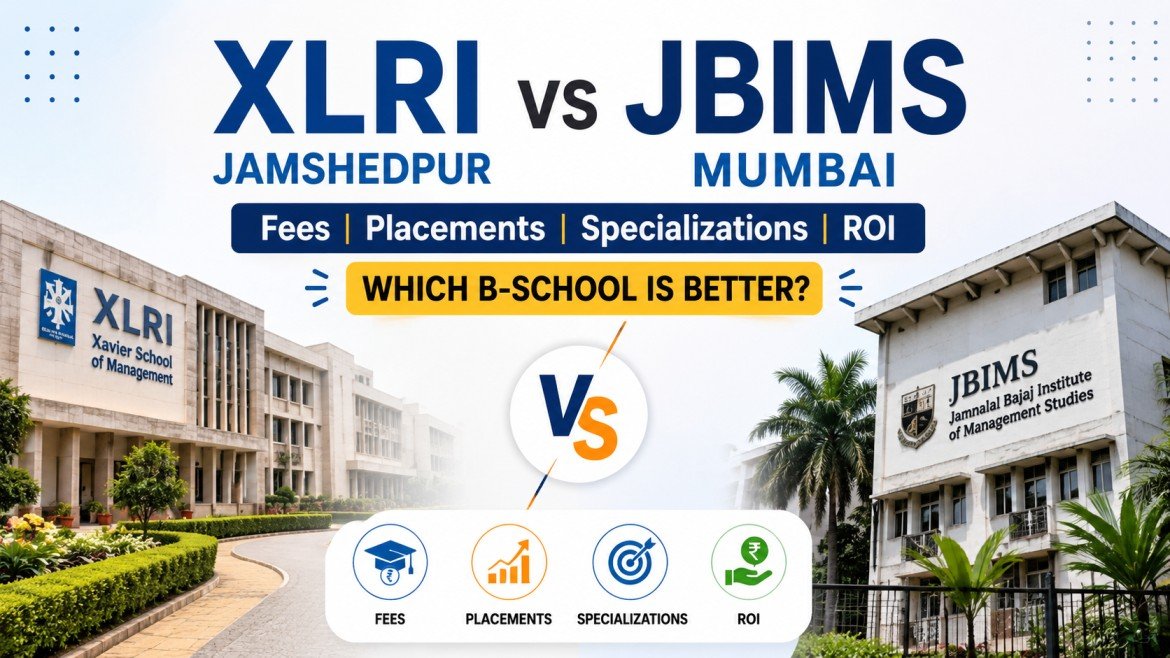
Choosing between XLRI Jamshedpur and JBIMS Mumbai is not a simple matter of comparing two famous business schools. Both have strong brands, excellent alumni networks, competitive placements and access to leading recruiters. Yet the experience they offer is quite different.
For a student searching for XLRI vs JBIMS, the real decision usually comes down to four questions: Which institute offers better placements? Which has lower fees? Which school is stronger for a particular specialization? And which one gives better ROI?
The answer depends heavily on the career you want to build.
XLRI is especially well known for Human Resource Management and has a strong presence across consulting, BFSI, FMCG, technology, general management and sales and marketing. Its Business Management programme provides a broad management education with considerable flexibility in career direction.
JBIMS, located in Mumbai and affiliated with the University of Mumbai, has a particularly strong reputation for finance, consulting, banking, investment-related careers and corporate management. Its location in India's financial capital also gives students access to a dense corporate ecosystem.
The latest available final placement information makes the comparison particularly interesting. XLRI's 2024–26 PGDM BM and HRM batch reported an average salary of ₹31.40 lakh per annum, a median of ₹29 lakh, a highest domestic offer of ₹59 lakh and a highest international offer of ₹1.10 crore. JBIMS' 2024–26 MMS placement report reports a mean CTC of ₹26.67 lakh, a median CTC of ₹26.15 lakh and a highest CTC of ₹80 lakh. These figures come from different programmes and placement structures, so they should not be interpreted as a perfect apples-to-apples salary comparison.
This is why XLRI vs JBIMS should be evaluated through programme, career path, fees, location, specialization, admission route and ROI rather than through the highest package alone.
XLRI vs JBIMS at a Glance
| Factor | XLRI Jamshedpur | JBIMS Mumbai |
|---|---|---|
| Institute | XLRI – Xavier School of Management | Jamnalal Bajaj Institute of Management Studies |
| Location | Jamshedpur, Jharkhand | Churchgate, Mumbai |
| Flagship programme considered | PGDM Business Management / PGDM HRM | MMS |
| Major strength | HR, management, consulting, BFSI, FMCG, marketing | Finance, consulting, BFSI, corporate management |
| Main entrance route | XAT for flagship two-year programmes | Maharashtra CAP route / accepted qualifying exams as applicable |
| 2026 placement batch | 2024–26 | 2024–26 |
| XLRI average/mean salary | ₹31.40 LPA | — |
| JBIMS mean salary | — | ₹26.67 LPA |
| XLRI median salary | ₹29 LPA | — |
| JBIMS median salary | — | ₹26.15 LPA |
| XLRI highest domestic offer | ₹59 LPA | — |
| JBIMS highest reported CTC | — | ₹80 LPA |
| XLRI highest international offer | ₹1.10 crore | — |
| Major geographic advantage | National and international alumni network | Mumbai corporate ecosystem |
| Best known specialization | HRM | Finance |
| Overall character | Broad, rigorous residential B-school experience | Compact, highly connected Mumbai management ecosystem |
The table gives a quick snapshot, but it does not answer the most important question: which one should you actually choose?
To answer that, it is necessary to look at the two institutes individually.
What Is XLRI Jamshedpur?
XLRI – Xavier School of Management is one of India's oldest and most recognised management institutions. Established in 1949, the institute has developed a particularly strong reputation in Human Resource Management while also building a powerful Business Management programme.
XLRI's two-year PGDM HRM programme is one of its defining academic offerings. The institute describes the programme as a specialised HRM course covering areas such as human resource planning, HR information systems, selection, performance management, training and development, compensation and employee relations.
The Business Management programme is broader. Students receive exposure to multiple management disciplines and can build careers in consulting, finance, marketing, operations, strategy, general management, technology and other areas.
For students comparing XLRI vs JBIMS, XLRI's greatest advantage is arguably the breadth of career opportunities combined with a particularly strong institutional identity around responsible leadership and HR.
XLRI also has a large and influential alumni network spread across Indian and international organisations.
The institute's 2026 placement information confirms the breadth of its recruiter base. The 2024–26 PGDM BM and HRM batch had 145 recruiting organisations across XLRI Jamshedpur and Delhi-NCR, including 25 first-time recruiters. The placement process generated more than 576 domestic offers and two international offers for the combined cohort.
The placement report also states that 42.5% of students received Pre-Placement Offers.
For someone evaluating XLRI vs JBIMS placements, these figures show that XLRI's value is not limited to one industry. Consulting, BFSI, sales and marketing, ITES, e-commerce, FMCG, general management and other sectors all contributed to recruitment.
What Is JBIMS Mumbai?
Jamnalal Bajaj Institute of Management Studies, popularly known as JBIMS, is a management institute associated with the University of Mumbai.
The institute has developed a particularly strong reputation in finance and corporate management. Its location in Churchgate, Mumbai, is an important part of its appeal.
Mumbai is home to a large concentration of banks, financial institutions, consulting firms, investment companies, conglomerates, consumer companies and corporate headquarters. This creates a unique ecosystem for students interested in careers that benefit from proximity to the financial and corporate sector.
JBIMS is also widely associated with the phrase "CEO Factory", reflecting the prominence of its alumni in senior corporate positions.
Its flagship MMS programme has historically attracted candidates interested in finance, consulting, marketing, operations, strategy and general management.
For students researching XLRI vs JBIMS, JBIMS is particularly compelling if Mumbai's corporate ecosystem and finance-oriented career opportunities are major priorities.
The latest 2024–26 MMS placement information reports more than 70 recruiters, 21+ new recruiters and 93 PPO/PPI offers. The mean CTC was ₹26.67 lakh, median CTC ₹26.15 lakh and highest CTC ₹80 lakh.
XLRI vs JBIMS: Which Has Better Placements?
Placement outcomes are one of the first things students compare when searching for XLRI vs JBIMS placements.
On the latest reported numbers, XLRI has a higher mean and median salary for the combined PGDM BM and HRM cohort.
XLRI reported:
Average salary: ₹31.40 LPA
Median salary: ₹29 LPA
Highest domestic offer: ₹59 LPA
Highest international offer: ₹1.10 crore
Top 10% average: ₹49.20 LPA
Top 25% average: ₹44.18 LPA
42.5% PPO rate
JBIMS MMS reported:
Mean CTC: ₹26.67 LPA
Median CTC: ₹26.15 LPA
Highest CTC: ₹80 LPA
70+ recruiters
21+ new recruiters
93 PPO/PPI offers
The figures immediately create an interesting distinction.
XLRI has the stronger reported average and median compensation, while JBIMS reported the higher maximum package.
However, the highest package should not dominate the decision.
A highest package of ₹80 lakh does not mean every student at JBIMS receives anything close to ₹80 lakh. Similarly, the ₹1.10 crore international offer at XLRI represents the highest international offer rather than a typical salary.
Median salary is often more useful than the highest salary when evaluating placement consistency.
On that measure, XLRI's ₹29 lakh median is higher than JBIMS' ₹26.15 lakh median in the latest reported placement cycle.
XLRI Placement Strengths
XLRI's placement ecosystem is broad.
The 2024–26 report identifies consulting, BFSI and sales and marketing as the major domains, with consulting accounting for 36% of roles offered. BFSI represented 18%, sales and marketing 12%, and ITES 15%.
Recruiters included organisations such as:
Boston Consulting Group
Bain & Company
Accenture
Deloitte
EY Parthenon
McKinsey & Company
PwC
Amazon
American Express
HUL
ITC
P&G
JPMorgan Chase
Morgan Stanley
Goldman Sachs
Citi
Barclays
Aditya Birla Group
Bajaj Auto
Tata Group companies
Marico
Asian Paints
The diversity of recruiters matters because it reduces dependence on a single industry.
JBIMS Placement Strengths
JBIMS has a particularly strong presence in finance, banking, consulting and corporate roles.
Its 2024–26 placement cycle included more than 70 recruiters and 21+ new recruiters.
The reported highest CTC was ₹80 lakh, while the mean CTC stood at ₹26.67 lakh and median at ₹26.15 lakh.
The recruiter ecosystem includes companies from consulting, BFSI, technology, consumer businesses, conglomerates and other sectors.
For a student who wants to build a career in Mumbai's finance ecosystem, JBIMS can offer a significant networking advantage.
XLRI vs JBIMS: Placement Comparison
The most sensible way to compare the latest placement figures is through mean and median compensation rather than the highest salary.
| Placement Metric | XLRI PGDM BM + HRM | JBIMS MMS |
|---|---|---|
| Placement batch | 2024–26 | 2024–26 |
| Mean / average salary | ₹31.40 LPA | ₹26.67 LPA |
| Median salary | ₹29 LPA | ₹26.15 LPA |
| Highest domestic / CTC | ₹59 LPA | ₹80 LPA |
| Highest international | ₹1.10 Cr | Not comparable from the same metric |
| Recruiters | 145 across combined XLRI Jamshedpur + Delhi-NCR process | 70+ |
| New recruiters | 25 | 21+ |
| PPO / PPI | 42.5% PPO rate | 93 PPO/PPI offers |
These figures should be read with caution because the institutes do not necessarily report every metric using identical definitions.
Still, they suggest that both schools belong to the upper tier of India's management education ecosystem.
If your priority is average compensation, XLRI currently has the stronger reported figure.
If your focus is the highest reported package, JBIMS has the higher number in the latest available comparison.
If your concern is breadth of career options, both are strong, with XLRI showing particularly broad sectoral recruitment.
XLRI vs JBIMS: Fees
Fees are crucial when evaluating ROI.
A school can offer excellent placements and still be a weaker financial decision if the total cost is significantly higher.
This is where XLRI vs JBIMS fees becomes particularly important.
For the 2026–28 full-time XLRI PGDM BM and HRM programmes, current published secondary sources report tuition of approximately ₹30.50 lakh over two years, or about ₹15.25 lakh per year, with hostel, mess and related costs additional.
The exact amount payable should always be confirmed from the admission offer and official fee schedule because institutions can revise fees and additional charges.
For JBIMS, the fee structure is substantially more complicated because admission and fee arrangements are linked to the applicable Maharashtra admission process and category.
Official JBIMS admission material confirms the 2026–27 MMS admission cycle. The institute's 2025–26 admission notice showed an open-category fee of ₹4,22,175, demonstrating how different the fee structure can be from unofficial management-quota claims.
This is important because several websites publish much higher "management quota" figures for JBIMS. Such numbers should not be confused with the standard official CAP admission fee.
Therefore, when comparing XLRI vs JBIMS fees, students should compare the fee applicable to their actual admission route rather than a number found on an unofficial website.
Why JBIMS Can Have a Stronger ROI
If a student enters JBIMS through the standard applicable admission route and pays the comparatively low institutional fee, the ROI can be exceptionally attractive.
Consider a simplified example.
Suppose a student pays roughly ₹4–5 lakh in academic fees and receives a median CTC around ₹26.15 lakh.
The ratio between annual CTC and academic tuition is extremely favourable.
XLRI, on the other hand, involves a significantly higher academic investment. Yet its reported median salary is also higher.
This means both can deliver strong ROI, but they do so through different financial structures.
Why XLRI Can Still Offer Excellent ROI
ROI is not simply:
Salary ÷ tuition fee
A more realistic ROI analysis should include:
Tuition
Hostel and mess
Living expenses
Loan interest
Opportunity cost
Internship outcomes
Career progression
Alumni network
Brand value
Geographic mobility
Industry access
Long-term earning potential
XLRI's stronger median compensation and broad recruiter base can justify the higher upfront investment for many students.
A student who obtains a consulting, investment banking, strategy, product, sales leadership or other high-growth role can potentially recover the investment quickly.
XLRI vs JBIMS: Which Has Better ROI?
If ROI means pure financial return on academic fees, JBIMS has a powerful advantage because of its relatively low standard fee structure for eligible admission routes.
If ROI means career return relative to the total cost of attendance, the answer becomes more nuanced.
XLRI has:
Higher reported average salary
Higher reported median salary
Strong consulting presence
Strong BFSI recruitment
Strong FMCG recruitment
Powerful HR reputation
National and international alumni network
Broad career options
JBIMS has:
Strong finance reputation
Mumbai location
High recruiter quality
Very competitive compensation
Low standard institutional fee relative to placement outcomes
Strong corporate alumni network
Therefore:
JBIMS is arguably the ROI winner when standard academic fees are the main consideration.
XLRI becomes extremely attractive when the student values salary level, career breadth, HR leadership, consulting access and national brand strength.
XLRI vs JBIMS: Specializations
Specialization is one of the biggest differences between the two institutions.
XLRI for Human Resources
If your target career is HR, the comparison is much easier.
XLRI has an unusually strong position in HR education.
Its PGDM HRM programme is specifically designed around human resources and includes subjects covering:
Human resource planning
Recruitment and selection
Performance management
Training and development
Compensation
Employee relations
HR information systems
Organisational behaviour
Labour relations
People analytics
Leadership
Strategic HR
The institute's HR alumni occupy senior positions across Indian and multinational companies.
For someone specifically asking:
XLRI vs JBIMS for HR, which is better?
XLRI is the clear choice.
JBIMS has an MHRD programme, but its institutional identity and market reputation are not as strongly centred on HR as XLRI's flagship HRM programme.
XLRI for Business Management
XLRI's PGDM BM is a broad management programme.
The curriculum allows students to explore areas such as:
Finance
Marketing
Operations
Strategy
Information systems
Economics
General management
This makes the programme suitable for students who do not want to commit to a single functional area too early.
The programme can lead to careers in:
Consulting
Strategy
Finance
Product management
Marketing
Sales
Operations
General management
Technology management
Business analytics
JBIMS for Finance
JBIMS is particularly attractive for finance-focused candidates.
Mumbai's ecosystem provides proximity to:
Investment banks
Commercial banks
Asset managers
Private equity firms
Wealth management companies
Insurance companies
Financial technology companies
Consulting firms
Corporate finance teams
This does not guarantee a particular job, but the location is an important structural advantage.
For a student whose main objective is finance, XLRI vs JBIMS may lean toward JBIMS depending on the exact role targeted.
JBIMS for Consulting
Both institutes have strong consulting recruitment.
XLRI's latest placement report showed consulting as its largest role category, accounting for 36% of roles.
JBIMS also attracts leading consulting organisations.
Therefore, the choice for consulting should not be made purely on brand.
A candidate should compare:
Desired consulting firms
Previous recruiter participation
Role types
Location
Alumni network
Personal strengths
Cost of education
For general management consulting, both are excellent options.
XLRI vs JBIMS for Finance
Finance deserves a separate discussion because this is one area where JBIMS can be particularly compelling.
Students interested in:
Investment banking
Equity research
Corporate finance
Wealth management
Asset management
Private equity
Commercial banking
Financial markets
should carefully investigate JBIMS.
XLRI also has strong finance recruitment. Its 2024–26 placement report lists institutions such as Citi, Deutsche Bank, Goldman Sachs, Morgan Stanley, JPMorgan Chase, Barclays, Axis Bank, Kotak Mahindra Bank, HSBC and others among the finance recruiters.
So it would be inaccurate to describe XLRI as weak for finance.
The distinction is more subtle.
JBIMS benefits from its Mumbai location and long-standing finance identity.
XLRI offers finance as part of a broader management ecosystem with particularly strong cross-functional opportunities.
For a student who is 100% committed to finance, JBIMS deserves serious consideration.
For a student who wants finance but wants the freedom to move into consulting, marketing, strategy or general management later, XLRI can be attractive.
XLRI vs JBIMS for HR
This is the easiest category.
XLRI wins.
The institute's PGDM HRM programme is one of the country's most established specialised HR programmes.
XLRI's HR reputation is supported by:
Dedicated HR curriculum
Long institutional history
Strong HR alumni
HR leadership roles
Corporate recruiter relationships
People analytics exposure
Labour relations expertise
Strong HR consulting ecosystem
Students targeting careers such as:
HR business partner
Talent management
Compensation and benefits
HR consulting
Organisation development
Learning and development
Employee relations
People analytics
Talent acquisition
HR leadership
should strongly consider XLRI.
XLRI vs JBIMS for Marketing
Marketing is a more balanced comparison.
XLRI has strong recruiters in FMCG and consumer businesses, including major organisations such as HUL, ITC, P&G, Asian Paints, Marico, Nestlé and others.
JBIMS also has a strong corporate network in Mumbai and attracts recruiters across consumer, technology, consulting and financial sectors.
For marketing, the better choice depends more on the student's desired recruiter set and role than on a simple institutional ranking.
If you are interested in FMCG marketing and brand management, XLRI has a particularly strong ecosystem.
If you want a broader Mumbai corporate exposure, JBIMS can be attractive.
XLRI vs JBIMS for Consulting
Consulting is one of the strongest areas for both.
XLRI's latest placement report lists:
BCG
Bain & Company
McKinsey
Accenture Strategy
Deloitte
EY Parthenon
PwC
KPMG
Vector Consulting Group
YCP Auctus
among its consulting recruiters.
JBIMS also attracts major consulting firms and has a strong alumni base in strategy and consulting.
For consulting, students should focus on:
Role quality > company count
A list of famous recruiter names is useful, but what matters more is:
What role was offered?
What percentage of the batch entered consulting?
Was the role strategy, implementation, risk, analytics or another function?
What was the compensation?
What career progression followed?
XLRI's latest report provides a particularly strong signal because consulting represented 36% of roles.
XLRI vs JBIMS: Location Advantage
Location is often underestimated in MBA decisions.
Jamshedpur
XLRI is located in Jamshedpur, an established industrial city with a strong connection to Tata and manufacturing.
The residential campus environment allows students to spend substantial time within the academic community.
This can encourage:
Peer learning
Student clubs
Case competitions
Alumni interaction
Campus activities
Academic immersion
Mumbai
JBIMS is located in Churchgate, Mumbai.
That is a completely different environment.
Students are surrounded by India's largest concentration of financial and corporate institutions.
Mumbai's location is particularly useful for:
Finance
Investment banking
Consulting
Corporate networking
Industry events
Guest lectures
Internships
Professional exposure
If you want the classic residential B-school experience, XLRI may feel more immersive.
If you want to be embedded in India's corporate capital, JBIMS has a unique advantage.
XLRI vs JBIMS: Alumni Network
Both schools have highly respected alumni networks.
XLRI alumni work across:
Consulting
HR
Finance
FMCG
Technology
Entrepreneurship
General management
Government
International organisations
JBIMS alumni are strongly represented across:
Finance
Banking
Consulting
Consumer businesses
Technology
Entrepreneurship
General management
The difference is not simply "which has better alumni?"
The more useful question is:
Which alumni network is stronger for your target career?
For HR, XLRI's alumni network has a major advantage.
For finance in Mumbai, JBIMS alumni can provide an exceptionally valuable ecosystem.
For general management and consulting, both are highly competitive.
XLRI vs JBIMS: Admission Process
The admission routes are significantly different.
XLRI Admission
XLRI's flagship two-year programmes are associated with XAT.
The selection process does not depend only on the raw entrance exam score. Academic profile, work experience, interview performance and other factors can influence selection.
The XAT route is therefore a central part of the XLRI admission journey.
Students preparing for XLRI should take the following seriously:
XAT preparation
Decision Making
Quantitative Ability
Verbal Ability
Logical Reasoning
General Awareness
Essay-related requirements where applicable
Personal Interview preparation
The institute can also consider factors beyond the entrance test during selection.
JBIMS Admission
JBIMS MMS admission follows the applicable Maharashtra management admission framework and CAP process.
Students should not rely on outdated admission articles because rules, accepted exams, cutoffs and seat allocation procedures can change.
The 2026–27 admission cycle is actively reflected on the official JBIMS website, including MMS CAP admission notices.
Therefore, candidates should check the current JBIMS admission notification and Maharashtra admission authority instructions before applying.
XLRI vs JBIMS: Entrance Exam Difference
This creates an important strategic difference.
If your target is XLRI, XAT preparation is essential.
If your target is JBIMS, you need to understand the current accepted entrance examination and CAP framework.
A student who is preparing for multiple B-schools should build a strategy around the actual exam requirements rather than assuming that CAT preparation automatically covers every requirement.
For XLRI vs JBIMS, entrance strategy can influence the decision long before the final college choice.
XLRI vs JBIMS: Campus Life
Campus experience also matters because a management programme is not only about classroom teaching.
XLRI offers a strong residential campus culture.
Students participate in:
Student committees
Business competitions
Cultural activities
Sports
Case competitions
Corporate events
Alumni interactions
Academic projects
JBIMS offers a more urban experience.
Because of its Mumbai location, students can access a large professional ecosystem outside the classroom.
This creates a different style of networking.
Neither model is objectively better.
It depends on whether you prefer:
Residential campus immersion
or
Urban corporate exposure
XLRI vs JBIMS: Faculty and Learning
Both institutions have experienced faculty and strong academic reputations.
XLRI's pedagogy is known for case-based learning, classroom discussion, management theory and practical application.
Its programmes cover both functional knowledge and leadership.
JBIMS also uses an interdisciplinary approach and focuses on business situations that require students to understand the interaction between different management functions.
For students, the more important point is that the learning environment at both institutes requires active participation.
An MBA or MMS is not valuable simply because the institute has a famous name.
Students need to make use of:
Faculty
Peer groups
Alumni
Competitions
Internships
Projects
Corporate interactions
Student committees
XLRI vs JBIMS: Batch and Peer Group
The peer group can have a major impact on management education.
XLRI attracts candidates from:
Engineering
Commerce
Economics
Humanities
Science
Technology
Work experience backgrounds
JBIMS also attracts students with varied academic and professional backgrounds.
A diverse classroom creates opportunities to learn how people from different functions approach the same business problem.
This becomes particularly useful during:
Case discussions
Group projects
Presentations
Consulting cases
Business simulations
Student competitions
XLRI vs JBIMS: Brand Value
Both names carry substantial weight in Indian management recruitment.
XLRI has a national brand that is particularly strong in HR.
JBIMS has a strong legacy in Mumbai and the broader Indian corporate environment.
When a recruiter sees XLRI on a resume, the institute's reputation immediately communicates a certain level of selectivity and management training.
The same is true of JBIMS.
However, brand value should not be considered in isolation.
A strong brand combined with the right specialization and strong personal performance creates much more value than brand alone.
XLRI vs JBIMS: Work Experience
Work experience can influence the way you benefit from either programme.
A candidate with prior work experience may be able to contribute more effectively during:
Case discussions
Group projects
Leadership exercises
Interviews
Consulting assignments
However, lack of work experience does not automatically make either institute unsuitable.
The important factor is the eligibility and selection criteria for the specific programme and admission year.
Applicants should always verify the current programme requirements before applying.
XLRI vs JBIMS: Which Is Better for Freshers?
Both can work well for fresh graduates.
A fresher should focus on:
Academic profile
Entrance examination performance
Interview preparation
Internships
Extracurricular activities
Certifications where relevant
Communication skills
Business awareness
If you are a fresher and want HR, XLRI is especially compelling.
If you are a fresher targeting finance and can secure JBIMS through the appropriate admission route, JBIMS can be highly attractive.
For consulting, both are strong.
XLRI vs JBIMS: Which Is Better for Working Professionals?
Working professionals should look beyond salary.
The decision should consider:
Opportunity cost
Existing career trajectory
Desired career switch
Programme duration
Loan requirement
Target industry
Post-MBA role
Someone already working in HR may obtain particularly strong value from XLRI HRM.
Someone working in banking or finance may find JBIMS particularly relevant if the goal is to deepen a Mumbai-based financial career.
XLRI vs JBIMS: Loan and Financial Risk
A management degree should be treated as an investment.
Suppose you need a substantial education loan.
Then your calculation should include:
Total borrowed amount + interest + living expenses + lost salary during the programme
This matters because a higher salary does not automatically mean better financial outcomes.
For example, a student earning ₹31 lakh after XLRI but carrying a much larger loan may have a different financial position from a student earning ₹26 lakh after JBIMS with substantially lower academic fees.
That is why XLRI vs JBIMS ROI is a better search question than simply "XLRI vs JBIMS package."
A Practical ROI Framework
Before accepting an offer, calculate:
Net education cost = tuition + hostel + living expenses + other academic costs – scholarships
Then calculate:
Financial burden = education loan repayment + interest
Then consider:
Career upside = expected post-MBA salary + career growth + role quality + brand value
Do not use the highest package for this calculation.
Use median or realistic expected compensation.
XLRI vs JBIMS: Scholarships and Financial Support
Students should check the latest scholarship policies directly with the institutes.
Scholarships can change by programme and year.
XLRI's online programmes, for example, publish specific fee-waiver provisions for categories including women, SC/ST, PwD and Northeast domicile candidates. Full-time programme support can differ.
Similarly, JBIMS and the applicable Maharashtra admission authorities have their own fee structures and category-based provisions.
Therefore, a student should never assume that a scholarship shown on a third-party website automatically applies to the exact programme being considered.
XLRI vs JBIMS: Recruiter Diversity
Recruiter diversity is an important indicator of placement resilience.
XLRI's latest placement report demonstrates substantial diversity across:
Consulting
BFSI
Sales and marketing
ITES
E-commerce
FMCG
Pharma
Real estate
Manufacturing
Energy
Telecommunications
General management
Public sector
JBIMS similarly has a broad recruiter base, although its historical positioning is particularly strong in finance and corporate management.
If you are uncertain about your eventual career direction, XLRI's broad sectoral spread can be reassuring.
If you already know you want finance, JBIMS's ecosystem can be especially attractive.
XLRI vs JBIMS: International Opportunities
XLRI reported a highest international offer of ₹1.10 crore for its 2024–26 placement cycle.
International exposure can also come through alumni networks, exchange opportunities, international programmes and global recruiters.
JBIMS also has international exposure through its alumni and corporate network.
However, students should distinguish between:
International recruiter
International job
International exchange
International salary
These are not the same thing.
A headline international salary should not be treated as representative of the entire batch.
XLRI vs JBIMS: Entrepreneurship
Both institutes have alumni who have gone into entrepreneurship.
Entrepreneurship depends heavily on the student's ability to:
Build networks
Find co-founders
Understand customers
Raise capital
Build products
Manage teams
Execute under uncertainty
Mumbai can provide strong access to investors, startups and corporate networks.
XLRI provides a strong alumni ecosystem across sectors and cities.
For entrepreneurship, there is no obvious universal winner.
XLRI vs JBIMS: Student Committees and Extracurriculars
Student committees can become an important part of management education.
They help develop:
Leadership
Negotiation
Event management
Communication
Stakeholder management
Teamwork
Time management
Students should therefore research not only the curriculum but also the student-driven culture.
In a competitive B-school, extracurricular leadership can sometimes become almost as valuable as classroom grades.
XLRI vs JBIMS: Which Has Better Networking?
Networking depends on the type of network you need.
XLRI networking advantage
XLRI provides a national and international alumni network across management functions.
It is particularly strong in:
HR
Consulting
General management
FMCG
BFSI
Corporate leadership
JBIMS networking advantage
JBIMS provides especially strong Mumbai and finance-oriented connections.
It is particularly attractive for:
Banking
Finance
Investment
Consulting
Corporate management
Entrepreneurship
Therefore, neither network is universally better.
The right question is:
Where are the people you need to meet?
XLRI vs JBIMS: Career Growth After Graduation
Placement salary is only the first stage of ROI.
A candidate may join at ₹25–30 lakh and then experience substantial growth over the next five to ten years.
Career progression depends on:
Role
Industry
Performance
Leadership ability
Job switches
Skills
Economic environment
Professional network
XLRI and JBIMS both provide strong platforms for long-term career development.
The institute gives you an opportunity; the student's performance determines much of the eventual outcome.
XLRI vs JBIMS: Is XLRI Worth the Higher Fee?
For many students, yes.
XLRI's higher fee can make sense if you value:
Higher reported median compensation
Strong HR reputation
Consulting opportunities
National brand
Broad recruiter base
Strong alumni network
Career flexibility
But the higher fee is not automatically justified for every student.
If you have a strong chance of receiving a JBIMS seat through a low-cost official admission route and your primary objective is finance or consulting, JBIMS may provide extraordinary financial ROI.
XLRI vs JBIMS: Is JBIMS Worth Choosing Over XLRI?
Yes, particularly in specific circumstances.
JBIMS can be the better decision when:
You are highly finance-oriented
Mumbai is strategically important to you
You value a low standard academic fee
You want a strong corporate network
You are comfortable with the MMS structure
You have access to the regular admission route
You want to maximise financial ROI
A student should not reject JBIMS simply because XLRI has a higher average package.
The fee difference can substantially change the ROI equation.
XLRI vs JBIMS: The Best Choice by Career Goal
| Career Goal | Better Fit |
|---|---|
| Human Resources | XLRI |
| HR Consulting | XLRI |
| People Analytics | XLRI |
| Talent Management | XLRI |
| Finance | JBIMS / XLRI depending on role |
| Investment Banking | JBIMS can be especially attractive |
| Consulting | Both |
| Strategy | Both |
| FMCG Marketing | XLRI has strong positioning |
| General Management | Both |
| Mumbai corporate career | JBIMS |
| National career mobility | XLRI |
| Lowest academic-cost ROI | JBIMS |
| Highest reported median salary | XLRI |
| Highest reported package in latest cycle | JBIMS |
| Broad management education | XLRI BM |
| Specialised HR education | XLRI HRM |
XLRI vs JBIMS: Pros and Cons
XLRI Advantages
Strong national reputation
Exceptional HR positioning
Strong consulting recruitment
Strong BFSI recruitment
Strong FMCG ecosystem
Broad Business Management curriculum
Strong alumni network
Higher reported average and median salary in the latest combined BM/HRM placement report
Strong international recognition
Diverse recruiter base
XLRI Limitations
Higher tuition investment
Jamshedpur is less financially connected than Mumbai
HRM is highly specialised
Residential programme requires substantial time away from home
Total cost is higher than JBIMS under the standard low-fee admission route
JBIMS Advantages
Mumbai location
Strong finance reputation
Strong corporate network
Excellent consulting opportunities
Strong alumni presence
Very attractive ROI under the standard applicable fee structure
Strong compensation despite lower tuition
Access to India's financial ecosystem
JBIMS Limitations
Highly competitive admission
Mumbai living costs can be significant
Finance-oriented reputation may make the choice particularly attractive for finance candidates but less differentiated for students specifically targeting HR
Fee figures found online can be confusing because unofficial management-quota numbers are sometimes mixed with regular admission fees
XLRI vs JBIMS: What About the Highest Package?
Students often search:
XLRI vs JBIMS highest package
But this is one of the least useful ways to make the decision.
A highest package represents one of the best outcomes in a batch.
It does not tell you:
Median salary
Number of students placed
Number of offers
Role distribution
Average salary
Recruiter quality
Career progression
Fee burden
JBIMS reported a highest CTC of ₹80 lakh in its 2024–26 MMS placement cycle.
XLRI reported a highest domestic offer of ₹59 lakh and a highest international offer of ₹1.10 crore.
These numbers are impressive, but the correct conclusion is not "JBIMS is better because ₹80 lakh is higher" or "XLRI is better because ₹1.10 crore is higher."
The meaningful comparison is the overall placement distribution.
XLRI vs JBIMS: What About the Average Package?
This comparison is more useful.
XLRI reported an average salary of ₹31.40 lakh for the combined 2024–26 PGDM BM and HRM placement process.
JBIMS reported a mean CTC of ₹26.67 lakh for MMS.
That gives XLRI the higher reported average.
However, candidates should understand that different institutes can define and calculate compensation differently.
For a final decision, compare official placement reports rather than third-party "average package" pages.
XLRI vs JBIMS: What About the Median Package?
Median salary can provide a better picture of the middle of the placement distribution.
XLRI reported a median of ₹29 lakh.
JBIMS reported a median of ₹26.15 lakh.
This suggests that the typical compensation level reported by XLRI was higher in the latest comparison.
Again, programme composition and reporting methodology matter.
XLRI vs JBIMS: Which Has Better Career Security?
No B-school can guarantee career security.
However, a strong institute can improve the probability of accessing high-quality jobs.
Career resilience comes from:
Strong skills
Alumni network
Recruiter relationships
Adaptability
Communication
Technical knowledge
Leadership
Industry experience
Both XLRI and JBIMS offer strong platforms.
XLRI may have an advantage for students who want broader geographic and functional mobility.
JBIMS can be particularly powerful for students building a career in Mumbai's corporate and finance ecosystem.
XLRI vs JBIMS for International Careers
For students planning to work abroad, the brand's international recognition, alumni presence and role type matter.
XLRI has an established international alumni network and reported an international placement outcome in its latest placement cycle.
Students should still evaluate international career opportunities carefully because immigration rules, work visas and local employment markets change frequently.
An MBA from India does not automatically provide work rights in another country.
XLRI vs JBIMS: How Should You Make the Final Decision?
A practical decision matrix can help.
Give yourself a score from 1 to 10 for each factor.
| Factor | Weight |
|---|---|
| Target career | 25% |
| Placement outcomes | 20% |
| Fees and loan burden | 20% |
| Specialization | 10% |
| Location | 10% |
| Alumni network | 5% |
| Campus experience | 5% |
| Personal preference | 5% |
Now score XLRI and JBIMS.
The important point is that the weights should reflect your goals.
If HR is your target career, increase the specialization weight.
If finance is your goal, increase location and career-fit weight.
If you need an education loan, increase the fee and ROI weight.
A Student Targeting HR
If your target is HR:
XLRI > JBIMS
There is little reason to complicate this decision unless you have an unusual personal circumstance.
XLRI's HRM programme is one of its defining strengths.
A Student Targeting Finance
If your target is finance:
JBIMS and XLRI are both excellent, but JBIMS deserves serious preference for a Mumbai-focused finance path.
Compare the exact roles offered by both institutes rather than relying only on brand rankings.
A Student Targeting Consulting
For consulting:
XLRI ≈ JBIMS
Both have strong consulting ecosystems.
The final decision can be driven by:
Fee
Admission probability
Personal location preference
Specific consulting firms
Loan requirement
A Student Targeting Marketing
For marketing:
XLRI has a strong case, particularly for FMCG and consumer-facing careers.
However, JBIMS should not be dismissed because Mumbai provides strong corporate exposure.
A Student Who Wants Maximum ROI
If by ROI you mean:
minimum academic fee + high placement compensation
then JBIMS can be extremely difficult to beat.
The low official fee structure associated with the regular admission route dramatically changes the financial calculation.
A Student Who Wants Maximum Career Flexibility
XLRI Business Management may be the stronger choice.
The programme offers exposure across multiple management functions and has a broad recruiter base.
XLRI vs JBIMS: Final Verdict
There is no single winner for every student.
The better question is:
Which institute is better for your career goal, financial situation and preferred work ecosystem?
If you want HR, choose XLRI.
If you want finance and particularly value Mumbai's corporate ecosystem, JBIMS deserves serious consideration.
If you want consulting, both are excellent.
If you want marketing and FMCG, XLRI has a strong advantage.
If you want maximum ROI from a low standard academic fee, JBIMS can be the stronger financial choice.
If you want higher reported average and median compensation and broader national career mobility, XLRI has a strong case.
The latest placement numbers reinforce this distinction. XLRI's 2024–26 PGDM BM and HRM placement process reported a ₹31.40 lakh average salary and ₹29 lakh median, while JBIMS' 2024–26 MMS placement cycle reported a ₹26.67 lakh mean and ₹26.15 lakh median. At the same time, JBIMS reported a higher maximum CTC of ₹80 lakh, while XLRI reported a ₹59 lakh highest domestic offer and ₹1.10 crore highest international offer.
So the answer to XLRI vs JBIMS is not determined by one package figure.
It is determined by the intersection of career fit, specialization, fees, placement distribution, location and ROI.
For a student who can afford XLRI and wants HR, consulting, general management or broad career flexibility, XLRI is a compelling choice.
For a student who gets JBIMS through the regular admission route, wants finance or consulting, and wants to minimise education costs while maintaining access to elite placements, JBIMS can be an exceptional choice.
Ultimately, neither institute is a "safe" choice simply because of its name. Your outcome will depend on the role you target, how well you use the two years, your internship performance, networking, skills and ability to convert the opportunities available on campus.
Frequently Asked Questions
Is XLRI better than JBIMS?
XLRI is better for students targeting HR, broad management, consulting and careers where XLRI's national brand and alumni network are particularly valuable. JBIMS can be better for students targeting finance or Mumbai-based corporate careers, especially when standard academic fees are a major consideration.
Which has better placements, XLRI or JBIMS?
On the latest reported 2024–26 placement figures, XLRI reported a higher average salary of ₹31.40 LPA and median of ₹29 LPA for its combined PGDM BM and HRM placement process. JBIMS MMS reported a mean CTC of ₹26.67 LPA and median of ₹26.15 LPA.
Which has the highest package, XLRI or JBIMS?
JBIMS reported a highest CTC of ₹80 lakh for its 2024–26 MMS placement cycle. XLRI reported a highest domestic offer of ₹59 lakh and highest international offer of ₹1.10 crore.
Which has better ROI, XLRI or JBIMS?
JBIMS can offer exceptional ROI because its standard institutional fee through the regular admission route is much lower than XLRI's tuition. XLRI has a higher reported median salary, so the better ROI depends on the actual fee paid, loan burden and career outcome.
Which is better for HR, XLRI or JBIMS?
XLRI is clearly stronger for HR. Its PGDM HRM programme is one of the institute's flagship offerings and has a long-standing reputation in HR education and recruitment.
Which is better for finance, XLRI or JBIMS?
Both are strong, but JBIMS is particularly attractive for finance because of its Mumbai location and established finance ecosystem. XLRI also attracts major financial institutions and offers strong finance career opportunities.
Which is better for consulting?
Both XLRI and JBIMS are strong consulting schools. XLRI's latest placement report showed consulting as the largest role category, accounting for 36% of roles offered.
Is JBIMS cheaper than XLRI?
Under the standard applicable admission route, JBIMS can be substantially cheaper in academic fees than XLRI. Students should verify the exact current fee applicable to their category and admission route.
Is XLRI worth the higher fee?
For students targeting HR, consulting, general management or high-growth corporate careers, XLRI can justify the higher investment through its strong brand, alumni network and placement outcomes. Whether it is financially worthwhile depends on the student's loan and opportunity cost.
Does XLRI accept CAT?
For its flagship two-year programmes, XAT is the principal entrance route associated with XLRI admissions. Candidates should check the specific programme's current admission rules.
What exam is required for JBIMS MMS?
JBIMS MMS admissions follow the applicable Maharashtra management admission and CAP framework. Candidates should verify the current year's official admission notice and accepted qualifying examination requirements.
Which has a better location, XLRI or JBIMS?
There is no universal answer. XLRI offers a residential campus environment in Jamshedpur, while JBIMS is located in Churchgate, Mumbai, giving students direct access to one of India's largest corporate and financial ecosystems.
Which is better for freshers?
Both can be excellent for freshers. The better option depends on career objective, entrance performance, programme fit and specialization.
Which is better for an MBA aspirant who wants consulting?
Both should be considered. XLRI has a very strong consulting placement ecosystem, while JBIMS benefits from its Mumbai corporate network and strong alumni presence.
Which is better for marketing?
XLRI has particularly strong positioning in FMCG and consumer-facing recruitment, making it a strong choice for marketing aspirants. JBIMS also offers strong corporate exposure.
Which has a stronger HR brand?
XLRI.
Which has a stronger finance ecosystem?
JBIMS has a particularly strong finance ecosystem because of its Mumbai location, although XLRI also has substantial finance recruitment.
Should I choose XLRI or JBIMS if I have both offers?
Choose XLRI if your career target aligns with HR, consulting, broad management or if you value XLRI's national brand and higher reported compensation.
Choose JBIMS if your target is finance or Mumbai corporate careers and you can access the regular low-cost fee structure.
Is the highest package important while choosing a B-school?
It should not be the main factor. Median salary, average salary, recruiter quality, role quality, placement coverage and total education cost are more useful indicators.
What should I compare before accepting an offer?
Compare:
Total fees
Hostel and living expenses
Loan requirement
Median salary
Average salary
Recruiters
Role profiles
Internship outcomes
Alumni network
Location
Specialization
Career progression
Is XLRI vs JBIMS a better comparison than XLRI vs IIMs?
XLRI and JBIMS are both elite management options, but they belong to different institutional ecosystems. The right comparison depends on the exact IIM and programme being considered.
Which institute has better alumni?
Both have excellent alumni. XLRI has particularly strong HR and national management alumni, while JBIMS has a powerful finance and Mumbai corporate alumni network.
Which college is better for long-term career growth?
Both can support excellent long-term careers. The institute is an accelerator, not a guarantee. Your role, performance, skills and network will determine much of your long-term trajectory.
Conclusion
The XLRI vs JBIMS debate becomes much easier once you stop searching for a single winner.
XLRI stands out for HR, consulting, broad management education, FMCG, BFSI and national career mobility. Its latest placement figures also show strong average and median compensation.
JBIMS stands out for finance, consulting, Mumbai corporate exposure and exceptional financial ROI under its standard admission fee structure. Its latest MMS placement cycle also produced strong compensation and an ₹80 lakh highest CTC.
For HR, XLRI is the stronger choice.
For finance, JBIMS deserves serious consideration.
For consulting, both are excellent.
For pure fee-to-salary ROI, JBIMS can have a remarkable advantage.
For broader management flexibility and a stronger reported median compensation, XLRI has a compelling case.
The smartest decision is therefore not simply to ask "XLRI vs JBIMS — which is better?"
Ask instead:
"Which one gives me the best combination of career fit, placement opportunity, affordability and long-term ROI?"
Once you answer that question honestly, the right choice becomes much clearer.
Sources and Further Reading
The latest placement and admission information should always be checked against the official institute websites before making an admission decision. XLRI publishes its placement reports and programme information through its official website, while JBIMS publishes its MMS admission notices and placement reports through its official website.
The placement figures used in this article are based primarily on the institutes' latest available 2024–26 placement information, while 2026–27 admission information is referenced separately where applicable. Older placement figures should not be treated as current 2026 outcomes.
Search Keywords
xlri vs jbims, xlri vs jbims placements, xlri vs jbims fees, xlri vs jbims roi, xlri vs jbims which is better, xlri or jbims, xlri vs jbims comparison, xlri jamshedpur vs jbims mumbai, xlri vs jbims salary, xlri vs jbims package, xlri vs jbims highest package, xlri vs jbims average package, xlri vs jbims median package, xlri vs jbims placement comparison, xlri vs jbims fee comparison, xlri vs jbims admission, xlri vs jbims eligibility, xlri vs jbims cutoff, xlri vs jbims xat, xlri vs jbims finance, xlri vs jbims hr, xlri vs jbims marketing, xlri vs jbims consulting, xlri vs jbims business management, xlri vs jbims mms, xlri vs jbims pgdm, xlri jamshedpur fees, xlri jamshedpur placements, xlri pgdm bm fees, xlri pgdm hrm fees, xlri pgdm bm placements, xlri pgdm hrm placements, jbims mumbai fees, jbims mms fees, jbims placements, jbims mms placements, jbims average package, jbims highest package, jbims median package, jbims roi, xlri roi, jbims roi, best mba college for roi, best b school roi india, best mba college for finance, best mba college for hr, best mba college for consulting, xlri hrm, xlri business management, jbims finance, jbims mms, xlri placement report, jbims placement report, xlri placement 2026, jbims placement 2026, xlri placements 2026, jbims placements 2026, xlri fees 2026, jbims fees 2026, xlri admission 2026, jbims admission 2026, xlri vs jbims 2026, xlri vs jbims 2026 fees, xlri vs jbims 2026 placements, xlri vs jbims 2026 roi, xlri vs jbims career, xlri vs jbims career opportunities, xlri vs jbims salary comparison, xlri vs jbims recruiter comparison, xlri vs jbims alumni, xlri vs jbims campus, xlri vs jbims location, xlri vs jbims specialization, xlri vs jbims finance comparison, xlri vs jbims hr comparison, xlri vs jbims marketing comparison, xlri vs jbims consulting comparison, xlri vs jbims general management, xlri vs jbims fresher, xlri vs jbims work experience, xlri vs jbims loan, xlri vs jbims scholarship, xlri vs jbims admission process, xlri vs jbims entrance exam, xlri xat, jbims cap admission, jbims mms admission, xlri xat cutoff, jbims cutoff, xlri salary, jbims salary, xlri median salary, jbims median salary, xlri average salary, jbims average salary, xlri highest salary, jbims highest salary, xlri recruiter, jbims recruiter, xlri consulting placements, jbims consulting placements, xlri finance placements, jbims finance placements, xlri hr placements, jbims hr placements, xlri marketing placements, jbims marketing placements, xlri career opportunities, jbims career opportunities, xlri alumni network, jbims alumni network, xlri campus life, jbims campus life, xlri location advantage, jbims location advantage, xlri vs jbims return on investment, xlri vs jbims cost, xlri vs jbims total fees, xlri vs jbims tuition fees, xlri vs jbims education loan, xlri vs jbims placement statistics, xlri vs jbims placement report 2026, xlri vs jbims salary 2026, xlri vs jbims fees 2026, xlri vs jbims admission 2026, xlri vs jbims specialization 2026, xlri vs jbims career 2026, xlri vs jbims better for finance, xlri vs jbims better for hr, xlri vs jbims better for consulting, xlri vs jbims better for marketing, xlri vs jbims better for freshers, xlri vs jbims better for finance, xlri vs jbims better for mba, xlri vs jbims better for management, xlri vs jbims worth it, xlri vs jbims decision, xlri vs jbims comparison 2026
Long-Tail & Short-Tail Searches
which is better xlri or jbims, xlri vs jbims which college is better, xlri vs jbims which has better placements, xlri vs jbims which has better roi, xlri vs jbims which has lower fees, xlri vs jbims which is better for finance, xlri vs jbims which is better for hr, xlri vs jbims which is better for consulting, xlri vs jbims which is better for marketing, xlri vs jbims which has higher salary, xlri vs jbims average package comparison, xlri vs jbims median salary comparison, xlri vs jbims highest package comparison, xlri vs jbims total cost of mba, xlri vs jbims fees and placements, xlri vs jbims roi calculation, xlri vs jbims placement statistics 2026, xlri vs jbims fees 2026 27, xlri vs jbims placements 2026, xlri vs jbims admission process 2026, xlri vs jbims xat and cet, xlri vs jbims entrance exam comparison, xlri vs jbims for finance careers, xlri vs jbims for investment banking, xlri vs jbims for consulting careers, xlri vs jbims for hr careers, xlri vs jbims for marketing careers, xlri vs jbims for fresh graduates, xlri vs jbims for working professionals, xlri vs jbims loan burden, xlri vs jbims financial roi, xlri vs jbims long term roi, xlri vs jbims salary after mba, xlri vs jbims career growth, xlri vs jbims alumni network comparison, xlri vs jbims location comparison, xlri vs jbims campus life comparison, xlri vs jbims specialization comparison, xlri vs jbims recruiter comparison, xlri vs jbims placement report comparison, xlri vs jbims average salary 2026, xlri vs jbims median salary 2026, xlri vs jbims highest salary 2026, xlri vs jbims fee structure 2026, xlri vs jbims admission criteria 2026, xlri vs jbims cutoff 2026, xlri vs jbims xat cutoff, xlri vs jbims finance placement, xlri vs jbims hr placement, xlri vs jbims consulting placement, xlri vs jbims marketing placement, xlri vs jbims general management placement, xlri vs jbims roi for mba, is xlri worth the fee compared with jbims, is jbims worth choosing over xlri, should i choose xlri or jbims, xlri or jbims for finance, xlri or jbims for hr, xlri or jbims for consulting, xlri or jbims for marketing, xlri or jbims for mba, xlri or jbims for fresher, xlri or jbims for high roi, xlri vs jbims which has better career opportunities, xlri vs jbims which has stronger alumni network, xlri vs jbims which has stronger brand, xlri vs jbims which has better corporate exposure, xlri vs jbims which has better finance opportunities, xlri vs jbims which has better hr opportunities, xlri vs jbims which has better consulting opportunities, xlri vs jbims which has better marketing opportunities, xlri vs jbims which has better salary outcomes, xlri vs jbims which has better placement outcomes, xlri vs jbims which college should i choose, xlri vs jbims decision making guide, xlri vs jbims complete comparison, xlri vs jbims detailed comparison, xlri vs jbims fees placements roi, xlri vs jbims placements fees specialization, xlri vs jbims salary fees roi, xlri vs jbims career fees placements, xlri vs jbims finance fees placements, xlri vs jbims hr fees placements, xlri vs jbims 2026 comparison, xlri vs jbims 2026 admission, xlri vs jbims 2026 fees, xlri vs jbims 2026 placements, xlri vs jbims 2026 roi, xlri vs jbims 2026 salary, xlri vs jbims 2026 specialization, xlri vs jbims latest placement report, xlri vs jbims latest fees, xlri vs jbims latest admission information, xlri vs jbims latest salary comparison, xlri vs jbims latest roi comparison.
Key Takeaways
XLRI is particularly strong for Human Resources and HR leadership careers.
JBIMS is especially attractive for finance and Mumbai-based corporate careers.
XLRI reported a ₹31.40 LPA average and ₹29 LPA median for its 2024–26 BM and HRM placements.
JBIMS can offer exceptional ROI because its regular institutional fee is substantially lower than XLRI's.
XLRI has a broad recruiter base across consulting, BFSI, IT, FMCG, sales and marketing.
JBIMS benefits significantly from its location in Mumbai's financial and corporate ecosystem.
For consulting, both XLRI and JBIMS are highly competitive options.
For marketing and FMCG careers, XLRI has a strong recruiter ecosystem.
For pure fee-to-placement ROI, JBIMS can have a major advantage.
The highest package should not be the only factor; median salary, fees, role quality and career fit matter more.
Students should verify the latest official admission, fee and placement information before making a final decision.
Ask a question
Still confused? Leave your question and our team will help you.