
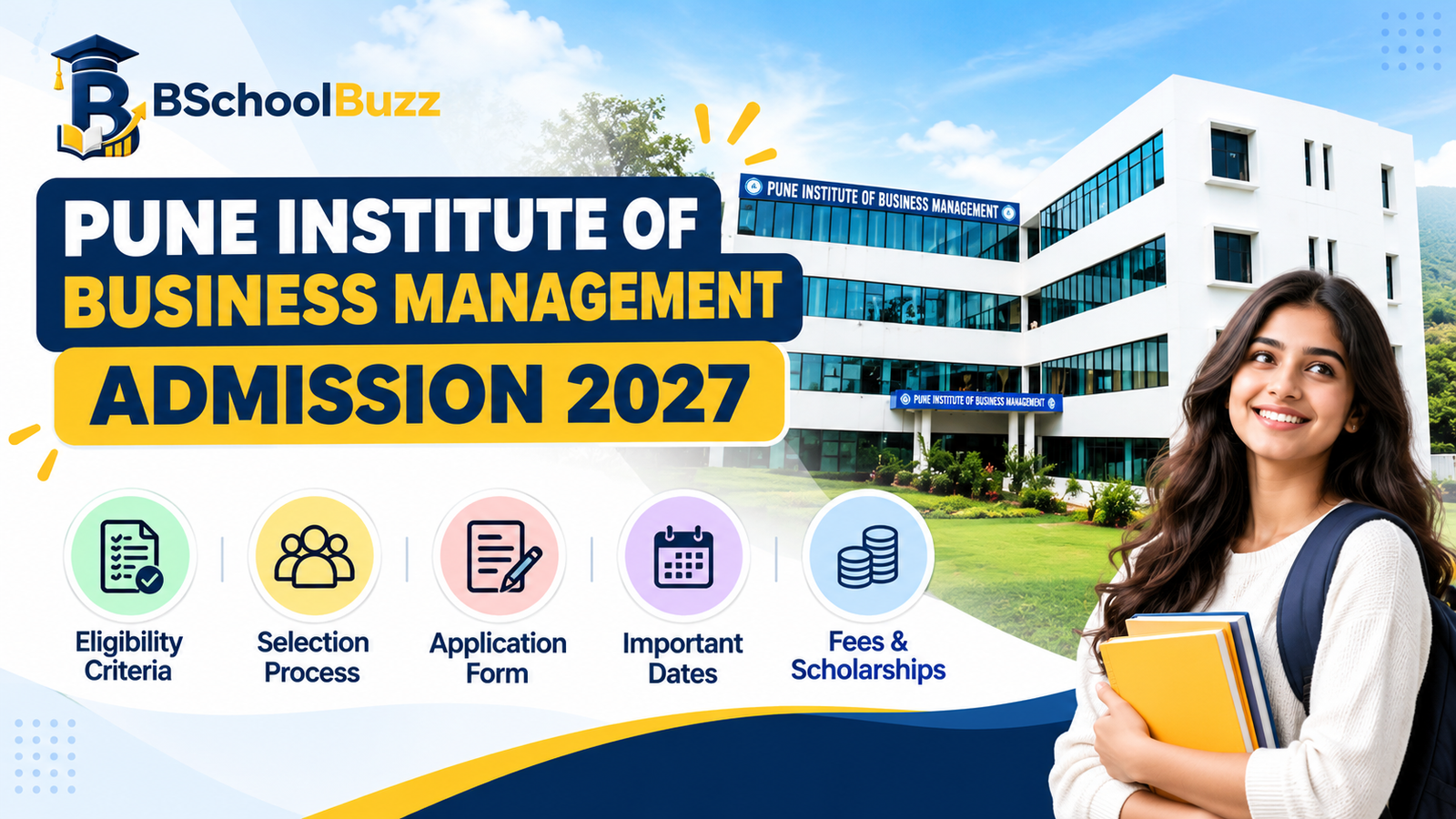
Quick Summary
- PIBM has announced its flagship management admissions for the 2027–29 batch.
- The general eligibility page states a minimum of 50% aggregate marks in Class 10, Class 12 and graduation.
- PIBM lists CAT, XAT, MAT, CMAT, ATMA and PMAT among its accepted aptitude tests, subject to programme-specific rules.
- The selection process may include academic assessment, aptitude tests, written tests, group discussions and personal interviews.
- Applications are available through the official PIBM website and online admission portal.
- PIBM's published fee page lists registration, tuition, hostel and security-deposit charges; confirm the final 2027–29 fee directly.
- PIBM offers MBA and PGDM pathways, along with specialised MBA programmes.
- Review official placement reports for the relevant programme and graduating batch before estimating career outcomes.
- Confirm deadlines, eligibility, fee payments and refund terms through official PIBM communication.
- Official website: https://www.pibm.in/
Pune Institute of Business Management Admission 2027: Eligibility, Selection Process, Application Form & Important Dates
Introduction
Pune Institute of Business Management (PIBM), Pune, offers postgraduate management programmes for students who want to develop skills in business, finance, marketing, human resources, analytics and related fields. For candidates planning admission in 2027, the main considerations include academic eligibility, entrance examination requirements, application procedures, selection rounds, programme fees, internship opportunities and placement outcomes.
PIBM’s official website has announced admissions for its flagship management programmes for the 2027–29 batch. Applicants should still check the programme-specific admission page and the latest prospectus before paying an application fee, because requirements and deadlines can differ between programmes and admission cycles.
This article explains the admission process in a practical sequence, distinguishes the MBA from the PGDM, and highlights the information applicants should verify directly with the institute.
Table of Contents
Pune Institute of Business Management Admission 2027: Overview
About PIBM Pune
PIBM Admission 2027 Important Dates
Courses Offered at PIBM Pune
PIBM Admission 2027 Eligibility Criteria
Entrance Exams Accepted by PIBM
PIBM Selection Process 2027
How to Apply for PIBM Admission 2027
Documents Required for Admission
PIBM Pune Fee Structure
Scholarships and Education Loan Facilities
PIBM Placements and Internship Opportunities
Specialisations and Career Opportunities
Campus Life and Learning Environment
MBA vs PGDM at PIBM: What Should You Choose?
How to Prepare for the PIBM Selection Process
Common Application Mistakes to Avoid
Is PIBM Pune the Right Choice for You?
Official Links and Contact Information
Conclusion
About MBA Compass
Related Search Keywords
1. Pune Institute of Business Management Admission 2027: Overview
Pune Institute of Business Management Admission 2027 is relevant to graduates seeking admission to management programmes at PIBM’s Pune campus. The institute offers a mix of degree and diploma pathways, so candidates should first identify the programme they want to pursue rather than treating every course as having identical admission conditions.
Admission overview
| Particular | Details |
|---|---|
| Institute | Pune Institute of Business Management (PIBM) |
| Location | Pune, Maharashtra |
| Admission cycle | 2027–29 for flagship postgraduate management programmes, as announced on the official website |
| Main programme options | PGDM, MBA and specialised MBA programmes |
| Programme duration | The flagship full-time postgraduate programmes are generally presented as two-year programmes; confirm the duration of the chosen course |
| Academic eligibility | The general admissions page states a minimum of 50% aggregate marks in Class 10, Class 12 and graduation |
| Accepted tests listed by PIBM | CAT, XAT, MAT, CMAT, ATMA and PMAT, subject to programme-specific rules |
| Selection components | Aptitude-test performance, written assessment, group discussion and personal interview, as applicable |
| Application route | Official website and online admission portal |
| Official website | https://www.pibm.in/ |
| Online application portal | https://www.pibm.net |
Important: The institute’s general admission page lists the eligibility and selection criteria above, but individual programmes can have additional or different conditions. Confirm the exact rules for the 2027–29 intake before applying.
2. About PIBM Pune
Pune Institute of Business Management is a management education institution located in Pune, Maharashtra. Its academic offerings include the AICTE-approved PGDM and MBA programmes affiliated with Savitribai Phule Pune University, along with specialised management programmes listed on its official website.
The institute describes its teaching approach as industry-oriented, with training activities, corporate interactions, internships and practical assignments. These activities can help students connect classroom concepts with business problems, but the actual value depends on the quality of participation, the student's chosen specialisation and the opportunities available during the programme.
Recognition and programme type
PIBM lists multiple institutional and programme-related recognitions on its website. Its homepage states that the PGDM has been accorded equivalence to an MBA by the Association of Indian Universities (AIU). The institute also lists AICTE approval for the PGDM and affiliation with Savitribai Phule Pune University for its MBA programmes.
Candidates should distinguish between institutional accreditation and programme approval. Before enrolling, verify the current approval or affiliation status of the specific course, the awarding body, and the qualification that will appear on the final certificate.
This is particularly important for applicants who plan to pursue doctoral studies, apply for government roles, seek international education or need a specific qualification for professional eligibility.
3. PIBM Admission 2027 Important Dates
Admission dates can change as applications progress and interview schedules are released. PIBM’s official website has announced admissions for the flagship management programmes for the 2027–29 batch. Candidates should use the official admission portal for the current application deadline and their individual test, group discussion and interview schedules.
Important dates to track
| Admission event | Status or guidance for 2027 |
|---|---|
| Admission announcement | The official website announces the 2027–29 flagship management intake |
| Application start | Check the live application portal for the programme-specific opening status |
| Last date to apply | Confirm the current deadline on the official portal; do not rely on an older cycle's date |
| Entrance-test score submission | Follow the selected programme's instructions |
| PMAT, if applicable | Schedule communicated by the admissions department |
| Written test, if applicable | Confirm the applicable round and format with the institute |
| Group discussion | Date and instructions communicated to shortlisted applicants |
| Personal interview | Date and instructions communicated to shortlisted applicants |
| Final selection | Follow official communication from the admissions department |
| Fee payment and registration | Complete within the deadline in the official offer or admission instructions |
| Programme commencement | Confirm with the institute for the 2027–29 batch |
How to avoid missing a deadline
Check the official admissions page and portal regularly rather than relying on third-party websites or social-media posts. Keep a copy of your submitted application, payment receipt and any communication from the admissions department. If a date is unclear, contact the institute before assuming that an application window is still open.
A deadline published for an earlier intake is not automatically valid for 2027. The same rule applies to interview schedules, entrance-test requirements and fee-payment dates.
4. Courses Offered at PIBM Pune
PIBM's official website lists several management pathways. The programmes differ in qualification type, curriculum, affiliation or approval, and potentially their admission conditions.
| Programme | Broad description | What applicants should verify |
|---|---|---|
| PGDM | A postgraduate diploma in management with an industry-oriented curriculum | AICTE approval, current specialisations, AIU equivalence details and batch-specific fee |
| MBA | A postgraduate management degree affiliated with Savitribai Phule Pune University, according to PIBM | Current affiliation, university admission rules, entrance-test requirements and specialisation options |
| MBA in FinTech | A specialised management degree focused on financial technology-related areas | Current course availability, syllabus, eligibility and fee |
| MBA in Project Management | A specialised management degree focused on project-management concepts and practice | Current course availability, syllabus, eligibility and fee |
| Other or newer offerings | PIBM may list additional programmes or delivery formats on its website | Whether the course is offered at the Pune campus and whether its admission route differs |
Not every programme listed on the institute's website necessarily follows the same admission calendar. A candidate interested in the MBA should not automatically apply the PGDM admission rules to that degree, or vice versa.
How to choose a programme
Start with the kind of qualification you need. If you prefer a university-affiliated degree, examine the MBA route and its university requirements. If you are considering the PGDM, read the programme's approval, recognition, curriculum and equivalence details. Then compare the specialisation, learning format, total cost, internship structure and likely career paths.
Do not select a course only because its name includes a fashionable specialisation. Review the syllabus, software or analytical tools taught, project work, faculty expertise and the types of roles for which the programme prepares students.
5. PIBM Admission 2027 Eligibility Criteria
The general admissions page on PIBM's official website states that applicants should have completed formal Indian education under the 10+2+3 or 10+2+4 system and secured at least 50% aggregate marks in Class 10, Class 12 and graduation.
Because eligibility rules may differ by programme, applicants must confirm the current 2027–29 requirements for their intended course.
General eligibility information
| Criterion | General information published by PIBM | What you should check |
|---|---|---|
| Class 10 marks | The general page states a minimum 50% aggregate | Confirm how the institute calculates the aggregate |
| Class 12 marks | The general page states a minimum 50% aggregate | Confirm accepted board and documentation requirements |
| Graduation marks | The general page states a minimum 50% aggregate | Confirm accepted degrees and any programme-specific conditions |
| Graduation pattern | 10+2+3 or 10+2+4 system is mentioned | Ask the admissions team if your qualification follows a different pattern |
| Entrance test | Accepted tests are listed on the admissions page | Check which tests are valid for the chosen programme and intake |
| Work experience | The institute states that additional weightage may be given to applicants with work experience | Confirm accepted evidence and how experience is assessed |
| Final-year students | The general page does not fully explain every final-year scenario | Confirm whether provisional applications are permitted and the deadline for submitting final results |
Can final-year students apply?
Students completing their undergraduate degree should not assume that they are eligible—or ineligible—without checking the current programme rules. Ask the admissions office whether final-year candidates can submit an application, what academic documents are required at the time of application, and when final graduation results must be submitted.
If provisional admission is offered, obtain written confirmation of the conditions that must be satisfied before enrolment is finalised.
Can students from non-management backgrounds apply?
PIBM's FAQ states that students do not need to have studied management subjects during graduation to be considered for its MBA or PGDM programmes. This means applicants from disciplines such as commerce, science, engineering, arts and other recognised fields may explore the relevant programmes, subject to the current eligibility rules.
Students from non-management backgrounds should prepare to explain why they want to study management and how their undergraduate education relates to their intended career.
Is work experience compulsory?
PIBM's general admissions information describes work experience as a factor that can receive additional weightage. It does not present work experience as a universal compulsory condition on that page. Fresh graduates should still verify the requirements of their selected programme and prepare evidence of internships, projects or employment where relevant.
6. Entrance Exams Accepted by PIBM
PIBM's general admissions page lists CAT, XAT, MAT, CMAT, ATMA and PMAT (PIBM's own aptitude test) among the tests accepted for consideration. However, its FAQ distinguishes between the MBA and PGDM routes, so candidates should confirm the exact requirement for the programme they intend to join.
Entrance exams listed by PIBM
| Examination | Full name | Applicant action |
|---|---|---|
| CAT | Common Admission Test | Check the score validity and programme-specific minimum requirements |
| XAT | Xavier Aptitude Test | Confirm whether the current intake accepts the score |
| MAT | Management Aptitude Test | Check the accepted test window and score-submission procedure |
| CMAT | Common Management Admission Test | Confirm the current eligibility and score requirements |
| ATMA | AIMS Test for Management Admissions | Verify whether the selected programme accepts the relevant score |
| PMAT | PIBM's internal aptitude test | Ask whether you need to take it and how to book the test |
What if you have not taken a national-level entrance exam?
PIBM's FAQ states that candidates who have not taken the listed examinations and wish to apply for the PGDM may need to take PMAT, the institute's internal aptitude assessment. The same FAQ indicates that the MBA route has a national-level entrance-test requirement.
These are programme-specific statements, not a guarantee that every applicant can enter through the same route. Confirm the 2027 rules before making a decision based on PMAT.
What does PMAT assess?
PIBM's published FAQ describes PMAT as an online aptitude test covering quantitative ability, logical reasoning and data interpretation, and verbal ability. The FAQ gives a format of 50 questions, a duration of 75 minutes, a total of 200 marks and negative marking for incorrect answers. It also states a minimum passing score of 50%.
Treat these details as the format published in the institute's FAQ, and confirm them with the admissions team before preparing for the 2027 test. Test structure, scoring and qualifying rules can change.
How should applicants prepare?
A balanced preparation plan should cover:
Quantitative ability: percentages, ratios, averages, arithmetic, basic algebra and data-based calculations.
Logical reasoning: arrangements, sequences, deductions and pattern-based questions.
Data interpretation: tables, charts, graphs and numerical comparisons.
Verbal ability: reading comprehension, vocabulary in context, grammar and sentence logic.
Current affairs: business and economic developments, especially if mentioned in the current assessment instructions.
Use timed practice to improve speed and accuracy. If negative marking applies, learn when to attempt a question and when to move on. Verify the latest test format instead of relying exclusively on older preparation material.
7. PIBM Selection Process 2027
PIBM describes its selection process as a combination of academic performance, aptitude-test results and performance in assessment rounds. The official admissions page lists an aptitude test, written test, group discussion and personal interview. The FAQ also refers to internal aptitude assessment where applicable.
Selection stages
| Stage | What it may assess | How to prepare |
|---|---|---|
| Application screening | Eligibility, academic history and completeness of the application | Enter accurate details and upload readable documents |
| Entrance or aptitude test | Quantitative, verbal and reasoning skills | Practise timed questions and understand the current test rules |
| Written assessment | Written communication and structured thinking, if required | Practise concise, logically organised responses |
| Group discussion | Communication, listening, reasoning and teamwork | Follow current affairs and practise presenting evidence-based views |
| Personal interview | Motivation, academic background, goals and suitability | Prepare clear, honest answers supported by examples |
| Final evaluation | Combined assessment under the institute's selection framework | Follow all instructions and respond promptly to official communication |
The table describes the assessment components mentioned by PIBM; it should not be interpreted as a guaranteed sequence for every programme or candidate. The institute may communicate different instructions depending on the selected course and admission round.
How academic performance affects selection
PIBM's FAQ says that its selection process uses weightage for different parameters, including previous academic performance, entrance or aptitude-test scores, group discussion, interview and the internal aptitude test. The precise 2027 weightage should be confirmed with the institute; applicants should not rely on an unofficial percentage breakdown.
A candidate with strong academics should still prepare seriously for the entrance test and interview. Similarly, a student with a less consistent academic record should not assume that other components will automatically compensate. The final outcome depends on the current selection framework and the applicant's performance.
How to prepare for the personal interview
Prepare to discuss your academic choices, projects, internships, work experience, strengths, areas for improvement and career objectives. If you have a gap in education or a change in career direction, explain it honestly and briefly.
You may also be asked why you want to study at PIBM, why you selected a particular programme, what you understand about your preferred specialisation and how you follow business developments. Read the official course description so your answers reflect the actual programme.
Group discussion preparation
A group discussion is not simply a contest to speak the most. Practise making a clear point, supporting it with a reason or example, listening to other participants and disagreeing respectfully. Current business, social, economic and technology topics can be useful practice areas, but follow any specific topic guidance issued by PIBM.
8. How to Apply for PIBM Admission 2027
PIBM provides an online application route through its website and admission portal. Its FAQ describes an account-registration process, application-fee payment, form completion and subsequent communication about the selection schedule.
Step-by-step application process
Step 1: Visit the official website.
Open https://www.pibm.in/ and locate the admissions section for the programme you want to study.
Step 2: Select the correct programme.
Choose the intended course carefully. The MBA, specialised MBA programmes and PGDM may have different requirements, fees or assessment rules.
Step 3: Open the online application portal.
Use the official admission portal at https://www.pibm.net when directed by the institute.
Step 4: Create an account.
Register with accurate personal and contact details. Use an email address and phone number that you can access regularly, because admissions updates may be sent through them.
Step 5: Pay the application fee.
PIBM's FAQ lists an application-form fee of ₹1,000 and describes online payment options including UPI, internet banking, debit card and credit card. Confirm the current amount on the 2027 portal before payment. The general admissions page also refers to a demand draft for candidates obtaining a prospectus and application form; follow the method specified for your application route.
Step 6: Complete the application form.
Enter your educational history, examination details, contact information and any other requested information. Check spelling, marks, dates and entrance-test details before submission.
Step 7: Submit the required information.
Upload or provide the documents and test scores requested by the current application portal. Do not assume that submission is complete merely because the payment has succeeded.
Step 8: Monitor official communication.
PIBM states that its admissions department communicates the dates for the relevant selection activities, including GD, PI and PMAT where applicable.
Step 9: Attend the selection rounds.
Follow the instructions in the official communication and keep the necessary documents ready.
Step 10: Review the admission offer.
If selected, read the offer carefully. Confirm the course, fee schedule, payment deadline, refund conditions, reporting instructions and any conditions attached to admission before paying a large amount.
Application checklist
Before submitting, check that:
You selected the intended programme and intake.
Your name and date of birth match your documents.
Class 10, Class 12 and graduation marks are entered accurately.
Entrance-test details are correct.
Your contact details are active.
All required documents are legible.
The application fee and payment method match the current portal instructions.
You saved the submission confirmation and payment receipt.
9. Documents Required for Admission
The exact document checklist can vary by programme and stage of admission. The following is a preparation list, not a replacement for the official 2027 checklist.
| Document | Why it may be required |
|---|---|
| Class 10 marksheet or certificate | Proof of date of birth and school-level academic record |
| Class 12 marksheet or certificate | Proof of higher-secondary academic record |
| Graduation marksheets | Verification of undergraduate performance |
| Degree certificate or provisional certificate | Proof of graduation, where applicable |
| Entrance-test scorecard | Verification of the test accepted for the chosen programme |
| Government-issued photo identification | Identity verification |
| Recent photograph | Application or student-record requirements |
| Signature image, if requested | Online application verification |
| Work-experience documents, if applicable | Evidence of employment claimed in the application |
| Category or other supporting certificate, if specifically requested | Verification of any applicable claim under the institute's current rules |
| Application confirmation and fee receipt | Proof of submission and payment |
| Any additional forms specified by PIBM | Compliance with the current admission instructions |
Keep original documents and clear digital copies available. Do not upload documents that are altered or inconsistent with the information in your form. If your final-year marksheet or degree certificate has not yet been issued, ask the admissions office what provisional evidence it accepts and by what date the final document must be submitted.
10. PIBM Pune Fee Structure
Fees are a major part of the admission decision. PIBM's published management-programme fee page currently lists the following amounts for Indian students. Because the 2027–29 intake may have a revised schedule, applicants should treat these as the figures displayed on the official fee page at the time of research—not as a guaranteed final fee for every 2027 programme.
Fee figures listed on PIBM's official page
| Fee component | Amount shown on the official page |
|---|---|
| Registration fee | ₹50,000 |
| Tuition fee – first year | ₹4,47,500 |
| Tuition fee – second year | ₹4,47,500 |
| Hostel fee – first year | ₹2,00,000 |
| Hostel fee – second year | ₹2,00,000 |
| Security deposit | ₹10,000 |
| Total of the listed components | ₹13,55,000 |
The total above is the arithmetic sum of the components listed on the page. It is not a separate official quotation for the 2027–29 batch. The fee page does not establish that the same schedule applies identically to every programme, so candidates should request a course-specific written breakdown.
What should you confirm before paying?
Ask the admissions office for a written fee schedule that specifies:
The total fee for your exact programme and intake.
Whether the listed tuition covers the entire two-year programme.
The payment dates and instalment amounts.
Whether hostel accommodation is compulsory or optional for your course.
Whether mess, books, examination, transport or other charges are additional.
The amount and conditions of the security deposit.
The refund and cancellation policy.
Whether any fee can be revised after admission.
Whether a payment is a booking amount, part of tuition or a separate charge.
Do not assume that a fee shown on a general management-programme page is the final amount for a specialised course. Similarly, do not add a separate living-cost estimate to the official total without first checking whether the relevant expense is already included.
Understanding the security deposit
PIBM lists a security deposit separately from registration, tuition and hostel charges. Applicants should ask whether the deposit is refundable, which deductions may apply and when the refund is normally processed. The fact that an amount is called a security deposit does not by itself establish every condition for its return.
Education loans and instalments
PIBM's fee page mentions education-loan facilities through SBI Scholar Loan and other associated banks, including Punjab National Bank and Axis Bank. Its FAQ also refers to EMI options through bank financing.
Loan availability, interest rates, collateral conditions, moratoriums and approval depend on the lender's current policy and the individual applicant. Obtain a written sanction and repayment schedule before relying on a loan to fund admission. Compare the total borrowing cost with the expected monthly repayment rather than considering only the amount of the instalment.
11. Scholarships and Education Loan Facilities
Financial support should be checked directly with the institute. PIBM's FAQ states that it does not currently have provisions for scholarships, while the institute's website mentions education-loan facilities. Because policies can change, confirm the position for the 2027–29 intake in writing.
| Financial-support option | What is known | What to do |
|---|---|---|
| Institute scholarship | PIBM's published FAQ says scholarships are not currently provided | Ask whether a new policy has been introduced for the 2027 intake |
| SBI Scholar Loan | Mentioned on PIBM's fee page | Confirm eligibility, interest rate, repayment and documentation with SBI |
| Other bank loans | PNB and Axis Bank are mentioned by PIBM | Contact the lender for current terms and approval conditions |
| EMI or instalment arrangements | PIBM's FAQ refers to EMI options through banks | Confirm the payment schedule and total financing cost |
| External scholarships | Not established by the cited PIBM pages as a specific institute award | Check the relevant government or external scholarship authority for eligibility |
Do not reduce the expected fee by an assumed scholarship amount unless you have received a formal award letter. A bank loan is financing, not a fee waiver: the borrowed amount must be repaid under the lender's terms.
12. PIBM Placements and Internship Opportunities
Placements matter, but published placement claims must be interpreted carefully. PIBM maintains a placement-results page with reports for multiple batches, including 2024–26, 2023–25 and earlier cohorts. Applicants should consult the report for the relevant programme and batch rather than treating one headline figure as a guaranteed outcome for every student.
Roles and sectors
PIBM lists career areas such as business analytics, financial research, corporate finance, investment banking, equity advisory, consulting, commercial credit, channel management, retail management, digital marketing, human resources and recruitment.
The type of role a student pursues will depend on the programme, specialisation, internships, academic performance, technical skills, communication ability and employer requirements. A specialisation name alone does not guarantee entry into a particular role.
Internship exposure
PIBM describes internship opportunities and refers to summer and winter internships for its management students. Its published FAQ says that students can pursue internship opportunities related to their domain and specialisation.
Internships can help students understand workplace expectations, build practical examples for interviews and test whether a chosen field suits their interests. Students should ask how internships are allocated, whether they are compulsory, how evaluation works and what support is provided if an initial opportunity does not align with their goals.
How to read placement reports
When reviewing a placement report, check:
Which graduating batch it covers.
Whether it relates to MBA, PGDM or a combined group.
The number of eligible students and the number placed.
Whether salary figures are average, median or highest.
Whether the report includes domestic and international offers together.
Whether the reported figure covers fixed pay only or total compensation.
Whether the methodology and exclusions are explained.
Which job roles and sectors appear in the report.
The highest package describes an upper-end outcome, not what a typical student should expect. An average can also be influenced by a small number of high offers. If a median figure is available, review it alongside the average and highest package to get a more balanced picture.
PIBM's website lists major recruiters across areas such as consulting, banking, finance, IT, consumer goods and other sectors. A company logo or recruiter list, however, does not prove that every student will receive an offer from that employer. Applicants should assess the report's data and the roles offered, not just the brand names.
Evaluating return on investment
A practical ROI assessment should compare the full cost of attendance with realistic career outcomes. Include tuition, registration, hostel, living expenses, loan interest and any other compulsory charges. Then compare the total cost with the salary range and role types relevant to your profile.
Avoid dividing the highest package by the course fee and presenting the result as a reliable ROI measure. A more useful assessment considers median compensation where published, the proportion of students placed, job suitability, likely take-home pay, loan repayment and long-term career growth.
13. Specialisations and Career Opportunities
PIBM's published course information lists areas including Finance, Marketing, Human Resources, Business Analytics and Operations or Analytics as a minor, with availability varying by programme. Its FAQ specifically notes that Applied Business Analytics is available in the PGDM programme.
Finance
Finance-oriented students may explore corporate finance, financial analysis, credit, equity research, financial planning or banking-related roles. The specific opportunities depend on the course content, technical skills, internships and employer requirements.
Students considering finance should strengthen accounting fundamentals, spreadsheet skills, numerical reasoning and their understanding of financial statements. Some roles may also require specialised software knowledge or additional qualifications.
Marketing
Marketing can lead to work in sales, brand management, market research, digital marketing, customer insights, channel management and related functions. Students should consider whether they prefer analytical work, communication, client-facing roles or a combination of these activities.
Practical projects, campaign analysis, customer research and presentation skills can strengthen a marketing profile. Applicants should examine the curriculum to see whether it includes analytics tools and practical projects relevant to their goals.
Business Analytics
Business analytics combines business understanding with data interpretation. Potential roles can include business analyst, reporting analyst, marketing analyst or operations analyst, subject to the employer's requirements.
Students interested in analytics should check the amount of quantitative coursework, practical software training and project work offered by the selected programme. Basic statistics, spreadsheets, data visualisation and structured problem-solving are useful foundations.
Human Resources
HR-oriented career paths can include talent acquisition, learning and development, HR operations, employee engagement and related functions. Communication, discretion, organisation and an understanding of workplace policies are useful in this field.
Applicants should review whether HR is offered as a major or specialisation in the particular programme and how the curriculum is structured.
Operations and related areas
Operations-related study can support interests in supply chain, process improvement, logistics, quality management and business operations. Students should look at the actual course structure and whether analytics, process tools and live projects are part of the learning experience.
How to choose a specialisation
Use three questions:
What work do you enjoy? Decide whether you prefer numbers, people management, market-facing work, technology-enabled analysis or process improvement.
What skills do you already have? Identify your strengths and the areas you need to develop.
What does the curriculum teach? Compare subjects, tools, projects, internships and relevant career outcomes rather than selecting by name alone.
14. Campus Life and Learning Environment
A management programme involves more than classroom lectures. Students may need to manage group projects, presentations, case discussions, internships, assessments and placement preparation at the same time. A residential environment can provide opportunities for peer learning, but students should verify the facilities and living arrangements before enrolling.
PIBM lists extracurricular activities, student clubs and committees on its website. Such activities can help students practise teamwork, communication, leadership and event management. Their value depends on participation and the quality of the experience rather than simply on the number of clubs available.
Questions to ask during a campus visit
What accommodation options are available for the selected programme?
Are hostel charges included in the fee quoted for the intake?
What are the rules for room allocation and security deposits?
Are meals included, and what additional costs may apply?
What library, computer and study facilities can students use?
How are internships and live projects organised?
What career counselling and placement preparation are provided?
What are the attendance and assessment requirements?
What is the procedure for complaints, fee queries or student support?
If possible, speak with current students and alumni from the same programme. Ask about the actual workload, faculty access, internship process and placement preparation. Use those conversations as additional context, while treating official programme documents as the authority for fees, eligibility and formal policies.
15. MBA vs PGDM at PIBM: What Should You Choose?
PIBM offers both MBA and PGDM routes, but the qualifications are not identical in structure. The MBA is described by PIBM as affiliated with Savitribai Phule Pune University, while the PGDM is presented as an AICTE-approved programme. PIBM also states that its PGDM has been accorded MBA equivalence by AIU.
Comparison
| Factor | MBA route | PGDM route |
|---|---|---|
| Qualification type | University degree | Postgraduate diploma |
| Institutional relationship listed by PIBM | Affiliated with Savitribai Phule Pune University | AICTE-approved programme |
| Curriculum | Check the current university and programme syllabus | Check the current PGDM syllabus and specialisation structure |
| Entrance requirements | Confirm the current MBA-specific test and eligibility rules | Confirm the current PGDM test and eligibility rules, including PMAT where applicable |
| Fee structure | Request the current MBA-specific fee schedule | Request the current PGDM-specific fee schedule |
| Career planning | Compare relevant roles, internships and employer expectations | Compare relevant roles, internships and employer expectations |
| Further studies | Check the requirements of the university or institution where you intend to apply | Check the receiving institution's requirements and the applicable equivalence documentation |
Which is better?
Neither qualification should be chosen solely on the basis of the label. Compare the course curriculum, academic recognition, total fee, admission conditions, internship structure and the requirements of your intended career or further study.
If you plan to apply for a specific government position, doctoral programme or international course, verify the qualification rules with the organisation that will evaluate your credential. Do not assume that a general equivalence statement automatically satisfies every institution's requirements.
16. How to Prepare for the PIBM Selection Process
Preparation should begin before the application deadline, especially if you need to improve aptitude-test performance or organise academic documents.
A four-part preparation plan
Part 1: Verify eligibility and programme choice.
Read the official page for your selected course. Check academic marks, accepted tests, application steps, fees and any special conditions.
Part 2: Prepare for the aptitude assessment.
Practise quantitative ability, logical reasoning, data interpretation and verbal ability. Use timed exercises and review incorrect answers to identify patterns in your mistakes.
Part 3: Prepare your profile.
Review your academic record, projects, internships, work experience and extracurricular activities. Prepare to explain what you learned and how it relates to your management goals.
Part 4: Practise communication.
Work on structured answers, current-affairs awareness and interview confidence. For group discussions, practise listening as well as speaking.
Sample interview questions
Why do you want to pursue a management programme?
Why have you selected PIBM?
Why are you interested in the MBA or PGDM route?
Which specialisation interests you, and why?
What did you learn from your undergraduate course?
Tell us about a project or internship you completed.
What business or economic development have you followed recently?
What are your short-term career goals?
What skill do you most need to improve?
How would you respond to a disagreement in a team?
Use these questions for practice, not as a prediction of the exact interview. Answer honestly and use specific examples wherever possible.
17. Common Application Mistakes to Avoid
Applying without checking programme-specific eligibility
The general admission page is useful, but it may not answer every question about a specialised course. Read the correct programme page and confirm the rules for the 2027–29 batch.
Assuming every entrance exam is interchangeable
PIBM lists multiple entrance tests, but the MBA and PGDM routes may have different requirements. Confirm which score is accepted for your course and whether a minimum percentile or other condition applies.
Using old fee information
A fee figure from an earlier batch should not be treated as the 2027–29 fee. Obtain the current schedule, including hostel charges, deposits and payment deadlines.
Entering inconsistent academic details
Check every mark, percentage, examination date and personal detail against your documents. Errors can cause delays or require corrections during verification.
Preparing only for the entrance test
PIBM lists other assessment components, including group discussion, personal interview and written assessment where applicable. Prepare for the complete selection process.
Relying only on the highest salary figure
Review placement reports for the relevant programme and batch. Examine average and median figures where published, the number of students placed and the roles offered.
Paying before reading the offer terms
Confirm the course, fee breakdown, refund conditions and reporting deadline in writing. Keep receipts and copies of official communication.
18. Is PIBM Pune the Right Choice for You?
PIBM may be worth considering if you want a management programme that includes aptitude training, practical projects, internship opportunities and preparation for job-specific roles. Whether it is the right choice depends on your goals, academic profile, preferred qualification and financial circumstances.
PIBM may suit you if:
You are interested in business management and can identify a clear career direction.
The selected programme offers subjects aligned with your interests.
You are willing to participate in aptitude preparation, presentations, group projects and interviews.
You have compared the current total fee with your budget and financing options.
You have reviewed the placement report for the course and batch relevant to you.
You have verified the qualification and recognition requirements for your future plans.
Think carefully before accepting an offer if:
You have not received a written fee breakdown.
You are relying on a scholarship that has not been formally confirmed.
You have not checked the difference between the MBA and PGDM.
Your preferred career requires a specific qualification or additional certification.
You are assuming that a published highest package is a likely individual outcome.
You have not compared PIBM with other institutions using the same criteria.
A sensible decision considers the complete cost, curriculum, learning environment, internship access and realistic career outcomes. Do not make the decision based only on promotional language or one placement statistic.
19. Official Links and Contact Information
Use official sources for admission forms, current dates, fees and programme requirements.
| Purpose | Official resource |
|---|---|
| Main website | https://www.pibm.in/ |
| MBA and PGDM admissions | https://www.pibm.in/mba-and-pgdm-admissions.html |
| Online application portal | https://www.pibm.net |
| Fee structure | https://www.pibm.in/fee-structure.html |
| Frequently asked questions | https://www.pibm.in/pibm-faqs.html |
| Placement results | https://www.pibm.in/results.html |
| Downloads and prospectus | https://www.pibm.in/download.html |
| Contact page | https://www.pibm.in/contact.html |
PIBM's website lists its corporate office in Pune and provides admission contact details on its contact page. Check the official page for the current phone number and email address before contacting the institute, as contact details may change.
When writing to the admissions team, mention the programme name, intended intake (2027–29), entrance test taken and the specific question you need answered. Ask for written clarification when the response affects eligibility, fees, deadlines or refund conditions.
Conclusion
Pune Institute of Business Management Admission 2027 requires applicants to understand the differences between the available management programmes, check the correct eligibility criteria and follow the current application instructions. PIBM's official website lists CAT, XAT, MAT, CMAT, ATMA and PMAT among the accepted aptitude tests, while its general selection information refers to academic performance, aptitude assessments, written tests, group discussions and interviews as applicable.
The institute's published fee page provides a useful reference, but applicants should obtain the final fee schedule for their exact programme and 2027–29 intake. The same approach applies to entrance-test requirements, application deadlines, scholarships, internship arrangements and placement outcomes.
Before accepting an offer, compare the curriculum, qualification type, total cost and career opportunities with your personal goals. Verify all important details directly through the official PIBM website and admission portal, retain written confirmation of key terms, and make your decision using programme-specific evidence rather than assumptions based on an earlier admission cycle.
Key Takeaways
Check programme-specific eligibility: Requirements for the MBA and PGDM may differ.
Verify accepted entrance exams: Confirm which test scores are valid for your chosen programme in the 2027–29 intake.
Prepare for every selection stage: Do not focus only on the entrance examination; prepare for other assessments listed by PIBM.
Use current fee information: Request a written fee breakdown for your exact course and batch before paying.
Understand the qualification: Compare the MBA degree and PGDM diploma, including affiliation, approval and equivalence requirements.
Evaluate placements carefully: Review batch-specific reports and distinguish average, median and highest packages.
Check financial support: Confirm scholarship availability and loan conditions instead of assuming that financial assistance is guaranteed.
Keep documents ready: Maintain accurate academic records, scorecards, identification and any other documents requested.
Save application records: Retain your form confirmation, payment receipt and official admissions correspondence.
Make an informed decision: Compare curriculum, total cost, internships and career goals before accepting an offer.
Frequently Asked Questions
Is PIBM Pune admission open for 2027?
PIBM's official website has announced admissions for its flagship management programmes for the 2027–29 batch. Check the official admission portal for the current application status, deadlines and programme-specific instructions.
What is the eligibility for Pune Institute of Business Management Admission 2027?
PIBM's general admissions page states that applicants should have completed the 10+2+3 or 10+2+4 education pattern and secured at least 50% aggregate marks in Class 10, Class 12 and graduation. Confirm the exact eligibility conditions for your chosen programme.
Which entrance exams does PIBM accept?
PIBM lists CAT, XAT, MAT, CMAT, ATMA and PMAT among its accepted aptitude tests. Requirements can differ between the MBA and PGDM, so verify the accepted test and score conditions for your intended programme.
Can I apply to PIBM without a CAT or other national-level entrance exam?
PIBM's FAQ states that candidates seeking PGDM admission without a listed national-level entrance examination may need to take PMAT, its internal aptitude test. The MBA route has separate entrance-test requirements, which should be confirmed directly with the institute.
What is the selection process at PIBM Pune?
PIBM describes a selection framework that may consider academic performance, entrance-test or aptitude-test scores, written assessment, group discussion and personal interview. The exact stages and weightage should be verified for the 2027–29 admission cycle.
What is the application fee for PIBM admission?
PIBM's published FAQ lists an application-form fee of ₹1,000. Confirm the current fee and payment instructions on the official admission portal before submitting your application.
What is the total fee at PIBM Pune for 2027–29?
The final fee for the 2027–29 intake should be confirmed with PIBM. Its published management-programme fee page lists registration, tuition, hostel and security-deposit charges, but applicants should obtain the current programme-specific schedule before making a payment.
Does PIBM Pune offer scholarships or education loans?
PIBM's FAQ states that the institute does not currently provide scholarships, while its fee page mentions education-loan facilities through SBI Scholar Loan and other banks. Contact the institute and relevant lender to verify current options and eligibility.
What programmes are available at PIBM Pune?
PIBM lists PGDM, MBA, MBA in FinTech and MBA in Project Management among its postgraduate management offerings. Check the official website to confirm which programmes are accepting applications for your intended intake and the requirements for each course.
How can I apply for Pune Institute of Business Management Admission 2027?
Visit https://www.pibm.in/, select your intended programme and follow the official application instructions. You can also use the online portal at https://www.pibm.net. Complete the form accurately, pay the applicable fee and monitor official communication about selection rounds.
Ask a question
Still confused? Leave your question and our team will help you.