
Quick Summary
- Welingkar Mumbai offers full-time PGDM programmes and a separate MMS degree.
- The latest verified PGDM brochure for 2026–2028 specifies a minimum of 50% in a bachelor's degree from a recognised university.
- The 2026–2028 PGDM cycle lists CAT, XAT, GMAT, ATMA and CMAT, subject to the applicable examination year or session.
- Relevant post-graduation work experience is preferred but not compulsory under the published 2026–2028 guidance.
- Entrance-test shortlisting thresholds differ by programme.
- Meeting the minimum eligibility criteria does not guarantee final admission.
- MMS admissions follow Maharashtra's state admission process, separate from the institute's PGDM process.
- Applicants for 2027–2029 should verify the new official brochure, accepted test sessions, cutoffs and application deadlines before applying.
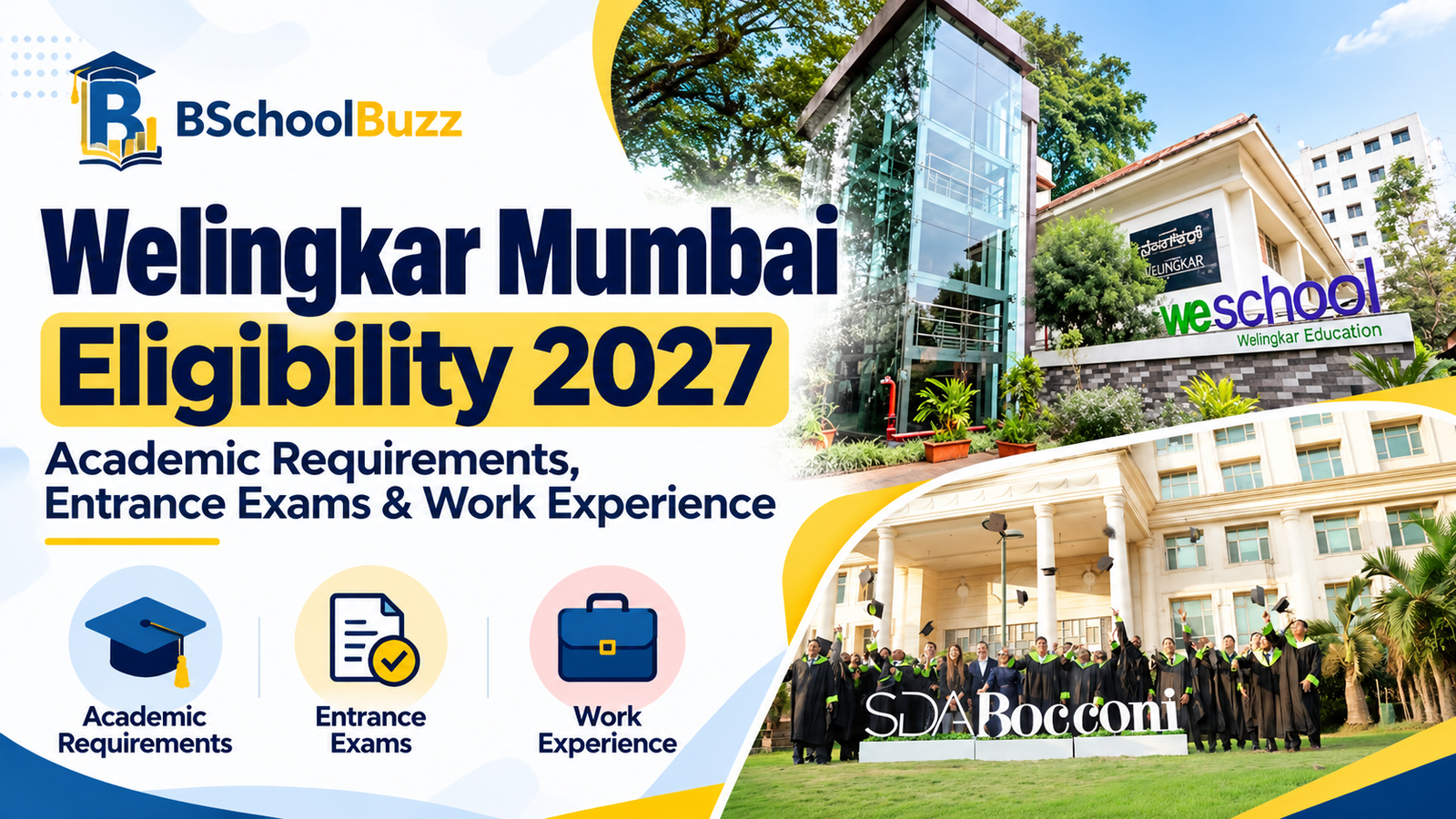
Welingkar Mumbai Eligibility 2027: Academic Requirements, Entrance Exams & Work Experience
Introduction
Students planning to pursue a management qualification at Prin. L. N. Welingkar Institute of Management Development & Research in Mumbai should understand the admission requirements before selecting an entrance examination or submitting an application. Welingkar, also known as WeSchool, offers multiple management programmes, and eligibility requirements can vary according to the programme and admission route.
This article focuses primarily on the full-time, two-year PGDM programmes at the Mumbai campus. It explains graduation requirements, entrance examinations, cutoffs, work experience, the selection process, application preparation and common eligibility mistakes. The institute also offers an MMS degree, but MMS admissions follow a separate Maharashtra state admission process. These two routes should not be treated as interchangeable.
The latest detailed PGDM admission material that could be verified for this article relates to the 2026–2028 batch. The 2027–2029 admission brochure and its final requirements should be checked when officially published. Previous-cycle figures are identified as such instead of being presented as confirmed 2027 requirements. <Cite refs={["turn319602search23","turn319602search0","turn319602search1"]}/>
Table of Contents
Welingkar Mumbai Eligibility 2027: Overview
Understanding Welingkar and Its Management Programmes
Academic Eligibility Criteria
Graduation Marks and Degree Requirements
Accepted Entrance Examinations
Entrance Exam Cutoffs: What Previous-Cycle Data Shows
Is Work Experience Required?
Welingkar Mumbai Selection Process
How Academic Performance Affects Your Application
Application Process and Documents
PGDM and MMS: Important Differences
Eligibility Mistakes Applicants Should Avoid
How to Prepare Before Applying for 2027 Admission
Frequently Asked Questions
Conclusion
About MBA Compass
Related Search Keywords
1. Welingkar Mumbai Eligibility 2027: Overview
Welingkar Mumbai eligibility refers to the academic qualifications, entrance-test requirements and selection conditions candidates must satisfy to be considered for admission to the institute's management programmes.
The institute's full-time PGDM admissions and its MMS admissions have different procedures. Therefore, applicants should first decide which qualification they want to pursue. The eligibility conditions described in a PGDM brochure should not automatically be applied to the MMS course.
The following table summarises the main requirements established by the latest detailed PGDM material available for this article.
| Eligibility factor | Latest verifiable PGDM information | What 2027 applicants should do |
|---|---|---|
| Qualification | Bachelor's degree from a recognised university | Verify the final 2027–2029 brochure |
| Graduation marks | Minimum 50% in the 2026–2028 admission brochure | Check whether the next cycle retains the same threshold |
| Entrance exams | CAT, XAT, GMAT, ATMA and CMAT, subject to the applicable test year | Confirm the accepted tests and dates for 2027 admission |
| Work experience | Relevant experience is preferred, not mandatory, according to the published 2026–2028 portal | Review the next cycle's selection guidance |
| Selection | Profile-based evaluation involving academics, test performance and further selection stages | Follow the exact process announced for the chosen programme |
| Cutoff | Varies by programme and entrance examination | Do not assume that the 2026–2028 cutoff will remain unchanged |
| Programme | Full-time PGDM programmes at the Mumbai campus | Confirm the exact programme before applying |
Sources: Welingkar's official PGDM brochure, the official 2026–2028 admission portal and programme information. <Cite refs={["turn319602search23","turn319602search0","turn319602search4"]}/>
Why the admission year matters
A candidate applying for the 2027–2029 batch must follow the rules published for that particular intake. Entrance examinations have their own schedules, and the institute specifies which examination sessions are accepted for each admission cycle. Graduation completion deadlines can also change.
For example, the 2026–2028 brochure refers to CAT 2025, XAT 2026, ATMA 2026 and CMAT 2026, alongside a specified GMAT testing window. These are not automatically the correct examinations for 2027–2029 applicants. Candidates should check the next official brochure before deciding which tests to take. <Cite refs={["turn319602search23","turn319602search0"]}/>
2. Understanding Welingkar and Its Management Programmes
Prin. L. N. Welingkar Institute of Management Development & Research is commonly known as WeSchool. Its Mumbai campus offers full-time PGDM programmes as well as the Master of Management Studies programme.
These qualifications may both prepare students for management careers, but their admission processes differ.
Full-time PGDM programmes
Welingkar's PGDM admissions are handled through the institute's own admission process. The published process considers entrance-test results and other elements of a candidate's profile. The institute publishes programme-specific eligibility and shortlisting criteria.
The Mumbai campus offers several PGDM options, including the general PGDM and specialised programmes. Different programmes can have different entrance-test shortlisting thresholds. A cutoff published for one programme should not be assumed to apply to every other programme.
Master of Management Studies (MMS)
MMS is a separate postgraduate degree. Welingkar's official MMS admissions page states that admissions are governed by Maharashtra's Directorate of Technical Education and the state admission framework. Candidates participate in the relevant admission process and seat-allotment rounds according to the applicable rules. <Cite refs={["turn319602search1","turn319602search2"]}/>
Which programme should you check?
| If you are interested in… | The correct information to check |
|---|---|
| Full-time PGDM | Welingkar's official PGDM admission portal and the latest programme brochure |
| PGDM E-Business | The programme-specific eligibility and entrance-test criteria |
| PGDM Business Design | The relevant programme's admission requirements |
| PGDM Research & Business Analytics | Its own published admission and shortlisting criteria |
| MMS | The official MMS page and the applicable Maharashtra CET Cell or DTE admission documents |
This distinction matters because the accepted examinations, cutoff process, fees, sanctioned intake and admission authority may differ. Always identify the exact qualification before comparing eligibility conditions.
3. Academic Eligibility Criteria
Academic eligibility is one of the first requirements applicants should verify. For the 2026–2028 full-time PGDM admission cycle, the official brochure specified a minimum of 50% in a bachelor's degree from a recognised university. It also stated a degree-completion deadline for that particular cycle. <Cite refs={["turn319602search23","turn319602search0"]}/>
The 50% threshold is the most important baseline in the available brochure, but applicants should not treat it as the only condition for admission. Meeting the minimum academic requirement makes a candidate eligible to be considered; it does not guarantee shortlisting, selection or a seat.
What counts as a bachelor's degree?
The published eligibility language refers to a bachelor's degree from a recognised university. Applicants should verify that their qualification is recognised and that they can provide the required academic documentation.
Candidates from different undergraduate disciplines should consult the programme's own eligibility conditions rather than assume that only commerce, business or management graduates can apply. The relevant brochure is the final reference for the programmes and qualifications accepted in a particular year.
Does an undergraduate subject determine eligibility?
The general PGDM eligibility statement is based on graduation and the minimum marks requirement. However, applicants should check the individual programme page if a programme lists additional academic suitability requirements.
For example, specialised programmes can have their own guidance about relevant educational backgrounds. Do not apply the eligibility rules of a specialised programme to the general PGDM, or vice versa, without checking the official source.
Academic eligibility versus selection
These are two different stages:
Eligibility: Whether the candidate meets the published minimum academic and examination requirements.
Shortlisting: Whether the candidate meets the relevant entrance-test criteria or is considered under an announced profile-based route.
Final selection: Whether the candidate performs sufficiently well across the selection components used by the institute.
A candidate can meet the graduation requirement and still fall short of a programme's entrance-test shortlisting threshold. Similarly, satisfying a published cutoff does not automatically guarantee final admission.
4. Graduation Marks and Degree Requirements
The latest detailed PGDM brochure available for this article specifies a minimum of 50% in the bachelor's degree. It also says that the degree must be completed by June 2026 for the 2026–2028 batch. That date applies to the cited admission cycle; it is not a confirmed deadline for 2027–2029 applicants. <Cite refs={["turn319602search23","turn319602search0"]}/>
What if your graduation marks are below 50%?
Candidates who have not reached the stated minimum should not assume that a strong entrance-test score will compensate for the shortfall. The academic eligibility requirement and the entrance-test requirement are separate conditions.
Before applying, check the new brochure for:
The minimum graduation percentage.
Whether the percentage is calculated using aggregate marks or another specified method.
Any rules for candidates with a grading or CGPA system.
Requirements for final-year candidates.
The deadline for completing the degree.
The documents needed to prove eligibility.
If your marks are close to the stated threshold, confirm how the institute expects the percentage to be calculated. Do not rely on an unofficial conversion formula if the institute or university provides a specific rule.
What if you are in the final year of graduation?
The degree-completion deadline is especially important for students who are still studying when they apply. A candidate may be allowed to begin the application process while awaiting results, but that does not necessarily remove the requirement to complete the degree by the specified date.
The 2026–2028 material includes a deadline for degree completion. Applicants for the 2027–2029 cycle should confirm the equivalent date and any provisional-admission conditions in the new brochure. <Cite refs={["turn319602search23","turn319602search27"]}/>
What documents should you prepare?
Depending on the application instructions, candidates should be prepared to provide relevant educational records, such as:
Class 10 marksheet or certificate.
Class 12 marksheet or certificate.
Undergraduate semester marksheets.
Graduation certificate, if already issued.
Entrance-test score report.
Identity and contact details required by the application portal.
Additional declarations or certificates specifically requested by the institute.
This is a preparation checklist, not a confirmed exhaustive list for the 2027 cycle. Follow the final application form for the documents actually required.
5. Accepted Entrance Examinations
Entrance-test eligibility is another central part of the Welingkar Mumbai admission process. The official brochure for the 2026–2028 PGDM batch lists the following tests:
Common Admission Test (CAT).
Xavier Aptitude Test (XAT).
Graduate Management Admission Test (GMAT).
AIMS Test for Management Admissions (ATMA).
Common Management Admission Test (CMAT).
The brochure specifies the relevant test year or window for each examination. Applicants must therefore verify both the examination name and the accepted session, not simply whether the test appears on a list. <Cite refs={["turn319602search23","turn319602search0"]}/>
Entrance exams table
| Entrance examination | Listed for the 2026–2028 PGDM cycle? | What 2027 applicants should verify |
|---|---|---|
| CAT | Yes | Accepted CAT session and required percentile |
| XAT | Yes | Accepted XAT session and required percentile |
| GMAT | Yes | Eligible test dates and score requirements |
| ATMA | Yes | Accepted ATMA session and cutoff |
| CMAT | Yes | Accepted session and the applicable cutoff |
The table records the previous published cycle, not a guarantee that every test will be accepted under identical conditions for the 2027–2029 intake.
How should you choose an entrance exam?
Start by checking the official admission brochure, then compare the accepted sessions with your preparation timeline. If you are considering more than one examination, confirm whether Welingkar accepts each test for your selected programme and which score or percentile will be used.
A practical approach is to:
Identify the PGDM programme you want to apply for.
Check its officially accepted entrance examinations.
Confirm the relevant exam year or testing window.
Review the published shortlisting threshold.
Plan your test preparation around the application schedule.
Keep your score report available for the application process.
Do not assume that a test accepted by another business school is automatically accepted by Welingkar. Likewise, do not rely on an old brochure to decide which test to take for a new intake.
6. Entrance Exam Cutoffs: What Previous-Cycle Data Shows
Welingkar's published shortlisting criteria for the 2026–2028 intake show that cutoffs vary by programme and examination. The institute's official cutoff document lists the following Mumbai-campus thresholds for the general merit list. <Cite refs={["turn319602search28","turn319602search4"]}/>
| Mumbai PGDM programme group | CAT / XAT / GMAT threshold | ATMA / CMAT threshold |
|---|---|---|
| PGDM, PGDM E-Business, PGDM Research & Business Analytics | 80 percentile | 85 |
| PGDM Retail, PGDM Media and Entertainment, PGDM Business Design | 75 percentile | 80 |
| PGDM Healthcare Management | 70 percentile as listed in the published criteria | Programme-specific clarification should be checked in the official document |
| PGDM Rural Management | Programme-specific details should be checked in the official cutoff document | Programme-specific details should be checked in the official cutoff document |
Important: These figures relate to the 2026–2028 batch. They must not be presented as confirmed 2027–2029 cutoffs. The published document also distinguishes percentile-based criteria from other score information, so applicants should read the applicable column carefully. <Cite refs={["turn319602search28","turn319602search4"]}/>
Is the cutoff the same for all programmes?
No. The published figures demonstrate differences between programme groups. Candidates should identify their preferred programme before interpreting a cutoff.
For instance, the published general-merit threshold for the general PGDM group differs from the threshold shown for some specialised programmes. Applying the lower threshold of a different programme to the general PGDM could lead to an incorrect assessment of eligibility for shortlisting.
What is the difference between eligibility and cutoff?
The minimum graduation percentage is an academic eligibility condition. An entrance-test cutoff is used for shortlisting according to the applicable admissions criteria.
These conditions serve different purposes. A candidate may satisfy the minimum graduation requirement but not reach the entrance-test threshold. Conversely, a high entrance-test result does not remove the need to satisfy the academic eligibility and documentation requirements.
Should you target only the minimum cutoff?
A cutoff published for shortlisting is not a promise of admission. The institute describes a profile-based selection process that considers several elements of an applicant's record. Candidates should prepare for the entire selection process instead of treating the cutoff as the only factor that matters. <Cite refs={["turn319602search23","turn319602search0"]}/>
7. Is Work Experience Required?
For the 2026–2028 PGDM cycle, Welingkar's official admission portal describes relevant work experience after graduation as preferred but not mandatory. It also indicates that candidates without work experience can apply. <Cite refs={["turn319602search0","turn319602search7"]}/>
This is useful for recent graduates who are considering a management programme immediately after completing their bachelor's degree.
Can freshers apply?
The published guidance indicates that freshers can apply for the cited PGDM cycle. Candidates without full-time work experience should focus on meeting the formal academic and entrance-test requirements and preparing a clear application.
Applicants should still read the programme-specific instructions for the new admission year. The fact that work experience was not compulsory for a previous intake should not replace checking the final 2027–2029 criteria.
Does work experience help?
The institute's published selection description assigns importance to a candidate's broader profile, including academic performance and work experience. Relevant professional experience may therefore form part of the profile considered during selection. However, the available information does not establish that a particular number of work-experience months guarantees admission. <Cite refs={["turn319602search23","turn319602search0"]}/>
Candidates with experience should prepare accurate details about their roles, responsibilities and employment dates. They should not inflate the length of their experience or count an internship as full-time employment unless the application instructions allow it.
What if you have an internship but no full-time experience?
An internship can provide useful examples for interviews, but it should not automatically be treated as equivalent to full-time post-graduation work experience. State the nature and duration of your experience accurately and follow the institute's documentation rules.
8. Welingkar Mumbai Selection Process
Welingkar describes its PGDM admission approach as profile-based. The published process gives importance to entrance-test performance, academic record and work experience, along with further selection stages such as group activity and a personal interview. The exact process can vary by admission cycle and programme. <Cite refs={["turn319602search23","turn319602search4"]}/>
Main selection components
| Component | What applicants should understand |
|---|---|
| Entrance-test performance | The relevant score or percentile must satisfy the programme's applicable criteria |
| Academic record | The institute considers academic performance as part of the profile |
| Work experience | Relevant experience can contribute to the applicant's profile; it is not compulsory under the cited 2026–2028 guidance |
| Group activity or other assessment | Follow the stages listed for the relevant intake |
| Personal interview | Prepare to discuss academic choices, career interests, experience and motivation |
| Overall profile | Meeting minimum requirements does not guarantee final selection |
The table describes components identified in the available official material. Applicants should not assume that every component will have the same weightage in the 2027–2029 cycle.
How should you prepare for a personal interview?
Preparation should focus on explaining your background clearly and honestly. Review your academic choices, entrance-test preparation, work or internship experience and reasons for selecting the particular programme.
You may also prepare examples that demonstrate communication, teamwork, problem-solving and awareness of your intended career path. These are useful preparation areas, not a guarantee that the interview will follow a fixed set of questions.
Why the overall profile matters
A profile-based process means that an applicant should not focus exclusively on one number. Entrance-test performance is important, but academic consistency, the quality of the application and performance in the selection stages can also matter.
The most reliable preparation strategy is to meet the published minimum requirements, aim for a competitive test result and follow the institute's current instructions for each selection stage.
9. How Academic Performance Affects Your Application
Academic marks serve two purposes in the admission process. First, they help establish whether the candidate meets the minimum graduation requirement. Second, the institute's published description indicates that academic performance forms part of the wider applicant profile. <Cite refs={["turn319602search23","turn319602search0"]}/>
Class 10 and Class 12 results
Candidates should retain their school marksheets and enter the requested details accurately. If the application asks for marks, percentages or grades, use the figures reflected in the relevant official documents and follow the form's instructions for calculating percentages.
Graduation performance
The minimum graduation requirement is a formal condition. Applicants should check their aggregate marks and confirm the institute's method for dealing with CGPA or grading systems, if applicable.
If a university issues a consolidated transcript or follows a specific conversion formula, retain the official documentation. Do not assume that every institution uses the same conversion method.
Academic consistency
The published process identifies academic performance as one part of the profile. Applicants should be prepared to explain their educational background, including any unusual changes, gaps or circumstances if asked during selection.
The objective is not to invent a perfect academic story. It is to present an accurate record and explain relevant context clearly.
10. Application Process and Documents
The application process for 2027 should be followed through the official PGDM admission portal and the latest brochure. The previous-cycle portal describes a process that includes creating an account, verifying an OTP, paying the registration fee, completing the application and uploading required documents. The exact steps, fee and deadlines should be confirmed for the next intake. <Cite refs={["turn319602search0","turn319602search7"]}/>
Application preparation checklist
| Step | What to do |
|---|---|
| 1. Identify the programme | Confirm that you are applying to the Mumbai campus and the correct PGDM programme |
| 2. Read the latest brochure | Verify the eligibility threshold, accepted examinations and degree-completion deadline |
| 3. Check your entrance test | Confirm that your exam session is accepted for the relevant admission year |
| 4. Prepare academic records | Keep school and undergraduate documents ready |
| 5. Complete the online form | Enter personal, academic and examination information accurately |
| 6. Upload documents | Follow the file and document requirements shown in the application portal |
| 7. Pay the application fee | Use the amount and payment method displayed on the official portal |
| 8. Track notifications | Check the official portal and registered contact details for shortlisting or selection updates |
Why applicants should not delay verification
Admission processes can have more than one phase, and dates can change. The official 2026–2028 portal displayed separate phases with their own application and selection dates. That previous schedule should not be reused as the 2027–2029 calendar. <Cite refs={["turn319602search0","turn319602search7"]}/>
Candidates should record the deadlines from the new official notification, including any deadline for updating scores, completing essays or attending an interview if such stages are specified.
Document accuracy
Use the same name and personal details across the application and supporting records wherever possible. If there is a discrepancy in a name, date or academic record, find out what supporting documentation the institute requires rather than changing information informally.
Before final submission, review every field. Incorrect entrance-test details or missing documents can complicate an application even when the candidate meets the academic criteria.
11. PGDM and MMS: Important Differences
One common source of confusion is the use of the terms MBA, PGDM and MMS as though they refer to the same admission process. At Welingkar Mumbai, applicants must distinguish the institute's full-time PGDM admissions from its MMS degree admissions.
The official MMS admissions page states that MMS admissions are regulated through Maharashtra's Directorate of Technical Education and the state admission framework. The PGDM route has its own institute-published brochure and selection procedure. <Cite refs={["turn319602search1","turn319602search2","turn319602search23"]}/>
| Feature | Full-time PGDM | MMS |
|---|---|---|
| Programme type | Postgraduate diploma in management | Master of Management Studies degree |
| Admission route | Institute's PGDM admission process | Maharashtra state admission process |
| Main information source | Official PGDM admission portal and programme brochure | Official MMS admissions page and state admission documents |
| Entrance requirements | As specified for the particular PGDM cycle | As specified by the applicable state admission rules |
| Cutoff interpretation | Programme-specific PGDM shortlisting criteria | State admission merit and counselling information |
| What to verify | Accepted tests, programme eligibility and selection stages | Current eligibility rules, accepted tests, registration and seat allotment |
Do not use the PGDM cutoff table as an MMS cutoff table. Similarly, do not assume that the PGDM application portal is the correct place to complete an MMS application.
12. Eligibility Mistakes Applicants Should Avoid
Mistake 1: Using an old admission brochure
A previous brochure can be useful for understanding the general process, but its exam years, deadlines and cutoffs may no longer apply. Always confirm the intake year on the document.
Mistake 2: Confusing eligibility with guaranteed admission
Meeting the minimum graduation requirement only establishes one part of eligibility. Entrance-test shortlisting and the institute's selection process remain separate considerations.
Mistake 3: Assuming every programme has the same cutoff
Welingkar's published 2026–2028 criteria show different thresholds for different programme groups. Check the exact programme before deciding whether your score meets the applicable requirement. <Cite refs={["turn319602search28","turn319602search4"]}/>
Mistake 4: Treating work experience as compulsory
The official portal for the cited cycle says that relevant work experience is preferred but not mandatory. Applicants should not assume they are ineligible simply because they are fresh graduates. They should still confirm the next cycle's criteria. <Cite refs={["turn319602search0","turn319602search7"]}/>
Mistake 5: Confusing PGDM with MMS
These qualifications have separate admission routes. Confirm which programme you want before reviewing eligibility, entrance-test rules and deadlines.
Mistake 6: Relying on unofficial cutoff predictions
Predicted cutoffs published by third parties are not substitutes for official criteria. Use the institute's own cutoff notice when available.
Mistake 7: Ignoring the degree-completion deadline
A candidate who is still completing graduation must check the applicable deadline and any provisional-admission conditions. The previous cycle's deadline should not be assumed to apply to the next intake.
Mistake 8: Entering incorrect information
Application details should match supporting documents. Review marks, test sessions, personal information and uploaded records before submitting the form.
13. How to Prepare Before Applying for 2027 Admission
Candidates can take several practical steps before the official 2027–2029 PGDM details are released or finalised.
Step 1: Decide which programme fits your goals
Start by identifying the specific PGDM programme at the Mumbai campus. Different programmes may have different published shortlisting thresholds, so programme selection should come before interpreting the cutoff.
Step 2: Check your graduation eligibility
Review your bachelor's degree marks and the recognition status of your university. Keep your academic documents accessible so that you can verify information quickly when the application opens.
Step 3: Choose an accepted entrance examination
Use the next official brochure to confirm accepted test names and sessions. Do not rely only on the list published for 2026–2028.
Step 4: Set a preparation target
Once the relevant cutoff is published, use it as a minimum reference rather than an assurance of admission. Plan to achieve a strong result while also preparing for the wider selection process.
Step 5: Prepare a clear application profile
Organise details about academic achievements, internships, work experience, extracurricular activities and career interests. Report them accurately and retain supporting evidence where appropriate.
Step 6: Prepare for selection stages
If the applicable process includes an essay, group activity or personal interview, practise communicating your thoughts clearly. Read the official instructions to understand the format and schedule.
Step 7: Track the official admission calendar
Record the application opening date, deadline, test-score requirements, shortlist announcement and selection dates once they are published. Check the portal regularly during the application period.
Step 8: Keep PGDM and MMS applications separate
If you are considering both qualifications, maintain separate checklists for their respective admission routes. Their rules and timelines should be verified independently.
Official Sources to Check
Use these official resources when confirming the final 2027–2029 requirements:
Welingkar PGDM brochure for the 2026–2028 cycle: Official brochure PDF
Welingkar PGDM admission portal for the 2026–2028 cycle: Official admission portal
Welingkar's published PGDM cutoff document: Entrance-test cutoff PDF
Welingkar Mumbai MMS admissions and fees: Official MMS admission page
These references are useful for understanding the current official framework. Because the first three sources relate to the 2026–2028 intake, applicants should look for the next cycle's brochure and cutoff notice before relying on any numerical requirement for 2027–2029.
Conclusion
Welingkar Mumbai eligibility 2027 should be checked against the final admission requirements for the exact programme and intake. The latest detailed PGDM material available for this article specifies a minimum of 50% in a recognised bachelor's degree, lists CAT, XAT, GMAT, ATMA and CMAT for the 2026–2028 cycle, and describes relevant work experience as preferred rather than compulsory.
Those details provide a useful starting point, but the previous cycle's test sessions, cutoff figures and degree-completion deadline should not be treated as confirmed 2027–2029 rules. Applicants should consult the latest official brochure, verify their programme-specific requirements and keep academic and entrance-test records ready before submitting an application.
The most important distinction is between meeting minimum eligibility and being selected. Candidates should satisfy the published academic conditions, prepare for an accepted entrance examination, complete the application accurately and follow the institute's current selection instructions.
About MBA Compass
MBA Compass helps prospective management students understand admissions, eligibility requirements, entrance examinations, programme options and other information relevant to business-school decisions. Readers should use the platform's guides as a starting point and verify changing dates, cutoffs and admission rules through the official institution and examination authorities before applying.
Related Search Keywords
Welingkar Mumbai eligibility 2027, Welingkar eligibility 2027, Welingkar Mumbai admission 2027, Welingkar PGDM eligibility, Welingkar Mumbai PGDM admission, Welingkar Institute of Management Mumbai, WeSchool Mumbai eligibility, WeSchool PGDM admission, Welingkar admission criteria, Welingkar graduation marks, Welingkar minimum percentage, Welingkar entrance exams, Welingkar accepted exams, Welingkar CAT eligibility, Welingkar CAT cutoff, Welingkar XAT eligibility, Welingkar XAT cutoff, Welingkar GMAT eligibility, Welingkar ATMA eligibility, Welingkar CMAT eligibility, Welingkar entrance cutoff 2027, Welingkar PGDM cutoff, Welingkar Mumbai cutoff, Welingkar work experience requirement, Welingkar fresher eligibility, Welingkar final year students, Welingkar degree completion deadline, Welingkar academic eligibility, Welingkar selection process, Welingkar profile based selection, Welingkar personal interview, Welingkar group activity, Welingkar application process, Welingkar admission brochure 2027, Welingkar PGDM brochure, Welingkar 2027 admission criteria, Welingkar Mumbai management course, Welingkar full time PGDM, Welingkar PGDM Mumbai, Welingkar PGDM E-Business, Welingkar Business Design eligibility, Welingkar Research and Business Analytics eligibility, Welingkar Retail Management eligibility, Welingkar Healthcare Management eligibility, Welingkar Rural Management eligibility, Welingkar Media and Entertainment eligibility, Welingkar entrance exam requirements, Welingkar entrance test year, Welingkar CAT percentile requirement, Welingkar XAT percentile requirement, Welingkar GMAT score requirement, Welingkar ATMA cutoff, Welingkar CMAT cutoff, Welingkar eligibility after graduation, Welingkar 50 percent graduation, Welingkar recognised university degree, Welingkar undergraduate marks criteria, Welingkar academic documents, Welingkar application documents, Welingkar admission deadline 2027, Welingkar admission dates 2027, Welingkar 2027–2029 admission, Welingkar PGDM 2027–2029, Welingkar 2027 intake, Welingkar entrance test cutoff 2027, Welingkar Mumbai selection criteria 2027, Welingkar Mumbai admission requirements, Welingkar eligibility for freshers, Welingkar eligibility for working professionals, Welingkar work experience preference, Welingkar admission for final year students, Welingkar graduation percentage for PGDM, Welingkar minimum marks for admission, Welingkar entrance score criteria, Welingkar profile evaluation, Welingkar MBA eligibility, Welingkar MBA entrance exams, Welingkar MBA admission process, Welingkar MBA cutoff 2027, Welingkar PGDM vs MMS, Welingkar MMS eligibility, Welingkar MMS admission process, Welingkar MMS cutoff, Welingkar Mumbai MMS admission, Welingkar DTE admission, Welingkar Maharashtra CET Cell, Welingkar state admission process, Welingkar PGDM versus MMS, Welingkar Mumbai courses eligibility, WeSchool Mumbai admission process, WeSchool accepted entrance tests, WeSchool graduation criteria, WeSchool work experience, WeSchool entrance cutoff, WeSchool admission brochure, WeSchool 2027 admissions, Welingkar official admission portal, Welingkar official eligibility criteria, Welingkar entrance exam list 2027, Welingkar general PGDM eligibility, Welingkar specialisation eligibility, Welingkar academic profile requirements, Welingkar interview preparation, Welingkar admission profile, Welingkar selection stages, Welingkar application form 2027, Welingkar PGDM application, Welingkar admission updates, Welingkar Mumbai college admission, Welingkar management institute eligibility, Welingkar eligibility after BCom, Welingkar eligibility after BBA, Welingkar eligibility after engineering, Welingkar eligibility after BA, Welingkar eligibility after BSc, Welingkar degree recognition, Welingkar entrance exam planning, Welingkar test score validity, Welingkar official cutoff PDF, Welingkar PGDM admission guidelines, Welingkar application verification, Welingkar 2027 eligibility requirements, Welingkar Mumbai admission guide, Welingkar eligibility and cutoff, Welingkar academic and entrance criteria, Welingkar admission for graduates, Welingkar management programme admission, Welingkar entrance score shortlist, Welingkar admissions official website
Key Takeaways
Confirm the exact Welingkar Mumbai programme before checking eligibility.
Verify the latest 2027–2029 admission brochure when it is officially published
Check your graduation marks against the programme's minimum requirement.
Confirm the accepted entrance examination and eligible test session.
Treat previous-cycle cutoffs as historical information, not confirmed 2027 cutoffs.
Remember that academic eligibility and entrance-test shortlisting are separate conditions.
Work experience is preferred, not compulsory, under the cited 2026–2028 PGDM guidance.
Prepare academic records, entrance-test results and other documents requested by the official portal.
Do not confuse the full-time PGDM admission process with the MMS state admission process.
Use official Welingkar and relevant government admission sources to verify final dates, eligibility and selection rules.
Frequently Asked Questions
What is the eligibility for Welingkar Mumbai PGDM admission 2027?
For the latest officially verifiable 2026–2028 PGDM admission cycle, candidates needed at least 50% marks in a bachelor’s degree from a recognised university. Applicants should verify the final 2027–2029 brochure for updated requirements.
Is 50% in graduation compulsory for Welingkar Mumbai?
The official 2026–2028 PGDM brochure specifies a minimum of 50% in the bachelor’s degree. Check the applicable 2027–2029 brochure for any revised conditions.
Which entrance exams does Welingkar Mumbai accept for PGDM?
The 2026–2028 brochure lists CAT, XAT, GMAT, ATMA and CMAT, with the applicable test year or testing window specified for that admission cycle.
Is work experience compulsory for Welingkar Mumbai PGDM?
The official 2026–2028 admission portal describes relevant post-graduation work experience as preferred, not mandatory. Confirm the next admission cycle’s rules before applying.
Does Welingkar Mumbai have a fixed entrance cutoff?
For the 2026–2028 batch, the published Mumbai-campus shortlisting criteria differed by programme. The main PGDM, PGDM E-Business and PGDM Research & Business Analytics listed 80 percentile for CAT/XAT/GMAT and 85 for ATMA/CMAT. These are previous-cycle figures, not confirmed 2027 cutoffs.
Can final-year graduation students apply?
The latest brochure states that the degree must be completed by June 2026 for the 2026–2028 cycle. Final-year applicants should check the next brochure for the applicable completion deadline and documentation rules.
What is the selection process at Welingkar Mumbai?
The institute describes a profile-based process that considers entrance-test performance, academic record, work experience and selection-stage performance. The exact stages and weightages should be checked in the relevant admission-cycle instructions.
Are Welingkar Mumbai PGDM and MMS eligibility criteria the same?
No. The PGDM programmes and the MMS degree follow different admission routes. MMS admissions are governed by Maharashtra’s state admission process, while the institute’s PGDM admissions have a separate process.
Where can applicants verify Welingkar Mumbai eligibility?
Use the official Welingkar PGDM website and the latest programme brochure. For MMS admissions, consult the institute’s official MMS admissions page and the relevant Maharashtra CET Cell or Directorate of Technical Education instructions.
Are the 2027 Welingkar Mumbai entrance cutoffs confirmed?
The figures cited in this article relate to the published 2026–2028 cycle. Do not treat them as confirmed 2027–2029 cutoffs until Welingkar publishes the applicable criteria.
Ask a question
Still confused? Leave your question and our team will help you.