
Quick Summary
- Welingkar Mumbai offers two-year full-time PGDM programmes in general management and specialised fields.
- The previous-cycle eligibility requirement was a minimum of 50% in a bachelor's degree.
- Entrance exams listed for the 2026–28 batch included CAT, XAT, CMAT, ATMA and GMAT, with specific test years and conditions.
- The previous-cycle selection process considered entrance-test performance, academics, candidate profile, group activity and personalinterview.
- Published shortlisting criteria for 2026–28 are historical reference points, not confirmed 2027–29 cutoffs.
- The official Mumbai PGDM page displays annual tuition fees and other charges of ₹7.50 lakh, subject to change.
- Hostel charges are listed separately, with accommodation at the Mumbai campus subject to availability.
- The official brochure reports a maximum salary of ₹40 lakh per annum, average salary of ₹11.70 lakh and median salary of ₹11.78 lakh for the2023–25 batch.
- The 2027–29 application dates, entrance-test requirements, cutoffs and final fee structure must be confirmed through current official announcements.
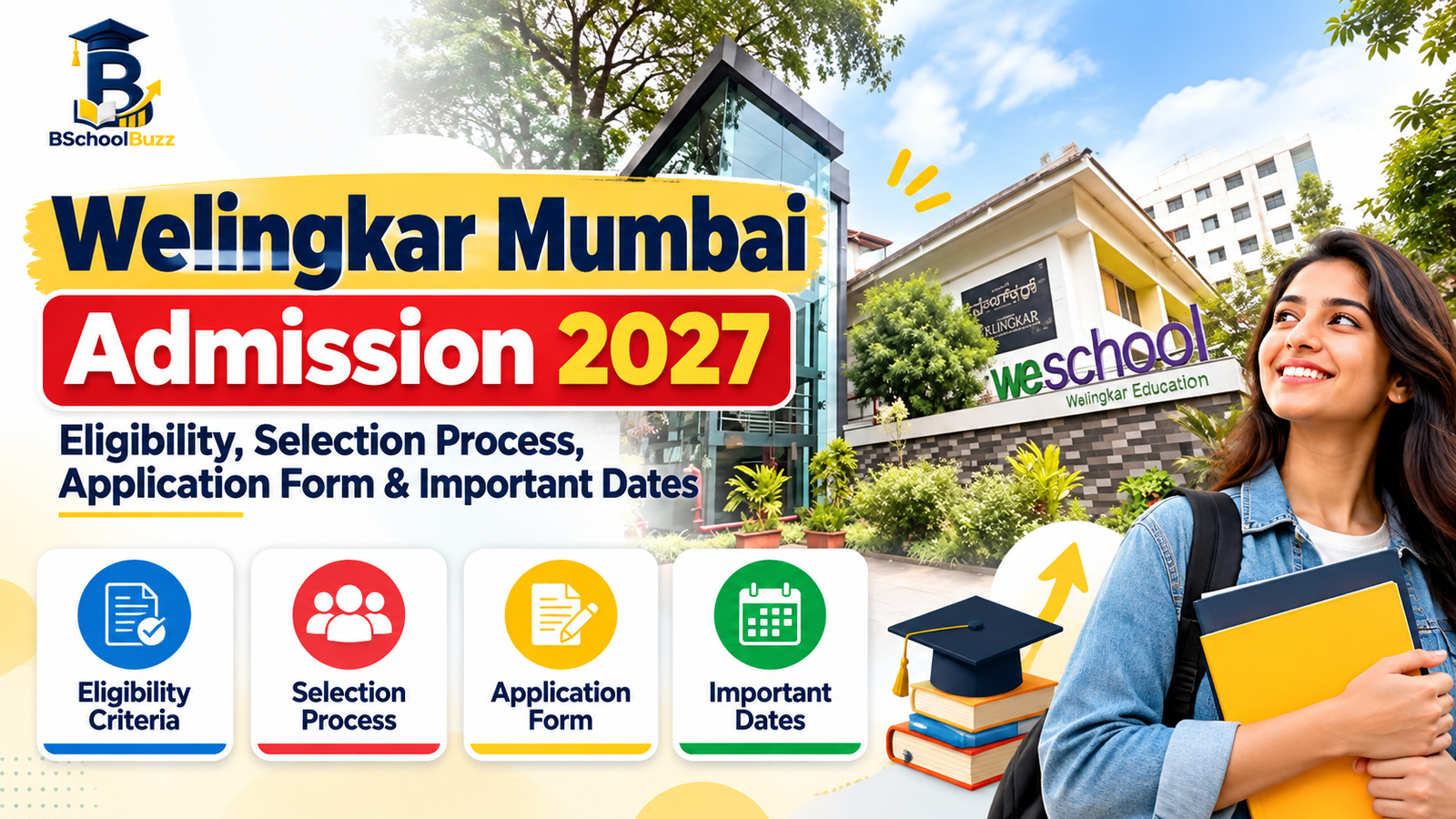
Welingkar Mumbai Admission 2027: Eligibility, Selection Process, Application Form & Important Dates
Introduction
Welingkar Institute of Management Development and Research, Mumbai, popularly known as WeSchool, is a management institute offering postgraduate programmes for students interested in business management, marketing, finance, human resources, operations, analytics, entrepreneurship and other management-related fields. For applicants planning to join in 2027, understanding the admission process early can help them prepare their entrance-test scores, academic documents, application details and interview responses.
The first important distinction is between the institute's 2027 admission cycle and the latest fully documented cycle currently available on its official website. The published information for the 2026–28 batch provides a useful reference for eligibility, accepted entrance examinations and programme structure. However, its application dates, exam years, cutoffs and fee figures should not automatically be treated as confirmed details for the 2027–29 batch.
The official institute website is the primary place to check new announcements: Welingkar Institute of Management. The current PGDM admission information can be reviewed through the official Mumbai PGDM page and the 2026–28 PGDM brochure.
This article explains the eligibility criteria, entrance examinations, previous published cutoffs, selection process, online application steps, programmes, fees, scholarships, placements and practical preparation strategy for Welingkar Mumbai admission 2027. Whenever the 2027–29 details have not been confirmed in the available official information, the distinction is stated rather than presenting an older figure as a new announcement.
Table of Contents
Welingkar Mumbai Admission 2027: Overview
What Is Welingkar Institute of Management?
Programmes Offered at the Mumbai Campus
Welingkar Mumbai Admission 2027: Eligibility Criteria
Entrance Exams Accepted
Expected Cutoffs: What the Previous Cycle Shows
Welingkar Mumbai Selection Process
How to Apply for Welingkar Mumbai Admission 2027
Important Dates and Admission Timeline
Welingkar Mumbai Fees and Other Expenses
Scholarships and Tuition Fee Waivers
Placements and Career Opportunities
Documents Required for Admission
How to Prepare for the Selection Process
Common Mistakes Applicants Should Avoid
Is Welingkar Mumbai the Right Choice for You?
Frequently Asked Questions
Conclusion
About BSchoolBuzz
1. Welingkar Mumbai Admission 2027: Overview
Welingkar Mumbai admission is relevant to graduates who want to pursue a management qualification after completing their bachelor's degree. The institute's Mumbai campus offers multiple two-year full-time postgraduate diploma programmes, each designed around a particular management or industry focus.
The admission process for its PGDM programmes is institute-specific. Candidates should not assume that admission to every programme follows the same process as Maharashtra's centralised MBA/MMS admission system. The institute's PGDM programmes and its Master of Management Studies (MMS) programme have separate admission arrangements.
The table below summarises the key points applicants should understand before starting their preparation.
| Particular | Details |
|---|---|
| Institute | Prin. L. N. Welingkar Institute of Management Development and Research |
| Common name | Welingkar / WeSchool |
| Campus covered | Mumbai, Maharashtra |
| Main programme category | Full-time PGDM programmes |
| PGDM duration | Two years, according to the institute's programme information |
| Basic graduation requirement in the previous cycle | Minimum 50% in a bachelor's degree |
| Entrance exams listed for the 2026–28 cycle | CAT 2025, XAT 2026, CMAT 2026, ATMA February 2026 and GMAT from 2023 onwards |
| Previous-cycle selection stages | Entrance-test performance, academic record, work experience/profile, group activity and personal interview |
| 2027–29 application dates | Check the official announcement; not confirmed by the cited 2026–28 schedule |
| Official website | welingkar.org |
The entrance examinations and graduation completion date in the table relate to the 2026–28 batch, not automatically to the 2027–29 batch. Applicants should use them as a preparation reference and verify the new cycle's instructions before submitting an application.
Why should applicants begin early?
Early preparation gives candidates time to select an appropriate entrance examination, improve their scores, organise academic documents and prepare for interview-based assessment. It also allows them to compare programmes before selecting preferences.
An applicant interested in general management may have different priorities from someone who wants to work in healthcare management, retail, media, business design or research and business analytics. Programme choice should therefore be based on career direction rather than the institute name alone.
2. What Is Welingkar Institute of Management?
Prin. L. N. Welingkar Institute of Management Development and Research operates under the WeSchool identity. Its official website describes a portfolio of management programmes at Mumbai and Bengaluru. This article focuses on the Mumbai campus, so Bengaluru-specific cutoffs, programme offerings and campus arrangements should not be mixed with the Mumbai details.
Welingkar's flagship PGDM is a general management programme. Its official programme page describes a multidisciplinary approach and lists functional areas such as marketing, finance, human resources and operations. Other programmes focus on specialised areas, allowing students to align their studies with a particular sector or type of work.
The institute also offers an MMS programme. Unlike the institute's PGDM admission route, the official MMS page states that admission is governed through the Directorate of Technical Education, Maharashtra and the applicable state admission process. Applicants must identify the exact programme before following an application procedure.
Official references:
PGDM and MMS are not interchangeable
Although both qualifications are related to management education, the programmes have different admission routes and award structures. PGDM applicants should follow the institute's PGDM application portal and selection instructions. MMS applicants should check the applicable Maharashtra admission authority's rules and schedule.
This distinction matters because entrance-test requirements, seat allocation, category rules, fee approval and deadlines may differ. A candidate should not rely on a PGDM cutoff to determine MMS admission chances, or vice versa.
3. Programmes Offered at the Mumbai Campus
Welingkar Mumbai offers a range of management programmes. Applicants should examine the curriculum, programme objectives, industry focus and admission criteria for the particular programme they intend to pursue.
The institute's official Mumbai programme pages include the following options:
| Programme | Main academic or career focus |
|---|---|
| PGDM | General management with functional areas such as marketing, finance, human resources and operations |
| PGDM E-Business | Business management combined with digital business and technology-related concepts |
| PGDM Research and Business Analytics | Business research, analytics and evidence-based decision-making |
| PGDM Business Design | Business design, innovation and design-oriented management thinking |
| PGDM Retail Management | Retail businesses, consumer markets and retail operations |
| PGDM Media and Entertainment | Management in media, entertainment and related industries |
| PGDM Healthcare Management | Management applications in healthcare and health-related organisations |
| PGDM Rural Management | Rural markets, rural enterprises and related development-oriented business contexts |
| MMS | A separate management degree with admission through the applicable Maharashtra process |
Programme names, availability and eligibility should be checked on the official website for the intended intake. A programme appearing on a website does not itself establish that applications for the 2027–29 batch are open.
Which Welingkar programme should you choose?
The right programme depends on your academic interests, strengths and career goals.
PGDM: Consider the general PGDM if you want broad management training and expect to explore areas such as marketing, finance, HR or operations during your course.
PGDM E-Business: This may be worth exploring if you are interested in the relationship between technology and business, including digital business models, e-commerce and technology-enabled operations.
PGDM Research and Business Analytics: Examine this option if you enjoy working with data, research questions, analytical methods and business decision-making.
PGDM Business Design: This is relevant to applicants interested in innovation, designing business solutions and understanding customer needs alongside management fundamentals.
PGDM Retail Management: Explore this programme if retail, consumer-facing businesses, merchandising, store operations or retail strategy align with your career plans.
PGDM Media and Entertainment: This option may suit candidates who want to study management in media, entertainment and related sectors.
PGDM Healthcare Management: This is relevant to candidates interested in healthcare organisations and management functions within the sector.
PGDM Rural Management: Applicants interested in rural markets, rural enterprises and rural development-related business challenges may wish to examine this programme.
Do not select a specialised programme simply because you believe its cutoff will be lower. Review the curriculum, placement information, work opportunities and fee structure before deciding. A programme's specialisation can shape the internships and early career roles you pursue.
4. Welingkar Mumbai Admission 2027: Eligibility Criteria
Eligibility is one of the first requirements to verify. Candidates should distinguish between the minimum academic requirement, entrance-exam requirements and the additional criteria used during selection.
For the 2026–28 PGDM cycle, the official programme information specified a minimum of 50% in the bachelor's degree, with the degree to be completed by June 2026. That completion date applies to the previous intake and must not be reused as the 2027–29 deadline without a fresh official notification.
Academic qualification
The published requirement for the previous cycle was a minimum of 50% in graduation from a recognised university. Candidates should check the 2027–29 admission notice for the applicable wording, degree completion deadline and any additional conditions.
Students who are still completing their final year should pay particular attention to the deadline for completing their degree and producing final academic documents. A candidate may be permitted to apply while awaiting results only if the current admission rules allow it. Permission to submit an application does not remove the requirement to meet the final eligibility criteria.
Eligibility checklist
| Requirement | What applicants should check |
|---|---|
| Bachelor's degree | Whether the degree and awarding institution meet the current eligibility rules |
| Minimum marks | The official minimum aggregate for the intended programme |
| Final-year status | Whether final-year students may apply and the deadline for completing the degree |
| Entrance exam | Whether the test and test year are accepted for the 2027–29 intake |
| Score validity | Whether the score falls within the permitted examination period |
| Supporting documents | Mark sheets, degree certificate or provisional documents as applicable |
| Programme-specific conditions | Any additional requirements mentioned for the chosen programme |
Does work experience matter?
The institute's selection information considers a candidate's profile, and the previous-cycle application material discusses work experience as part of the broader evaluation. Work experience should not be treated as a universal mandatory requirement unless the official rules for the chosen programme explicitly state so.
Fresh graduates should not assume that they cannot apply merely because they have no full-time work experience. Applicants with experience should prepare to explain their responsibilities, achievements, skills and reasons for pursuing management education.
Can final-year students apply?
The applicable rule must be confirmed from the current admission notice. The previous-cycle official eligibility information required the degree to be completed by June 2026. That date is not a valid completion deadline for the 2027–29 batch unless the institute confirms it again.
If you are in your final year, monitor the official application page and keep your semester mark sheets, identity documents and other available records ready. Before paying the application fee, verify how the institute treats pending results and what proof must be submitted before joining.
5. Entrance Exams Accepted for Welingkar Mumbai
The entrance examinations listed for Welingkar Mumbai's 2026–28 PGDM intake were CAT 2025, XAT 2026, CMAT 2026, ATMA February 2026 and GMAT scores from 2023 onwards. These test years are specific to that admission cycle.
For the 2027–29 batch, candidates should wait for or verify the official announcement identifying the accepted tests and eligible test years. Do not assume that a test accepted in the previous cycle will automatically be accepted in the next one.
Previous-cycle examination list
| Entrance exam | Previous-cycle reference |
|---|---|
| CAT | CAT 2025 |
| XAT | XAT 2026 |
| CMAT | CMAT 2026 |
| ATMA | February 2026 ATMA |
| GMAT | GMAT from 2023 onwards, as stated in the previous-cycle information |
Official reference: Welingkar's 2026–28 PGDM brochure.
Which exam should you take?
Choose an examination based on your preparation level, eligibility, test schedule and the programmes to which you want to apply. Before registering, check the current admission criteria and confirm that the institute accepts the examination for your chosen programme and intake.
A sensible exam-planning approach is to:
Review the syllabus and format of each relevant examination.
Compare your mock-test performance.
Confirm the dates and score-reporting timeline.
Check whether the target institute accepts the test for the required batch.
Prepare a backup plan if one examination does not produce the score you need.
Candidates should also distinguish between the entrance examination's overall score or percentile and the institute's shortlisting threshold. Meeting a published threshold may allow a candidate to be considered for the next stage; it does not guarantee final admission.
6. Expected Cutoffs: What the Previous Cycle Shows
The official Welingkar Mumbai programme page published shortlisting criteria for the 2026–28 batch. These figures are useful as historical reference points for preparation, but they are not confirmed cutoffs for Welingkar Mumbai admission 2027.
The institute's published table distinguishes between CAT/XAT/GMAT percentiles and the ATMA/CMAT criteria. Applicants should read the exact column headings carefully rather than treating every figure as a percentile for every examination.
Published shortlisting criteria for the 2026–28 cycle
| Mumbai programme group | CAT 2025 / XAT 2026 / GMAT reference | ATMA February 2026 / CMAT 2026 reference |
|---|---|---|
| PGDM, PGDM E-Business, PGDM Research and Business Analytics | 80 percentile | 85 |
| PGDM Retail, PGDM Media and Entertainment, PGDM Business Design | 75 percentile | 80 |
| PGDM Healthcare Management | 70 percentile across the listed entrance tests | 70 percentile across the listed entrance tests, as applicable to the stated criteria |
| PGDM Rural Management | 70 percentile across the listed entrance tests | 70 percentile across the listed entrance tests, as applicable to the stated criteria |
Source: Official entrance-test cutoff document for the 2026–28 batch.
Important: The official page indicates that the CMAT cutoff would be announced after the result was declared. The table above should therefore be read as the institute's published shortlisting criteria, not as a guarantee that every number was the final applicable threshold for every test at every point in the cycle.
How should you interpret these figures?
A candidate targeting the general PGDM, E-Business or Research and Business Analytics programmes can use the previous cycle's criteria to understand the level of performance that was used for shortlisting. The same approach applies to the specialised programmes, but their previous-cycle thresholds were different.
However, a previous cutoff is not a prediction of the next cutoff. Shortlisting criteria may change with the intake, programme, entrance-test performance and the institute's admission policy. A candidate should avoid relying on a single number when deciding whether to apply.
Does meeting the cutoff guarantee admission?
No. A shortlisting threshold and final admission are different stages. The institute's stated selection approach considers academic performance, entrance-test scores, work experience/profile and interview-related assessment. A candidate who meets a minimum threshold may still need to perform well in the remaining stages.
For the 2027–29 cycle, use the latest official cutoff notice once it is released. Avoid relying on unverified claims that a particular percentile guarantees a seat.
7. Welingkar Mumbai Selection Process
Welingkar describes its PGDM selection approach as profile-based. The published information indicates that selection considers more than entrance-test scores, with academic performance, work experience/profile, group activity and personal interview forming part of the assessment.
The precise 2027–29 stages, format and weightage must be confirmed from the new admission notice. The following explanation describes the general approach indicated by the institute's previous-cycle information.
Stage 1: Entrance-test performance
Candidates must meet the applicable eligibility and entrance-test requirements. The accepted test, score year and shortlisting threshold should be confirmed for the selected programme.
A strong score can help a candidate qualify for consideration, but applicants should not neglect the other parts of their profile.
Stage 2: Academic record
Academic performance is part of the institute's profile-based assessment. Candidates should keep their Class 10, Class 12 and undergraduate records accurate and readily available. Where the application asks for marks, percentages or CGPA, enter the information according to the institute's instructions.
If your university uses a CGPA system, do not invent a conversion formula. Use the official university conversion method where required and follow the application instructions.
Stage 3: Profile and work experience
The institute's selection approach considers profile-related information. Relevant work experience, achievements and other activities may help the panel understand the applicant's background, but candidates should not exaggerate responsibilities or present participation as leadership without evidence.
Freshers can prepare by identifying academic projects, internships, competitions, volunteering and other experiences that demonstrate initiative, teamwork or problem-solving.
Stage 4: Group activity or group-based assessment
Group activity is mentioned in the institute's previous-cycle selection information. Candidates should confirm the current format and whether the activity will be conducted online or offline for their admission cycle.
For preparation, practise expressing a clear point, listening to other participants, building on relevant ideas and disagreeing respectfully. Speaking continuously is not the same as contributing effectively.
Stage 5: Personal interview
The personal interview gives the institute an opportunity to understand the candidate's academic background, motivations, communication, interests and suitability for management education.
Prepare to answer questions such as:
Why do you want to study management?
Why are you applying to Welingkar Mumbai?
Why have you selected this particular programme?
What did you learn from your undergraduate course?
What are your short-term and long-term career goals?
What is one achievement you are proud of?
How have you handled a difficult team situation?
What are your strengths and areas for improvement?
Use examples from your own experience. A clear, honest answer is more useful than memorising a polished response that does not reflect your background.
Stage 6: Merit list and offer
The institute publishes admission-related notices and merit information through its official channels. Applicants should check their email and the official portal regularly after completing the application and selection stages.
If offered a seat, read the offer letter carefully. Confirm the programme, payment deadline, fee components, document requirements and joining instructions before paying. Keep the payment acknowledgement and copies of all submitted documents.
8. How to Apply for Welingkar Mumbai Admission 2027
The application procedure for the 2027–29 intake should be followed only after the institute publishes the relevant form and instructions. The 2026–28 application timeline is historical and should not be used as the next cycle's deadline.
The following steps provide a practical checklist based on the previous cycle's online application process.
Step 1: Visit the official website
Open the Welingkar official website and navigate to the Mumbai full-time PGDM programme or the admission announcement for the intended intake. Check that the page refers to the correct batch and campus.
Do not begin with a third-party application link unless it is linked from the official institute website.
Step 2: Read the current admission notification
Before creating an account, verify:
The programme name and campus
Academic eligibility
Accepted entrance exams and eligible test years
Application opening date and deadline
Application fee and payment terms
Required documents
Selection stages
Any additional instructions for final-year students
This step helps avoid submitting an application under the wrong programme or relying on outdated test information.
Step 3: Register on the application portal
The previous-cycle portal instructed applicants to create an account and verify the contact details through an OTP. The exact 2027 portal workflow should be followed as displayed when the new application opens.
Use an email address and phone number that you can access throughout the admission period. Save the login details securely and monitor the registered contact channels for updates.
Step 4: Complete the application form
Enter your personal details, academic history, entrance-exam information and other requested profile information. Make sure the names and dates match your official documents.
If the form asks for a programme preference, select it carefully. Check whether the institute permits changes after submission and whether separate applications or fees are required for different programme choices.
Step 5: Upload the requested documents
Upload clear, legible files in the formats and size limits stated by the portal. Do not upload a cropped or unreadable mark sheet merely to meet a deadline. If a document is pending, follow the institute's instructions for applicants awaiting results.
Step 6: Pay the application fee
The application fee and payment method for the 2027–29 batch must be verified from the current portal. Do not assume the previous-cycle fee remains unchanged.
Use the official payment gateway and retain the transaction reference, receipt and application number. If a payment is debited but the application status does not update, follow the portal's official support instructions rather than making repeated payments without checking.
Step 7: Review and submit
Before submitting, review your academic scores, exam details, contact information and programme preference. Correct any error while the form allows it. Save a copy of the completed application and payment confirmation.
Step 8: Monitor selection updates
Check the official portal and registered email for shortlisting information, assessment dates and any additional requirements. If called for a group activity or interview, follow the instructions for the specified venue or online format.
Step 9: Respond to an admission offer
If selected, confirm the offer deadline and payment instructions. Review the financial commitment and refund conditions before paying. If you need an education loan, begin the process early and confirm the institute's accepted payment schedule with the admissions office.
9. Important Dates for Welingkar Mumbai Admission 2027
As of 11 October 2026, the cited official sources provide a completed schedule for the 2026–28 intake, but do not establish a confirmed full set of 2027–29 dates. Candidates should check the institute's official website for the next admission announcement rather than treating last year's dates as current.
Previous-cycle dates: 2026–28
| Admission event | Published 2026–28 date |
|---|---|
| Phase I application opening | 18 October 2025 |
| Phase I application deadline | 23 January 2026 |
| Phase I GD/PI shortlist announcement | 27 January 2026 |
| Phase I merit list and first waitlist | 27 March 2026 |
| Phase II application opening | 19 February 2026 |
| Phase II application deadline | 20 March 2026 |
| Phase II GD/PI shortlist announcement | 26 March 2026 |
| Phase II last date for descriptive essay | 1 April 2026 |
| Phase II merit list and first waitlist | 30 April 2026 |
The official portal also listed selection dates at different locations for the 2026–28 intake. Those dates were part of the previous cycle and should not be used to plan attendance for 2027–29.
Source: Welingkar PGDM 2026–28 admission portal.
How to keep track of the 2027–29 schedule
Use the official website as the main reference and check it periodically for the new application link. Once the institute publishes dates, record the opening date, deadline, test-score update deadline, selection dates, merit-list dates and fee-payment deadline separately.
It is also sensible to leave a buffer before the application deadline. Waiting until the last day can create avoidable problems if a payment fails, a document is unreadable or an application detail needs correction.
10. Welingkar Mumbai Fees and Other Expenses
Fee planning should use the latest official figure for the exact programme and intake. The official Mumbai PGDM page currently displays tuition fees and other charges of ₹7,50,000 per annum, subject to change, along with a refundable library deposit of ₹4,000. It lists hostel fees from ₹1,60,000 to ₹2,20,000 per annum and a refundable hostel deposit of ₹10,000.
These are the figures displayed on the official programme page available for reference; they should not be represented as a confirmed fee offer for the 2027–29 batch until the institute publishes or confirms the applicable schedule.
Published fee information to use as a reference
| Fee component | Amount displayed on the official Mumbai PGDM page | Notes |
|---|---|---|
| Tuition fees and other charges | ₹7,50,000 per annum | Subject to change |
| Library deposit | ₹4,000 | Refundable, according to the page |
| Hostel fees | ₹1,60,000–₹2,20,000 per annum | Hostel availability applies at Mumbai |
| Hostel deposit | ₹10,000 | Refundable, according to the page |
| 2027–29 confirmed total | Not established by the cited source | Check the current batch fee notice |
Official reference: Welingkar Mumbai PGDM fees and admission information.
How much should a candidate budget?
Do not calculate a final 2027–29 cost simply by multiplying an older annual fee by two and assuming nothing else will change. First confirm whether the displayed amount applies to the intended programme and intake, and whether it includes all academic charges or whether additional charges are listed separately.
A realistic budget should account for:
Programme tuition and other academic charges
Refundable deposits
Hostel accommodation, if required
Food and personal living expenses
Travel to and from campus
Books, stationery, a laptop or other study materials, if needed
Any additional charges specified in the official fee schedule
Hostel charges should be considered separately from academic fees unless the institute explicitly states that accommodation is included. The official page says Mumbai hostel accommodation is subject to availability, so applicants should not assume that a room is guaranteed with admission.
Refundable deposits versus course fees
A refundable deposit is different from tuition. It is paid at the beginning of the programme and may be returned according to the institute's applicable conditions. Candidates should check the deposit rules, deductions and refund timeline in the relevant documents.
Do not treat a refundable deposit as an automatic reduction in the amount due at admission. You may still need to pay it upfront and wait until the applicable refund process is completed.
What about fee payment deadlines and refunds?
The 2027–29 payment schedule and refund rules should be checked in the official offer letter, fee document and current admission instructions. Before paying, retain a copy of the applicable terms.
If you are comparing Welingkar with another institute, compare the total compulsory cost for the same duration and programme type. Comparing one institute's tuition alone with another institute's tuition-plus-hostel figure can give a misleading result.
11. Scholarships and Tuition Fee Waivers
Candidates who need financial assistance should review the official scholarship and fee-waiver conditions rather than assuming that every applicant receives a discount.
Welingkar's published programme information describes a Tuition Fee Waiver (TFW) scheme with seats of up to 5% of the sanctioned intake per course. The displayed conditions for the previous cycle included a parental annual income limit of ₹8 lakh, supported by an income certificate issued by the Tehsildar office and valid until March 2026. The waiver was limited to tuition fees, with other fees remaining payable by the beneficiary.
These dates and conditions relate to the published scheme for the previous cycle. They should not be assumed to apply unchanged to 2027–29.
What applicants should verify
| Item | What to confirm |
|---|---|
| Availability | Whether the scheme is offered for the selected programme and 2027–29 intake |
| Income eligibility | The current income ceiling and accepted proof |
| Certificate requirements | Issuing authority, format and validity period |
| Coverage | Whether the waiver covers tuition only or other components |
| Number of seats | The current sanctioned intake and applicable scheme limit |
| Application procedure | Whether a separate form or additional documents are required |
| Continuation rules | Whether academic or other conditions apply after admission |
Applicants should ask the institute for the latest official scholarship or TFW documentation. Do not assume that a waiver covers hostel, deposits, food or other charges when the published scheme states that the waiver is limited to tuition.
12. Placements and Career Opportunities
Placement figures are an important part of the decision, but they must be interpreted in the context of the exact programme and graduating batch. A single placement figure should not be applied indiscriminately to every programme at Welingkar Mumbai.
The institute's 2026–28 PGDM brochure reports the following placement figures for the 2023–25 batch:
| Placement measure | Published figure for the 2023–25 batch |
|---|---|
| Maximum salary | ₹40.00 lakh per annum |
| Average salary | ₹11.70 lakh per annum |
| Median salary | ₹11.78 lakh per annum |
Source: Official PGDM brochure, 2026–28.
These are historical figures for the batch identified in the brochure, not a guarantee of what students joining in 2027 will earn. The highest salary is the maximum reported figure and does not describe the typical outcome for every student. The average and median provide additional context, but applicants should also check the latest programme-specific report and its methodology.
Why is the median useful?
The average can be affected by a small number of unusually high salaries. The median identifies the midpoint of the reported salary distribution and can help applicants understand the central outcome more clearly. Neither measure alone guarantees an individual's salary.
Before deciding, examine the latest available placement report and check whether it provides programme-wise statistics, batch size, the number of students seeking placements, the number placed, roles, recruiter information and domestic or international distinctions where applicable.
Match placement outcomes to your programme
A student interested in analytics should examine roles and recruiters relevant to analytics and research. Someone interested in retail or media should review opportunities related to those sectors rather than relying only on the general PGDM's headline figure.
For a more informed comparison, consider:
Programme-specific average and median salary
The number of students in the relevant graduating batch
Roles and functional areas offered
Internship opportunities
Recruiter mix and industry coverage
The student's own prior skills and work experience
Total programme cost and likely financing burden
Placement statistics and return on investment
Return on investment is not simply the highest salary divided by the fee. The maximum salary may belong to one individual and is not a reliable basis for estimating the outcome of a typical student.
A more practical assessment compares the total cost of attendance with programme-specific placement outcomes and the career path you intend to pursue. Also account for loan interest, living expenses and the fact that salary packages are not the same as take-home pay.
13. Documents Required for Admission
The exact document list for the 2027–29 intake should be confirmed through the official application portal and admission offer. The following checklist covers common documents applicants should prepare in advance; it is not a substitute for the institute's final list.
| Document | Why it may be required |
|---|---|
| Government-issued photo identification | Identity verification |
| Recent photograph | Application or admission record |
| Class 10 mark sheet or certificate | Academic history and date-of-birth details where applicable |
| Class 12 mark sheet or certificate | Academic history |
| Undergraduate semester/year mark sheets | Verification of graduation performance |
| Degree certificate or provisional certificate | Confirmation of completed qualification, where applicable |
| Entrance-exam scorecard | Verification of the accepted test result |
| Work-experience documents | Verification if experience is declared or requested |
| Resume or profile details | Supporting information if requested |
| Income certificate | If applying under an applicable income-based scheme |
| Additional declarations or forms | As specified by the current admission instructions |
Before uploading documents
Check that every file is legible and that the name, marks and dates match the information entered in the form. If your name has changed or differs between documents, follow the official instructions for supporting proof.
Final-year students should keep their latest available mark sheets ready and verify the deadline for submitting final results. If an income-based fee waiver is relevant, check the issuing authority and certificate validity requirements before applying.
Do not upload sensitive documents through unofficial links or send them to unknown individuals claiming to represent the institute. Use the official portal or verified contact details.
14. How to Prepare for the Selection Process
A good preparation plan addresses both the entrance test and the profile-based assessment. Candidates should avoid spending all their time on exam preparation and leaving interview preparation until after receiving a shortlist.
Build an entrance-test plan
Start by identifying which tests the institute accepts for the 2027–29 batch. Once the accepted tests and dates are confirmed, create a study plan based on your current level and target score.
Use mock tests to identify weaknesses and review mistakes instead of repeatedly taking tests without analysis. Track accuracy, time management and consistency across sections. Your choice of exam should reflect both the official requirements and your strengths.
Prepare your academic story
Interviewers may ask why you chose your undergraduate degree, what you learned from it and why you now want management education. Prepare a concise explanation that connects your past experience with your future goals.
If you are changing fields, explain the reason clearly. A change in direction is not inherently a problem, but you should be able to show that you understand the programme and have thought seriously about the transition.
Research the programme
Read the official programme page and curriculum for the programme you selected. Be ready to explain why it fits your interests. A generic response such as wanting a good job is unlikely to demonstrate that you have researched the course.
Consider the subjects you want to study, the kinds of roles you want to explore and the skills you need to develop. If you are comparing two Welingkar programmes, explain why your preferred option is a better fit for your goals.
Practise group discussions or activities
For group-based assessment, practise discussing a current business or social topic with others. Work on making a relevant point, supporting it with reasoning, listening carefully and responding constructively.
Avoid dominating the discussion or repeating points that others have already made. If you disagree, address the argument rather than criticising the person. A useful contribution can be concise when it adds something meaningful.
Prepare interview examples
Prepare real examples of teamwork, leadership, failure, conflict resolution, initiative and learning. Students without full-time work experience can draw on academic projects, internships, extracurricular activities and volunteering.
For every example, be ready to explain the situation, your contribution, the outcome and what you learned. Do not invent an achievement simply because you think it sounds impressive.
Keep current affairs in perspective
Follow major business, economic, technology and industry developments. Rather than memorising long lists of headlines, understand why a development matters and how it could affect companies, consumers or markets.
Practise explaining a topic in a clear sequence: what happened, why it matters and what consequences might follow. If you do not know an answer, acknowledge the gap instead of guessing confidently.
15. Common Mistakes Applicants Should Avoid
Even candidates who meet the minimum academic requirements can make avoidable mistakes during the application process.
Using old entrance-test information
The previous-cycle exam years were CAT 2025, XAT 2026, CMAT 2026, ATMA February 2026 and GMAT from 2023 onwards. These should not be copied into a 2027–29 application plan without checking the new official rules.
Confusing eligibility with selection
Meeting the minimum graduation percentage or a test threshold does not guarantee admission. Applicants must follow all the remaining stages and comply with the current instructions.
Applying for the wrong programme
The general PGDM and specialised programmes have different academic focuses. Review the curriculum and intended career outcomes before selecting a programme.
Assuming the old fee is final
The published fee page states that the annual amount is subject to change. Check the latest fee document for the exact intake, and distinguish tuition, deposits and accommodation charges.
Treating the highest salary as a typical outcome
The reported maximum salary of ₹40 lakh per annum belongs to the 2023–25 batch shown in the official brochure. It is not a promise of an equivalent salary for future students. Compare the median, average and programme-specific information as well.
Waiting until the last date
An incomplete form, payment issue or missing document can disrupt an application. Apply early enough to review your submission and resolve technical issues.
Relying on unofficial admission promises
Use the official website and verified institute contact details. Be cautious if someone promises guaranteed admission in exchange for money outside the published process. Do not share account passwords or OTPs with third parties.
16. Is Welingkar Mumbai the Right Choice for You?
Welingkar Mumbai may be worth considering if its programme options, curriculum and location align with your career plans. However, a good decision requires more than recognition of the institute name or one placement statistic.
Start by identifying your preferred field. If you want broad management education, compare the general PGDM with specialised programmes that interest you. If you have a defined career goal, examine whether the programme's subjects and industry focus support that goal.
Next, review eligibility and entrance requirements. A candidate should apply only after confirming that the chosen test and academic qualification satisfy the current admission rules. Previous-cycle cutoffs can help with preparation, but they should not be treated as promises for the next intake.
Then compare the total cost. Include academic fees, accommodation if needed, deposits, living expenses and the potential cost of borrowing. Ask for the official fee schedule before making a financial commitment.
Finally, assess career outcomes using the latest available official placement information for the relevant programme. Look at median and average salaries, role types, recruiter mix and the number of students represented in the report. Consider whether the programme can help you build the skills required for your intended career.
A practical decision checklist
Before submitting your application, ask yourself:
Have I confirmed the programme and campus?
Does my degree meet the current eligibility requirement?
Is my entrance examination accepted for the 2027–29 intake?
Have I checked the latest application dates?
Do I understand the selection stages?
Have I reviewed the current fee and refund terms?
Have I considered accommodation and living expenses?
Have I checked programme-specific placement information?
Can I explain why this programme fits my goals?
If you can answer these questions using current official information, you will be in a better position to decide whether to apply.
Conclusion
Welingkar Mumbai admission 2027 requires applicants to track the new admission announcement, verify eligibility, choose an accepted entrance examination and prepare for the institute's profile-based selection process. The published 2026–28 information offers useful background on programme options, entrance-test shortlisting criteria, fees and placement results, but it must not be mistaken for a confirmed 2027–29 schedule.
The most practical approach is to begin preparation early, keep academic and entrance-test documents ready, research the specific programme and review the total financial commitment. Before paying an application fee or accepting an offer, confirm the latest requirements directly through Welingkar's official website and the relevant programme page.
Admission decisions should be based on current eligibility rules, programme fit, realistic cost planning and carefully interpreted placement information—not on an old cutoff, a headline salary or an unofficial promise.
About BSchoolBuzz
BSchoolBuzz helps management aspirants research business schools, understand admission requirements and organise important information before applying. For decisions involving eligibility, application deadlines, fees, scholarships and selection rules, readers should use the institute's latest official documents as the final reference.
Official Sources
Key Takeaways
Welingkar Mumbai admission 2027 applicants should monitor the official website for the new intake announcement.
Confirm the accepted entrance exams and test years before registering for an examination.
Check the eligibility requirements for the specific programme rather than assuming every programme has identical conditions.
Treat the 2026–28 cutoffs as historical information, not guaranteed 2027–29 thresholds.
Prepare for the full selection process, including academic-profile assessment and interview-related stages.
Verify programme fees, deposits, accommodation charges and refund conditions before paying.
Compare programme-specific placement outcomes instead of relying only on the highest salary.
Keep academic mark sheets, entrance-test scorecards and identity documents ready.
Apply through the official portal and retain the application confirmation and payment receipt.
Use the latest official admission notification as the final authority for deadlines and requirements.
Frequently Asked Questions
When will Welingkar Mumbai admission 2027 applications open?
The exact opening date for the 2027–29 intake should be confirmed through the official Welingkar website. The 2026–28 cycle opened its Phase I application process in October 2025, but that historical date does not establish the next cycle's schedule.
What is the eligibility criteria for Welingkar Mumbai PGDM admission?
For the 2026–28 intake, the official information specified a minimum of 50% in a bachelor's degree from a recognised university. Applicants must check the 2027–29 notification for the current academic requirements and degree completion deadline.
Which entrance exams were accepted by Welingkar Mumbai?
The previous cycle listed CAT 2025, XAT 2026, CMAT 2026, ATMA February 2026 and GMAT from 2023 onwards. Applicants should verify the accepted examinations and eligible test years for the 2027–29 batch.
What was the Welingkar Mumbai PGDM cutoff for the previous admission cycle?
For 2026–28, the published shortlisting criteria included 80 percentile in CAT/XAT/GMAT for PGDM, E-Business and Research and Business Analytics, and 75 percentile for Retail, Media and Entertainment, and Business Design. These figures are historical and should not be treated as confirmed 2027–29 cutoffs.
What is the selection process at Welingkar Mumbai?
The institute's published PGDM information describes a profile-based selection approach that considers entrance-test performance, academic record, work experience/profile, group activity and personal interview. The precise stages and assessment rules for the next intake should be checked in the current admission notice.
What is the Welingkar Mumbai PGDM fee?
The official Mumbai PGDM page displays tuition fees and other charges of ₹7.50 lakh per annum, subject to change. Candidates should verify the latest programme-specific fee schedule for the 2027–29 batch before calculating their total cost.
Does Welingkar Mumbai provide hostel accommodation?
The official PGDM page lists hostel fees of ₹1.60 lakh to ₹2.20 lakh per annum and a refundable deposit of ₹10,000. It also states that hostel accommodation at the Mumbai campus is subject to availability, so applicants should confirm availability and the applicable charges.
What are the placements at Welingkar Mumbai?
The official 2026–28 brochure reports a maximum salary of ₹40 lakh per annum, an average of ₹11.70 lakh and a median of ₹11.78 lakh for the 2023–25 batch. These are historical figures and should not be interpreted as guaranteed outcomes for future students.
Can final-year students apply to Welingkar Mumbai?
Final-year applicants should check the current intake's eligibility rules and deadline for completing their degree. The previous cycle specified a degree completion deadline of June 2026, which should not be assumed to apply to the 2027–29 intake.
Where can I apply for Welingkar Mumbai admission 2027?
Start at the official website, https://www.welingkar.org/, and follow the admission link for the relevant Mumbai programme and intake. Check the programme, eligibility, accepted exam, application fee and deadline before submitting the form.
Ask a question
Still confused? Leave your question and our team will help you.