
Quick Summary
- SOIL Institute of Management’s published PGDM fee for the 2027–29 batch is ₹17,20,000.
- The total tuition component is ₹9,85,000 across two years.
- Programme fees total ₹6,70,000.
- Student activity charges are ₹47,000, while the refundable security deposit is ₹30,000.
- The displayed payment instalments total ₹17,50,000, so applicants should obtain written clarification from the institute.
- Accommodation is additional, and students should request a current residential quotation.
- The institute requires PGDM students to bring a compatible laptop.
- The application fee listed on the official admissions page is ₹2,000.
- SOIL lists CAT, XAT, GMAT, MAT, CMAT, NMAT, SNAP and ATMA, subject to specific score-combination rules.
- For the PGDM Class of 2026, SOIL reports a highest CTC of ₹24.8 LPA and an average CTC of ₹11.83 LPA.
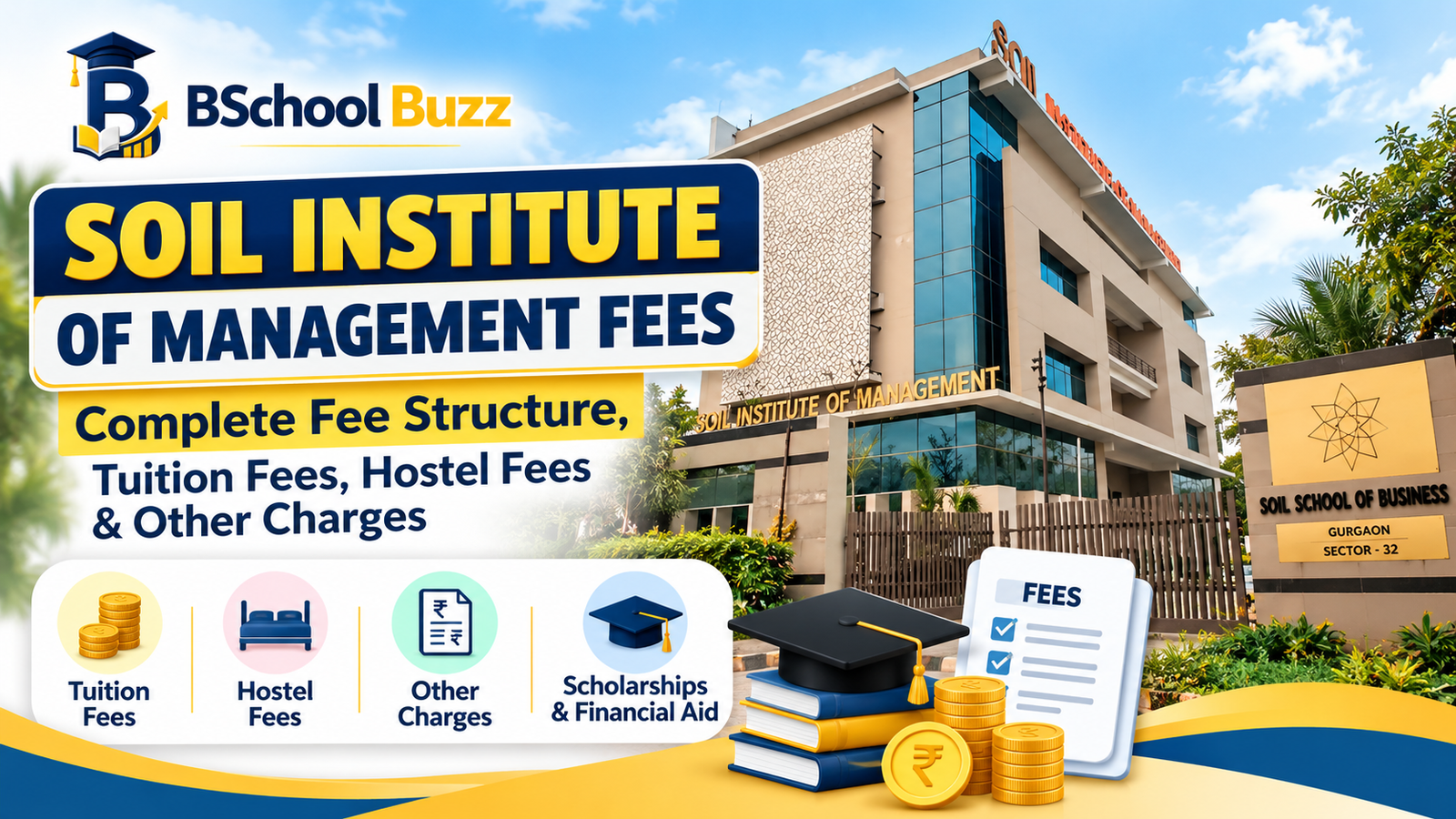
SOIL Institute of Management Fees: Complete Fee Structure, Tuition Fees, Hostel Fees & Other Charges
Introduction
Choosing a management institute requires more than looking at the headline programme fee. Students need to understand what tuition covers, which charges are collected separately, whether accommodation is included, and how much money they should arrange before joining. At SOIL Institute of Management, these details depend on the programme selected.
SOIL offers a two-year Post Graduate Diploma in Management (PGDM) at its Manesar campus near Gurgaon, along with one-year programmes including the Post Graduate Programme in Management (PGPM) and PGPM in Human Resources (PGPM-HR). These programmes have different fee structures and should not be compared as if they were the same course.
For the 2027–29 PGDM batch, SOIL’s official fee page lists a programme fee of ₹17,20,000, plus a refundable security deposit of ₹30,000, subject to the institute’s conditions. The published fee includes tuition, examination fees, on-campus extra and co-curricular activities, library resources, reading material and IT services. Accommodation is an additional consideration: SOIL helps students find residential options, and the PGDM admissions information describes a hostel arrangement for both academic years.
The official payment schedule also requires careful checking because its listed instalments add up to a different amount from the published programme-fee total. Applicants should get written confirmation of the final payable amount and due dates before transferring money.
This article explains the official PGDM fee structure, the distinction between tuition and programme charges, accommodation expenses, payment schedule, refunds, financial assistance, eligibility, admissions and placements. Where the institute does not publish a fixed amount for a cost, the article identifies it as a variable expense rather than inventing a figure.
Official sources: SOIL PGDM Fees and Financial Support, SOIL PGDM Admissions Process, and SOIL PGDM Programme.
Table of Contents
SOIL Institute of Management Fees at a Glance
SOIL PGDM Fee Structure for 2027–29
Tuition Fee and Programme Fee Explained
Year-Wise Fee Breakdown
SOIL Institute of Management Hostel Fees
Other Expenses Beyond the Programme Fee
Payment Schedule and Important Fee Checks
Refund and Cancellation Policy
Scholarships and Financial Support
Application Fee and Admission Requirements
SOIL PGDM Admission Process
Placement Statistics and Return on Investment
Difference Between PGDM, PGPM and PGPM-HR Fees
How to Prepare a Realistic SOIL Budget
Questions to Ask Before Paying
Frequently Asked Questions
Conclusion
About BSchoolBuzz
Related Search Keywords
1. SOIL Institute of Management Fees at a Glance
SOIL Institute of Management publishes separate fee information for its two-year PGDM and one-year programmes. For students looking for the two-year management programme, the 2027–29 PGDM fee page is the most relevant starting point.
The official fee page lists the following amounts for the PGDM batch of 2027–29. <Cite refs={["turn292640search0","turn292640search6"]}/>
| Fee component | Published amount | Details |
|---|---|---|
| Tuition fee | ₹9,85,000 | Total across the two academic years |
| Programme fees | ₹6,70,000 | Total across the two academic years |
| Student activity charges | ₹47,000 | Listed in the first year |
| Personal accidental benefit policy | ₹5,000 | Listed for two years |
| Knowledge resources | ₹3,000 | Listed in the first year |
| Alumni subscription | ₹10,000 | Listed in the second year |
| Total programme fee | ₹17,20,000 | Official published total |
| Security deposit | ₹30,000 | Refundable, subject to conditions |
| Accommodation | Separate | Cost depends on the residential option |
| Optional trips | Additional where applicable | Opt-in and actual-cost basis |
The ₹17.20 lakh programme fee is the institute’s published total for the 2027–29 PGDM batch. The refundable security deposit is shown separately, so a student should plan for a total of at least ₹17.50 lakh before accommodation and other personal costs, subject to confirmation of the final payment schedule.
The institute states that the main programme fee includes tuition, examination fees, extra and co-curricular activities on campus, library books and reading material, IT services and related programme provisions. Students should still review the official fee page for exclusions and additional expenses.
Why the programme matters
SOIL’s fee structure for PGDM should not be used to estimate the cost of its one-year PGPM or PGPM-HR. The programmes differ in duration, curriculum, target applicants and published fees. If you are applying to a one-year programme, use its dedicated fee page rather than the two-year PGDM table.
2. SOIL PGDM Fee Structure for 2027–29
The published programme fee for the 2027–29 PGDM batch is ₹17,20,000. It is divided into tuition and programme-related components rather than presented as tuition alone. <Cite refs={["turn292640search0"]}/>
Detailed fee structure
| Particulars | 2027–28 | 2028–29 | Total |
|---|---|---|---|
| Tuition fee | ₹5,35,000 | ₹4,50,000 | ₹9,85,000 |
| Programme fees | ₹3,90,000 | ₹2,80,000 | ₹6,70,000 |
| Student activity charges | ₹47,000 | ₹0 | ₹47,000 |
| Personal accidental benefit policy | ₹5,000 | ₹0 | ₹5,000 |
| Knowledge resources | ₹3,000 | ₹0 | ₹3,000 |
| Alumni subscription | ₹0 | ₹10,000 | ₹10,000 |
| Published annual total | ₹9,80,000 | ₹7,40,000 | ₹17,20,000 |
Source: Official SOIL PGDM fee structure.
The first-year total is listed as ₹9.80 lakh, while the second-year total is ₹7.40 lakh. The amounts are not evenly divided between the years because the institute allocates different components to each year.
What is included?
SOIL states that the programme fee includes tuition, examination fees, on-campus extra and co-curricular activities, library books and reading material, and IT services. This is important when comparing fee structures: a tuition figure from one institute may not cover the same services as a programme-fee figure from another.
However, inclusion in the programme fee should not be taken to mean that every possible student expense is covered. Accommodation, travel, a personal laptop and certain optional experiences can require additional spending.
Refundable security deposit
The official fee page lists a security deposit of ₹30,000, refundable after programme completion subject to clearance of outstanding dues and damage-related liabilities. <Cite refs={["turn292640search0"]}/>
This amount is different from the programme fee. It should be treated as money payable upfront but potentially refundable later, not as a guaranteed discount on tuition. Students should retain the receipt and review the conditions for receiving the deposit back.
3. Tuition Fee and Programme Fee Explained
The SOIL fee table separates tuition from programme fees. Understanding the distinction helps applicants compare the cost with other business schools.
Tuition fee
For the 2027–29 PGDM batch, tuition totals ₹9,85,000 across the two years. The official table allocates ₹5,35,000 to 2027–28 and ₹4,50,000 to 2028–29.
Tuition is the academic teaching component of the fee. It is a substantial part of the total but not the full programme cost.
Programme fees
The institute lists programme fees of ₹6,70,000 across the two years. This is separate from tuition and is included in the published ₹17.20 lakh total.
Because the official table does not itemise every service inside this component, students should not assume that the entire programme-fee amount represents a separate tuition payment. Use the institute’s own component labels when reviewing the invoice.
Student activity charges
The fee structure includes ₹47,000 in student activity charges for the first year. The institute’s programme fee notes that extra and co-curricular activities on campus are included in the overall fee arrangement.
Students should confirm the exact services covered by this charge and whether any activity outside the standard programme is optional and billed separately.
Knowledge resources
A ₹3,000 knowledge-resources charge appears in the first-year column. The official fee notes also refer to library books and reading material within the broader programme-fee coverage.
Do not add the knowledge-resources amount a second time if you are already using the official total of ₹17.20 lakh. It is a component of that total.
Alumni subscription
The fee table includes a ₹10,000 alumni subscription in the second year. This is already included in the official programme-fee total.
What does the breakdown tell applicants?
The most reliable comparison figure is the complete published programme fee, not the tuition amount alone. A college that advertises a lower tuition figure may have additional compulsory academic or programme charges. Compare the total cost, the services included, the refundable deposit and the cost of accommodation before making a decision.
4. Year-Wise Fee Breakdown
The official fee table divides the programme cost into two academic years. This helps students understand when larger expenses are likely to arise, although the actual payment dates should be checked against the offer letter.
| Academic year | Published total |
|---|---|
| 2027–28 | ₹9,80,000 |
| 2028–29 | ₹7,40,000 |
| Total programme fee | ₹17,20,000 |
| Refundable security deposit | ₹30,000, listed separately |
The first-year total is ₹2.40 lakh higher than the second-year total in the official table. This difference reflects the way SOIL allocates the listed components across the academic years.
Estimated amount before accommodation
If a student uses the published programme fee and adds the separate refundable deposit, the simple calculation is:
Programme fee: ₹17,20,000
Refundable security deposit: ₹30,000
Total before accommodation and other separate expenses: ₹17,50,000
This calculation uses the official published total and deposit. It does not include accommodation, meals or personal expenses, and it should not replace the actual invoice or payment instructions.
Important payment-schedule discrepancy
SOIL’s fee page also lists an instalment schedule: ₹2,10,000 at enrolment, followed by ₹4,00,000, ₹4,00,000, ₹3,70,000 and ₹3,70,000. Those listed instalments add up to ₹17,50,000, which is ₹30,000 more than the published ₹17,20,000 programme-fee total. <Cite refs={["turn292640search0"]}/>
The published page lists the ₹30,000 security deposit separately, but the payment schedule does not clearly label how that amount is reflected in its instalments. Applicants should not guess which figure is correct. Ask SOIL admissions for a written, itemised payment schedule that reconciles the programme fee, refundable deposit and each instalment.
This is particularly important before paying the enrolment amount or arranging an education loan.
5. SOIL Institute of Management Hostel Fees
Accommodation is a major consideration for students moving to Manesar or the wider Gurgaon area. SOIL’s PGDM admissions information describes accommodation support and a hostel arrangement for the two-year programme. The institute also says that it assists students in finding residential options close to campus at additional cost. <Cite refs={["turn292640search0","turn292640search5"]}/>
Is hostel accommodation included in the PGDM fee?
The official fee page lists accommodation separately from the ₹17.20 lakh programme fee. Students should therefore treat housing as an additional expense unless their offer or a specific written accommodation agreement states otherwise.
The PGDM admissions information describes the hostel contract as covering both academic years, with an overall duration of 20 months. It also states that the hostel facility is available during specified academic periods and is not available during the summer internship period. Confirm the dates and current arrangements for the batch you are joining. <Cite refs={["turn292640search5"]}/>
Is a fixed hostel fee published?
The official PGDM fee page does not provide a single fixed hostel price in its main programme-fee table. It directs students who need accommodation to contact the institute for residential options. Because accommodation prices can depend on the property, room arrangement, meals and services, it would be misleading to invent a universal hostel fee.
For the latest accommodation information, use the contact details provided by SOIL on its official pages. Ask for the total cost for the full contract period, not just a monthly rent figure.
What should students ask about accommodation?
Before making a housing decision, confirm:
The total rent for the full required period.
Whether the arrangement is on-campus or off-campus.
Whether the room is shared or private.
Whether meals are included.
Whether electricity, Wi-Fi, housekeeping and laundry are included.
Whether a security deposit is required.
Whether the accommodation contract covers the internship period.
The rules for early exit, cancellation and refunds.
Whether transportation to campus is included or charged separately.
Why the hostel budget can vary
Two students may pay different residential costs even when they study the same programme. Room type, location, sharing arrangements, meals and the length of the contract can all affect the total. The safest approach is to request a current written quotation from the accommodation provider or the institute.
Do not add an assumed hostel amount to the programme fee and label the result as SOIL’s official total. Keep the published academic fee and the actual housing quotation separate in your budget.
6. Other Expenses Beyond the Programme Fee
The official programme fee covers several academic and campus services, but students may still have costs outside the published total. These should be considered before calculating the amount needed for the complete two-year experience.
Laptop requirement
SOIL’s official PGDM admissions information says students are required to bring a compatible laptop for coursework. The institute provides minimum configuration guidance on the admissions portal. Students should check the current specification before purchasing a device, especially if they already own a laptop. <Cite refs={["turn292640search5"]}/>
The laptop purchase price is not listed as part of the ₹17.20 lakh programme fee. If you need a new device, budget for it separately.
Global Immersion Experience
SOIL describes a Global Immersion Experience intended to provide international exposure. Its fee page states that additional charges may apply depending on the destination and any value-added experiences. Students may also have to pay visa fees and medical insurance premiums, as applicable. The programme is subject to the institute’s decisions and prevailing travel conditions. <Cite refs={["turn292640search0"]}/>
Do not assume that every possible international trip is fully covered by the standard programme fee. Confirm whether the experience is part of your particular batch’s plan, which expenses are subsidised and what students must pay themselves.
Optional trips
The fee page states that optional trip charges are on an opt-in basis and billed on an actual-cost basis. The institute says students who choose to participate must pay the relevant charges in advance according to the published terms. <Cite refs={["turn292640search0"]}/>
These expenses are different from compulsory tuition or the standard programme fee. Ask for the itinerary, inclusions and payment deadline before opting in.
Travel and personal expenses
Students should also budget for transport, phone connectivity, toiletries, clothing, personal purchases and travel home. These costs vary by individual and are not fixed programme fees.
Students living outside the hostel may have additional costs for daily commuting. Students living in residential accommodation should check whether local transport and meals are included in the quoted rent.
A practical cost checklist
| Expense | Included in published PGDM fee? | What to verify |
|---|---|---|
| Tuition | Yes | Annual allocation and payment dates |
| Programme fees | Yes | Current fee schedule |
| Examination fees | Included according to the official fee note | Confirm the invoice breakdown |
| Library books and reading material | Included according to the official fee note | Any optional purchases |
| IT services | Included according to the official fee note | Laptop and software requirements |
| Laptop | Not stated as included | Purchase or upgrade cost |
| Accommodation | Separate | Full contract quotation |
| Meals | Depends on accommodation arrangement | Mess or food charges |
| Optional trips | Additional when opted in | Actual cost and payment date |
| International travel-related costs | Additional charges may apply | Visa, insurance and destination costs |
| Personal spending | Separate | Individual monthly budget |
This table distinguishes expenses covered by the official fee description from those that require separate planning.
7. Payment Schedule and Important Fee Checks
SOIL publishes an instalment schedule for the 2027–29 PGDM batch. The schedule shown on the official page is as follows. <Cite refs={["turn292640search0"]}/>
| Instalment | Published due date | Amount |
|---|---|---|
| Enrolment fee | At the time of admission | ₹2,10,000 |
| First instalment | On or before 16 May 2027 | ₹4,00,000 |
| Second instalment | On or before 5 September 2027 | ₹4,00,000 |
| Third instalment | On or before 6 February 2028 | ₹3,70,000 |
| Fourth instalment | On or before 7 August 2028 | ₹3,70,000 |
| Total of listed instalments | ₹17,50,000 |
Why you should confirm the schedule
The instalment amounts total ₹17.50 lakh, whereas the programme fee is published as ₹17.20 lakh and the refundable security deposit as ₹30,000 separately. The official page does not clearly reconcile these figures in the displayed schedule.
Before payment, ask the admissions team to confirm in writing:
The programme fee payable over the two years.
Whether the ₹30,000 security deposit is included in the enrolment amount or payable separately.
The exact amount of each instalment.
The due dates applicable to your offer.
Whether any amount is adjusted or refunded later.
The accepted payment methods and official account details.
Use the payment schedule issued with your admission offer if it supersedes the general website table. Keep all receipts and correspondence.
Avoid unofficial payment requests
Use the official payment channel described in the offer letter or the institute’s admissions portal. If a third party asks you to transfer money to a personal account or offers to change your payment deadline, verify the request directly with SOIL before proceeding.
8. Refund and Cancellation Policy
Refund terms matter because a student’s circumstances can change after accepting an offer. SOIL publishes a refund and cancellation policy for the two-year PGDM programme. The rules depend on when the withdrawal request is received and, in some cases, whether the vacated seat is filled by another candidate. <Cite refs={["turn292640search0"]}/>
Withdrawal before the start of the programme
The official fee page states that when a student withdraws before the start of the induction, orientation, foundation, academic session or course—whichever is earlier—the institute refunds the fee collected after deducting a processing fee of no more than ₹1,000, subject to the published policy.
Students should submit a formal withdrawal request through the prescribed channel and obtain written acknowledgement. Do not rely solely on a phone conversation.
Withdrawal after joining
The official policy describes a different situation for students who leave after joining the induction, orientation, foundation, academic session or course. If the vacated seat is filled by another student by the last date of admission, the policy provides for refund after the permitted processing fee and proportionate deductions for monthly fees and hostel rent, where applicable.
The exact amount depends on the circumstances and the official terms. Students should request a written calculation rather than assume that the full payment will be returned.
Refundable security deposit
The ₹30,000 security deposit is described as refundable after programme completion, subject to clearance of dues and damage-related liabilities. This deposit should not be confused with a programme-fee refund following withdrawal.
Documents to keep
Keep copies of:
The admission offer.
Fee invoices and payment receipts.
The applicable refund policy.
The withdrawal request and acknowledgement.
Emails confirming refund calculations.
Any hostel or accommodation agreement.
For a withdrawal, contact SOIL directly and follow the current policy for the applicable admission batch.
9. Scholarships and Financial Support
Management education can involve a significant upfront commitment, so students should investigate scholarships and education-loan options before accepting an offer.
SOIL’s official PGDM pages provide programme and admission information, and its admissions process page outlines how applicants are assessed. For current scholarships, financial assistance or loan tie-ups, applicants should consult the official admissions and financing pages and ask the institute for the rules applicable to their batch. <Cite refs={["turn292640search0","turn292640search8"]}/>
Do not assume a scholarship amount
A scholarship may depend on merit, financial need, category, academic results or a separate application. Unless the current official document specifies the award amount and eligibility conditions, it is better not to subtract an assumed scholarship from the programme fee.
Ask the institute:
Which scholarships are available for the 2027–29 PGDM batch?
Is the award based on academic merit, financial need or both?
What documents must be submitted?
Is the award a one-time payment or renewable?
Does it reduce the fee invoice directly?
What academic performance is required to retain it?
Can it be combined with an education loan or another award?
Education loans
SOIL’s official PGDM FAQ identifies education-loan options and mentions providers including Bank of Baroda, Axis Bank, Credila Financial, Yes Bank and IDFC First Bank. Availability and terms should be confirmed with the lender and the institute. <Cite refs={["turn292640search6"]}/>
When comparing loans, consider the interest rate, processing charges, repayment start date, moratorium, co-applicant requirements and whether the lender pays the institute directly. A loan approval does not remove the student’s responsibility to meet fee deadlines.
Plan using the full fee first
Create your budget using the published ₹17.20 lakh programme fee and the separate refundable deposit. Add the actual accommodation quotation and your expected living expenses. Only then apply any confirmed scholarship or loan support.
This prevents a funding gap if a scholarship is not awarded or a loan is sanctioned for a lower amount than expected.
10. Application Fee and Admission Requirements
SOIL’s official PGDM admissions process page lists an application fee of ₹2,000. Applicants should verify the amount and payment instructions on the live application portal before submitting their form. <Cite refs={["turn292640search8"]}/>
Entrance exams accepted
The official admissions page lists the following aptitude tests for the PGDM application:
CAT
XAT
GMAT
MAT
CMAT
NMAT
SNAP
ATMA
The page notes that NMAT and SNAP scores are considered only when accompanied by another AICTE-approved test score. Applicants should read the current rules carefully and confirm that their test combination is accepted. <Cite refs={["turn292640search8"]}/>
What the application asks for
The admissions page says applicants must submit academic-background details, information about extracurricular activities and achievements where applicable, valid aptitude-test scores, supporting documents and the application fee.
Keep the information consistent with your certificates and score reports. Incorrect dates, marks, work-experience details or test information can delay processing or affect eligibility review.
Check the programme and batch
SOIL has more than one management programme. Confirm that the application is for the two-year PGDM, not the one-year PGPM or PGPM-HR. The fee, duration, eligibility details and placement information can differ.
Official reference: SOIL PGDM Admissions Process.
11. SOIL PGDM Admission Process
The official admissions page describes a multi-stage process that considers the applicant’s profile and aptitude-test scores. It is not simply a matter of paying the fee or meeting one exam-score threshold. <Cite refs={["turn292640search8"]}/>
Step 1: Complete the application form
Enter your academic background, aptitude-test information, extracurricular achievements and other required details. Upload the supporting documents requested by the portal and pay the application fee.
Step 2: Profile shortlisting
SOIL says it uses a holistic profile review. Its listed considerations include leadership potential, academic excellence and extracurricular involvement. The institute’s current admissions page should be used to confirm the complete criteria and any batch-specific changes.
Step 3: Participate in the selection process
Shortlisted candidates should follow the interview or other selection instructions communicated by the institute. Prepare to explain your academic choices, professional interests, leadership experiences, career goals and reasons for choosing the PGDM.
Step 4: Review the offer
If selected, read the offer letter carefully. Check the acceptance deadline, enrolment payment, fee schedule, refund conditions and document requirements.
Step 5: Confirm the total amount payable
Because the general fee page’s displayed instalments do not reconcile with the stated programme-fee total, obtain a written itemised schedule for your offer before transferring funds.
Step 6: Complete enrolment requirements
Submit the documents required for enrolment and confirm the laptop specification, accommodation arrangements and joining instructions. Keep copies of all submitted records and payments.
12. Placement Statistics and Return on Investment
Fee comparisons are more useful when paired with placement information. However, placement results must be read for the correct programme and reporting batch.
SOIL’s official PGDM placement page displays results for the Class of 2026, including a highest CTC of ₹24.8 lakh and an average CTC of ₹11.83 lakh. The page also reports ₹13.48 lakh for the top 50% of the batch and ₹14.27 lakh for the top 25%. It states that 93% opted for placements and provides additional context about students who did not opt for placement. <Cite refs={["turn292640search4"]}/>
| PGDM placement indicator | Figure displayed by SOIL |
|---|---|
| Highest CTC | ₹24.8 LPA |
| Average CTC | ₹11.83 LPA |
| CTC of top 50% | ₹13.48 LPA |
| CTC of top 25% | ₹14.27 LPA |
| Students who opted for placements | 93% |
Source: Official SOIL PGDM Placement Report.
Placement figures are not salary guarantees
The highest CTC represents the top reported offer, not the salary every student should expect. Average CTC summarises the reported group, while top-percentile figures describe stronger outcomes within that group.
Students should also check the methodology and whether a figure refers to the entire batch, only students who opted for placements, or a particular programme. These distinctions matter when comparing one business school with another.
Calculate ROI carefully
A simple comparison between the ₹17.20 lakh programme fee and a placement CTC is not the same as a full return-on-investment calculation. A student must also consider the refundable deposit, accommodation, food, travel, personal spending, loan interest and taxes.
CTC can include components that do not arrive as monthly take-home salary. Variable pay, employer contributions and benefits may be part of the headline figure. The amount available for loan repayment therefore depends on the salary structure and personal living costs.
A sensible comparison method
When assessing SOIL against another business school, compare:
Total programme fee, not just tuition.
Accommodation and living expenses.
The correct programme’s placement report.
Average and median CTC, if officially reported.
The proportion of students who opted for placements.
The roles, industries and recruiters relevant to your goals.
The likely loan repayment burden after graduation.
Use the placement report as one input into your decision, not as a promise of an individual outcome.
13. Difference Between PGDM, PGPM and PGPM-HR Fees
SOIL’s programme names can be confusing for applicants who are comparing management courses. The two-year PGDM and the one-year PGPM programmes have different fee pages and should be assessed separately.
Two-year PGDM
The official fee page lists ₹17.20 lakh for the 2027–29 batch, plus a separately listed refundable security deposit of ₹30,000. Accommodation is additional. This is the programme covered by the main fee breakdown in this article. <Cite refs={["turn292640search0"]}/>
One-year PGPM
SOIL publishes a separate fee structure for the PGPM. Its official page lists tuition and academic fees, programme fees, alumni membership and a refundable caution deposit as separate components. The applicable batch and fee table should be checked directly on the official PGPM fee page. <Cite refs={["turn292640search1"]}/>
One-year PGPM-HR
The PGPM-HR also has its own fee page and is not covered by the two-year PGDM fee. Students interested in HR management should use the official PGPM-HR fee page and confirm the current batch’s charges. <Cite refs={["turn292640search2"]}/>
Comparison at a glance
| Programme | Duration | Which fee page to use |
|---|---|---|
| PGDM | Two years | Official PGDM fees and financial support page |
| PGPM | One year | Official PGPM fees and financial support page |
| PGPM-HR | One year | Official PGPM-HR fees and financial aid page |
Do not use a one-year programme’s fee as the cost of the two-year PGDM, or compare placement figures from different programmes without identifying the relevant batch.
14. How to Prepare a Realistic SOIL Budget
A realistic budget starts with published charges and then adds costs that depend on the student’s choices.
Step 1: Start with the official programme fee
Use ₹17,20,000 as the published programme-fee figure for the 2027–29 PGDM batch. Add the separately listed ₹30,000 refundable security deposit when calculating the initial funding requirement, but confirm how the instalment schedule accounts for it.
Step 2: Reconcile the instalments
The published instalment schedule adds up to ₹17.50 lakh. Since this differs from the programme-fee total, obtain a written breakdown before making the first payment. Do not assume the difference is a separate charge without confirmation.
Step 3: Obtain a residential quotation
Ask SOIL for the current accommodation options and costs for the complete contract period. Confirm the room type, meals, deposit, utilities and whether housing is available during internships.
Step 4: Budget for the laptop
Check the current laptop specification. If you already own a compatible device, you may not need to purchase another one. If you need an upgrade, include that cost separately.
Step 5: Estimate monthly living expenses
Make a personal estimate for meals, travel, phone bills, laundry, toiletries, entertainment and travel home. Use actual accommodation and transport options rather than an assumed universal amount.
Step 6: Decide how you will fund the programme
If you plan to use a scholarship, education loan or family savings, map the available funds against the official instalment deadlines. Confirm the loan disbursement date with the lender so that the payment reaches the institute on time.
Step 7: Keep an emergency reserve
Unexpected expenses can arise during a two-year programme. Keep a reserve based on your household’s financial situation and avoid committing the entire available budget to tuition and rent.
15. Questions to Ask Before Paying
Before accepting an offer, ask the admissions team for written answers to the following questions.
Fee questions
Is ₹17.20 lakh the final programme fee for my batch?
How is the ₹30,000 refundable security deposit collected?
Why does the displayed instalment schedule total ₹17.50 lakh?
What is the exact amount due at enrolment?
Are there any additional compulsory charges not shown in the fee table?
Which fee components are refundable?
Accommodation questions
What is the total cost for the full hostel or accommodation contract?
Is accommodation mandatory for my programme and batch?
Are meals, electricity, laundry and Wi-Fi included?
Is accommodation available during the internship period?
Is a separate deposit required?
What are the cancellation and refund terms?
Scholarship and loan questions
Which financial assistance options are currently available?
What eligibility documents are required?
Can a scholarship be renewed in the second year?
Does the lender pay the institute directly?
What is the deadline for loan disbursement?
What happens if a loan is delayed beyond the fee deadline?
Admission questions
Which aptitude tests are accepted for my application?
Are there any score-combination requirements?
What is the current application deadline?
Which documents must be submitted at enrolment?
Where can I find the latest joining instructions?
Having written answers reduces the risk of misunderstanding the total cost and makes it easier to plan the two-year programme.
16. Frequently Asked Questions
1. What are SOIL Institute of Management fees for 2027–29?
SOIL’s official fee page lists the two-year PGDM programme fee at ₹17,20,000 for the 2027–29 batch. A refundable security deposit of ₹30,000 is listed separately, subject to the institute’s conditions. Accommodation and other personal expenses are additional.
2. What is the tuition fee at SOIL Institute of Management?
The official PGDM fee table lists total tuition of ₹9,85,000 across the two academic years. The programme fee and other listed charges are added to this amount to reach the published total of ₹17,20,000.
3. Is the SOIL PGDM hostel fee included in the programme fee?
The official fee table lists accommodation separately. SOIL assists students in finding residential options, but applicants should obtain a current quotation for the full accommodation period before calculating their overall cost.
4. Is the ₹30,000 security deposit refundable?
Yes. SOIL describes the deposit as refundable after programme completion, subject to clearance of outstanding dues and damage-related liabilities. Students should retain the payment receipt and confirm the refund process.
5. What is the SOIL PGDM application fee?
The official admissions process page lists an application fee of ₹2,000. Applicants should confirm the current amount and payment instructions on the live application portal.
6. Which entrance exams does SOIL accept for PGDM admission?
The official admissions page lists CAT, XAT, GMAT, MAT, CMAT, NMAT, SNAP and ATMA. It also states that NMAT and SNAP scores are considered only when accompanied by another AICTE-approved test score.
7. Does the SOIL programme fee include a laptop?
The official PGDM admissions information says students must bring a compatible laptop for coursework. The published fee structure does not list a laptop purchase as an included item, so students should budget for a device if needed.
8. What is the highest placement package at SOIL PGDM?
SOIL’s official placement page for the Class of 2026 displays a highest CTC of ₹24.8 lakh and an average CTC of ₹11.83 lakh. These figures apply to the reported batch and should not be interpreted as guaranteed outcomes for future students.
9. Does SOIL offer a one-year PGPM as well as a two-year PGDM?
Yes. SOIL publishes separate information for the two-year PGDM, one-year PGPM and one-year PGPM-HR. Each programme has its own fee structure, so applicants should use the official page for the exact programme they intend to join.
10. Why should applicants confirm the SOIL fee payment schedule?
The official page lists a programme-fee total of ₹17.20 lakh, while the displayed instalments add up to ₹17.50 lakh. Applicants should ask the institute for a written itemised schedule explaining the programme fee, refundable deposit and instalments before making payment.
17. Conclusion
SOIL Institute of Management’s official fee page lists the two-year PGDM programme fee at ₹17.20 lakh for the 2027–29 batch, with a separate refundable security deposit of ₹30,000. The fee covers tuition, programme charges and several academic and campus services, but accommodation and certain other expenses must be budgeted separately.
The most important practical point is to confirm the payment schedule. The displayed instalments add up to ₹17.50 lakh, which does not match the published programme-fee total. Obtain a written, itemised explanation from the admissions office before paying the enrolment amount.
Students should also request current accommodation pricing, review optional trip expenses, check the laptop requirements and explore financial support before committing to the programme. Use the official placement report for the relevant batch when assessing career outcomes, and do not treat the highest CTC as a guaranteed salary.
For the most reliable estimate, combine the official programme fee with the confirmed payment schedule, a written accommodation quotation and your own living-cost budget. Verify all details against the current admission offer before making a financial decision.
About BSchoolBuzz
BSchoolBuzz helps students and families understand management education by explaining college fees, entrance exams, admissions, scholarships, accommodation and placement reports in a practical format. Our aim is to make key information easier to compare while encouraging students to confirm important financial and admission details directly with official institutions.
For SOIL Institute of Management, applicants should rely on the current fee page, admissions portal, offer letter and written clarification from the institute when finalising their budget.
Related Search Keywords
SOIL Institute of Management fees, SOIL fees, SOIL Institute fees 2027, SOIL PGDM fees, SOIL PGDM fee structure, SOIL Institute of Management fee structure, SOIL fees 2027-29, SOIL Gurgaon fees, SOIL Manesar fees, SOIL MBA fees, SOIL PGDM total fees, SOIL tuition fees, SOIL programme fees, SOIL Institute tuition fee, SOIL PGDM tuition fee, SOIL PGDM total cost, SOIL Institute of Management total fees, SOIL PGDM fee per year, SOIL PGDM fees for two years, SOIL 2027-29 fee structure, SOIL first year fees, SOIL second year fees, SOIL PGDM annual fees, SOIL PGDM instalments, SOIL admission fee, SOIL enrolment fee, SOIL application fee, SOIL application fees 2027, SOIL security deposit, SOIL refundable deposit, SOIL hostel fees, SOIL PGDM hostel charges, SOIL Manesar hostel fee, SOIL Gurgaon hostel cost, SOIL accommodation fees, SOIL student accommodation, SOIL PGDM residential facilities, SOIL hostel contract, SOIL hostel duration, SOIL PGDM other charges, SOIL student activity charges, SOIL knowledge resources fee, SOIL alumni subscription fee, SOIL accidental benefit policy fee, SOIL examination fees, SOIL library fees, SOIL IT services fee, SOIL laptop requirement, SOIL laptop specifications, SOIL global immersion fee, SOIL optional trip charges, SOIL international immersion expenses, SOIL PGDM scholarship, SOIL scholarships 2027, SOIL financial aid, SOIL education loan, SOIL bank loan options, SOIL fee payment schedule, SOIL payment dates 2027, SOIL fee refund policy, SOIL cancellation policy, SOIL PGDM refund rules, SOIL admission process, SOIL PGDM admission 2027, SOIL PGDM eligibility, SOIL entrance exams, SOIL CAT admission, SOIL XAT admission, SOIL GMAT admission, SOIL MAT admission, SOIL CMAT admission, SOIL NMAT admission, SOIL SNAP admission, SOIL ATMA admission, SOIL application deadline, SOIL profile-based selection, SOIL PGDM placement, SOIL PGDM placement report 2026, SOIL highest package, SOIL average package, SOIL median package, SOIL placements 2026, SOIL PGDM average CTC, SOIL PGDM highest CTC, SOIL return on investment, SOIL PGDM ROI, SOIL fees and placements, SOIL fee comparison, SOIL PGDM vs PGPM fees, SOIL PGPM fees, SOIL PGPM-HR fees, SOIL one year programme fees, SOIL two year programme fees, SOIL Institute Gurgaon admission, SOIL Institute Manesar campus, SOIL Institute of Management Haryana, SOIL business school fees, SOIL management college fees, SOIL postgraduate diploma fees, SOIL PGDM total cost with hostel, SOIL PGDM total cost without hostel, SOIL tuition and hostel expenses, SOIL fee breakdown 2027-29, SOIL programme fee included services, SOIL fee schedule official, SOIL official fee page, SOIL admissions portal, SOIL fee due dates, SOIL first instalment fee, SOIL second instalment fee, SOIL third instalment fee, SOIL fourth instalment fee, SOIL fee discrepancy, SOIL fee payment clarification, SOIL refundable security conditions, SOIL accommodation quotation, SOIL hostel meals cost, SOIL PGDM living expenses, SOIL Manesar living costs, SOIL Gurgaon student expenses, SOIL MBA budget, SOIL PGDM budget planning, SOIL course material charges, SOIL study material included, SOIL library reading materials, SOIL experiential learning charges, SOIL extracurricular activities fee, SOIL career management services, SOIL placement statistics, SOIL placement percentage, SOIL students opting for placements, SOIL placement report official, SOIL recruiters, SOIL PGDM career outcomes, SOIL management programme fees, SOIL admission fees and eligibility, SOIL PGDM admission requirements, SOIL postgraduate management admissions, SOIL Institute fee FAQs, SOIL PGDM fee questions, SOIL PGDM fees for Indian students, SOIL Institute fee payment methods, SOIL admission offer fee, SOIL joining expenses, SOIL education financing options, SOIL fee planning guide, SOIL programme cost 2027, SOIL PGDM fee latest update, official SOIL Institute of Management fees, SOIL fee structure and scholarships, SOIL PGDM fees and placements, SOIL PGDM fee including academic services, SOIL accommodation and living costs.
Key Takeaways
Published PGDM fee: ₹17.20 lakh for the 2027–29 batch.
Refundable deposit: ₹30,000, subject to the institute’s conditions.
Tuition component: ₹9.85 lakh across two years.
Accommodation: Separate from the published programme fee; request a written quotation.
Payment schedule: The listed instalments total ₹17.50 lakh, so confirm the final payable amount before transferring funds.
Other expenses: A laptop, personal living costs and certain optional trips may require additional spending.
Application fee: ₹2,000 as listed on the official admissions page.
Entrance exams: CAT, XAT, GMAT, MAT, CMAT, NMAT, SNAP and ATMA, subject to the stated rules.
Placement figures: Use the official report for the relevant programme and batch.
Financial planning: Check scholarships, loan terms, refund rules and the current offer letter before joining.
Frequently Asked Questions
What are SOIL Institute of Management fees for 2027–29?
The official website lists the two-year PGDM programme fee as ₹17,20,000. A refundable security deposit of ₹30,000 is listed separately, while accommodation and personal expenses require additional budgeting.
What is the tuition fee at SOIL Institute of Management?
The published PGDM fee table lists total tuition of ₹9,85,000 across the two academic years. Programme fees and other listed charges bring the published total to ₹17,20,000.
Does the SOIL PGDM fee include hostel accommodation?
No fixed hostel amount is included in the published programme-fee total. SOIL assists students in finding residential options, and applicants should request current accommodation costs directly from the institute.
Is the ₹30,000 SOIL security deposit refundable?
The institute describes the deposit as refundable after programme completion, subject to clearance of outstanding dues and damage-related liabilities.
What is the SOIL Institute of Management application fee?
The official PGDM admissions page lists an application fee of ₹2,000. Applicants should verify the amount and payment instructions on the current application portal.
Which entrance exams does SOIL accept for PGDM admission?
The official admissions page lists CAT, XAT, GMAT, MAT, CMAT, NMAT, SNAP and ATMA. NMAT and SNAP scores are subject to the additional score-combination condition specified by SOIL.
Does the SOIL PGDM fee include a laptop?
The official admissions information says students must bring a compatible laptop. The published programme-fee table does not list a laptop purchase as an included item.
What is the highest placement package at SOIL PGDM?
SOIL’s official placement page for the Class of 2026 displays a highest CTC of ₹24.8 lakh and an average CTC of ₹11.83 lakh. These figures describe the reported batch, not guaranteed future salaries.
Does SOIL offer one-year management programmes?
Yes. SOIL publishes separate information for its one-year PGPM and PGPM-HR programmes. Their fees differ from the two-year PGDM fee structure.
Why should applicants verify the SOIL fee instalments?
The official page lists a programme-fee total of ₹17.20 lakh, while the displayed instalments add up to ₹17.50 lakh. Applicants should obtain a written, itemised payment schedule from SOIL before making payments.
Ask a question
Still confused? Leave your question and our team will help you.