
Quick Summary
- SOIL offers a two-year, full-time PGDM programme for the 2027–29 batch.
- Candidates must hold a recognised bachelor's degree in any discipline.
- The minimum graduation requirement is 50% aggregate marks.
- The undergraduate qualification must involve at least three years of study after Class 12 or equivalent.
- Final-year students appearing in 2027 can apply, subject to the institute's prescribed conditions.
- Accepted entrance examinations include CAT, XAT, GMAT, CMAT, MAT, ATMA, NMAT and SNAP, subject to applicable conditions.
- Freshers and candidates with less than three years of full-time work experience are eligible.
- Internships and part-time jobs are not counted as full-time work experience under the published FAQ.
- The selection process considers entrance examination scores, academics, extracurricular activities, work experience and Group Exercise and Personal Interview performance.
- The application fee is ₹2,000 according to the official application information and is non-refundable.
- The published deadline for final-year candidates to submit their final marksheet and degree certificate is 1 October 2027.
- Meeting the minimum eligibility criteria does not guarantee admission.
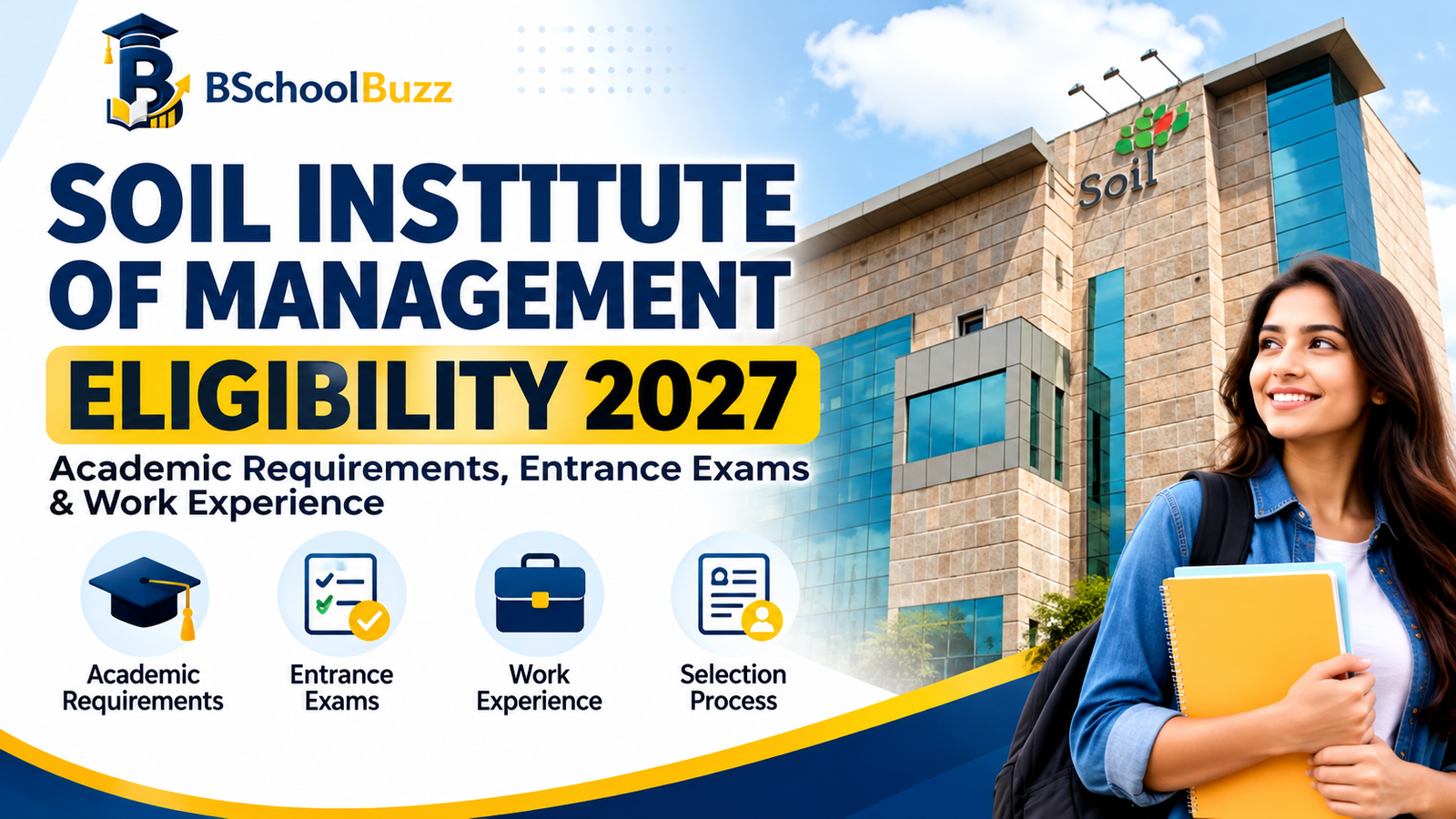
SOIL Institute of Management Eligibility 2027: Academic Requirements, Entrance Exams & Work Experience
Introduction
Students planning to pursue a postgraduate management diploma at SOIL Institute of Management should understand the admission requirements before completing their application. The institute's two-year Post Graduate Diploma in Management (PGDM) programme is designed for candidates interested in combining management education with design thinking, business problem-solving and experiential learning.
For the 2027–29 batch, SOIL's official admissions page states that applicants must hold a bachelor's degree with at least 50% aggregate marks from a UGC- or AIU-recognised university. The undergraduate qualification must involve at least three years of study after Class 12 or an equivalent qualification. Candidates appearing for their final-year examinations in 2027 can also apply, subject to the institute's academic and document-submission conditions.
The SOIL Institute of Management eligibility criteria also cover entrance examination scores, work experience and the selection process. The institute accepts scores from several management aptitude examinations, including CAT, XAT, GMAT, CMAT and MAT. NMAT and SNAP scores are subject to additional conditions specified by SOIL. The admissions team evaluates applicants through a combination of examination performance, academic record, extracurricular achievements, work experience and Group Exercise and Personal Interview performance.
This article focuses on the two-year PGDM programme for the 2027–29 batch at SOIL's Manesar campus. The one-year PGPM and PGPM-HR programmes have different eligibility requirements, so their work experience and examination conditions should not be mixed with those of the two-year PGDM.
Official reference: SOIL PGDM Admissions Process.
Table of Contents
SOIL Institute of Management Eligibility 2027: Overview
Academic Qualification Required for PGDM Admission
Minimum Graduation Marks and Percentage Requirements
Eligibility for Final-Year Students
Entrance Exams Accepted by SOIL
CAT, XAT, GMAT and Other Entrance Score Requirements
Work Experience Requirements for SOIL PGDM
SOIL PGDM Selection Criteria and Weightage
SOIL Institute of Management Admission Process
Documents Required for Admission
Application Fee and Important Admission Conditions
Common Eligibility Mistakes to Avoid
How to Check Your Eligibility
Official Sources for Admission Verification
Conclusion
1. SOIL Institute of Management Eligibility 2027: Overview
SOIL Institute of Management eligibility 2027 refers to the academic qualifications, entrance examination requirements, work experience conditions and selection criteria that candidates must satisfy to be considered for admission to the two-year PGDM programme for the 2027–29 academic batch.
SOIL's official admissions page identifies the programme as a full-time, two-year PGDM offered at its Manesar campus in the Gurgaon region. The programme combines business management with design thinking and liberal arts.
Eligibility criteria at a glance
| Eligibility Parameter | Requirement for the 2027–29 PGDM Batch |
|---|---|
| Institute | SOIL Institute of Management |
| Programme | Two-year PGDM |
| Programme duration | 24 months |
| Campus | Manesar, New Gurgaon |
| Undergraduate qualification | Bachelor's degree in any discipline |
| Minimum graduation marks | 50% aggregate |
| University recognition | UGC- or AIU-recognised university, as specified by SOIL |
| Minimum degree duration | Three years of study after 10+2 or equivalent |
| Final-year students | Eligible to apply, subject to the institute's conditions |
| Accepted entrance examinations | CAT, XAT, GMAT, CMAT, MAT, ATMA, NMAT and SNAP, subject to specific conditions |
| Work experience | Freshers and candidates with less than three years of full-time experience are eligible |
| Selection stages | Profile evaluation, Group Exercise and Personal Interview |
| Application fee | ₹2,000, stated as non-refundable on the official application information |
| Programme commencement | June 2027, according to the official PGDM programme page |
Sources: Official PGDM Admissions Process, PGDM Application Portal and Official PGDM Programme Page.
The table summarises the published conditions, but candidates must also follow the detailed admission instructions concerning examination score validity, final-year documentation and application deadlines.
For example, a graduate with 55% marks may meet the minimum academic requirement but must still submit an accepted entrance examination score and complete the selection process. Similarly, a final-year student may apply before receiving the final degree certificate, but must meet SOIL's conditions for completing the qualification.
Important distinction: Eligibility allows an applicant to be considered for admission. It does not guarantee shortlisting, selection or a final offer.
2. Academic Qualification Required for PGDM Admission
The first requirement for SOIL Institute of Management eligibility is a recognised bachelor's degree. SOIL's official PGDM admissions page specifies a minimum of 50% aggregate marks in a bachelor's degree in any discipline.
This broad academic requirement means that applicants are not restricted to graduates of business administration or commerce programmes. Students from different educational backgrounds can apply if their qualifications satisfy the institute's recognition, duration and marks conditions.
Which bachelor's degrees are accepted?
SOIL's eligibility information allows graduates from different academic streams to apply. Examples include:
Bachelor of Commerce (BCom)
Bachelor of Business Administration (BBA)
Bachelor of Arts (BA)
Bachelor of Science (BSc)
Bachelor of Technology (BTech)
Bachelor of Engineering (BE)
Other recognised bachelor's degrees
This list is illustrative rather than exhaustive. The decisive factors are whether the degree is recognised and whether it satisfies the institute's published academic requirements.
A candidate with an undergraduate degree in engineering, for example, may be interested in business analytics, product development or operations. A commerce graduate may want to pursue finance or marketing, while a humanities graduate may be interested in leadership, organisational behaviour or business strategy.
The institute's general eligibility requirement does not restrict applicants to one undergraduate discipline.
Is a three-year graduation degree sufficient?
Yes, a recognised three-year bachelor's degree can satisfy SOIL's published minimum duration requirement, provided it involves at least three years of study after Class 12 or an equivalent qualification.
Candidates with four-year degrees or integrated programmes should review the recognition and documentation conditions applicable to their particular qualification.
Applicants with foreign degrees, unusual degree structures or qualifications whose recognition is uncertain should obtain confirmation from SOIL before completing their application.
Does the undergraduate subject affect eligibility?
SOIL's published PGDM eligibility criteria permit applicants from any discipline. The official admissions process also evaluates academic performance as part of the overall application.
Although the undergraduate stream does not restrict eligibility under the general criteria, students should consider whether their academic background prepares them for the programme's quantitative, analytical and business-related subjects.
A candidate should review the curriculum and learning approach before applying, particularly if they are transitioning from a subject that is substantially different from management.
What if the degree is from a private university?
Applicants should verify that the university and qualification satisfy SOIL's stated recognition requirement. Candidates should not assume that every degree will automatically qualify simply because the awarding institution describes itself as a university.
If recognition or equivalence is unclear, contact SOIL's admissions team and obtain clarification before submitting the application.
3. Minimum Graduation Marks and Percentage Requirements
SOIL's official PGDM admissions page specifies at least 50% aggregate marks in the bachelor's degree.
This is a minimum academic requirement, not a guarantee of admission. The institute also evaluates examination scores, academic history, extracurricular activities, work experience and performance during the selection process.
| Academic Situation | How to Interpret the Requirement |
|---|---|
| Graduation marks above 50% | The candidate meets the stated minimum percentage, subject to other conditions |
| Graduation marks exactly 50% | The candidate meets the stated threshold if the result is calculated and recognised under the applicable rules |
| Graduation marks below 50% | The candidate generally does not meet the published minimum academic requirement |
| CGPA or grade-point result | Follow the official conversion method prescribed by the awarding university |
| Final-year student | Apply under the prescribed provisional eligibility and document-submission conditions |
| Degree recognition uncertain | Confirm eligibility with SOIL before applying |
Source: SOIL Official PGDM Admissions Process.
Can candidates with exactly 50% marks apply?
A candidate whose recognised undergraduate result meets the 50% minimum may satisfy the basic academic eligibility condition.
However, SOIL follows a broader selection process. Academic eligibility alone does not establish that the candidate will be shortlisted or receive an admission offer.
Applicants should therefore prepare a competitive entrance examination score and work on their interview and group exercise skills alongside checking the graduation requirement.
What if graduation marks are below 50%?
Candidates whose final undergraduate marks fall below the stated minimum generally do not satisfy the published academic requirement.
If a candidate believes the calculation is affected by an official revaluation, corrected marksheet or university-prescribed conversion formula, they should obtain the relevant documentation and contact SOIL.
A high CAT, XAT or GMAT score should not be assumed to replace the minimum academic requirement.
How should CGPA be converted into percentage?
Applicants whose universities use CGPA or another grading system should follow the official conversion method prescribed by the awarding institution.
Do not use an unofficial online calculator if the university has a specific conversion formula. Where the marksheet does not provide a percentage, ask the university how the equivalent result should be documented.
This is particularly important because incorrect conversion can create inconsistencies between the application form and academic records.
Are Class 10 and Class 12 marks also relevant?
SOIL's published PGDM selection criteria state that undergraduate academic performance is considered in the admissions assessment. Its profile-based evaluation may also collect information about Class 10 and Class 12 performance.
Candidates should enter their school and graduation marks accurately wherever requested. However, they should distinguish between the minimum eligibility conditions and the wider academic profile reviewed during selection.
The published PGDM eligibility page identifies the bachelor's degree and 50% aggregate marks as the main academic qualification. Candidates should check the current application form for any additional school-level information required.
4. Eligibility for Final-Year Students
Final-year students can apply for SOIL's two-year PGDM programme, subject to the institute's prescribed conditions.
This option is useful for students who want to pursue management education immediately after completing their undergraduate degree. They do not necessarily need to wait until their final marksheet has been issued before beginning the application process.
However, provisional application does not remove the obligation to complete the degree and meet the minimum marks requirement.
What are the final-year eligibility conditions?
SOIL's official admissions page states that students appearing for their final-year examinations in 2027 may apply with a certificate confirming 50% marks. The final marksheet and degree certificate must be submitted by 1 October 2027, according to the published 2027–29 admission information.
Applicants should check the latest official instructions to confirm whether any revised deadline or additional document requirement applies to their application.
| Requirement | What Final-Year Applicants Should Do |
|---|---|
| Academic status | Be appearing for the final-year examination in 2027 |
| Minimum academic performance | Meet the applicable 50% requirement |
| Supporting certificate | Obtain the certificate specified by SOIL |
| Final marksheet | Submit by the published deadline |
| Degree certificate | Submit by the published deadline |
| Admission conditions | Follow all instructions attached to the admission offer |
Source: SOIL PGDM Admissions Process.
Can final-year students apply without the final degree certificate?
Yes. The published criteria permit final-year students to apply before the final degree certificate is available, subject to the institute's conditions.
Candidates must provide the required academic certificate and submit the final marksheet and degree certificate by the prescribed deadline.
What happens if the final result does not meet the requirement?
SOIL's official admissions page warns that failure to fulfil the stated eligibility conditions can lead to cancellation of admission. It also states that fees are non-refundable in this situation.
Applicants should therefore avoid assuming that a provisional offer is unconditional. Read the offer letter carefully and clarify any academic or documentation concerns before accepting the offer.
What should final-year students prepare?
Before applying, candidates should:
Keep all available undergraduate marksheets ready.
Obtain the required certificate from their college or university.
Check how their institution calculates aggregate marks.
Track the final result and degree-certificate deadline.
Confirm whether any pending examination affects completion of the qualification.
Retain copies of submitted documents and official correspondence.
Taking these steps early can reduce the risk of missing an admission condition after selection.
5. Entrance Exams Accepted by SOIL
Entrance examination scores are a mandatory part of the published eligibility criteria for SOIL's two-year PGDM programme.
The institute accepts scores from multiple management aptitude examinations. This gives candidates more than one route to demonstrate aptitude, but each examination must satisfy SOIL's applicable conditions for the 2027–29 intake.
The official admissions page lists CAT, XAT, GMAT, CMAT, MAT, ATMA, NMAT and SNAP. The institute's published notes place additional conditions on NMAT and SNAP scores.
Entrance examinations accepted for the 2027–29 PGDM batch
| Entrance Examination | Acceptance Status | Important Condition |
|---|---|---|
| CAT | Accepted | Submit a valid score for the applicable admission cycle |
| XAT | Accepted | Check the examination year specified by SOIL |
| GMAT | Accepted | Confirm the score-validity requirements |
| CMAT | Accepted | Check the relevant score year |
| MAT | Accepted | Confirm the score validity for the admission cycle |
| ATMA | Accepted | Follow the current application instructions |
| NMAT | Accepted subject to conditions | SOIL specifies additional conditions for NMAT scores |
| SNAP | Listed on the official admissions page, subject to conditions | Confirm the additional score requirement directly with SOIL |
Sources: Official PGDM Admissions Process and SOIL PGDM FAQs.
Is CAT compulsory for SOIL PGDM?
No. SOIL's published PGDM admissions criteria accept multiple entrance examinations rather than limiting all applicants to CAT.
Candidates may submit eligible scores from the examinations listed by the institute. If more than one valid score is submitted, SOIL states that it will consider the best score among those provided.
This allows applicants to select an examination route that suits their preparation and application timeline, provided the score is valid under the institute's rules.
Does SOIL accept CMAT, MAT and ATMA?
Yes. These examinations are listed among the accepted aptitude tests for the two-year PGDM programme.
Applicants should check the current admission portal to verify the applicable examination year and any score-submission requirements. A score accepted for one admission cycle should not automatically be assumed valid for another.
Are NMAT and SNAP scores accepted independently?
SOIL's official admissions page lists both NMAT and SNAP, but its published note states that these scores are considered only when accompanied by another AICTE-approved test score.
The institute's FAQ also specifies an additional condition for NMAT. Because the exact supporting-score rule can affect eligibility, candidates intending to apply using NMAT or SNAP should confirm the requirement directly with the admissions team before submitting their application.
Does SOIL conduct its own entrance examination?
The published two-year PGDM admissions criteria identify recognised aptitude test scores as a mandatory requirement. Candidates should not assume that a separate institute test can automatically replace an accepted score for this programme.
If an applicant has not taken an accepted examination or is uncertain about score validity, they should contact SOIL to confirm the available options for the relevant intake.
6. CAT, XAT, GMAT and Other Entrance Score Requirements
Submitting an accepted examination score is not simply a matter of entering a percentile or total score in the application. Candidates must also ensure that the examination year and score-validity period meet SOIL's requirements.
The institute's online PGDM application information specifies accepted examination years and score-validity conditions. These details should be checked against the current 2027–29 application instructions.
CAT score requirements
Candidates applying through CAT should follow the examination year specified by SOIL for the relevant admission cycle. The official PGDM application information identifies CAT 2026 as an accepted examination for the 2027–29 batch.
Applicants should retain their official scorecard and enter the details accurately in the application form.
XAT score requirements
SOIL's application information identifies XAT 2027 among the accepted examination routes for the 2027–29 batch.
Candidates should verify the relevant examination year, scorecard availability and submission instructions before completing the form.
GMAT score requirements
SOIL accepts GMAT scores, subject to the published validity conditions. The official application information specifies GMAT scores taken after 1 January 2023 for the 2027–29 PGDM admissions route.
Because score-validity rules can be updated, applicants should confirm the exact date requirement on the live portal before applying.
MAT and CMAT score requirements
The institute lists MAT and CMAT among its accepted aptitude tests. Applicants should check the score years stated on the current application portal.
Do not assume that every older score is accepted merely because the examination itself is listed.
What happens if a candidate has multiple scores?
SOIL's official admissions information states that candidates may submit multiple examination scores and that the best valid score among those submitted will be considered.
For example, a candidate who has valid CAT and XAT scores can report both if the application permits it. The institute's stated approach is to consider the best valid score rather than automatically using the earliest examination result.
This does not guarantee shortlisting. The institute also considers academic performance, extracurricular achievements, work experience and performance during the selection process.
How can candidates avoid score-related errors?
Before submitting the application:
Check the examination year accepted by SOIL.
Verify that the score is still valid for the relevant intake.
Enter the score details exactly as reported on the official scorecard.
Upload supporting evidence if requested.
Confirm any additional requirement attached to NMAT or SNAP.
Retain a copy of the submitted application.
These checks are particularly important for candidates applying close to the deadline.
7. Work Experience Requirements for SOIL PGDM
SOIL's two-year PGDM programme is intended for fresh graduates and candidates with limited professional experience.
The official admissions information states that freshers and applicants with less than three years of work experience are eligible. SOIL's current FAQ further clarifies that only full-time work experience is considered for the programme's experience-related conditions.
This is an important distinction because the institute's one-year PGPM and PGPM-HR programmes have different work experience expectations.
Can freshers apply to SOIL PGDM?
Yes. Freshers are eligible to apply if they meet the academic and entrance examination requirements.
The official selection criteria assign a portion of the evaluation to work experience, if any, while explicitly encouraging freshers to apply. Applicants do not need to assume that a full-time job is compulsory before entering the two-year PGDM programme.
Fresh graduates should focus on presenting their academic achievements, entrance examination performance, extracurricular involvement, projects and motivation for pursuing management education.
How much work experience is permitted?
SOIL's official PGDM admissions information specifies eligibility for freshers and candidates with less than three years of work experience.
The application portal instructs candidates to report full-time work experience as of 30 June 2027. Applicants should check the current portal and admissions FAQ for the exact experience calculation and eligibility conditions.
Candidates with experience close to the permitted limit should confirm their eligibility directly with SOIL before applying.
Do internships count as work experience?
SOIL's published FAQ states that internships and part-time jobs are not counted as full-time work experience.
Candidates should report these activities in the appropriate sections of the application if requested, but they should not misrepresent them as full-time employment.
Does work experience improve admission chances?
Work experience may contribute to the candidate's overall profile, but it does not guarantee admission.
SOIL evaluates applicants through a combination of examination scores, academic performance, extracurricular activities, work experience and Group Exercise and Personal Interview performance.
A candidate with professional experience should explain responsibilities, achievements and learning clearly. A fresher should highlight meaningful academic projects, leadership activities, teamwork and career goals.
What about entrepreneurs and family-business experience?
SOIL's official FAQ indicates that full-time experience in an entrepreneurial venture or family-owned business may be considered when supported by valid documentation.
Applicants in this situation should provide accurate details and supporting evidence. If their experience does not fit a standard employment structure, they should confirm the required documentation with the admissions team.
8. SOIL PGDM Selection Criteria and Weightage
Meeting the academic eligibility requirements and submitting an accepted entrance examination score are only the first stages of admission.
SOIL uses a holistic selection process designed to assess academic ability, aptitude, leadership potential, communication, teamwork and professional or extracurricular experience.
According to the official PGDM admissions page, the selection weightage is distributed as follows.
| Selection Component | Published Weightage | What It Assesses |
|---|---|---|
| Entrance examination score | 35% | Performance in an accepted aptitude test |
| Academic performance | 15% | Undergraduate marks, GPA, honours or distinctions |
| Extracurricular activities | 5% | Participation and achievements in cultural, sports or social activities |
| Work experience | 5% | Relevant professional exposure, where applicable |
| Group Exercise and Personal Interview | 40% | Teamwork, leadership, communication, motivation and career clarity |
| Total | 100% | Combined evaluation under the published selection framework |
Source: SOIL Official PGDM Admissions Process.
Why does the entrance examination matter?
The entrance examination component accounts for 35% of the published selection weightage. Candidates should therefore prepare carefully for their chosen aptitude test and ensure that their score meets SOIL's validity conditions.
Because multiple examinations are accepted, applicants should choose an appropriate route and verify the score requirements before applying.
How important are academic marks?
Academic performance accounts for 15% of the stated selection weightage. SOIL considers undergraduate performance as part of the candidate's overall academic profile.
This is separate from the minimum eligibility requirement. A candidate may satisfy the 50% graduation threshold but still be evaluated in comparison with other applicants through the broader selection process.
Do extracurricular activities matter?
Yes. SOIL allocates 5% of its published selection weightage to extracurricular activities.
Candidates may be asked to provide details about participation or achievements in sports, cultural activities, student organisations or social initiatives. Applicants should report their involvement accurately and be prepared to explain their responsibilities or contributions.
How is work experience evaluated?
Work experience accounts for 5% of the published selection weightage. The institute's criteria refer to professional exposure and the responsibilities or contributions demonstrated by the applicant.
Freshers are also encouraged to apply, so candidates should not treat the absence of full-time work experience as an automatic disqualification.
Why should candidates prepare for GEPI?
Group Exercise and Personal Interview performance accounts for 40% of the published selection weightage. This is a substantial part of the assessment.
Candidates should practise expressing ideas clearly, listening to others, supporting arguments with relevant examples and discussing their academic and professional goals.
The institute uses the process to assess communication, teamwork, leadership potential and motivation for management education.
9. SOIL Institute of Management Admission Process
The admission process involves several steps. Applicants should complete each stage carefully and follow the deadlines published for the 2027–29 batch.
Step 1: Check eligibility
Confirm that you hold a recognised bachelor's degree, meet the minimum 50% aggregate marks requirement and satisfy the degree-duration conditions.
Final-year students should also review the provisional eligibility and final-document submission rules.
Step 2: Take an accepted entrance examination
Choose an examination accepted by SOIL for the relevant admission cycle. Check the score-validity rules and any additional conditions that apply to NMAT or SNAP.
Step 3: Complete the online application
Apply through the official SOIL PGDM application portal.
The application requires information about academic background, entrance examination scores, extracurricular activities and supporting documents, as specified by the institute.
Step 4: Pay the application fee
The official application information lists an application fee of ₹2,000 and states that it is non-refundable.
Confirm the amount and payment instructions on the live application portal before paying. SOIL also cautions applicants against unauthorised application-fee coupon schemes.
Step 5: Profile shortlisting
SOIL reviews applicants' profiles using the criteria published for the programme. The institute identifies factors such as leadership potential, academic performance, extracurricular involvement, intellectual capacity and work experience, if any.
Meeting the minimum eligibility requirement does not guarantee that an applicant will be shortlisted.
Step 6: Participate in Group Exercise and Personal Interview
Shortlisted candidates attend the GEPI process. The institute assesses teamwork, communication, leadership, problem-solving and motivation for management education.
Applicants should be prepared to discuss their background, career objectives, reasons for choosing SOIL and understanding of business-related issues.
Step 7: Receive the admission decision
The institute evaluates candidates using its published selection framework. Successful candidates should read their offer letter carefully and comply with the stated conditions and payment deadlines.
Step 8: Complete enrolment formalities
Candidates must submit the documents requested by SOIL and satisfy the academic conditions attached to their offer.
Final-year students must ensure that their final marksheet and degree certificate are submitted by the applicable deadline.
10. Documents Required for Admission
The exact document checklist depends on the instructions in the current application portal and the applicant's academic status. Candidates should use the institute's official requirements rather than relying solely on a general checklist.
| Document | Purpose |
|---|---|
| Class 10 marksheet or certificate | School academic record, if requested |
| Class 12 marksheet or certificate | School academic record, if requested |
| Undergraduate marksheets | Verification of graduation performance |
| Degree or provisional certificate | Proof of completed undergraduate qualification, where available |
| Final-year certificate | Supporting evidence for applicants awaiting results |
| Final graduation marksheet | Verification of final academic eligibility |
| Degree certificate | Proof of degree completion |
| Entrance examination scorecard | Verification of the accepted aptitude test |
| Government-issued identity document | Identity verification, as required |
| Photograph and signature | Application documentation, where requested |
| Work experience evidence | Verification of declared full-time experience, if applicable |
| Additional certificates | Any other records requested by SOIL |
Document preparation tips
Keep readable digital copies of academic records and ensure that all information matches the application form.
Candidates should use the official university conversion method when reporting CGPA or percentage. Applicants with work experience should maintain accurate employment dates and supporting evidence.
Final-year students should pay special attention to the documents and deadlines specified in their admission instructions. Failure to satisfy the prescribed conditions may affect provisional admission.
11. Application Fee and Important Admission Conditions
The SOIL PGDM application portal lists an application fee of ₹2,000 and states that the fee is non-refundable.
Applicants should distinguish the application fee from programme tuition and other admission-related payments. These are separate financial obligations, and the amount payable after selection should be checked on the official fee page and offer letter.
| Item | Published Information | What Applicants Should Do |
|---|---|---|
| Application fee | ₹2,000 | Confirm the amount on the live portal |
| Refund status | Non-refundable | Review the conditions before payment |
| Accepted examination score | Mandatory under the published PGDM criteria | Check the valid examination and score year |
| Final-year documents | Required by the prescribed deadline | Track the deadline carefully |
| Work experience | Less than three years under the published PGDM eligibility conditions | Confirm the experience calculation if uncertain |
| Fee payment after selection | As specified in the offer and fee schedule | Follow the official payment instructions |
Sources: SOIL PGDM Application Portal and SOIL PGDM Fees and Financial Support.
Why should applicants check the offer letter carefully?
An admission offer may include conditions relating to academic eligibility, documents, payments and deadlines. Candidates should read all conditions before accepting the offer.
Applicants who are still awaiting their final graduation results should confirm how provisional admission will be handled and what happens if the final marks or documents do not satisfy the requirements.
Are application-fee discounts or coupons authorised?
SOIL's official application information cautions applicants against unauthorised fee coupon schemes and states that the application fee must be paid in full.
Candidates should use the official portal and follow the payment instructions shown there. If a third party offers a discount or coupon, verify its legitimacy directly with the institute before making a payment.
12. Common Eligibility Mistakes to Avoid
Applicants can reduce the risk of admission problems by avoiding the following mistakes.
Mistake 1: Confusing minimum eligibility with admission selection. A bachelor's degree with 50% marks is not a guarantee of selection.
Mistake 2: Assuming CAT is the only accepted entrance examination. SOIL lists several aptitude tests for its PGDM programme.
Mistake 3: Ignoring score validity. An examination may be accepted in principle, but an older score may not meet the requirements for the current intake.
Mistake 4: Assuming NMAT and SNAP are accepted without additional conditions. Read SOIL's specific notes and confirm the supporting-score requirements.
Mistake 5: Treating internships as full-time employment. SOIL states that internships and part-time jobs are not counted as full-time work experience.
Mistake 6: Applying the one-year PGPM rules to the two-year PGDM. The programmes have different work experience requirements and admission conditions.
Mistake 7: Ignoring final-year deadlines. Candidates must submit their final marksheet and degree certificate within the specified timeframe.
Mistake 8: Using an unofficial CGPA conversion formula. Follow the awarding university's official conversion rules.
Mistake 9: Paying the application fee through an unverified source. Use the official SOIL portal and follow its payment instructions.
Mistake 10: Preparing only for the entrance examination. The published selection criteria assign 40% weightage to Group Exercise and Personal Interview performance.
13. How to Check Your Eligibility
Use the following checklist to review your position before applying.
I hold a recognised bachelor's degree in any discipline.
My degree satisfies the required duration of at least three years after Class 12 or equivalent.
My graduation marks meet the minimum 50% aggregate requirement.
I have an accepted aptitude test score that meets SOIL's validity conditions.
I have checked the additional rules for NMAT or SNAP, if applicable.
My full-time work experience falls within the permitted eligibility conditions.
If I am a final-year student, I understand the certificate and final-result submission requirements.
I have prepared the documents requested in the application portal.
I understand the GEPI selection process and its published weightage.
I have checked the application fee and relevant admission deadlines.
I am applying for the two-year PGDM rather than confusing its conditions with a different SOIL programme.
If any item remains uncertain, contact SOIL's admissions team before submitting the application or paying the fee.
14. Official Sources for Admission Verification
For the most accurate information about SOIL Institute of Management eligibility 2027, applicants should prioritise the institute's official website and application portal.
1. SOIL PGDM Admissions Process
https://www.soil.edu.in/pgdm/admissions-process/
Use this page to verify the academic eligibility criteria, accepted entrance examinations, work experience conditions and selection weightage.
2. SOIL PGDM Application Portal
Use the application portal to review current application instructions, score-validity conditions, document requirements and payment information.
3. SOIL PGDM FAQs
https://www.soil.edu.in/pgdm/faqs/
Consult this page for questions about final-year eligibility, accepted examination scores, work experience and the admission process.
4. SOIL PGDM Programme Page
Review the programme duration, location, commencement information and programme overview.
5. SOIL PGDM Fees and Financial Support
https://www.soil.edu.in/pgdm/fees-and-financial/
Use this page to verify the published fee structure and payment schedule for the 2027–29 batch.
Applicants should confirm the current admission instructions immediately before applying. If the official programme page and application portal display different conditions, contact SOIL for clarification about the rule applicable to the 2027–29 intake.
15. Conclusion
SOIL Institute of Management eligibility 2027 requires applicants to meet the academic, entrance examination and other conditions published for the two-year PGDM programme. The institute specifies a recognised bachelor's degree with at least 50% aggregate marks and accepts multiple management aptitude examinations, subject to score-validity rules and specific conditions for certain tests.
Freshers can apply, as can candidates with less than three years of work experience under the published criteria. Final-year students may also apply, provided they meet the academic requirement and submit their final marksheet and degree certificate within the prescribed deadline.
The selection process extends beyond academic marks and entrance examination scores. SOIL evaluates applicants through academic performance, extracurricular involvement, work experience where applicable, and Group Exercise and Personal Interview performance.
Before submitting an application, verify the current requirements on the official admissions portal. Pay particular attention to the accepted examination year, NMAT and SNAP conditions, final-year documentation deadline and application fee. Preparing these details in advance can help you assess your eligibility accurately and complete the admission process with fewer avoidable errors.
Key Takeaways
Graduation requirement: A recognised bachelor's degree in any discipline with at least 50% aggregate marks.
Degree duration: At least three years of undergraduate study after Class 12 or equivalent.
Accepted examinations: CAT, XAT, GMAT, CMAT, MAT, ATMA, NMAT and SNAP, subject to SOIL's conditions.
Final-year applicants: Students appearing in 2027 can apply and must satisfy the prescribed documentation deadlines.
Work experience: Freshers and candidates with less than three years of full-time experience are eligible.
Internships: Internships and part-time jobs are not treated as full-time work experience under the published FAQ.
Selection weightage: Entrance scores account for 35%, academics 15%, extracurricular activities 5%, work experience 5%, and GEPI 40%.
Application fee: ₹2,000, stated as non-refundable on the official application portal.
Final-year deadline: The official admissions page specifies 1 October 2027 for submitting the final marksheet and degree certificate.
Official verification: Confirm the latest examination score rules, eligibility conditions and deadlines on SOIL's official website before applying.
Frequently Asked Questions
What is the eligibility criteria for SOIL Institute of Management in 2027?
Candidates must hold a bachelor's degree in any discipline from a recognised university with at least 50% aggregate marks. They must also meet the accepted entrance examination and other admission requirements.
What is the minimum graduation percentage required for SOIL PGDM admission?
SOIL requires at least 50% aggregate marks in a recognised bachelor's degree for its two-year PGDM programme, according to the published eligibility criteria.
Which entrance exams are accepted by SOIL Institute of Management for 2027?
SOIL lists CAT, XAT, GMAT, CMAT, MAT, ATMA, NMAT and SNAP for its two-year PGDM programme, subject to the applicable score-validity and additional examination conditions.
Can final-year students apply for SOIL PGDM admission in 2027?
Yes. Final-year students appearing in 2027 may apply with the required academic certificate. The published admissions page specifies 1 October 2027 as the deadline for submitting the final marksheet and degree certificate.
Is work experience compulsory for SOIL Institute of Management?
No. Freshers can apply for the two-year PGDM programme. Candidates with less than three years of full-time work experience are also eligible under the published admission criteria.
Does SOIL accept NMAT and SNAP scores?
SOIL lists both examinations, but its admissions information specifies additional conditions. Candidates should verify the supporting-score requirements directly with the institute before applying.
What is the application fee for SOIL PGDM admission 2027?
The official application information lists a fee of ₹2,000 and states that it is non-refundable. Applicants should confirm the amount and payment instructions on the current application portal.
What is the selection process for SOIL Institute of Management PGDM?
The selection process evaluates entrance examination scores, academic performance, extracurricular achievements, work experience and Group Exercise and Personal Interview performance. GEPI accounts for 40% of the published selection weightage.
Are internships counted as work experience for SOIL PGDM admission?
According to SOIL's published FAQ, internships and part-time jobs are not counted as full-time work experience. Candidates should report their experience accurately in the application.
Where can I check the official SOIL Institute of Management eligibility criteria for 2027?
Visit https://www.soil.edu.in/pgdm/admissions-process/ for eligibility and selection information. The application portal is https://app.soil.edu.in/pgdm, where candidates can review current application requirements.
Ask a question
Still confused? Leave your question and our team will help you.