
Quick Summary
- SIES College of Management Studies is located in Nerul, Navi Mumbai.
- The institute's main management programme is the two-year, full-time Master of Management Studies (MMS).
- The official 2026–27 fee document lists a standard first-year fee total of ₹2,35,000.
- The standard fee comprises ₹2,04,348 in tuition fees and ₹30,652 in development fees.
- Caution money of ₹25,000 is listed separately.
- The fee document also shows a separate management-seat category with a listed amount of ₹7,05,000.
- Hostel and mess costs should be confirmed separately; do not assume they are included in the published standard fee.
- The MMS specialisations listed by the institute are Marketing, Finance, Operations, Systems and Human Resources.
- The institute reports an MMS highest salary of ₹17.00 lakh and an average salary of ₹8.76 lakh for the 2023–2025 placement season.
- Students should verify the second-year fees, refund rules, admission category and current admission requirements through official documents before paying.
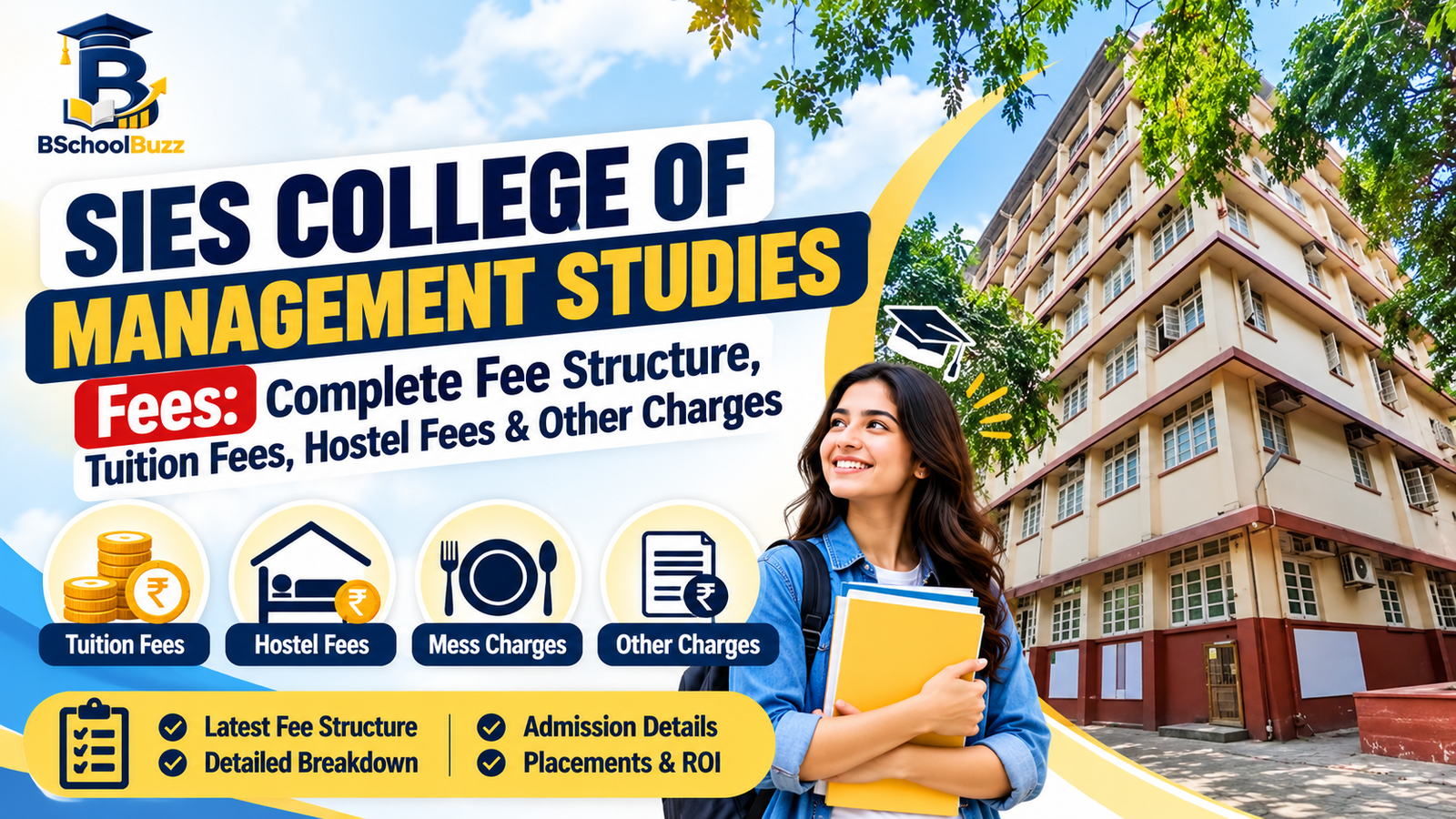
SIES College of Management Studies Fees: Complete Fee Structure, Tuition Fees, Hostel Fees & Other Charges
Introduction
Choosing a management college involves more than comparing tuition fees. Students also need to understand development charges, caution money, accommodation expenses, admission requirements, placement outcomes and the total amount they may need to arrange before joining.
SIES College of Management Studies (SIESCOMS), located in Nerul, Navi Mumbai, offers a two-year, full-time Master of Management Studies (MMS) programme. The institute publishes its fee information through its official website, making the institute's own documents the most appropriate starting point for applicants assessing the cost of management education.
For the 2026–28 MMS batch, the institute's published first-year fee document dated 1 August 2026 lists a standard fee total of ₹2,35,000 for the 2026–27 academic year. It separately lists management-seat fees and caution money. These categories should not be combined without understanding which admission route applies to the candidate. Official fee structure.
This article explains the officially published fee figures, what the individual charges mean, how hostel and living costs should be budgeted, and what applicants should verify before paying. It also covers MMS eligibility, entrance examinations, specialisations, admissions, placements and frequently asked questions.
Important distinction: SIESCOMS offers an MMS degree rather than a programme that should automatically be labelled an MBA or PGDM. Although MMS and MBA programmes serve a similar management-education purpose, their names, admission procedures and fee schedules may differ. This article focuses on the MMS programme at SIES College of Management Studies in Nerul, Navi Mumbai.
Table of Contents
SIES College of Management Studies: Overview
SIES College of Management Studies Fees 2026–28
Detailed Breakdown of the MMS Fee Structure
Standard Seats vs Management Seats
Tuition Fees and Development Charges
Caution Money and Other Charges
Hostel Fees, Mess Charges and Living Expenses
Is the Published Fee the Complete Cost?
Fee Payment and Important Checks
SIESCOMS MMS Eligibility Criteria
Entrance Exams and Admission Process
MMS Specialisations at SIESCOMS
Scholarships and Financial Assistance
SIES College of Management Studies Placements
Return on Investment: How to Evaluate the Cost
Campus Facilities and Student Expenses
How to Budget for the MMS Programme
Common Mistakes to Avoid While Paying Fees
Official Documents and Verification Checklist
Frequently Asked Questions
Conclusion
About BSchoolBuzz
Related Search Keywords
1. SIES College of Management Studies: Overview
SIES College of Management Studies is commonly known as SIESCOMS. It is situated in Nerul, Navi Mumbai, Maharashtra, and is part of the South Indian Education Society.
The institute was established in 1995. Its management programme is the Master of Management Studies, a two-year, full-time postgraduate course affiliated with the University of Mumbai. The official programme page states that the MMS programme is approved by the All India Council for Technical Education (AICTE). Official MMS programme page.
SIESCOMS at a glance
| Particular | Details |
|---|---|
| Institute name | SIES College of Management Studies |
| Common name | SIESCOMS |
| Location | Nerul, Navi Mumbai, Maharashtra |
| Establishment year | 1995 |
| Main management programme | Master of Management Studies (MMS) |
| Programme duration | Two years, full-time |
| University affiliation | University of Mumbai |
| Programme approval stated by institute | AICTE |
| Management specialisations | Marketing, Finance, Operations, Systems and Human Resources |
| Campus area | 3 acres, as stated on the institute's infrastructure page |
| Official website | https://siescoms.edu.in/ |
The institute's official pages also describe facilities such as classrooms, seminar halls, a library, an auditorium, computer facilities, a canteen and an amphitheatre. These facilities may influence the learning environment, but they should be considered separately from the financial cost of the programme.
Why the exact programme matters when comparing fees
Students often search for SIES MBA fees even when they are considering the MMS programme. This is understandable because both are postgraduate management qualifications. However, applicants should use the exact course name printed on the institute's admission notice and fee document.
The distinction matters for several reasons:
The course may follow a specific university's curriculum and academic regulations.
The applicable admission process may be determined by the state admission authority.
Fee schedules can vary by course, academic year and admission category.
Placement statistics may be published for a particular programme or graduating batch.
A fee figure from another SIES institution or programme may not apply to SIESCOMS MMS.
For an accurate financial comparison, applicants should compare the two-year MMS programme with equivalent two-year management programmes and should use the relevant academic year's official fee notification.
2. SIES College of Management Studies Fees 2026–28
The institute's official fee structure for 2026–27 identifies the first-year fee structure for the MMS batch covering the 2026–28 academic period. The document is dated 1 August 2026.
For the standard fee category, the document lists tuition fees of ₹2,04,348 and development fees of ₹30,652. Together, these amount to ₹2,35,000 for the year. It separately lists a caution-money amount of ₹25,000. Management-seat fees are shown under a different category. Official 2026–27 fee PDF.
Published first-year MMS fees
| Fee component | Published amount |
|---|---|
| Tuition fees | ₹2,04,348 |
| Development fees | ₹30,652 |
| Standard annual fee total | ₹2,35,000 |
| Caution money, listed separately | ₹25,000 |
| Total including caution money, if payable in addition | ₹2,60,000 |
The last figure is an arithmetic total of the published standard annual fee and the separately listed caution money. Applicants should confirm the payment demand issued to their own category before transferring funds.
What does the ₹2,35,000 figure represent?
The published ₹2,35,000 is the standard annual fee total for the first year shown in the official document. It is not automatically a verified two-year programme total. It is also not a complete personal budget covering accommodation, travel, meals, books, a laptop and other individual expenses.
This distinction is important when planning finances. A student should not assume that multiplying the first-year figure by two gives the final amount payable for the full course. The second-year fee schedule, if published separately, should be checked before calculating the complete programme cost.
Likewise, the separately listed caution money should not automatically be treated as a recurring annual charge. The institute's fee document identifies the amount, but students should obtain written confirmation of its collection, adjustment and refund conditions.
What about the 2026–27 academic year?
The institute has published a document explicitly titled “MMS & MCA Fees Structure for the year 2026–27.” For applicants joining the 2026–28 MMS batch, this is more relevant than an old fee table circulating on a third-party website.
Before payment, download the latest document from the institute's official Fees Structure page. If a revised notice or individual admission letter contains a different amount, ask the admissions or accounts office to clarify which document applies to your admission category.
3. Detailed Breakdown of the MMS Fee Structure
Understanding the components is more useful than looking at one headline number. SIESCOMS separates tuition fees and development fees in its published schedule.
Tuition fees: ₹2,04,348
Tuition is the largest item in the standard annual fee schedule. It relates to the academic programme and the instruction provided to students.
When evaluating this amount, applicants should check the payment notice to confirm:
The academic year to which the amount applies.
Whether the amount is payable in one instalment or multiple instalments.
The date by which payment must be completed.
Whether any late-payment charges apply.
Whether a payment receipt will identify the amount as tuition fees.
Do not use a tuition figure from an unrelated programme or an earlier admission year as the current MMS tuition amount.
Development fees: ₹30,652
The official schedule lists development fees separately from tuition. The published standard annual total is the sum of these two amounts.
Students should retain the fee notice and receipt so they can distinguish the academic tuition component from other charges. If the institute issues a revised fee circular, the new document should be checked for any changes to the component-wise amounts.
Caution money: ₹25,000
Caution money is shown separately in the fee document. The document's listing of this amount does not, by itself, establish every condition governing its refund.
Before paying, ask the institute to confirm:
Whether the amount is collected at the time of admission.
Whether it is payable in addition to the annual fee total.
Whether it is refundable, adjustable or subject to deductions.
Which documents are needed to claim a refund, if applicable.
The expected process and timeline for refund after course completion or withdrawal.
Keep the original receipt and any written explanation of the refund terms. Do not assume that an amount described as caution money will be returned automatically or in full regardless of the circumstances.
Management-seat fees: a separate category
The official fee schedule also includes a separate management-seat category and displays a total of ₹7,05,000 for that category in the document. The table identifies this as a distinct fee route rather than part of the standard ₹2,35,000 annual total.
Applicants must confirm their admission category before using this figure. The published document should be read as a category-specific fee schedule, not as evidence that every student must pay both the standard fee and the management-seat amount.
Do not add the management-seat amount to the standard fee unless the institute's official instructions for your particular admission route require it. Equally, do not assume that the management-seat amount is a second-year total or a universal fee for all candidates. Ask the accounts office to clarify the exact amount, coverage and payment schedule applicable to your offer.
4. Standard Seats vs Management Seats
A common source of confusion in college fee comparisons is the mixing of different admission categories. The SIESCOMS fee document distinguishes the standard fee total from the management-seat fee category.
| Comparison point | Standard fee category | Management-seat category |
|---|---|---|
| Amount shown in the 2026–27 fee document | ₹2,35,000 annual fee total | ₹7,05,000 shown for the category |
| Tuition and development components | Listed separately | Category-specific fee should be confirmed |
| Caution money | ₹25,000 shown separately | Confirm how the amount applies to the individual offer |
| Applicable to every applicant? | Do not assume; follow the admission allotment and fee notice | No; confirm that the category applies to the candidate |
| Best source for confirmation | Official fee circular and admission documents | Official fee circular and individual admission documents |
The table reproduces the categories as they appear in the institute's document. It should not be used to determine eligibility for a particular admission route. Admission category, seat allotment and payment instructions must be confirmed from the official admission documents.
Which figure should a student use?
Use the amount stated in the official fee demand issued for your admission. A general website page can help you estimate costs, but the final payable amount must match the category, year and programme on your admission documents.
If a counsellor, agent or third-party website quotes a different amount, request the exact official circular supporting that claim. Do not transfer money to a personal account or rely only on an informal message when the institute requires payment through specified channels.
5. Tuition Fees and Development Charges: What Students Should Understand
Tuition and development fees are listed as two separate components in the standard fee structure. Together, they form the ₹2,35,000 annual total shown for the 2026–27 academic year.
This distinction matters when comparing SIESCOMS with another institution. One college may publish a combined annual fee, while another may list tuition, development charges, examination fees and deposits separately. Comparing only the tuition figure can therefore create a misleading impression of which college is less expensive.
A fair comparison should record the following for every institution:
Annual tuition fee.
Development or institutional charges.
Examination and university-related charges, if separately payable.
Caution money or security deposit.
Hostel and meal charges.
Mandatory equipment, books or learning materials.
Whether the stated amount applies to one year or the complete programme.
The academic year and admission category.
For SIESCOMS, the currently identified official document gives the tuition and development figures above. Any additional charge not explicitly listed in that document should be confirmed separately rather than assumed to be included.
Is the annual fee fixed for both years?
The 2026–27 document provides the first-year fee structure for the 2026–28 MMS batch. It does not, by itself, establish that the same amount will necessarily apply in the second year.
For a reliable two-year budget, obtain the fee schedule applicable to the second academic year or written confirmation from the institute. If the institute publishes a revised circular, use the version that applies to the batch and category concerned.
6. Hostel Fees, Mess Charges and Other Expenses
Students moving to Navi Mumbai from another city should prepare a separate living-cost budget. The published fee schedule cited above provides the academic fee components and caution money; it does not establish a hostel-and-mess package within the stated ₹2,35,000 standard annual total.
Therefore, hostel fees and mess charges should not be assumed to be included in the published annual fee. Applicants who require accommodation should confirm the current arrangements directly with the institute.
Hostel and accommodation costs
Before selecting accommodation, ask whether the institute offers hostel facilities for MMS students or whether students generally arrange private accommodation. Confirm the following details in writing:
Availability for the relevant academic year.
Distance from the campus.
Room-sharing arrangement.
Monthly or annual rent.
Security deposit and refund conditions.
Electricity, water and internet charges.
Whether meals are included.
Rules regarding visitors, curfews and leave.
Cancellation conditions if admission is withdrawn.
Whether accommodation is guaranteed or subject to availability.
Do not rely on an old hostel price quoted for another academic year. Accommodation prices can vary by location, room type, occupancy and the facilities provided.
Mess and food expenses
Food costs depend on the student's living arrangement. A hostel or paying-guest facility may include meals, while a rented room may require separate meal arrangements.
When asking for a food estimate, check whether the quoted amount covers all meals, only selected meals or a monthly mess subscription. Also ask whether students must pay a refundable deposit or a one-time joining charge.
The institute's academic fee document should not be interpreted as proof that food is included unless the relevant official document explicitly says so.
Local transport
Transport expenses depend on where a student lives and how often they travel. A student staying close to the campus may spend less on daily commuting than someone travelling from a more distant part of the Mumbai metropolitan region.
Possible expenses include:
Local train or bus travel.
Auto-rickshaw or cab trips.
Occasional late-evening travel.
Travel to internships, interviews and recruitment events.
Trips home during holidays.
A realistic budget should use the student's intended accommodation and commute rather than a single generic monthly estimate.
Books, stationery and digital equipment
Students may also need to budget for textbooks, notebooks, printing, stationery, internet access and a suitable laptop. These expenses vary according to what the student already owns and the academic requirements of the programme.
Before buying expensive materials, review the syllabus and ask the relevant department whether specific books, software or equipment are compulsory. This avoids unnecessary purchases and helps distinguish required academic spending from optional personal purchases.
Personal and emergency expenses
A student budget should also leave room for ordinary personal expenses and unexpected costs. These may include toiletries, laundry, medical needs, mobile data, clothing, banking charges and emergency travel.
Such expenses are personal rather than a confirmed component of SIESCOMS's published fee structure. The amount will depend on individual circumstances, so it should be calculated separately from the official college fee.
7. Is the Published Fee the Complete Cost?
Not necessarily. The official document provides a defined set of fee components, but a student's overall cost of attending college can include expenses beyond those listed in the annual fee schedule.
A useful way to understand the difference is to divide the budget into three groups.
| Budget category | Examples | How to verify |
|---|---|---|
| Official college charges | Tuition, development fees, caution money | Current fee circular and admission demand |
| Accommodation and daily living | Rent, hostel, meals, transport, utilities | Current accommodation provider or institute confirmation |
| Personal and academic spending | Books, laptop, stationery, printing, personal expenses | Course requirements and individual budget |
A practical budgeting method
Start with the standard annual fee shown in the official document: ₹2,35,000. Then add the caution money if the institute's payment instructions require it as an additional payment. Next, calculate accommodation and living expenses based on a confirmed arrangement. Finally, add personal and academic costs.
Do not label the resulting figure as an official SIESCOMS fee unless the institute itself publishes that complete amount. It is a personal cost estimate built from the official academic fee plus the student's own expenses.
For example, a student living with family may have a very different total cost from a student renting a room in Navi Mumbai. The college fee may be identical, but accommodation, food and transport costs can differ substantially.
Why this distinction is important
A college's annual fee and a student's total education budget answer two different questions:
College fee: How much must the student pay to the institution under the applicable fee schedule?
Total study budget: How much money may the student need for the course, accommodation, food, travel and other costs?
Students should obtain both sets of information before making a financial decision.
8. Fee Payment and Important Checks
The official 2026–27 fee document instructs students to pay by NEFT, RTGS, IMPS or demand draft in favour of “SIES College of Management Studies,” payable at Mumbai. Applicants should recheck the current payment instructions on the official document and their individual admission communication before making a transaction.
Before making a payment
Use this checklist:
Confirm that the document applies to the MMS programme.
Check that the academic year and batch are correct.
Confirm whether your seat is in the standard or management-seat category.
Verify the amount due and the payment deadline.
Confirm whether caution money is additional.
Follow the payment methods and beneficiary details stated in the official instructions.
Save the transaction reference and fee receipt.
Keep a copy of the admission letter and fee circular.
Ask for written clarification if any amount differs from the published schedule.
What if the amount on the admission letter differs?
Do not guess which figure is correct. Contact the official admissions or accounts office and share the relevant fee document and admission communication. Ask for a written explanation of the difference and a corrected demand if required.
This is particularly important when a fee schedule contains separate categories. A candidate should not pay the standard fee, management-seat fee or any other category amount merely because it appears in a general document.
Refund and withdrawal conditions
The institute's fee table identifies caution money but does not, by itself, provide a complete explanation of every refund scenario. Students should read the current institute policy and applicable admission-authority rules before paying.
Ask specifically about withdrawal before classes begin, withdrawal after classes begin, cancellation of an allotted seat, refund of caution money and any permitted deductions. Keep the answer in writing.
Do not assume that every amount paid is refundable or that the same refund rule applies to every component.
9. SIESCOMS MMS Eligibility Criteria
SIESCOMS's flagship management programme is the two-year, full-time MMS. Applicants should use the official admission notice and the applicable Maharashtra admission rules to verify eligibility for the relevant admission cycle.
The institute's MMS page confirms the programme structure and university affiliation, while the current admission notice should be used for the detailed eligibility and application requirements. Official MMS programme page.
What applicants should verify
Before applying, check the following in the current official admission brochure:
Required undergraduate qualification.
Minimum marks or equivalent grade.
Whether candidates appearing for final-year examinations may apply.
Accepted entrance examinations and the applicable score requirements.
Category-specific eligibility provisions, if applicable.
Required documents for verification.
Application and admission deadlines.
Rules for candidates whose qualifying results are pending.
Do not rely on a cutoff or eligibility statement copied from a previous year without confirming that it applies to the current cycle.
Entrance examination and eligibility are not the same
Meeting the basic educational eligibility requirement does not guarantee admission. Candidates may also need to satisfy entrance-examination, merit-list, document-verification and seat-allotment requirements.
Applicants should distinguish between eligibility to apply, the score required to participate in the admission process, and the score or rank that ultimately results in an allotment. These are different measures and may vary by category and admission round.
10. Entrance Exams and Admission Process
Admission to the MMS programme should be checked through the official Maharashtra State Common Entrance Test Cell and the institute's current admission notice. The State CET Cell's official information brochure for MAH-MBA/MMS CET 2026 concerns admissions to eligible management institutions for academic year 2026–27. Official MAH-MBA/MMS CET 2026 brochure.
How to approach the admission process
The exact sequence and dates must be confirmed from the official cycle-specific notices. In general, applicants should be prepared to complete the following types of steps where required by the current rules:
Check the admission notification. Confirm the programme, academic year, eligibility conditions and application route.
Register for the applicable entrance process. Follow the relevant authority's instructions and deadlines.
Complete the examination requirements. Appear for the applicable examination and preserve the scorecard.
Register for centralised admission, where applicable. Follow the instructions issued by the state admission authority.
Complete document verification. Provide the required educational and category documents in the specified format.
Review the merit list and allotment. Check the candidate's details, category and allotted institution.
Confirm the seat and pay the applicable fee. Use the official payment demand for the allotted seat.
Complete institute reporting. Follow the instructions for original-document verification and enrolment.
This is a planning outline, not a substitute for the official schedule. Candidates should follow the sequence and deadlines in the current admission notice.
Documents to keep ready
The exact list may vary by candidate and admission route. Check the current official brochure, but be prepared to organise:
Class 10 certificate or marksheet.
Class 12 certificate or marksheet.
Undergraduate marksheets and degree certificate, where available.
Entrance-examination scorecard.
Government-issued identity proof.
Recent photographs, if required.
Category or reservation documents, where applicable.
Domicile or other supporting certificates, if required by the admission rules.
Allotment letter or admission communication.
Fee-payment receipt.
Only submit documents requested under the applicable rules. If the original degree certificate is not yet available, confirm which provisional documents the authority accepts.
Are previous-year cutoffs reliable?
Previous-year cutoffs can provide context, but they should not be presented as the official cutoff for the current admission cycle. The score needed for an allotment can vary by category, seat availability, candidate preferences and admission round.
For a verified figure, use the official cutoff or allotment records for the relevant year and round. If the applicable official figure is not published or cannot be confirmed, it is better to leave it unquoted than to present an estimate as fact.
11. MMS Specialisations at SIESCOMS
The institute's official MMS page lists functional specialisations in Marketing, Finance, Operations, Systems and Human Resources. Official programme details.
The following descriptions explain the general focus of these management areas. They are intended to help students compare interests; they do not replace the institute's syllabus or subject-allocation rules.
Marketing
Marketing focuses on understanding customers, products, brands and markets. Students interested in consumer behaviour, market research, sales, brand management or digital marketing may want to examine the marketing curriculum closely.
When comparing programmes, review the actual subjects offered, opportunities for projects and the kinds of roles graduates pursue. A specialisation name alone does not guarantee a particular job or salary.
Finance
Finance is relevant to students interested in financial analysis, accounting, corporate finance, banking, investments and related business functions.
Candidates should check the programme's quantitative requirements and subject list. They may also want to review their comfort with financial statements, numerical analysis and data-driven decisions.
Operations
Operations deals with how organisations deliver products and services efficiently. Depending on the subjects offered, this area may connect with process management, supply chains, production planning, quality and service operations.
Students considering this path should review the actual course modules and the types of internships or projects available.
Human Resources
Human Resources focuses on people and organisational management. Related work may involve recruitment, training, employee relations, performance management and organisational development.
Applicants interested in HR should examine the syllabus, practical activities and the kinds of entry-level roles relevant to the programme.
Systems
Systems is relevant to the intersection of management, business processes and information systems. Students should examine the specific subjects in the current curriculum to understand the technical and managerial balance of this specialisation.
How should students choose a specialisation?
A sensible choice considers three factors:
Interest: Which business problems do you enjoy understanding and solving?
Preparation: Which subjects and skills do you already have, and which are you willing to develop?
Career direction: What kinds of roles are you targeting, and what capabilities do those roles require?
The institute's current syllabus and department guidance should be used to confirm subject combinations, availability and any allocation conditions.
12. Scholarships and Financial Assistance
Before relying on a scholarship to reduce the cost of SIESCOMS MMS, applicants should identify the specific scheme and confirm that it applies to their programme, category and academic year.
A scholarship or fee concession should never be assumed merely because a student has a particular entrance score or academic record. The amount, eligibility criteria, documentation and renewal conditions need to be confirmed from the applicable official policy.
Questions to ask about financial support
Is the scheme offered by the institute, government or another authorised body?
Does it apply to MMS students?
Is eligibility based on income, category, merit or another condition?
Does it cover tuition only or additional fee components?
Is the support paid directly to the institution or reimbursed later?
Are there minimum attendance or academic-performance requirements?
Must students renew the application each year?
What happens if the student's circumstances or academic status change?
Scholarship versus fee waiver
These terms are not necessarily interchangeable. A scholarship may cover a defined amount or percentage, while a fee waiver may apply only to specific charges. A reimbursement scheme may require the student to pay first and claim the eligible amount later.
Applicants should ask for the exact scheme rules rather than subtracting an assumed scholarship from the published fee.
Planning without an unconfirmed scholarship
For initial budgeting, use the official fee applicable to your admission category. Treat any scholarship as a possible reduction only after eligibility and award details are confirmed in writing.
This approach reduces the risk of accepting an offer that becomes financially difficult if the expected support is not approved.
13. SIES College of Management Studies Placements
Placement outcomes are an important part of the financial decision, but they should be interpreted carefully. The institute's official homepage publishes results for the 2023–2025 placement season for the MMS programme. It lists the highest salary as ₹17.0 lakh, average salary as ₹8.76 lakh, 119 recruiters, 38 new recruiters and 87% of students placed. Official SIESCOMS website.
Officially published MMS placement figures
| Placement indicator | Published figure |
|---|---|
| Placement season | 2023–2025 |
| Highest salary | ₹17.00 lakh |
| Average salary | ₹8.76 lakh |
| Total recruiters | 119 |
| New recruiters | 38 |
| Students placed | 87% |
These figures should be attributed to the placement season identified by the institute. They should not be described as the 2026 placement outcome unless the institute publishes a newer report confirming that year.
Highest package versus average package
The highest salary represents the top reported outcome, not the salary every student should expect. It can be useful as an indication of the upper end of the reported results, but it does not reveal the distribution of salaries across the batch.
The average salary is more informative for a broad overview, although it can still be affected by a small number of high salaries. The median salary, salary distribution, number of eligible students and number of students who accepted offers can provide additional context.
If those details are not present in the specific official summary being used, they should not be invented.
What does the 87% placement figure mean?
The institute's homepage reports that 87% of students were placed for the stated MMS placement season. Applicants should check the detailed placement report, if available, to understand the denominator and reporting methodology.
For example, a placement percentage may refer to students eligible for placements rather than every student enrolled in the programme. The exact definition matters when comparing two institutions.
Recruiter count and new recruiters
The official summary lists 119 recruiters and 38 new recruiters. These figures indicate the breadth of recruiter participation reported for that season, but recruiter count alone does not establish the quality of every role, the number of offers per company or the salary distribution.
Candidates should also review job functions, industry mix, internship opportunities and the kinds of skills employers seek.
How to use placement data when comparing fees
Compare placement figures only when the programme, batch year and reporting definitions are reasonably consistent. A fee figure for the 2026–28 batch and placement statistics for the 2023–2025 season belong to different time periods. They can be used together for planning, but the difference must be clear.
Students should also consider their own profile. Academic performance, internship experience, communication skills, analytical ability, interview preparation and career choices can influence individual outcomes.
14. Return on Investment: How to Evaluate the Cost
Return on investment (ROI) is often used when comparing management colleges. For an individual student, however, it depends on more than the fee and one placement statistic.
A useful analysis considers the full cost of study, likely career opportunities, personal financial circumstances and the time needed to recover the investment.
Step 1: Establish the correct programme cost
Start with the official fee schedule for your admission category. For the standard category, the institute lists ₹2,35,000 as the first-year fee total for 2026–27. Confirm the second-year fee separately before treating any number as the complete two-year academic cost.
Add the applicable caution money and any other confirmed mandatory charges. Then add your own accommodation, food, travel and study expenses.
Step 2: Separate salary from take-home income
Placement reports commonly present salary or compensation figures, which may be expressed as CTC. CTC is not necessarily the amount credited to an employee's bank account.
Depending on the offer, CTC may include fixed pay, variable pay, employer contributions, bonuses and benefits. For financial planning, students should review the salary breakup rather than assuming that the headline figure equals monthly take-home pay.
Step 3: Compare realistic outcomes, not only the highest salary
The highest salary should not be treated as a typical outcome. Use the published average and, where available, median salary and salary distribution to understand the broader picture.
Even the average does not predict what an individual will earn. A candidate's specialisation, experience, skills, interview performance and target industry all influence the outcome.
Step 4: Account for opportunity cost
Students may also need to consider income they would have earned if they had worked instead of studying full-time. The relevance of this factor depends on the candidate's current employment situation.
Opportunity cost is not a fee paid to the college, but it can affect the overall financial value of pursuing a postgraduate programme.
Step 5: Avoid treating a simple ratio as a guarantee
Dividing a salary figure by tuition fees can produce a quick comparison, but it is not a complete ROI calculation. It ignores living expenses, taxes, loan interest, opportunity cost and variation in individual outcomes.
A more useful decision combines verified fees with placement evidence, career goals and a realistic personal budget.
15. Campus Facilities and Student Expenses
SIESCOMS describes its campus as being spread over 3 acres. Its official infrastructure page lists an auditorium, classrooms, seminar halls, computer facilities, a library, an amphitheatre, a canteen, a gymnasium and other student-support facilities. Official infrastructure information.
These facilities are relevant when assessing the educational environment, but students should avoid assuming that every facility is free to use or that every personal expense is included in tuition.
Library and learning resources
The library can support coursework, assignments, research and independent study. Students should check the current library rules, borrowing limits, access to electronic resources and any charges for lost or damaged materials.
Computer and internet facilities
Management students often work with presentations, spreadsheets, research databases and digital learning resources. Confirm what computer facilities are available and whether students are expected to bring their own devices.
Canteen and daily food
A campus canteen can be convenient, but it does not automatically mean meals are included in the academic fee. Students who plan to eat on campus regularly should include food spending in their own budget.
Recreation and student activities
Facilities such as an amphitheatre, gymnasium and student activity areas can contribute to campus life. Applicants should check current access arrangements and any charges for particular activities.
16. How to Budget for the MMS Programme
A clear budget can help applicants avoid unexpected expenses after accepting an admission offer.
Make a two-year budget, not just a first-year calculation
The published first-year fee is useful, but a complete plan should cover the full duration of the programme. Create separate entries for each academic year and update the amounts when the institute publishes the applicable fee schedule.
A simple budget can be structured as follows:
| Budget item | What to enter |
|---|---|
| First-year college fee | Use the official fee demand |
| Second-year college fee | Confirm from the applicable official schedule |
| Caution money | Confirm amount and refund conditions |
| Hostel or rent | Use the confirmed accommodation quotation |
| Food and meals | Estimate from the actual meal arrangement |
| Transport | Calculate from accommodation and commute |
| Books and stationery | Review course requirements |
| Laptop and software | Include only necessary purchases |
| Personal expenses | Set a realistic monthly allowance |
| Emergency reserve | Keep a separate contingency amount |
Students living with family
Students who already live within commuting distance may not need to pay for hostel or rented accommodation. Their main additional costs may involve transport, food outside the home, learning materials and personal expenses.
This can make the total cost of attending college different from that of a student relocating to Navi Mumbai. The college fee itself should still be budgeted according to the official schedule.
Students relocating to Navi Mumbai
Students moving from another city should obtain accommodation details before finalising their budget. Rent, deposits, meals and transport may form a significant part of their total spending.
Check the location and commute before paying a housing deposit. Confirm whether the accommodation is available for the entire academic year and whether the terms allow cancellation if admission plans change.
Students using an education loan
Applicants considering an education loan should compare interest rates, processing fees, repayment commencement, moratorium conditions and prepayment terms. They should also verify which expenses the lender will finance.
Do not borrow based solely on the highest placement package. Use a conservative financial plan and understand the repayment obligation even if the first job takes longer to secure than expected.
17. Common Mistakes to Avoid While Paying Fees
Mistake 1: Treating the first-year fee as the full programme fee
The official document identifies the first-year fee structure. A two-year total requires confirmation of the second-year amount and any additional applicable charges.
Mistake 2: Adding every category in the fee table
The standard fee and management-seat fee appear as separate categories. They should not automatically be added together. Use the category applicable to the individual admission offer.
Mistake 3: Assuming caution money is automatically refundable
The document lists caution money, but students should confirm the specific refund rules, deductions and process before payment.
Mistake 4: Assuming hostel and meals are included
The cited fee document does not establish an inclusive hostel-and-mess package. Ask the institute about accommodation arrangements and calculate living expenses separately.
Mistake 5: Using outdated fee figures
A previous-year fee table may not apply to the 2026–28 batch. Always check the current official document and its date.
Mistake 6: Relying on an unverified cutoff
Previous-year scores can provide context but are not guaranteed to predict the current admission result. Use official cutoff and allotment records for the relevant year and category.
Mistake 7: Treating placement CTC as take-home salary
A reported salary package may contain components other than fixed monthly pay. Review the salary breakup before calculating repayment capacity.
Mistake 8: Paying without retaining evidence
Keep the fee circular, admission letter, transaction reference and official receipt. These records are important if a payment needs to be reconciled later.
18. Official Documents and Verification Checklist
Before completing admission, use the following official resources.
| Information needed | Recommended official source |
|---|---|
| Current MMS fee structure | SIESCOMS Fees Structure |
| 2026–27 MMS fee PDF | Official fee document |
| Programme duration and specialisations | Official MMS programme page |
| Admission cycle requirements | SIESCOMS official website |
| MAH-MBA/MMS CET information | Maharashtra CET Cell brochure |
| Campus facilities | Official infrastructure page |
| Placement summary | SIESCOMS official website |
| Accreditation and ranking information | Official rankings and accreditation page |
Final checks before paying
Confirm the exact course name: MMS.
Confirm the batch and academic year.
Download the latest fee document.
Identify the admission category applicable to your offer.
Confirm the amount payable now and the amount payable later.
Ask whether caution money is additional and how it is handled.
Obtain separate accommodation and food details if required.
Read the applicable cancellation and refund rules.
Verify the current admission deadlines.
Retain all official communications and receipts.
19. Frequently Asked Questions
1. What are SIES College of Management Studies fees for 2026–28?
The official 2026–27 fee document lists ₹2,35,000 as the standard first-year MMS fee total, comprising ₹2,04,348 in tuition fees and ₹30,652 in development fees. It separately lists ₹25,000 as caution money. Students should confirm the exact amount payable under their admission category and verify the second-year fee separately.
2. What is the tuition fee at SIESCOMS?
The official fee structure lists the first-year MMS tuition fee as ₹2,04,348 for the 2026–27 academic year. Development fees of ₹30,652 are listed separately, bringing the standard annual fee total to ₹2,35,000.
3. Is the ₹2,35,000 amount the total fee for two years?
No. The cited document labels ₹2,35,000 as the annual fee total for the first year. Applicants should obtain the applicable second-year fee information before calculating the full two-year academic cost.
4. Is caution money included in the standard annual fee?
The official document lists caution money of ₹25,000 separately from the ₹2,35,000 standard annual fee total. Confirm the amount due on your admission demand and ask the institute about the applicable refund or adjustment conditions.
5. What is the management-seat fee at SIESCOMS?
The official 2026–27 fee document displays ₹7,05,000 under the management-seat category. This is a separate category from the standard fee schedule. Candidates should confirm their admission category and the exact amount payable directly from their official admission documents.
6. Are hostel fees included in SIESCOMS MMS fees?
The cited official fee schedule does not establish that hostel and mess charges are included in the standard annual fee total. Students who need accommodation should confirm availability, rent, meals, deposits and other terms directly with the institute or accommodation provider.
7. Which specialisations are offered in the MMS programme?
The official programme page lists Marketing, Finance, Operations, Systems and Human Resources. Applicants should consult the current syllabus and institute guidance for details about subjects and specialisation arrangements.
8. What is the highest placement salary reported by SIESCOMS?
The institute's homepage reports a highest salary of ₹17.00 lakh for the MMS placement season 2023–2025. This figure applies to that stated season and should not be treated as a guaranteed salary or as the confirmed outcome for a later batch.
9. What is the average placement salary at SIESCOMS?
The institute reports an average salary of ₹8.76 lakh for the MMS placement season 2023–2025. Applicants should consider the reporting year and, where available, review the detailed placement report for additional context.
10. Where can students verify the latest SIESCOMS fee structure?
Students should use the official SIESCOMS Fees Structure page and its linked fee documents. They should also confirm the amount stated on their individual admission demand before making payment.
20. Conclusion
SIES College of Management Studies fees should be assessed using the current official fee schedule and the student's actual admission category. For the 2026–28 MMS batch, the published first-year standard fee total for 2026–27 is ₹2,35,000, consisting of tuition fees of ₹2,04,348 and development fees of ₹30,652. Caution money of ₹25,000 is listed separately, while a distinct management-seat category is also shown in the same document.
These figures provide a starting point, not a complete two-year personal budget. Students should verify the second-year fee, understand the caution-money conditions and separately account for accommodation, meals, travel, study materials and personal expenses where applicable.
The institute's published MMS placement summary for 2023–2025 reports a highest salary of ₹17.00 lakh and an average salary of ₹8.76 lakh. These are historical batch-specific figures, so applicants should use them as context rather than a promise of individual earnings.
Before accepting an offer, download the latest fee document, read the applicable admission notice and obtain written clarification for any unclear charge. A decision based on the correct course, current fee schedule and realistic living budget will be more reliable than one based on a single headline figure.
About BSchoolBuzz
BSchoolBuzz helps students explore business schools, management programmes, admissions, fees and career-related information. Our aim is to make important education details easier to understand by organising them into practical guides. Students should use the relevant institute and admission-authority documents to confirm the latest fees, eligibility rules, deadlines and payment conditions before making an admission decision.
Related Search Keywords
SIES, SIESCOMS, SIES College of Management Studies, SIES College of Management Studies fees, SIES fees, SIES MMS fees, SIES MBA fees, SIESCOMS fees 2026, SIES fees 2026, SIES MMS fee structure, SIES College fees, SIES Navi Mumbai, SIES Nerul, SIES management college, SIES management studies, SIES MMS admission, SIES MMS course, SIES College of Management Studies fee structure, SIES tuition fees, SIES development fees, SIES caution money, SIES management seat fees, SIES standard seat fees, SIES hostel fees, SIES mess fees, SIES living expenses, SIES fee details, SIES annual fees, SIES first year fees, SIES second year fees, SIES two year fees, SIES MMS total fees, SIES fee payment, SIES fee receipt, SIES fee refund policy, SIES admission fees, SIES admission process, SIES admission 2026, SIES MMS admission 2026, SIES MMS eligibility, SIES MMS entrance exam, SIES MAH MBA CET, SIES MAH MMS CET, SIES MMS cutoff, SIES MMS cutoff 2026, SIES MMS seats, SIES management quota fees, SIES management quota admission, SIES MMS specialisations, SIES finance specialisation, SIES marketing specialisation, SIES HR specialisation, SIES operations specialisation, SIES systems specialisation, SIES placement, SIES MMS placements, SIES placement package, SIES highest package, SIES average package, SIES placement report 2025, SIES MMS placement statistics, SIES recruiters, SIES students placed, SIES return on investment, SIES MMS ROI, SIES fee comparison, SIES fees and placements, SIES College of Management Studies 2026–28 fees, SIES MMS fees 2026–27, SIES tuition fee 2026, SIES development fee 2026, SIES caution money refund, SIES management seat fee structure 2026, SIES MMS fee for first year, SIES MMS fees for second year, SIES MMS complete fee structure, SIES MMS annual tuition fee, SIES MMS admission fee details, SIES college payment instructions, SIES official fee PDF, SIES official admission notice, SIES official website, SIES College of Management Studies Navi Mumbai fees, SIES Nerul MMS fee structure, SIES College of Management Studies hostel availability, accommodation near SIESCOMS, living expenses near SIES Nerul, SIES student budget, SIES education loan planning, SIES scholarship information, SIES financial assistance, SIES MMS documents required, SIES MMS admission eligibility 2026, SIES MMS admission procedure 2026, SIES MMS placement average salary, SIES MMS highest salary 2025, SIES MMS average salary 2025, SIES campus facilities, SIES campus area, SIES College of Management Studies accreditation, SIES College of Management Studies ranking, SIES University of Mumbai affiliation, SIES AICTE approval, SIES two year management course, SIES postgraduate management programme, SIES MMS versus MBA, MMS fees in Navi Mumbai, MMS colleges in Navi Mumbai, management colleges in Nerul, management colleges in Navi Mumbai, SIES fee payment deadline, SIES admission allotment, SIES fee category, SIES annual fee including caution money, SIES college budget for students, SIES fee structure with hostel, SIES fees without hostel, SIES academic charges, SIES student expenses, SIES admission payment verification, SIES fee circular 2026, SIES latest fees notification, SIES official placement data, SIES management education, BSchoolBuzz SIES fees guide.
Key Takeaways
SIESCOMS offers a two-year, full-time MMS programme.
The latest fee document referenced here is for the 2026–27 academic year and the 2026–28 MMS batch.
The standard first-year fee total is ₹2,35,000.
Tuition and development fees are listed separately in the official schedule.
Caution money is shown separately, so students should confirm the amount payable and refund conditions.
The management-seat fee category must not be confused with the standard fee category.
A complete two-year budget requires confirmation of the second-year fee.
Accommodation, food, transport, books and personal expenses may increase the overall cost.
Placement figures must be read with their stated batch year and should not be treated as guaranteed outcomes.
Use the official SIESCOMS website, fee circular and admission notices to verify information before making payments.
Frequently Asked Questions
What are SIES College of Management Studies fees for 2026–28?
The official 2026–27 fee document lists ₹2,35,000 as the standard first-year MMS fee total. It includes ₹2,04,348 in tuition fees and ₹30,652 in development fees. Caution money of ₹25,000 is listed separately.
What is the SIESCOMS tuition fee?
The published first-year MMS tuition fee is ₹2,04,348 for the 2026–27 academic year. Development fees of ₹30,652 bring the standard annual fee total to ₹2,35,000.
Is ₹2,35,000 the complete two-year MMS fee?
No. The cited document gives the first-year fee structure. Students should confirm the second-year fee before calculating the total academic cost for the full programme.
Is caution money included in the SIESCOMS annual fee?
The official fee document lists ₹25,000 as caution money separately from the standard annual fee total. Confirm the payment requirement and refund conditions with the institute.
What is the management-seat fee at SIESCOMS?
The official 2026–27 document displays ₹7,05,000 under the management-seat category. Candidates should verify whether this category applies to their admission and confirm the exact amount payable from their official admission documents.
Are hostel and mess charges included in SIES fees?
The cited fee schedule does not establish that hostel and mess charges are included in the standard annual fee. Students requiring accommodation should confirm current availability, rent, meals and deposits separately.
Which specialisations are offered in the SIES MMS programme?
The institute's official MMS page lists Marketing, Finance, Operations, Systems and Human Resources. Students should consult the current syllabus for the specific subjects and specialisation arrangements.
What is the highest placement salary reported by SIESCOMS?
The institute reports a highest salary of ₹17.00 lakh for the MMS placement season 2023–2025. This is a batch-specific historical figure, not a guaranteed salary for future graduates.
What is the average placement salary at SIESCOMS?
The official homepage reports an average salary of ₹8.76 lakh for the MMS placement season 2023–2025. Applicants should check the applicable reporting year and any detailed placement report before comparing outcomes.
Where can I check the latest SIES College of Management Studies fee structure?
Visit the official SIESCOMS Fees Structure page and review its latest linked fee documents. Before paying, compare the published information with the fee demand issued for your admission category.
Ask a question
Still confused? Leave your question and our team will help you.