
Quick Summary
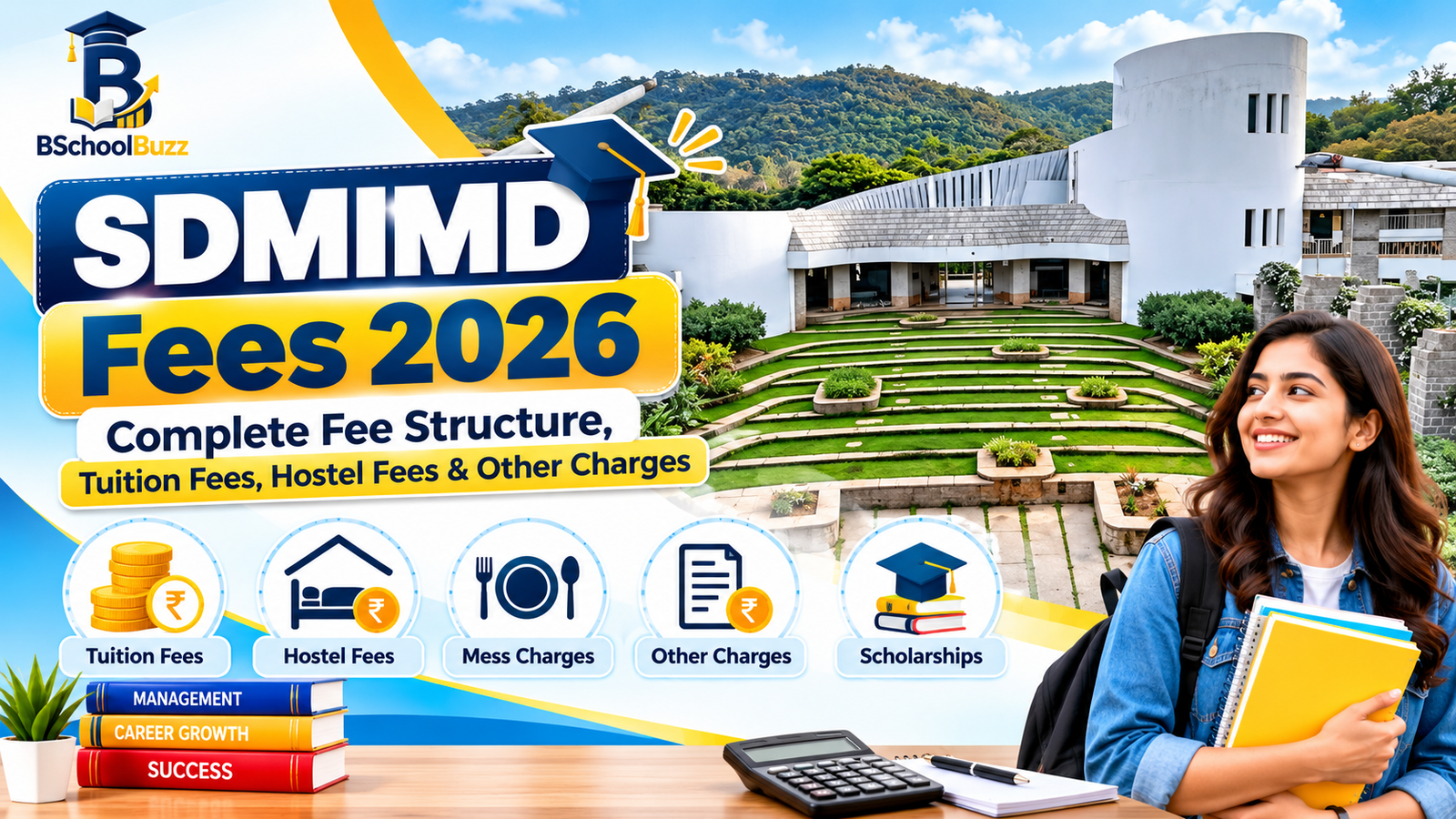
- SDMIMD's published PGDM fee for the 2026–28 batch is ₹14.10 lakh for two years, including tuition and hostel stay.
- Food and mess expenses are charged separately, with an approximate cost of ₹35,000 per year.
- The indicative total for the programme fee and two years of food expenses is ₹14.80 lakh, excluding personal expenses and other applicablecharges.
- The fee can be paid in six instalments across six terms; the exact schedule is provided in the admission offer letter.
- Scholarships listed by SDMIMD include entry-merit support, entrance-exam merit support, student-exchange subsidy and a tuition-fee waiverfor eligible students.
- Applicants should verify the current fee, scholarship conditions, refund policy and placement report before making a final decision.
SDMIMD Fees: Complete Fee Structure, Tuition Fees, Hostel Fees & Other Charges
Introduction
Choosing a management institute involves more than comparing tuition fees. Students need to understand the total programme cost, residential expenses, food charges, scholarships, payment deadlines and the financial commitment required over two academic years. For applicants considering SDMIMD Mysore, these details are important when comparing management education options and preparing a realistic budget.
Shri Dharmasthala Manjunatheshwara Institute for Management Development (SDMIMD), Mysuru, offers a two-year, full-time residential Post Graduate Diploma in Management (PGDM). The institute's official programme page lists the fee for the 2026–28 PGDM batch at ₹14.10 lakh, covering tuition and hostel accommodation. Food expenses are charged separately, with the institute indicating an approximate cost of ₹35,000 per year. The published fee is subject to revision for the 2027–29 batch. Official PGDM programme and fee details.
This article explains the published SDMIMD Mysore fee structure, additional expenses, instalment arrangements, scholarship opportunities, admission requirements and placement information. It also identifies the details prospective students should confirm directly with the institute before paying an admission instalment.
Important: The ₹14.10 lakh figure specifically relates to the 2026–28 PGDM batch. Applicants for another intake should use the fee applicable to their admission offer rather than automatically applying an earlier batch's charges.
Table of Contents
SDMIMD Mysore: Institute Overview
SDMIMD Fees 2026–28: Total Programme Cost
Tuition Fees and Hostel Charges
Food and Mess Expenses
Other Charges and Personal Expenses
Fee Instalments and Payment Planning
SDMIMD Scholarships for PGDM Students
Scholarship Eligibility and Conditions
SDMIMD Admission Eligibility
Entrance Examinations Accepted
SDMIMD Admission Process
Documents to Prepare for Admission
Refunds, Withdrawals and Fee Revision
SDMIMD Placements and Salary Figures
Understanding the Cost and Potential Return
How to Budget for SDMIMD Mysore
Questions to Ask Before Paying Fees
Official Information and Contact Details
Conclusion
About BSchoolBuzz
Related Search Keywords
1. SDMIMD Mysore: Institute Overview
SDMIMD is a management institute located in Mysuru, Karnataka. Its flagship programme is a two-year, full-time residential PGDM intended for graduates interested in management careers.
The programme combines classroom learning with electives, projects, case-based learning and a summer internship. According to the institute, the PGDM is approved by the All India Council for Technical Education (AICTE), accredited by the National Board of Accreditation (NBA), and recognised as equivalent to an MBA by the Association of Indian Universities (AIU). The institute also lists international EFMD accreditation for its PGDM programme. Students should consult the official website for the current status and applicable scope of each recognition.
SDMIMD PGDM at a glance
| Particular | Details |
|---|---|
| Institute | Shri Dharmasthala Manjunatheshwara Institute for Management Development |
| Common name | SDMIMD Mysore |
| Location | Mysuru, Karnataka |
| Flagship programme | Post Graduate Diploma in Management (PGDM) |
| Programme duration | Two years |
| Study format | Full-time, residential |
| Fee published for | PGDM 2026–28 batch |
| Programme fee | ₹14.10 lakh |
| What the stated fee covers | Tuition and hostel stay |
| Food expenses | Charged separately |
| Instalment arrangement | Six instalments across six terms |
| Entrance examinations listed | CAT, XAT, GMAT, CMAT, ATMA, MAT |
| MBA equivalence | Recognised by AIU, according to the institute |
| Official website | https://www.sdmimd.ac.in/ |
Source: SDMIMD official PGDM page.
The institute's residential format is an important factor when evaluating the fee. The published programme cost includes hostel stay, but students should not assume that every living expense is included. Food, personal purchases, travel and other individual expenses need separate consideration.
2. SDMIMD Fees 2026–28: Total Programme Cost
The most important figure for applicants is the published two-year programme fee.
SDMIMD fee structure
| Fee component | Published amount or status |
|---|---|
| Two-year PGDM programme fee | ₹14.10 lakh |
| Tuition fee | Included in the programme fee; separate amount not stated on the main fee summary |
| Hostel stay | Included in the programme fee; separate amount not stated on the main fee summary |
| Food and mess expenses | Approximately ₹35,000 per year |
| Approximate food expenses for two years | ₹70,000, calculated from the institute's annual estimate |
| Programme fee plus estimated two-year food expenses | Approximately ₹14.80 lakh |
| Personal expenses | Additional; depends on the student |
| Travel and other individual costs | Additional where applicable |
Source: SDMIMD official PGDM fee structure.
What does the ₹14.10 lakh fee mean?
The published ₹14.10 lakh is the combined fee for tuition and hostel accommodation for the two-year PGDM. It should not be interpreted as a tuition-only charge.
The institute states that fees can be paid in six instalments distributed across six terms. The payment schedule is provided with the admission offer letter. This arrangement spreads payments over the programme rather than requiring the entire stated programme fee in a single instalment.
The institute also says that breakfast, lunch and dinner are served through the mess, with food expenditure charged separately on a monthly basis. The published estimate is approximately ₹35,000 per year.
A practical budget calculation
Using the fee and food estimate published by SDMIMD:
| Calculation | Amount |
|---|---|
| Programme fee for two years | ₹14,10,000 |
| Estimated food expenses for two years | ₹70,000 |
| Indicative combined amount | ₹14,80,000 |
The ₹14.80 lakh figure is a calculation based on the institute's stated programme fee and estimated food expenses. It is not a separately published all-inclusive fee. It excludes personal spending and any additional charges that may apply to an individual student.
Food costs are estimates and may change with actual expenditure. Applicants should obtain the latest fee schedule and a written list of any additional compulsory charges before making a final budget.
3. Tuition Fees and Hostel Charges
Tuition and hostel accommodation form the two stated components of the ₹14.10 lakh programme fee.
Tuition fees
Tuition covers the academic component of the programme. However, the main official PGDM fee summary does not provide a separate tuition-only figure for the 2026–28 batch. It would therefore be misleading to divide the combined fee into invented tuition and accommodation amounts.
Applicants who need an itemised breakdown for education loans, employer reimbursement or personal financial planning should request a current, programme-specific statement from the admissions or accounts office.
Hostel fees
SDMIMD describes its PGDM as a residential programme and states that hostel stay is included in the published programme fee. The institute also lists single-occupancy hostel rooms among its programme highlights.
Even when accommodation is included, students should verify what the hostel component covers. For example, applicants may wish to confirm whether room-related deposits, laundry, optional services, damage charges or other facilities carry separate charges. These should not be treated as compulsory fees unless the institute confirms that they apply.
What should students verify?
Before accepting an offer, ask the institute to confirm:
The tuition and hostel amounts shown separately in the fee schedule, if available.
Whether the quoted amount covers the entire two-year duration for the applicable batch.
Whether any refundable security deposit is payable separately.
Whether accommodation is guaranteed for the full programme.
Whether there are additional charges for particular hostel facilities.
How a scholarship affects the amount payable and the timing of the adjustment.
The purpose of these questions is to establish the actual payment obligation, not to assume that additional charges necessarily exist.
4. Food and Mess Expenses
Food is the principal separately identified recurring expense in the official fee summary.
The institute indicates an approximate food expenditure of ₹35,000 per year. On that basis, the estimated cost over two years is ₹70,000.
Food expense calculation
| Period | Approximate food expense |
|---|---|
| One year | ₹35,000 |
| Two years | ₹70,000 |
| Monthly equivalent of the annual estimate | Approximately ₹2,917 |
The monthly equivalent is a mathematical calculation of the annual estimate, not a guaranteed monthly bill. Actual payments may vary because the institute says food is charged monthly according to distributed expenditure.
Is the mess fee included in SDMIMD fees?
The official programme page says the ₹14.10 lakh fee covers tuition and hostel stay, while food is charged separately. Students should therefore budget for mess expenditure in addition to the stated programme fee.
How should students plan for food costs?
Applicants should avoid treating ₹35,000 per year as a fixed amount for the entire duration. The institute describes it as approximate, so actual expenses can differ.
Before joining, confirm:
How and when monthly mess charges are collected.
Whether the amount is based on actual consumption or shared expenditure.
Whether any mess deposit is payable.
How food charges are handled during internships, holidays or approved periods away from campus.
Whether the estimate has changed for the relevant admission batch.
The latest written instructions from SDMIMD should take precedence over a budget prepared from an older estimate.
5. Other Charges and Personal Expenses
The main PGDM fee page identifies tuition, hostel stay and separately charged food. It does not provide a complete itemised list of every possible personal or administrative expense.
Students should distinguish between three categories: amounts already included in the programme fee, recurring costs charged separately, and optional or individual expenses.
Expenses to consider
| Expense category | Treatment for budgeting |
|---|---|
| Tuition | Included in the stated programme fee |
| Hostel stay | Included in the stated programme fee |
| Food and mess | Separately charged; approximate annual estimate published |
| Application fee | Official PGDM page lists ₹1,500; confirm the current applicable amount before paying |
| Books and stationery | Budget according to personal requirements and course instructions |
| Laptop and accessories | Depends on the student's existing equipment and programme requirements |
| Local travel | Depends on personal travel |
| Travel to and from Mysuru | Depends on home location and frequency of travel |
| Laundry and personal care | Individual expense |
| Telephone and internet use outside included facilities | Depends on usage and available services |
| Optional activities or travel | Depends on participation and applicable charges |
| Security deposit | Check the current offer and fee documents; do not assume an amount |
| Other compulsory charges | Obtain written confirmation from the institute |
The table is a planning checklist, not a declaration that every listed item is charged by SDMIMD. Some costs may not apply, may be covered by existing facilities or may depend on the student's choices.
Why the distinction matters
Suppose a student compares two management programmes based only on their advertised tuition. That comparison can be misleading if one programme includes accommodation while another requires the student to arrange it independently.
For SDMIMD, the published ₹14.10 lakh already includes hostel stay. The student should add the separately estimated food expenditure and personal expenses without adding a second hostel charge to the same calculation.
A useful budgeting document should show each cost once, identify whether it is compulsory, and specify whether it is payable to the institute or an outside provider.
6. Fee Instalments and Payment Planning
SDMIMD states that the programme fee may be paid in six instalments across six terms. The schedule is provided with the offer letter.
The official programme page does not publish the individual instalment amounts in its main fee summary. Therefore, applicants should not rely on an assumed equal division of ₹14.10 lakh into six payments. The actual instalment values and due dates must be taken from the offer letter or the current official fee schedule.
How to prepare for the instalments
Step 1: Obtain the offer letter.
Read the fee section carefully and identify the amount required to block or confirm the seat.
Step 2: Record every due date.
Create a calendar with all six payment deadlines. Do not assume that instalments fall at equal intervals or carry equal amounts.
Step 3: Separate programme fees from food charges.
The main programme fee and mess expenses are treated separately by the institute. Plan for both.
Step 4: Confirm scholarship adjustments.
If a scholarship is awarded, ask how it will affect the instalments and whether the benefit is credited immediately or later.
Step 5: Keep payment evidence.
Save receipts, transaction references, official emails and any revised fee schedule.
Step 6: Ask about late payment.
Check the applicable consequences of missing a deadline. Do not rely on a penalty schedule from a previous batch.
What if a student is taking an education loan?
The payment calendar should be shared with the bank or lender early. A loan sanction does not necessarily mean that the bank will release funds automatically before every instalment deadline.
Students should check:
Whether the lender accepts the institute's fee letter.
Whether the loan covers tuition, hostel and mess expenses.
Which expenses require self-funding.
Whether disbursement happens directly to the institute.
Whether any margin money or initial payment is required.
What documents are needed for each release.
The precise loan conditions depend on the lender and the applicant's circumstances. They are not determined by the institute's advertised fee alone.
7. SDMIMD Scholarships for PGDM Students
Scholarships can reduce the effective cost of management education, but the benefit depends on eligibility, selection and the scheme's terms. SDMIMD publishes scholarship information for its PGDM programme, including merit-based support, an entrance-examination merit scholarship, a student-exchange subsidy and a tuition-fee scholarship for eligible economically weaker students.
The following amounts are published on the institute's official scholarship page for the 2026–28 PGDM batch. Applicants should reconfirm their applicability for another intake.
Published scholarship schemes
| Scholarship scheme | Published benefit | Main condition shown by SDMIMD |
|---|---|---|
| Entry Merit Scholarship (EMS) | ₹75,000 | Minimum 75% each in Class 10, Class 12/PUC 2 and degree, for finally selected applicants |
| Entrance Exam Merit Scholarship (EEMS) | ₹1,00,000 | 85 percentile or higher in CAT/XAT and GMAT, as described on the official page |
| Student Exchange Subsidy (SES) | ₹40,000–₹1,25,000 | For eligible students selected for an international student-exchange programme; amount depends on host location |
| Merit Tuition Fee Scholarship (MTFS) | 100% tuition-fee waiver | Maximum of five meritorious students from economically weaker backgrounds, subject to applicable conditions |
Source: SDMIMD official scholarships and loans page.
Entry Merit Scholarship
The Entry Merit Scholarship is intended for finally selected applicants who meet the stated academic threshold. The published requirement is at least 75% in each of the three listed stages: Class 10, Class 12 or PUC 2, and degree.
The wording indicates that the threshold applies to each stage, rather than simply to an average across all qualifications. Applicants should confirm how the institute treats grading systems, equivalent qualifications and final-year results.
Entrance Exam Merit Scholarship
The institute lists a ₹1,00,000 Entrance Exam Merit Scholarship for candidates with a score of 85 percentile or higher in CAT/XAT and GMAT, as stated on its scholarship page.
Because examination scores use different reporting formats, applicants should obtain written confirmation of the exact qualifying score, exam validity period and documentation required. The official page's wording should be checked directly when determining whether a particular result qualifies.
Student Exchange Subsidy
Eligible students selected for international exchange may receive a subsidy between ₹40,000 and ₹1,25,000, depending on the host institution's location. This benefit is associated with student exchange, so applicants should not automatically deduct it from the standard programme fee.
A student should first establish whether they are eligible and selected for an exchange opportunity, then confirm the subsidy amount and the expenses it is intended to support.
Merit Tuition Fee Scholarship
SDMIMD states that its Merit Tuition Fee Scholarship can provide a 100% tuition-fee waiver to a maximum of five meritorious students from economically weaker backgrounds.
This does not necessarily mean that hostel, food and every other expense are waived. The official description specifically refers to tuition and says recipients pay applicable non-tuition fees. Students considering this scheme should request the application form, eligibility conditions, selection criteria and the exact amount that would remain payable.
8. Scholarship Eligibility and Conditions
Scholarship amounts should not be treated as automatic discounts for every admitted student. SDMIMD publishes conditions that affect how some benefits are awarded and applied.
Important published conditions
EMS and EEMS are mutually exclusive. The institute says a student receives whichever of the two is higher, rather than both together.
Scholarship amounts other than the Student Exchange Subsidy are adjusted against the final instalment, according to the published terms.
Scholarships are subject to the student joining and successfully completing the programme on schedule.
The institute's term-wise merit incentive requires a minimum CGPA of 3.25 in all terms, as specified on its scholarship page.
Student-exchange support depends on selection and the location of the host institution.
These terms matter when calculating the money required at the beginning of the programme. A scholarship that is adjusted against a later instalment may not reduce the initial payment due at admission.
Term-wise merit incentives
The institute also lists financial incentives based on term rankings for students who meet the stated CGPA condition.
| Term | Rank 1 | Rank 2 | Rank 3 |
|---|---|---|---|
| Term 1 | ₹10,000 | ₹5,000 | ₹2,500 |
| Term 2 | ₹20,000 | ₹10,000 | ₹5,000 |
| Term 3 | ₹25,000 | ₹15,000 | ₹10,000 |
| Term 4 | ₹30,000 | ₹15,000 | ₹10,000 |
| Term 5 | ₹40,000 | ₹20,000 | ₹15,000 |
| Term 6 | ₹50,000 | ₹25,000 | ₹20,000 |
Source: SDMIMD scholarship terms.
The institute states that these rewards are paid after completion of the course. Students should therefore avoid assuming that a term-wise award will be available immediately to fund the next fee instalment.
How to estimate the fee after a scholarship
For example, an applicant who is formally awarded the ₹75,000 Entry Merit Scholarship could calculate a nominal programme-fee balance of ₹13.35 lakh before separately charged food expenses and personal costs, assuming the full scholarship is applied against the stated ₹14.10 lakh fee.
This is an illustration of arithmetic, not a guarantee of the payment schedule or the amount due at admission. The scholarship's actual application must follow the institute's offer and scholarship terms. Applicants should also verify whether any additional non-tuition charges remain payable.
9. SDMIMD Admission Eligibility
Fee planning should begin alongside eligibility checks. Paying an application fee or beginning the admission process does not itself guarantee admission or scholarship eligibility.
According to SDMIMD's official PGDM page, applicants should meet the following broad requirements:
| Requirement | Officially stated information |
|---|---|
| Academic qualification | Graduation or final-year graduation |
| Graduation type | Full-time degree in any discipline recognised by UGC/AIU |
| Academic performance | Consistent academic record with at least 50% aggregate in Class 10, Class 12 and degree |
| Entrance examination | A valid score in one of the listed accepted examinations |
| Selection | Shortlisting followed by a personal interview |
| Work experience | Considered where applicable during shortlisting |
Source: SDMIMD PGDM eligibility.
Final-year students may apply, subject to the institute's rules. The official page says their academic percentage may be considered up to the second year or last completed semester when relevant.
Applicants should read the current admission instructions carefully, especially if they are awaiting final graduation results, have a non-standard grading system or need clarification about eligibility equivalence.
10. Entrance Examinations Accepted
The official PGDM page lists the following examinations:
| Examination | Abbreviation |
|---|---|
| Common Admission Test | CAT |
| Xavier Aptitude Test | XAT |
| Graduate Management Admission Test | GMAT |
| Common Management Admission Test | CMAT |
| AIMS Test for Management Admissions | ATMA |
| Management Aptitude Test | MAT |
Source: SDMIMD PGDM admissions information.
The institute says scores are considered according to the validity rules of the respective examinations. Applicants should confirm that their score is valid for the intended admission cycle and that the score report has been submitted correctly.
Is there a fixed SDMIMD cutoff?
A single guaranteed cutoff should not be assumed unless the institute publishes one for the relevant batch and category. SDMIMD describes shortlisting as considering academic consistency, competitive examination performance, extracurricular participation and work experience where applicable.
This means applicants should review the complete selection process rather than treating one entrance-score figure as a guaranteed admission threshold. A qualifying score and a final offer are different stages of selection.
11. SDMIMD Admission Process
The admission process described by SDMIMD includes application, shortlisting, an interview, an offer and fee payment.
Step 1: Submit the application
Complete the online application through the institute's official admissions route. The main PGDM page lists an application fee of ₹1,500. Verify the current amount and payment instructions before submitting the form.
Step 2: Provide entrance-examination details
Submit the applicable CAT, XAT, GMAT, CMAT, ATMA or MAT score in accordance with the institute's instructions. If a score is not yet available, follow the current admissions team's directions for updating the application.
Step 3: Shortlisting
The institute considers factors including academic performance, entrance examination results, extracurricular activities and relevant work experience where applicable.
Step 4: Attend the personal interview
Shortlisted applicants are invited to an interview. The schedule and interview mode should be checked through the current admission portal or official communication.
Step 5: Receive the offer letter
Selected candidates receive an offer with the applicable instructions. The offer letter is an important document because it should clarify the fee amount, instalment deadlines and conditions for securing a place.
Step 6: Pay the required instalment
SDMIMD says a seat is blocked after receipt of the first instalment by the deadline specified in the offer letter. Seat confirmation is subject to the entrance score and payment of the second instalment, as stated on the programme page.
Applicants should follow the instructions in their own offer letter rather than relying on general dates or schedules from a previous admission cycle.
12. Documents to Prepare for Admission
The exact document list should be taken from the current application portal and offer instructions. As a practical preparation checklist, applicants can keep the following documents ready where applicable:
Class 10 marksheet or certificate.
Class 12 or PUC marksheet.
Graduation marksheets and degree certificate, if issued.
Latest available marksheets for final-year students.
Entrance-examination scorecard.
Government-issued identity document.
Recent photographs, if requested.
Work-experience proof, if applicable.
Scholarship-related academic records, if applying.
Category or income documents, if specifically required for a relevant scheme.
Copies of the application, offer letter and payment receipts.
This is a preparation list, not a claim that every document is mandatory in every case. The institute may request additional or different documents depending on the applicant's circumstances.
13. Refunds, Withdrawals and Fee Revision
Refunds and withdrawals can materially affect the financial risk of joining a management programme. The published headline fee alone does not establish how much money will be returned if a student cancels admission.
Applicants should obtain the current written refund and cancellation policy applicable to their batch before paying a substantial instalment.
Questions about refunds
Confirm the following directly with SDMIMD:
What is the deadline for withdrawing from admission?
Which instalments, if any, are refundable?
Is there a separate application or registration charge that is non-refundable?
Are any deposits refundable, and what conditions apply?
How is the refund calculated if a student withdraws after joining?
What documents are required to submit a cancellation request?
What is the expected processing procedure and timeline?
Do not infer a refund entitlement from the fact that a charge is called a deposit. The applicable written policy and payment receipt should establish whether an amount is refundable and under what conditions.
Fee revision for later batches
SDMIMD's official programme page states that the fee is subject to revision for the 2027–29 PGDM batch. Therefore, the 2026–28 amount should not be treated as a guaranteed price for a later intake.
For applicants considering 2027–29 admission, the correct approach is to review the latest fee displayed by the institute and the amount stated in the admission offer. If those figures differ, seek written clarification before payment.
14. SDMIMD Placements and Salary Figures
Placement outcomes are relevant to the financial decision, but they should be examined separately from the fee schedule. A salary figure does not guarantee that every graduate will receive the same offer or that a student's personal expenses will be recovered within a particular period.
SDMIMD maintains an official placements website with batch-specific reports. The site lists placement reports for the 2024–26, 2023–25 and earlier PGDM batches, along with information for recruiters and the current recruitment process. See the official SDMIMD placements website.
Which placement figures should applicants use?
Use the placement report that corresponds to the relevant graduating batch. Where the report provides them, review:
Average salary.
Median salary.
Highest salary.
Number of students included in the report.
Number of students placed.
Number of participating recruiters.
Domestic and international offers, if separately reported.
Salary components and whether figures are annual CTC.
The distribution of offers across salary ranges.
The report's publication date and batch.
A highest package is the top reported outcome, not a typical salary. An average can also be influenced by a small number of high offers. The median often provides another useful point of comparison because it represents the midpoint of the reported distribution.
Avoid mixing placement years
A placement number from one graduating batch should not be combined with the fees of another batch without explaining the difference. The fee discussed in this article is for the 2026–28 intake, while a placement report for a completed batch necessarily describes students who enrolled earlier.
For a fair financial assessment, compare several indicators and understand their batch years. The official placement report should be the primary source for exact figures.
15. Understanding the Cost and Potential Return
The financial value of a PGDM depends on more than the programme fee or the highest salary reported by the institute. Students should compare the cost of attendance with realistic career expectations, personal circumstances and alternative programmes.
Begin with the cost of attendance
For the 2026–28 batch, the published programme fee is ₹14.10 lakh. Adding the institute's approximate food estimate for two years gives an indicative figure of ₹14.80 lakh before personal expenses and any other applicable costs.
That figure can serve as a starting point for budgeting, but it is not the same as the total amount every student will spend. Personal travel, equipment, lifestyle choices and other circumstances can change the final amount.
Consider the salary figures carefully
When assessing placements, do not use the highest package as the expected outcome for an individual student. Review the average and median alongside the number of students placed and the salary distribution where available.
Also distinguish between CTC and take-home pay. CTC may include components that are not received as monthly cash salary. Loan repayment and living expenses should be planned using realistic cash-flow expectations rather than the largest advertised package.
Understand the difference between salary and return on investment
A simple comparison between programme fee and annual salary can be useful for an initial discussion, but it is not a complete ROI calculation. A proper assessment should consider:
Total education expenditure.
Interest payable on any education loan.
Salary received after tax and payroll deductions.
Living expenses after graduation.
Time required to secure a suitable job.
Career progression and the possibility of changing roles.
The student's existing financial obligations.
The opportunity cost of spending two years in full-time education.
Students should not assume that the programme fee will be recovered in a fixed number of months. Employment outcomes and personal financial circumstances vary.
Compare programmes on a like-for-like basis
When comparing SDMIMD with another management institute, examine the same categories for both institutions:
| Comparison factor | What to check |
|---|---|
| Tuition and programme fee | Is the figure annual or for the entire programme? |
| Accommodation | Is hostel stay included? |
| Food | Is the mess fee included or charged separately? |
| Payment schedule | How many instalments are required, and when? |
| Scholarships | What are the eligibility conditions and timing of the benefit? |
| Placement data | Are figures for the same type of programme and a clearly identified batch? |
| Accreditation | What is the current status and scope of the recognition? |
| Programme structure | What specialisations, electives, internships and learning opportunities are offered? |
| Refund policy | What happens if admission is cancelled? |
| Loan planning | Which costs are eligible for financing under the chosen lender's terms? |
This approach helps prevent a misleading comparison in which one institute's tuition-only figure is compared with another institute's tuition-plus-hostel fee.
16. How to Budget for SDMIMD Mysore
A practical budget should separate fixed programme charges from recurring expenses and individual spending. This makes it easier to decide how much funding is required before joining and how much must remain available throughout the course.
Suggested budget worksheet
| Budget item | Amount to enter |
|---|---|
| Published two-year programme fee | ₹14,10,000 for PGDM 2026–28 |
| Estimated two-year food expense | Approximately ₹70,000 |
| Application fee | Verify current amount; official page lists ₹1,500 |
| Personal and study expenses | Enter your own estimate |
| Travel expenses | Enter your own estimate |
| Separate compulsory charges, if any | Use the official fee schedule |
| Scholarship confirmed in writing | Deduct only according to the applicable terms |
| Education-loan funding | Enter the amount approved by the lender |
| Family or personal contribution | Calculate after confirming all costs |
Do not deduct a scholarship merely because an applicant appears to meet the eligibility criteria. Include it in the final calculation only after the institute confirms the award and explains how it will be adjusted.
Plan for the first payment separately
The amount required to secure a seat may differ from the average instalment. Because the institute provides the payment schedule in the offer letter, applicants should establish the first due amount before making financial commitments.
If an education loan is still being processed, the first instalment deserves particular attention. Applicants should discuss the timing with both the institute and lender rather than assuming that a loan will be approved or released by a particular date.
Maintain a contingency amount
A contingency reserve can help cover changes in food expenditure, travel, personal purchases or other legitimate costs. Its size depends on the student's circumstances; there is no single official contingency amount published in the main fee summary.
The reserve should be separate from money already committed to the institute's scheduled payments.
17. Questions to Ask Before Paying Fees
Before making a payment, applicants can use the following checklist to reduce the risk of misunderstanding the financial commitment.
Fee and payment questions
Is ₹14.10 lakh the correct fee for my specific admission batch?
Does the fee include all tuition and hostel charges for the full programme?
Can the institute provide a written itemised fee statement?
What are the six instalment amounts and due dates?
Are there any compulsory charges outside the published programme fee?
How are monthly food charges calculated and collected?
What payment methods are currently accepted?
Scholarship questions
Which scholarship schemes apply to my admission batch?
Do I meet every eligibility condition?
Are EMS and EEMS mutually exclusive in my case?
When is the scholarship credited or adjusted?
Does the scholarship reduce the first instalment or a later payment?
Which non-tuition expenses remain payable?
Cancellation and documentation questions
What is the current refund policy?
What happens if I withdraw before joining?
What happens if I withdraw after joining?
Which documents are required to establish scholarship eligibility?
What official receipt will be provided for each payment?
Whom should I contact if my fee statement differs from the admission offer?
Written answers are especially useful when the applicant is relying on a family budget, an education loan or financial support from an employer.
18. Official Information and Contact Details
For final fee confirmation, use SDMIMD's own website and admissions communication rather than relying solely on summaries published elsewhere.
| Information required | Official source |
|---|---|
| PGDM fee and programme details | Official PGDM page |
| Scholarships and eligibility conditions | Official scholarships page |
| Placement reports | Official placements website |
| Institute website | www.sdmimd.ac.in |
Institute: Shri Dharmasthala Manjunatheshwara Institute for Management Development
Address: No. 1, Chamundi Hill Road, Siddarthanagar Post, Mysuru – 570011, Karnataka, India.
Telephone: +91-821-2429722, +91-821-2420490
Email: contact@sdmimd.ac.in
These contact details are published on the institute's official website. Applicants should use the current admissions contact details and follow the instructions relevant to their admission cycle.
19. Conclusion
SDMIMD Mysore's published fee for the two-year PGDM 2026–28 batch is ₹14.10 lakh, including tuition and hostel stay. Food expenses are charged separately, with the institute indicating an approximate annual cost of ₹35,000. Using that estimate, the combined programme and food amount is approximately ₹14.80 lakh for two years, before personal expenses and any other applicable charges.
Scholarships may reduce the effective cost for eligible applicants, but their conditions and timing matter. The institute lists entry-merit support, entrance-examination merit support, student-exchange subsidies and a tuition-fee waiver for a limited number of eligible students. Applicants should confirm their eligibility and the exact payment adjustment in writing.
For a sound decision, read the fee schedule alongside the admission offer, refund policy, scholarship terms and the placement report for the relevant graduating batch. Since SDMIMD states that fees can change for the 2027–29 batch, students applying for a later intake should not treat the 2026–28 amount as a guaranteed future price.
The most useful financial plan is one that includes the full programme fee, separately charged food, personal costs and the actual instalment deadlines. Confirming those details directly with SDMIMD before paying will help applicants prepare a more realistic budget.
About BSchoolBuzz
BSchoolBuzz helps students explore management education by organising information about institutes, programmes, fees, admissions, scholarships and placements. Its goal is to make college research easier to understand so applicants can compare important factors before making an academic decision.
For fee-related decisions, readers should always check the latest official institute documents and their own admission offer. Programme fees, eligibility rules, scholarships and placement figures can change between admission cycles, so confirming the applicable year is an essential part of responsible college research.
Related Search Keywords
SDMIMD Mysore fees, SDMIMD fees, SDMIMD fee structure, SDMIMD PGDM fees, SDMIMD Mysore PGDM fees, SDMIMD fees 2026, SDMIMD PGDM fees 2026-28, SDMIMD Mysore fee structure 2026, SDMIMD total fees, SDMIMD tuition fees, SDMIMD hostel fees, SDMIMD mess fees, SDMIMD food charges, SDMIMD programme fee, SDMIMD two year fees, SDMIMD admission fees, SDMIMD application fee, SDMIMD scholarship, SDMIMD merit scholarship, SDMIMD entrance exam scholarship, SDMIMD tuition fee waiver, SDMIMD student exchange subsidy, SDMIMD education loan, SDMIMD payment schedule, SDMIMD fee instalments, SDMIMD fee per year, SDMIMD fee for MBA equivalent, SDMIMD PGDM admission, SDMIMD eligibility, SDMIMD entrance exams, SDMIMD CAT admission, SDMIMD XAT admission, SDMIMD MAT admission, SDMIMD CMAT admission, SDMIMD GMAT admission, SDMIMD ATMA admission, SDMIMD cutoff, SDMIMD selection process, SDMIMD personal interview, SDMIMD placement, SDMIMD placements 2026, SDMIMD average package, SDMIMD highest package, SDMIMD median package, SDMIMD placement report, SDMIMD ROI, SDMIMD PGDM review, SDMIMD Mysore admission 2026, SDMIMD admission 2027, SDMIMD 2027-29 fees, SDMIMD fee revision, SDMIMD refund policy, SDMIMD cancellation policy, SDMIMD residential PGDM, SDMIMD single occupancy hostel, SDMIMD hostel accommodation, SDMIMD course duration, SDMIMD PGDM specialisations, SDMIMD accreditation, SDMIMD AICTE approval, SDMIMD NBA accreditation, SDMIMD AIU MBA equivalence, SDMIMD EFMD accreditation, SDMIMD Mysuru campus, SDM Institute for Management Development fees, Shri Dharmasthala Manjunatheshwara Institute for Management Development fees, SDMIMD fee including hostel, SDMIMD fee including food, SDMIMD PGDM total cost, SDMIMD total cost including mess, SDMIMD tuition and accommodation fees, SDMIMD cost of attendance, SDMIMD PGDM cost for two years, SDMIMD PGDM fee payment terms, SDMIMD six instalment fee structure, SDMIMD first instalment amount, SDMIMD admission fee payment deadline, SDMIMD fee offer letter, SDMIMD official fee details, SDMIMD official scholarship eligibility, SDMIMD scholarship amount 2026, SDMIMD entry merit scholarship criteria, SDMIMD CAT percentile scholarship, SDMIMD XAT percentile scholarship, SDMIMD entrance merit scholarship eligibility, SDMIMD economically weaker students scholarship, SDMIMD 100 percent tuition fee waiver, SDMIMD term wise merit scholarship, SDMIMD CGPA scholarship requirement, SDMIMD scholarship adjustment, SDMIMD scholarship last instalment, SDMIMD exchange programme subsidy, SDMIMD PGDM application fee 2026, SDMIMD PGDM eligibility criteria 2026, SDMIMD graduation marks requirement, SDMIMD 50 percent eligibility, SDMIMD final year admission, SDMIMD accepted entrance exams 2026, SDMIMD documents required for admission, SDMIMD admission interview process, SDMIMD admission offer process, SDMIMD hostel and tuition combined fees, SDMIMD fees after scholarship, SDMIMD PGDM expenses, SDMIMD student living expenses, SDMIMD Mysore education loan, SDMIMD hostel cost for two years, SDMIMD mess expenditure per year, SDMIMD monthly food expense, SDMIMD fee comparison, SDMIMD fees versus placement package, SDMIMD salary outcomes, SDMIMD placement statistics by batch, SDMIMD placement 2024-26, SDMIMD placement 2023-25, SDMIMD official placement reports, SDMIMD refund rules for admission cancellation, SDMIMD refundable charges, SDMIMD fee receipt, SDMIMD accounts office contact, SDMIMD admissions contact, SDMIMD official website fees, SDMIMD Mysore PGDM review and fees, SDMIMD Mysore cost for management education, SDMIMD PGDM fee details for parents, SDMIMD fee planning for students, SDMIMD PGDM scholarship and fees, SDMIMD admission expenses, SDMIMD tuition fee breakup, SDMIMD accommodation fee breakup, SDMIMD fee structure for incoming batch, SDMIMD current PGDM fee, SDMIMD latest official fees, SDMIMD PGDM 2026 intake fees, SDMIMD fee structure 2027-29, SDMIMD hostel charges included in tuition, SDMIMD food charges separate, SDMIMD fee instalment schedule 2026-28, SDMIMD PGDM affordability, SDMIMD management course budget, SDMIMD PGDM fee and scholarships, SDMIMD official admission guidelines, SDMIMD Mysore management institute fees, SDMIMD PGDM fee confirmation.
Key Takeaways
The ₹14.10 lakh fee applies to the SDMIMD PGDM 2026–28 batch.
Tuition and hostel stay are included in the published programme fee.
Food expenses are separate and estimated at approximately ₹35,000 per year.
The combined fee-plus-food estimate is approximately ₹14.80 lakh for two years.
The programme fee may be revised for the 2027–29 batch.
Six instalments are scheduled across six terms.
Scholarship benefits depend on eligibility, selection and scheme-specific terms.
EMS and EEMS are mutually exclusive according to the published scholarship conditions.
Entrance exams listed by the institute include CAT, XAT, GMAT, CMAT, ATMA and MAT.
Check the official offer letter, current refund policy and batch-specific placement report before paying.
Frequently Asked Questions
What are the SDMIMD Mysore fees for 2026–28?
SDMIMD lists a total programme fee of ₹14.10 lakh for its two-year PGDM 2026–28 batch. This includes tuition and hostel stay. Food expenses are charged separately.
Is hostel accommodation included in SDMIMD PGDM fees?
Yes. The institute's official fee summary states that the ₹14.10 lakh programme fee includes hostel stay and tuition. Students should confirm whether any additional hostel-related charges apply to their specific offer.
What are the mess charges at SDMIMD Mysore?
The institute indicates approximate food expenditure of ₹35,000 per year, charged separately according to distributed expenditure. Actual charges may vary, so students should confirm the current arrangement.
What is the estimated total cost of SDMIMD PGDM, including food?
Adding the ₹14.10 lakh programme fee to the approximate two-year food estimate of ₹70,000 gives ₹14.80 lakh. This is a calculation, not an all-inclusive official quote, and it excludes personal expenses and other applicable costs.
Can students pay SDMIMD fees in instalments?
Yes. SDMIMD says the programme fee can be paid in six instalments distributed across six terms. The exact amounts and due dates are supplied with the admission offer letter.
Does SDMIMD offer scholarships?
Yes. The institute lists an Entry Merit Scholarship, an Entrance Exam Merit Scholarship, a Student Exchange Subsidy and a Merit Tuition Fee Scholarship for eligible students. Each scheme has specific conditions, and applicants should consult the official scholarship page.
What is the SDMIMD Entry Merit Scholarship amount?
For the 2026–28 PGDM batch, the published Entry Merit Scholarship is ₹75,000 for finally selected applicants with at least 75% each in Class 10, Class 12/PUC 2 and degree. Confirm the applicable rules for the intended admission cycle.
Which entrance exams does SDMIMD accept for PGDM admission?
The official PGDM page lists CAT, XAT, GMAT, CMAT, ATMA and MAT. Applicants should confirm the score validity requirements and submission procedure for their admission cycle.
Is the SDMIMD fee the same for the 2027–29 batch?
Not necessarily. SDMIMD states that the fee is subject to revision for the 2027–29 PGDM batch. Applicants should use the latest official fee details and their admission offer rather than assuming that the 2026–28 fee will remain unchanged.
Where can I verify the official SDMIMD fee structure?
Visit the official SDMIMD PGDM page for the programme fee and admission information, and the official scholarships page for scholarship terms. For the exact instalment schedule and any additional charges, consult the current offer letter or contact the institute directly.
Ask a question
Still confused? Leave your question and our team will help you.