
Quick Summary
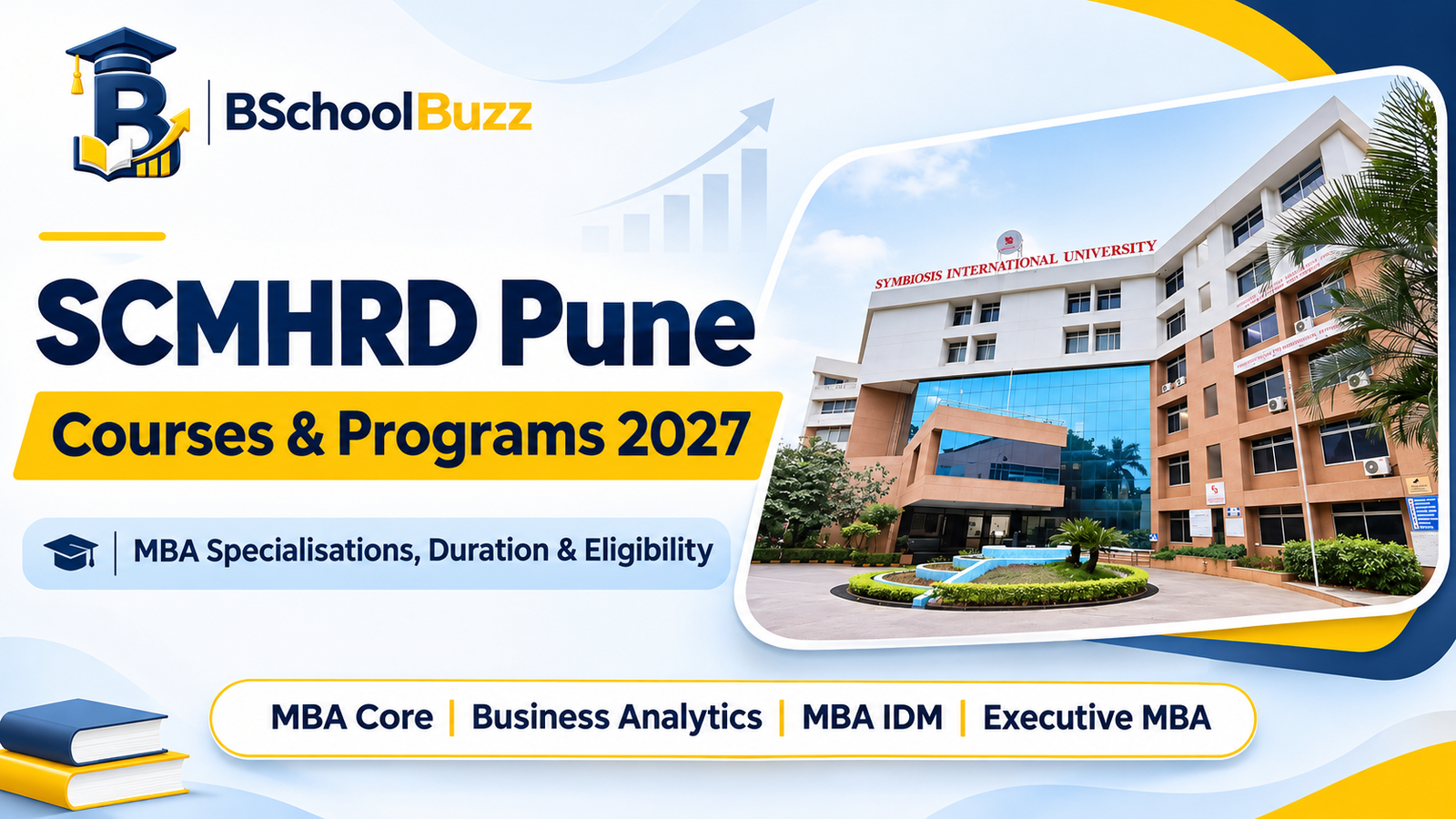
- SCMHRD Pune offers four major management programmes: MBA Core, MBA Business Analytics, MBA Infrastructure Development and Management, and MBA Executive.
- MBA Core is a two-year full-time residential programme with four principal specialisations: Marketing, Finance, Human Resource Management and Operations.
- MBA Business Analytics combines management education with programming, statistics, data visualisation and analytical decision-making.
- MBA Infrastructure Development and Management focuses on infrastructure planning, project execution, project finance and sector-specific management.
- MBA Executive is a two-year weekend programme designed for working professionals.
- The three full-time MBA programmes follow a SNAP-based admission process for Indian applicants.
- MBA Business Analytics requires at least two years of full-time post-graduation work experience.
- MBA IDM accepts eligible engineering, architecture and planning graduates, while non-engineering graduates need at least 12 months of relevant experience.
- MBA Core requires a recognised bachelor's degree with 50% marks, or 45% for SC/ST candidates.
- SCMHRD's current programme catalogue lists MBA degrees rather than a separate PGDM qualification.
- Students should compare programme duration, subjects, specialisations, work experience and career interests before selecting a course.
SCMHRD Pune Courses & Programs 2027: MBA Specialisations, Duration, Subjects & Eligibility
Introduction
Students exploring management education in Pune often consider SCMHRD because of its specialised MBA programmes, management curriculum and industry-oriented learning approach. However, choosing the right programme requires more than looking at the institute's name. Candidates should understand the differences between general management, business analytics, infrastructure management and executive education before applying.
SCMHRD offers multiple management pathways designed for different academic interests and career stages. Its programmes cover traditional business functions, data-driven decision-making, infrastructure development and management education for working professionals.
This article explains the SCMHRD Pune courses, programme structures, specialisations, duration, subjects, eligibility requirements, admission routes and career opportunities. It also clarifies the difference between the full-time MBA programmes and the Executive MBA.
Table of Contents
About SCMHRD Pune
SCMHRD Pune Courses and Programmes Offered
SCMHRD MBA Core Programme
MBA Specialisations at SCMHRD Pune
MBA in Business Analytics
MBA in Infrastructure Development and Management
MBA Executive Programme
SCMHRD Pune Courses – Duration Comparison
SCMHRD Pune Eligibility Criteria
SCMHRD Programme-Wise Eligibility Comparison
SCMHRD MBA Curriculum and Subjects
Teaching Methodology and Learning Approach
Career Opportunities After SCMHRD Courses
How to Choose the Right SCMHRD Programme
SCMHRD Pune Admission Process 2027
SNAP 2026 and MBA Admission Requirements
Programme Intake and Seat Information
Fees and Other Financial Considerations
Important Points Before Choosing an SCMHRD Course
Frequently Asked Questions
Conclusion
1. About SCMHRD Pune
The Symbiosis Centre for Management and Human Resource Development (SCMHRD) is a constituent institute of Symbiosis International (Deemed University), located in Hinjawadi, Pune, Maharashtra.
Established in 1993, SCMHRD focuses on management education, leadership development and professional learning. The institute offers programmes that address different areas of business and management, including finance, marketing, human resources, operations, analytics and infrastructure development.
SCMHRD is accredited by the Association to Advance Collegiate Schools of Business (AACSB). Its official programme information also identifies the National Board of Accreditation (NBA) among its accreditation credentials.
One of the important features of the institute is its range of specialised management programmes. Instead of limiting its offerings to a conventional MBA, SCMHRD provides dedicated programmes for students interested in business analytics and infrastructure development.
Its programme portfolio also includes an Executive MBA designed for working professionals.
What Makes SCMHRD Different?
The institute's educational approach combines academic learning with practical business exposure.
Some important elements of its learning environment include:
Management education across different functional areas.
Specialised programmes in business analytics and infrastructure.
Corporate case studies and practical assignments.
Industry interactions and guest lectures.
Projects and experiential learning.
Opportunities to develop communication and leadership skills.
Access to academic and digital learning resources.
Student-led activities, clubs and committees.
The objective is to help students understand how business organisations function and how management decisions influence organisational performance.
For candidates comparing SCMHRD Pune courses, understanding the institute's programme structure is particularly important because each MBA pathway serves a different professional purpose.
2. SCMHRD Pune Courses and Programmes Offered
SCMHRD's official website lists four major management programmes.
These include three principal full-time MBA programmes and one Executive MBA programme.
Complete List of SCMHRD Courses
| Course Name | Programme Type | Duration | Main Focus |
|---|---|---|---|
| MBA Core | Full-time MBA | 2 Years | General management and functional specialisations |
| MBA Business Analytics | Full-time specialised MBA | 2 Years | Business analytics, data and management |
| MBA Infrastructure Development and Management | Full-time specialised MBA | 2 Years | Infrastructure, project execution and finance |
| MBA Executive | Part-time MBA | 2 Years | Management education for working professionals |
The three full-time programmes follow the SNAP-based admission route for Indian applicants. The Executive MBA has a separate admission process.
Does SCMHRD Offer PGDM Courses?
This is an important clarification for students searching for SCMHRD MBA and PGDM courses.
SCMHRD's official programme catalogue lists Master of Business Administration programmes. It does not list a separate PGDM programme in its current programme portfolio.
Therefore, students should not assume that the MBA and PGDM are two different qualifications offered by SCMHRD.
The institute's programmes include:
Master of Business Administration (MBA).
Master of Business Administration in Business Analytics.
Master of Business Administration in Infrastructure Development and Management.
Master of Business Administration (Executive).
Candidates should always verify the exact qualification awarded for their chosen programme.
Which SCMHRD Course Should You Consider?
The right programme depends on your academic interests and professional objectives.
| Your Interest | Programme to Consider |
|---|---|
| General business and corporate management | MBA Core |
| Marketing and brand management | MBA Core – Marketing |
| Financial management and investment | MBA Core – Finance |
| Human resource management | MBA Core – HR |
| Supply chain and business operations | MBA Core – Operations |
| Data analytics and business intelligence | MBA Business Analytics |
| Infrastructure and construction projects | MBA Infrastructure Development and Management |
| Infrastructure project finance | MBA Infrastructure Development and Management |
| Career development while continuing employment | MBA Executive |
The important point is that candidates should select a programme based on the type of work they want to pursue after graduation, rather than selecting a specialisation only because it appears popular.
3. SCMHRD MBA Core Programme
The MBA Core programme is SCMHRD's flagship management course.
It is a full-time residential MBA designed to provide students with a broad understanding of business management, organisational functions and leadership.
The programme covers the major areas of business administration while allowing students to develop deeper knowledge through functional specialisations and elective courses.
MBA Core – Programme Overview
| Particular | Details |
|---|---|
| Programme Name | Master of Business Administration |
| Programme Type | Full-time residential |
| Duration | 2 Years |
| Academic Structure | 4 Semesters |
| Total Programme Credits | 100 |
| Eligibility | Graduation with prescribed minimum marks |
| Entrance Examination | SNAP |
| Major Specialisations | Marketing, Finance, Human Resources and Operations |
| Published Intake | 180 |
The 2026–2028 official programme structure specifies a duration of 24 months and a four-semester academic pattern.
The curriculum includes core management subjects, elective courses, specialisation-related learning and project work.
What Do Students Study in MBA Core?
Students begin with fundamental management subjects before moving towards more specialised areas.
The curriculum develops knowledge in several business functions.
Business Communication
Business communication helps students develop the ability to present information, communicate professionally and work effectively with different organisational stakeholders.
It supports activities such as:
Business presentations.
Professional writing.
Corporate communication.
Team discussions.
Negotiations.
Client interactions.
Business Statistics
Business statistics introduces quantitative methods used to interpret business information.
Students develop an understanding of statistical techniques, data interpretation and analytical reasoning.
These skills are useful in finance, marketing, operations and business research.
Financial Accounting
Financial accounting introduces students to the preparation and interpretation of financial statements.
Students learn how accounting information supports business decisions and financial reporting.
Managerial Economics
Managerial economics explains how economic concepts influence organisational decisions.
It covers areas such as market behaviour, demand, costs, pricing and resource allocation.
Organisational Behaviour
Organisational behaviour focuses on how individuals and teams behave within organisations.
Students explore leadership, motivation, teamwork, organisational culture and workplace relationships.
Operations Management
Operations management focuses on how organisations plan and control their processes.
It includes areas such as productivity, process improvement, resource planning and operational efficiency.
Human Resource Management
This subject introduces the management of employees and organisational talent.
It includes recruitment, performance management, employee development and workplace policies.
Business Analytics
Business analytics introduces the use of data and analytical techniques to support management decisions.
It helps students understand how organisations can use information to identify patterns and evaluate business performance.
MBA Core Electives
One of the important features of the SCMHRD MBA curriculum is its elective structure.
Students can explore different subjects according to their chosen specialisation and academic interests.
The published 2026–2028 programme structure includes electives such as:
Digital Marketing.
Marketing and Sales Analytics.
Retail Marketing.
Consumer Behaviour.
Brand Management.
HR Analytics.
Talent Acquisition.
Performance Management System.
Commercial Banking.
Corporate Valuation.
Financial Statement Analysis.
International Finance.
Introduction to FinTech.
Lean Six Sigma.
Supply Chain Management.
Warehouse Management.
Project Management.
Business Process Management.
Data Mining.
Data Analysis Using Python.
Visual Analytics.
Machine Learning.
Cloud and Big Data.
These examples demonstrate the breadth of the curriculum. The exact elective basket and availability may vary by academic batch.
Who Should Choose MBA Core?
MBA Core is suitable for candidates who want broad management education and flexibility in choosing their functional area.
It can be considered by:
Fresh graduates.
Candidates from commerce backgrounds.
Engineering graduates interested in management.
Students interested in marketing and finance.
Candidates planning careers in human resources.
Students interested in business operations.
Individuals considering management consulting or corporate leadership roles.
Students who are still exploring different business functions may find the broader curriculum useful.
However, candidates who already have a clear interest in analytics or infrastructure should compare the specialised MBA programmes before deciding.
4. MBA Specialisations at SCMHRD Pune
The MBA Core programme offers four principal functional specialisations.
These are:
Marketing Management.
Finance Management.
Human Resource Management.
Operations Management.
Each specialisation focuses on a different organisational function.
4.1 MBA in Marketing Management
Marketing is concerned with understanding customers, developing products, creating demand and building relationships between businesses and their target markets.
The marketing specialisation helps students understand how organisations develop and implement marketing strategies.
Important Marketing Subjects
The published curriculum includes courses such as:
Digital Marketing.
Consumer Behaviour.
Brand Management.
Retail Marketing.
Sales Force and Channel Management.
Marketing and Sales Analytics.
Integrated Marketing Communication.
Services Marketing.
Marketing Strategy.
Rural Marketing.
Customer Relationship Management.
Sports and Entertainment Marketing.
What Will Students Learn?
Students develop knowledge of how businesses identify customer requirements and position their products and services.
The specialisation also introduces students to marketing research, customer segmentation, brand development and sales management.
Digital platforms and analytics are increasingly important in marketing decisions, so the curriculum also includes opportunities to explore digital and data-oriented subjects.
Career Opportunities After Marketing
Depending on individual capabilities and recruitment opportunities, graduates may explore positions such as:
Marketing Manager.
Brand Manager.
Product Manager.
Marketing Analyst.
Digital Marketing Manager.
Sales Manager.
Market Research Analyst.
Business Development Manager.
Customer Relationship Manager.
Students interested in consumer markets, branding, sales strategy and customer engagement may consider this specialisation.
4.2 MBA in Finance Management
Finance is concerned with how organisations manage money, investments, financial risks and capital.
The finance specialisation develops an understanding of financial decision-making and business performance.
Important Finance Subjects
The published curriculum includes:
Commercial Banking.
Corporate Valuation.
Derivative Markets.
Financial Statement Analysis.
International Finance.
FinTech.
Financial Risk Management.
Fixed Income Markets.
Mergers and Acquisitions.
Security Analysis and Portfolio Management.
Behavioural Finance.
Wealth Management.
Taxation.
Insurance Management.
What Will Students Learn?
Students explore how organisations evaluate investment opportunities and make financial decisions.
They also develop an understanding of:
Financial statement interpretation.
Capital allocation.
Investment analysis.
Risk assessment.
Banking operations.
Corporate finance.
Financial markets.
Valuation techniques.
Quantitative and analytical skills are important for students choosing finance.
Career Opportunities After Finance
Potential career areas include:
Financial Analyst.
Corporate Finance Analyst.
Investment Banking Analyst.
Credit Analyst.
Risk Analyst.
Treasury Analyst.
Wealth Management Professional.
Financial Planning Analyst.
Banking and Financial Services.
Candidates who enjoy working with numbers, financial information and investment decisions may find finance suitable.
4.3 MBA in Human Resource Management
Human Resource Management focuses on managing people and building an effective organisational workforce.
The specialisation examines the relationship between employees, management and organisational objectives.
Important HR Subjects
SCMHRD's published curriculum includes:
Compensation and Reward Management.
Employment Related Laws.
HR Analytics.
Learning and Development.
Performance Management System.
Talent Acquisition.
Conflict and Negotiation.
Economics of Human Resources.
HRD Audit and Scorecard.
Industrial Relations.
Organisational Development and Change.
Talent Management.
Strategic Human Resource Management.
Coaching, Counselling and Mentoring.
What Will Students Learn?
The programme develops knowledge of how organisations attract, develop, motivate and retain employees.
Important learning areas include:
Recruitment strategies.
Workforce planning.
Employee engagement.
Compensation structures.
Performance evaluation.
Training and development.
Labour-related regulations.
Organisational development.
HR analytics.
Strategic workforce management.
Human resource management requires communication skills, professional judgement and the ability to understand organisational behaviour.
Career Opportunities After HR
Graduates may explore roles such as:
HR Manager.
Talent Acquisition Specialist.
HR Business Partner.
Learning and Development Manager.
Compensation and Benefits Analyst.
Employee Relations Specialist.
HR Analytics Professional.
Organisational Development Consultant.
Talent Management Professional.
This specialisation is suitable for students interested in people management, organisational development and workforce strategy.
4.4 MBA in Operations Management
Operations Management focuses on how businesses produce products and deliver services efficiently.
It covers the planning, management and improvement of business processes.
Important Operations Subjects
The published curriculum includes:
Lean Six Sigma.
Service Operations Management.
Supply Chain Management.
Warehouse Management.
Digital Transformation.
E-Business Operations.
International Trade and Logistics.
Internet of Things.
IT Consulting.
Project Management.
Supply Chain Modelling and Design.
Supply Chain Strategy.
Technology in Supply Chain.
Operations Strategy and Control.
Sustainable Supply Chain.
Business Process Management.
Project Risk Management.
What Will Students Learn?
Students develop an understanding of how organisations manage operational activities.
This includes:
Supply chain planning.
Inventory management.
Logistics.
Procurement.
Process optimisation.
Warehouse operations.
Quality management.
Project execution.
Operational risk.
Technology-enabled operations.
Operations management is relevant to manufacturing, logistics, retail, consulting and service organisations.
Career Opportunities After Operations
Possible career paths include:
Operations Manager.
Supply Chain Analyst.
Logistics Manager.
Procurement Manager.
Warehouse Manager.
Process Improvement Consultant.
Business Operations Analyst.
Project Manager.
Supply Chain Planning Specialist.
Candidates interested in process improvement, supply chains and operational efficiency may consider this specialisation.
Comparison of MBA Core Specialisations
| Specialisation | Main Focus | Important Skills | Suitable Career Interests |
|---|---|---|---|
| Marketing | Customers, brands and markets | Communication, research and strategy | Marketing and sales |
| Finance | Money, investments and risk | Quantitative analysis and financial interpretation | Banking and corporate finance |
| HR | People and organisational development | Communication, negotiation and people management | Talent and HR leadership |
| Operations | Processes and supply chains | Analytical thinking and process improvement | Logistics and operations |
Important: SCMHRD's programme page also describes Strategy, Innovation and Entrepreneurship as an important learning area. It should not automatically be treated as a fifth formally listed MBA Core specialisation. Students should distinguish core subjects and electives from the four principal functional specialisations.
5. MBA in Business Analytics
The MBA in Business Analytics is a specialised management programme offered by SCMHRD.
It combines business administration with data analysis, quantitative methods and analytical technologies.
Organisations increasingly use data to evaluate customer behaviour, financial performance, operational efficiency and business opportunities. This programme addresses the management requirements associated with such decisions.
MBA Business Analytics – Programme Overview
| Particular | Details |
|---|---|
| Programme Name | MBA in Business Analytics |
| Programme Type | Full-time specialised MBA |
| Duration | 2 Years |
| Latest Published Structure | 2026–2028 |
| Published Intake | 90 |
| Eligibility | Graduation with prescribed marks and minimum 2 years of full-time post-graduation work experience |
| Entrance Examination | SNAP |
| Main Focus | Business analytics and management |
What Is the Main Objective of MBA Business Analytics?
The programme aims to develop professionals who understand both management and analytical techniques.
Students learn how to use data to support business decisions.
For example, a retail organisation may want to understand why certain products perform better than others.
An analytics professional may study:
Customer purchase patterns.
Sales performance.
Product demand.
Regional market differences.
Customer retention.
Pricing trends.
The analysis can help management identify opportunities and make better decisions.
Important Subjects in MBA Business Analytics
SCMHRD's programme information and corporate brochure identify several technical and management learning areas.
Important subjects and technologies include:
Programming and Statistical Computing
Python.
R Programming.
SPSS.
Data Visualisation and Analytics
Tableau.
Visual Analytics.
Business Forecasting.
Marketing Analytics.
Advanced Analytics
Machine Learning.
Neural Analytics.
Data Mining.
Financial and Risk Analytics.
Emerging Technologies
Cloud and Big Data.
Internet of Things.
Mobile Analytics.
Database Technologies.
These examples reflect the institute's published programme information and brochure. Candidates should consult the current batch curriculum for the final course list.
Why Does Business Analytics Require Both Technical and Management Knowledge?
Technical knowledge alone does not always solve a business problem.
An analyst must understand what the organisation is trying to achieve and which information is relevant to that objective.
For example:
A finance department may want to identify customers with a higher probability of default.
A marketing team may want to understand which customer groups respond to a particular campaign.
A supply chain department may want to forecast demand and improve inventory planning.
In each situation, the analyst must understand the business requirement, interpret the available data and communicate useful findings.
That is why a management-focused analytics programme combines business concepts with analytical learning.
Eligibility for MBA Business Analytics
The official eligibility requirements include:
A bachelor's degree from a recognised university or Institution of National Importance.
Minimum 50% marks or equivalent grade.
Minimum 45% marks or equivalent grade for SC/ST candidates.
At least two years of full-time work experience after graduation.
The work-experience condition is a significant difference between MBA Core and MBA Business Analytics.
A candidate who has completed graduation but does not have the prescribed experience should not assume that the regular MBA eligibility criteria will apply.
Career Opportunities After MBA Business Analytics
Graduates may explore roles in different business and technology functions, depending on their technical skills and professional experience.
Potential roles include:
Business Analyst.
Data Analyst.
Business Intelligence Analyst.
Analytics Consultant.
Marketing Analyst.
Financial Analyst.
Decision Analytics Consultant.
Analytics Manager.
Data Strategy Professional.
Business Process Analyst.
The actual job title and technical requirements will depend on the employer and the position.
Who Should Choose MBA Business Analytics?
This programme may be appropriate for candidates who:
Have an interest in data and business decisions.
Enjoy analytical problem-solving.
Have relevant professional experience.
Want to combine management with technology.
Are interested in business intelligence.
Want to work in analytics-oriented business functions.
Have an interest in Python, R or statistical analysis.
Candidates should be comfortable working with quantitative information.
Those who dislike mathematics, statistics or data interpretation should carefully evaluate the course before applying.
6. MBA in Infrastructure Development and Management
The MBA in Infrastructure Development and Management, also known as MBA IDM, is a specialised programme offered by SCMHRD.
It focuses on the planning, development, financing, execution and management of infrastructure projects.
Infrastructure development involves several interconnected activities.
A large project may require:
Technical planning.
Financial feasibility.
Land acquisition.
Regulatory approvals.
Contract management.
Procurement.
Project execution.
Quality control.
Operations management.
The programme addresses the managerial and financial requirements associated with these activities.
MBA IDM – Programme Overview
| Particular | Details |
|---|---|
| Programme Name | MBA in Infrastructure Development and Management |
| Programme Type | Full-time specialised MBA |
| Duration | 2 Years |
| Latest Published Structure | 2026–2028 |
| Published Intake | 60 |
| Entrance Examination | SNAP |
| Main Focus | Infrastructure and project management |
| Functional Specialisations | Execution and Finance |
What Do Students Study in MBA IDM?
The programme covers general management alongside infrastructure-specific subjects.
Important learning areas include:
Infrastructure planning.
Project feasibility.
Infrastructure finance.
Project execution.
Procurement management.
Contract administration.
Supply chain management.
Business laws.
Regulatory frameworks.
Infrastructure operations.
Project risk management.
Environmental and social considerations.
The curriculum is designed to help students understand how infrastructure projects are structured and managed.
Functional Specialisations in MBA IDM
SCMHRD identifies two functional specialisation areas.
1. Execution
The Execution specialisation focuses on the practical implementation of infrastructure projects.
Students explore the management of activities required to complete projects efficiently.
Important areas include:
Project planning.
Procurement.
Material selection.
Equipment sourcing.
Contract administration.
Price negotiation.
Project monitoring.
Safety and quality.
Commissioning.
Execution management.
This area is relevant to individuals interested in the operational side of infrastructure projects.
2. Finance
The Finance specialisation focuses on the financial evaluation and structuring of infrastructure projects.
Infrastructure projects often require substantial investment and long-term financial planning.
Students explore areas such as:
Cash flow projections.
Financial feasibility.
Investment appraisal.
Financial risk assessment.
Project financing.
Capital structuring.
Investor returns.
Risk-sharing arrangements.
Financial evaluation.
This specialisation may be appropriate for candidates interested in project finance and infrastructure investment.
Sectoral Specialisations in MBA IDM
In addition to functional learning, SCMHRD identifies sector-specific areas.
These include:
Project Feasibility
Students explore how infrastructure projects are evaluated from economic, financial and practical perspectives.
Transportation
This area covers transportation-related infrastructure, including:
Urban transportation.
Railways.
Transportation economics.
Energy
The energy sector includes areas such as:
Conventional energy generation.
Electricity transmission and distribution.
Renewable energy.
Oil and gas business.
Energy processing and distribution.
Urban Infrastructure
Urban infrastructure focuses on facilities and services needed for growing cities.
Relevant learning areas include:
Urban water supply.
Sewerage systems.
Solid waste management.
Housing infrastructure.
Social infrastructure.
Commercial infrastructure.
The exact elective options and availability should be checked against the relevant programme structure.
Eligibility for MBA IDM
The programme provides two main eligibility routes.
Route 1: Engineering, Architecture and Planning Graduates
Candidates holding the following qualifications can apply:
B.E.
B.Tech.
B.Arch.
B.Plan.
The qualification must be from a recognised university or Institution of National Importance.
The minimum marks requirement is:
50% for general category applicants.
45% for SC/ST applicants.
Route 2: Non-Engineering Graduates
Candidates with a non-engineering bachelor's degree can also apply if they meet the following requirements:
Minimum 50% graduation marks or equivalent grade.
Minimum 45% for SC/ST candidates.
At least 12 months of relevant work experience.
The institute identifies relevant sectors such as:
Infrastructure.
Infrastructure consultancy.
Energy.
Real estate.
Logistics.
Supply chain.
Other infrastructure-related industries.
Career Opportunities After MBA IDM
The programme can be relevant to candidates interested in infrastructure development and project-oriented organisations.
Potential career areas include:
Infrastructure Project Management.
Project Finance.
Project Execution.
Infrastructure Consultancy.
Construction Management.
Transportation Projects.
Energy Projects.
Procurement and Contracts.
Infrastructure Operations.
Urban Infrastructure Development.
Possible employers and organisational categories include:
Private infrastructure developers.
Public-sector developers.
Engineering and construction companies.
Infrastructure consultancy firms.
Development institutions.
Financial institutions.
Government-sponsored infrastructure boards and corporations.
These are potential career directions rather than guaranteed placements.
Who Should Choose MBA IDM?
MBA IDM is worth considering if you have an interest in infrastructure, engineering projects, construction, transportation, energy or project finance.
Engineering graduates who want to move from purely technical roles into project management and business responsibilities may find the programme relevant.
Non-engineering graduates should carefully check the relevant experience requirement before applying.
7. MBA Executive Programme
SCMHRD also offers an Executive MBA for working professionals.
Unlike the regular full-time MBA programmes, the Executive MBA is structured to accommodate candidates who want to continue their professional responsibilities while pursuing management education.
The programme is designed for professionals seeking to strengthen their managerial knowledge, leadership abilities and business understanding.
MBA Executive – Programme Overview
| Particular | Details |
|---|---|
| Programme Name | MBA Executive |
| Programme Type | Part-time MBA |
| Duration | 2 Years |
| Learning Schedule | Weekend classes |
| Class Schedule Published by Institute | 8 hours per day on weekends |
| Target Group | Working professionals |
| Main Focus | Business and management development |
MBA Executive Specialisations
SCMHRD's Executive MBA information identifies the following specialisation areas:
Business Analytics.
Human Resources.
Marketing.
Finance.
Operations.
Information Technology.
These options allow professionals to choose a functional area aligned with their career objectives.
What Do Students Study?
The programme combines management fundamentals with specialised electives.
Important learning themes include:
Business strategy.
Financial management.
Human resource management.
Marketing management.
Business analytics.
Operations.
Information technology.
Leadership.
Applied research.
Business decision-making.
The programme also highlights experiential learning and a Capstone project in strategic management.
MBA Executive Eligibility
The SCMHRD programme webpage lists the following requirements:
A bachelor's degree from a recognised university or Institution of National Importance.
Minimum 50% graduation marks or equivalent grade.
Minimum 45% for SC/ST candidates.
At least one year of full-time work experience after graduation in a registered firm, company, industry, educational organisation, government or autonomous organisation.
Important eligibility clarification: Older SCMHRD Executive MBA brochures have listed a two-year experience requirement, while the current programme webpage lists one year. Applicants should confirm the applicable requirement in the admission notification for their intended batch rather than relying on older brochures.
MBA Executive Admission Process
The Executive MBA has a separate admission route from the full-time MBA programmes.
Its admission information includes application submission and Personal Interaction.
The Executive programme should not be confused with the SNAP-based admission route for MBA Core, MBA BA and MBA IDM.
The current published Executive admission schedule relates to the 2026–2028 batch. Candidates planning for a later intake should wait for the corresponding official admission notification.
Who Should Choose MBA Executive?
The programme may be suitable for:
Working managers.
Business professionals.
HR professionals.
Finance professionals.
Operations managers.
IT professionals.
Professionals seeking leadership responsibilities.
Individuals who want to continue working while studying.
The weekend format is particularly relevant to people who cannot leave their current employment for a full-time residential programme.
8. SCMHRD Pune Courses – Duration Comparison
Course duration is an important factor when selecting a management programme.
Students should consider whether they want to pursue a full-time residential MBA or continue working while studying.
SCMHRD offers different programme formats to address these requirements.
Programme-Wise Duration
| Programme | Duration | Mode | Academic Structure |
|---|---|---|---|
| MBA Core | 2 Years | Full-time | 4 Semesters |
| MBA Business Analytics | 2 Years | Full-time | 2026–2028 batch structure |
| MBA Infrastructure Development and Management | 2 Years | Full-time | 2026–2028 batch structure |
| MBA Executive | 2 Years | Part-time | Weekend learning |
Full-Time MBA Duration
The three principal full-time MBA programmes are designed around a two-year academic journey.
The published MBA Core structure specifies 24 months and four semesters.
The institute also publishes 2026–2028 programme structures for Business Analytics and Infrastructure Development and Management.
The full-time format generally requires students to prioritise academic activities, assignments, projects and institute-related commitments.
It is suitable for graduates who can dedicate themselves to management education without continuing a regular full-time job.
Executive MBA Duration
The Executive MBA is a two-year programme designed for working professionals.
The institute's programme page describes weekend classes lasting eight hours per day.
This arrangement allows professionals to pursue management education alongside their employment responsibilities.
However, candidates should understand that a part-time programme still requires substantial preparation, assignment work and participation outside classroom sessions.
Which Programme Format Is Better?
There is no universal answer.
A full-time MBA may be more suitable for someone looking to transition into management immediately after graduation.
An Executive MBA may be more appropriate for someone who already has professional experience and wants to develop additional management capabilities without leaving employment.
The choice should depend on career stage, financial planning, learning preferences and professional commitments.
9. SCMHRD Pune Eligibility Criteria
Eligibility is one of the most important factors when comparing SCMHRD Pune courses.
Although the programmes belong to the same institute, their requirements are not identical.
MBA Core, Business Analytics, Infrastructure Development and Management and Executive MBA each have their own conditions.
General Graduation Requirements
For the principal full-time MBA programmes, the institute generally requires candidates to hold a bachelor's degree from a recognised university or an Institution of National Importance.
The minimum marks requirement for the relevant programmes is generally:
General category: 50% or equivalent grade.
SC/ST category: 45% or equivalent grade.
However, the additional work-experience and qualification requirements must also be checked.
MBA Core Eligibility
Candidates applying for MBA Core should satisfy the following:
A bachelor's degree from a recognised university or Institution of National Importance.
At least 50% marks or equivalent grade.
At least 45% marks or equivalent grade for SC/ST candidates.
A valid SNAP score for the applicable admission cycle.
Final-year graduation students can also apply, subject to obtaining the prescribed minimum marks in the qualifying examination.
The institute does not list compulsory post-graduation work experience for the regular MBA Core programme.
MBA Business Analytics Eligibility
The eligibility requirements include:
A recognised bachelor's degree.
Minimum 50% graduation marks or equivalent grade.
Minimum 45% for SC/ST candidates.
At least two years of full-time work experience after graduation.
A valid SNAP score for Indian applicants.
The work-experience requirement is mandatory under the published eligibility criteria.
Candidates should calculate their experience from the completion of their bachelor's degree.
Internships undertaken during graduation should not automatically be counted as qualifying full-time post-graduation employment.
MBA Infrastructure Development and Management Eligibility
SCMHRD provides separate eligibility routes for technical and non-technical graduates.
Engineering, Architecture and Planning Graduates
Eligible degrees include:
Bachelor of Engineering.
Bachelor of Technology.
Bachelor of Architecture.
Bachelor of Planning.
Applicants must meet the prescribed minimum graduation marks.
Non-Engineering Graduates
Candidates from other academic disciplines can also apply if they meet the following conditions:
Recognised bachelor's degree.
Minimum 50% marks or equivalent grade.
Minimum 45% for SC/ST candidates.
At least 12 months of relevant full-time work experience.
The experience must relate to infrastructure or associated industries such as energy, real estate, infrastructure consultancy, logistics or supply chain.
MBA Executive Eligibility
The published programme webpage requires:
Graduation from a recognised institution.
Minimum 50% graduation marks.
Minimum 45% for SC/ST candidates.
At least one year of full-time post-graduation work experience under the current webpage criteria.
Applicants should verify the current intake's requirements because older Executive MBA brochures have mentioned a different experience threshold.
10. SCMHRD Programme-Wise Eligibility Comparison
The following table makes it easier to compare the major eligibility conditions.
| Requirement | MBA Core | MBA BA | MBA IDM | MBA Executive |
|---|---|---|---|---|
| Bachelor's Degree | Required | Required | Required | Required |
| Minimum General Category Marks | 50% | 50% | 50% | 50% |
| Minimum SC/ST Marks | 45% | 45% | 45% | 45% |
| Relevant Work Experience | Not compulsory | 2 years | 12 months for non-engineering route | Current webpage lists 1 year |
| Engineering Degree Mandatory | No | No | Only for direct technical route | No |
| SNAP | Required for Indian applicants | Required for Indian applicants | Required for Indian applicants | Separate admission route |
| Programme Format | Full-time | Full-time | Full-time | Part-time |
Important Eligibility Conditions
1. Recognised University
The graduation qualification must satisfy the institute's recognition requirements.
2. Equivalent Grade
Candidates whose universities use CGPA or another grading method should check the prescribed conversion and equivalence requirements.
3. International Qualifications
Applicants with foreign university qualifications may need an equivalence certificate from the Association of Indian Universities (AIU), as specified by the relevant programme.
4. Category Requirements
SC/ST concessions in minimum graduation marks apply according to the published institute conditions. International applicants should follow their separate admission requirements.
5. Work Experience Verification
Candidates applying for specialised or executive programmes should maintain proper employment records, including relevant experience certificates and supporting documents.
Meeting the minimum eligibility requirements makes a candidate eligible to apply. It does not guarantee shortlisting or final admission.
11. SCMHRD MBA Curriculum and Subjects
The curriculum is an important part of understanding SCMHRD Pune courses.
The institute's academic structure combines management fundamentals, specialisation-based subjects, electives, projects and practical learning.
The latest published 2026–2028 MBA Core structure provides a useful reference for understanding the academic design.
Semester 1: Management Fundamentals
The first semester focuses on building a common foundation in business management.
Published subjects include:
Business Communication.
Business Statistics.
Essentials of Marketing Management.
Financial Accounting.
Introduction to Financial Management.
Management of Operations.
Operations Research.
Organisational Behaviour.
Research Methodology.
Managerial Economics.
Human Resource Management.
Indian Ethos and Values for Management.
Advanced Excel.
Project I.
These subjects introduce students to the different functions of a business organisation.
For example, financial accounting helps students understand organisational financial information, while operations management introduces process planning and efficiency.
Semester 2: Analytical and Functional Learning
The second semester develops a deeper understanding of business decisions and management practices.
Subjects in the published structure include:
Business Research Methods.
Legal Aspects of Business.
Basic Econometrics.
Macroeconomics for Managers.
Business Analytics.
Management Accounting.
ESG Reporting, Frameworks and Regulations.
Design Thinking.
Project II.
Students also choose from the prescribed open elective basket.
The elective selection introduces students to their preferred functional areas.
Semester 3: Internship and Specialisation Learning
The third semester includes a summer internship component and additional management subjects.
Published common courses include:
Summer Internship.
Business Forecasting.
Innovation Management.
Strategic Management.
Concepts and Applications in Sustainability.
Project III.
Students can also choose from specialisation-oriented electives.
This stage provides opportunities to explore functional knowledge in greater depth.
Semester 4: Advanced Management and Electives
The fourth semester continues advanced management learning and includes a final project component.
Published common subjects include:
Global Business Environment.
Game Theory for Strategic Thinking.
Generative AI and Use Cases.
Project IV.
Additional elective options cover Marketing, HR, Finance, Operations and General Management.
How Does the Curriculum Help Students?
The structure is designed to develop more than theoretical knowledge.
It allows students to understand the relationship between business functions.
For example, a company's decision to launch a new product may involve:
Marketing research to identify customers.
Finance to evaluate investment requirements.
Operations to plan production.
HR to arrange workforce requirements.
Analytics to interpret market information.
Understanding these relationships is important for future managers.
Practical Learning Through Projects
Projects are an important part of the published curriculum.
Students work with academic concepts and apply them to selected business problems.
A project may involve analysing a business situation, evaluating available information and presenting recommendations.
The programme structure includes project components across multiple semesters, along with a summer internship.
The exact project requirements should be checked in the relevant academic regulations.
12. Teaching Methodology and Learning Approach
Management education requires students to develop the ability to apply knowledge, not just memorise concepts.
SCMHRD's official programme information describes an interactive learning approach that includes discussions, case studies, industry interactions and practical activities.
Classroom Learning
Classroom teaching introduces management concepts and encourages students to analyse business situations.
Instead of depending entirely on lectures, the learning approach encourages participation and discussion.
Students can explore how theoretical management concepts apply to organisational challenges.
Case Studies
Case studies help students understand business situations using practical examples.
For instance, students may examine:
A company's marketing strategy.
A financial decision.
A supply chain problem.
An organisational restructuring.
A business expansion decision.
The objective is to understand the problem, evaluate possible approaches and justify a suitable decision.
Industry Interaction
SCMHRD's programme information highlights guest lectures and interactions with industry professionals.
These activities help students understand business practices and professional expectations.
Industry interactions can also help students explore different functional areas and career paths.
Group Projects and Teamwork
Management professionals rarely work in isolation.
Projects and group assignments help students develop skills in:
Communication.
Collaboration.
Planning.
Delegation.
Conflict resolution.
Presentation.
Decision-making.
These abilities are relevant across all MBA specialisations.
Outbound Learning and Student Activities
The institute also describes outbound learning and team-building activities as part of its student experience.
Such activities encourage students to work together, build relationships and develop interpersonal skills.
13. Career Opportunities After SCMHRD Courses
Career opportunities depend on the programme selected, individual capabilities, professional background and the requirements of recruiting organisations.
SCMHRD's different MBA pathways are designed around different business functions.
Therefore, candidates should understand the type of career each programme can support.
Career Opportunities After MBA Core
MBA Core offers functional specialisations in four major areas.
Marketing
Possible roles include:
Brand Manager.
Marketing Analyst.
Product Manager.
Sales Manager.
Digital Marketing Professional.
Market Research Analyst.
Finance
Possible roles include:
Financial Analyst.
Corporate Finance Professional.
Risk Analyst.
Banking Professional.
Investment Analyst.
Treasury Professional.
Human Resources
Possible roles include:
HR Business Partner.
Talent Acquisition Professional.
HR Manager.
Learning and Development Professional.
Compensation Analyst.
Employee Relations Professional.
Operations
Possible roles include:
Operations Manager.
Supply Chain Analyst.
Logistics Manager.
Procurement Professional.
Process Improvement Consultant.
Project Management Professional.
Career Opportunities After MBA Business Analytics
Business Analytics graduates may explore roles involving data and business decision-making.
Potential opportunities include:
Business Analyst.
Data Analyst.
Analytics Consultant.
Business Intelligence Analyst.
Marketing Analyst.
Financial Analytics Professional.
Decision Analytics Consultant.
Analytics Manager.
Employers may require additional technical proficiency in programming, statistical methods, data visualisation and business intelligence tools.
Career Opportunities After MBA IDM
MBA IDM is relevant to the infrastructure and project management sectors.
Potential career areas include:
Infrastructure Project Management.
Project Finance.
Construction Management.
Infrastructure Consultancy.
Energy Projects.
Transportation Infrastructure.
Urban Infrastructure.
Procurement and Contracts.
Project Execution.
Career Opportunities After MBA Executive
The Executive MBA is intended to strengthen the management capabilities of working professionals.
Its value depends on the individual's previous experience and ability to apply new learning in professional responsibilities.
Potential areas of progression include:
Department management.
Business operations leadership.
HR leadership.
Finance management.
IT management.
Analytics management.
Marketing leadership.
Strategic management.
An Executive MBA does not automatically guarantee promotion or a salary increase.
Professional growth depends on experience, organisational requirements and individual performance.
14. How to Choose the Right SCMHRD Programme
Choosing a programme is an important decision because the curriculum, eligibility and career direction differ considerably.
Students should compare their interests and qualifications before applying.
Step 1: Identify Your Career Interest
Start by identifying the type of work you want to perform.
For example:
Interested in customers and markets? Consider Marketing.
Interested in investments and financial decisions? Consider Finance.
Interested in employees and organisational development? Consider HR.
Interested in processes and logistics? Consider Operations.
Interested in data and technology? Consider Business Analytics.
Interested in construction and infrastructure projects? Consider MBA IDM.
Step 2: Check Your Academic Background
Your graduation qualification can influence programme eligibility.
For example, MBA IDM provides a direct eligibility route for engineering, architecture and planning graduates.
Non-engineering applicants must meet its additional experience requirement.
Step 3: Evaluate Work Experience
Work experience is especially important for MBA BA and MBA Executive.
A candidate should verify the duration, nature and documentation of employment before applying.
Step 4: Compare Programme Formats
Decide whether you can commit to a full-time residential programme.
If you are already employed and want to continue working, examine the Executive MBA format.
Do not assume that weekend classes require less academic effort.
Step 5: Understand the Curriculum
Read the official programme structure.
Check the actual subjects, elective availability, projects and assessment methods.
A programme name alone does not explain what you will study.
Step 6: Consider Long-Term Career Goals
Consider the roles you want to pursue after graduation.
An analytics-focused MBA may be more appropriate for a data-oriented career than a general MBA with only a few analytics electives.
Similarly, MBA IDM is more directly aligned with infrastructure and project management.
Programme Selection Guide
| Candidate Profile | Recommended Programme |
|---|---|
| Fresh graduate interested in management | MBA Core |
| Commerce graduate interested in finance | MBA Core – Finance |
| Graduate interested in talent management | MBA Core – HR |
| Graduate interested in marketing | MBA Core – Marketing |
| Graduate interested in logistics and operations | MBA Core – Operations |
| Graduate with 2 years of qualifying experience interested in analytics | MBA Business Analytics |
| Engineering graduate interested in infrastructure | MBA IDM |
| Non-engineering graduate with relevant infrastructure experience | MBA IDM |
| Working professional seeking weekend management education | MBA Executive |
15. SCMHRD Pune Admission Process 2027
The admission process for the full-time MBA programmes is based on the SNAP examination and subsequent institute selection stages.
For the 2027–2029 batch, SCMHRD has published an admission schedule covering MBA Core, MBA Business Analytics and MBA Infrastructure Development and Management.
Step 1: Register for SNAP 2026
Indian applicants must register through the official SNAP website.
Candidates must enter the required personal and academic details and select their examination attempts.
Step 2: Select the SCMHRD Programme
During SNAP registration, candidates must select the relevant SCMHRD programme.
Programme selection is a separate requirement from paying the SNAP examination fee.
Step 3: Complete the Required Payments
Pay the prescribed SNAP registration fee and the additional SCMHRD programme registration fee.
Step 4: Appear for SNAP
Candidates must appear for the selected examination attempts.
The applicable SNAP score is used for the institute's shortlisting process.
Step 5: Check Shortlisting Status
SCMHRD publishes the shortlisted candidates according to the admission schedule.
Step 6: Participate in GE and PI
Shortlisted candidates must complete the required slot booking and attend the Group Exercise and Personal Interaction.
Step 7: Check the Merit List
Candidates should monitor the official website for merit-list announcements and further admission instructions.
Important Dates for 2027–2029 Full-Time MBA Admissions
| Admission Activity | Scheduled Date |
|---|---|
| SNAP 2026 Registration Closing | 25 November 2026 |
| SNAP Test 1 | 13 December 2026 |
| SNAP Test 2 | 19 December 2026 |
| SNAP Test 3 | 26 December 2026 |
| SNAP Result | 12 January 2027 |
| SCMHRD Registration Closing | 12 December 2026 |
| Shortlisting | 21 January 2027 |
| GE-PI Slot Booking | 21–24 January 2027 |
| MBA IDM GE-PI | 30–31 January 2027 |
| MBA Core GE-PI | 2–4 February and 9–12 February 2027 |
| MBA BA GE-PI | 5–7 February 2027 |
| First Merit List | 2 March 2027 |
| First Merit List Fee Payment Deadline | 16 March 2027 |
| Programme Commencement | 3 June 2027 |
These dates apply to the published full-time admission cycle. Executive MBA applicants must follow the separate Executive programme admission schedule.
16. SNAP 2026 and MBA Admission Requirements
SNAP stands for Symbiosis National Aptitude Test.
It is the entrance examination used for admission to the relevant Symbiosis MBA programmes.
For Indian applicants, a valid SNAP score is required for admission to SCMHRD's MBA Core, MBA Business Analytics and MBA Infrastructure Development and Management programmes.
SNAP Examination Attempts
Candidates can appear for up to three SNAP tests.
The examination dates for the 2026 cycle are:
13 December 2026.
19 December 2026.
26 December 2026.
Candidates should select their attempts based on preparation and examination preferences.
SNAP and GE-PI
The SNAP score is used for shortlisting candidates.
Shortlisted applicants then participate in Group Exercise and Personal Interaction.
The final selection considers cumulative performance across the prescribed stages.
A strong SNAP result is important, but candidates should not treat it as an automatic admission guarantee.
Is SNAP Required for MBA Executive?
The Executive MBA follows a separate application and selection process.
Candidates should refer to the Executive MBA admission portal instead of assuming that the full-time SNAP process applies to them.
17. Programme Intake and Seat Information
The institute's official programme pages publish the following intake figures for the principal full-time programmes.
| Programme | Published Intake |
|---|---|
| MBA Core | 180 |
| MBA Business Analytics | 90 |
| MBA Infrastructure Development and Management | 60 |
| MBA Executive | Refer to the applicable admission notification |
The published figures for MBA Core, Business Analytics and IDM help students understand the relative programme capacities.
However, sanctioned intake should not be interpreted as the number of vacant seats available at a particular moment.
Admission depends on the applicable selection process and category-wise requirements.
SCMHRD also publishes reservation provisions and separate arrangements for international applicants.
Students should consult the official eligibility and reservation information for their admission category.
18. Fees and Other Financial Considerations
When comparing SCMHRD Pune courses, students should consider the total cost of education rather than only the tuition amount.
The financial requirements can differ by programme.
For full-time residential programmes, the official fee structure may include:
Academic fees.
Institute deposit.
Hostel deposit.
Hostel charges.
Mess charges.
Applicable taxes.
For the Executive MBA, the fee structure follows a separate payment arrangement.
Why Should Students Compare the Complete Fee?
A student comparing MBA Core with MBA Business Analytics should not assume that both programmes have identical costs.
The academic fee can differ by programme.
Similarly, residential expenses should be considered separately from academic charges.
Important Financial Checks
Before accepting admission, review:
Total academic fee.
Installment schedule.
Refundable institute deposit.
Hostel deposit.
Hostel accommodation charges.
Mess charges.
Applicable taxes.
Refund and withdrawal conditions.
Fee revision provisions.
Payment deadlines.
The institute's published 2026–2028 fee information should not automatically be presented as the final 2027–2029 fee structure.
Candidates should use the relevant programme-specific fee notification for their actual admission batch.
19. Important Points Before Choosing an SCMHRD Course
Before selecting a programme, candidates should understand several important distinctions.
MBA Core and MBA Business Analytics Are Different
MBA Core provides broad management education with four functional specialisations.
MBA Business Analytics is a dedicated programme that combines management and analytical learning.
Its work-experience requirement is also different.
MBA IDM Is Not a General Engineering Course
MBA IDM is a management programme focused on infrastructure projects.
It is not simply an extension of an engineering degree.
Students explore project finance, execution, infrastructure planning and managerial responsibilities.
Executive MBA Is Not the Same as Full-Time MBA
The Executive MBA is structured for working professionals.
Its schedule, eligibility and admission procedure differ from the full-time programmes.
MBA and PGDM Should Not Be Used Interchangeably
SCMHRD's current official programme catalogue lists MBA qualifications.
Candidates should check the exact degree title rather than relying on generic MBA/PGDM descriptions used by third-party education websites.
Check the Actual Curriculum
A programme may have several electives, but that does not mean every student will study every elective.
The available choices can depend on the approved curriculum and academic arrangements for the relevant batch.
Do Not Select a Programme Only Based on Popularity
A popular specialisation may not be the right option for every student.
Your educational background, analytical abilities, professional experience and career interests should guide the decision.
20. Conclusion
SCMHRD Pune courses provide different pathways for students and professionals interested in management education.
The institute's programme portfolio includes MBA Core, MBA Business Analytics, MBA Infrastructure Development and Management and MBA Executive.
MBA Core is appropriate for students interested in broad business education and functional specialisations such as Marketing, Finance, Human Resources and Operations.
MBA Business Analytics is designed for candidates interested in combining management knowledge with data analysis and technology.
MBA Infrastructure Development and Management focuses on infrastructure projects, project execution, financial feasibility and sector-specific management.
The Executive MBA provides a separate learning option for working professionals who want to pursue management education through a weekend format.
Before selecting a programme, candidates should compare the course structure, duration, eligibility, work-experience requirements and admission procedure.
For the 2027–2029 full-time admission cycle, applicants should also follow the official SNAP and SCMHRD registration schedule.
The best programme is the one that matches your qualifications, professional interests and long-term career direction.
Key Takeaways
Four major programmes: SCMHRD offers MBA Core, MBA Business Analytics, MBA Infrastructure Development and Management, and MBA Executive.
MBA Core specialisations: Students can explore Marketing, Finance, Human Resources and Operations.
Business Analytics: This programme combines management with data analytics, programming and statistical methods.
Infrastructure Management: MBA IDM focuses on project execution, finance, infrastructure feasibility and sector-specific learning.
Executive MBA: The weekend format is designed for professionals who want to continue working while studying.
Course duration: The published full-time MBA structures cover two academic years. The Executive MBA is also listed as a two-year programme.
Eligibility matters: MBA BA requires two years of full-time experience after graduation. MBA IDM has a separate experience requirement for non-engineering graduates.
SNAP requirement: Indian applicants to the three principal full-time MBA programmes must follow the SNAP admission process.
PGDM clarification: SCMHRD's official programme catalogue lists MBA programmes, not a separate PGDM programme.
Choose carefully: Compare subjects, elective options, academic background, work experience and career objectives before applying.
Frequently Asked Questions
What courses are offered by SCMHRD Pune?
SCMHRD offers MBA Core, MBA in Business Analytics, MBA in Infrastructure Development and Management, and MBA Executive. These programmes cover general management, analytics, infrastructure and executive education.
Does SCMHRD Pune offer PGDM courses?
SCMHRD's current official programme catalogue lists Master of Business Administration programmes. It does not separately list a PGDM programme. Candidates should check the exact qualification awarded before applying.
What is the duration of MBA courses at SCMHRD?
The three principal full-time MBA programmes are designed around a two-year academic structure. The Executive MBA is also a two-year programme conducted through weekend classes.
What are the MBA specialisations available at SCMHRD?
The MBA Core programme offers four principal functional specialisations: Marketing, Finance, Human Resource Management and Operations. Students can choose relevant electives from the approved curriculum.
What is the eligibility for SCMHRD MBA Core?
Candidates need a bachelor's degree from a recognised university with at least 50% marks or an equivalent grade. The minimum requirement is 45% for SC/ST candidates. Final-year graduation students can also apply subject to the prescribed conditions.
What is the eligibility for SCMHRD MBA Business Analytics?
Candidates need a recognised bachelor's degree with at least 50% marks, or 45% for SC/ST candidates, along with a minimum of two years of full-time work experience after graduation.
Can non-engineering graduates apply for SCMHRD MBA IDM?
Yes. Non-engineering graduates can apply if they have the required graduation marks and at least 12 months of relevant work experience in infrastructure, infrastructure consultancy, energy, real estate, logistics, supply chain or allied sectors.
What specialisations are offered in SCMHRD MBA Infrastructure Development and Management?
MBA IDM offers functional specialisations in Execution and Finance. It also provides sectoral learning options covering Project Feasibility, Transportation, Energy and Urban Infrastructure.
What specialisations are available in SCMHRD Executive MBA?
The Executive MBA programme identifies Business Analytics, Human Resources, Marketing, Finance, Operations and Information Technology as its specialisation areas. The actual electives should be checked for the relevant batch.
Which SCMHRD course is best for a career in data analytics?
MBA Business Analytics is the most directly aligned programme for candidates interested in data-driven management. It covers analytical methods, programming, data visualisation and business applications. Candidates should also evaluate the mandatory two-year post-graduation work-experience requirement.
Ask a question
Still confused? Leave your question and our team will help you.