
Quick Summary
- RCM Bangalore offers two postgraduate management programmes: MBA and PGDM.
- Both programmes have a published duration of two years and are full-time.
- The MBA is affiliated with Bengaluru North University; the PGDM is AICTE-approved.
- MBA specialisations include Business Analytics, Finance, Healthcare Management, HR, Marketing, and Supply Chain & Logistics.
- PGDM specialisations include Business Analytics & IT, Entrepreneurship, Finance, HR, International Business, Marketing, and Operations & Supply Chain.
- The published general eligibility requirement is a bachelor's degree with at least 50% marks.
- Final-year students may apply if they complete graduation before the programme begins.
- The college describes a selection process involving an application, entrance assessment, and personal interview.
- The standard 2027 programme fee is ₹9,70,000 for both years for either programme.
- An early-bird fee of ₹9,00,000 is advertised for eligible admissions confirmed by 31 October 2026.
- University registration, examination, and hostel charges are additional.
- Scholarships are listed for eligible entrance-test scores, academic performance, and Armed Forces families.
- Applicants should verify current eligibility, specialisation availability, fees, scholarship conditions, and deadlines with the official college.
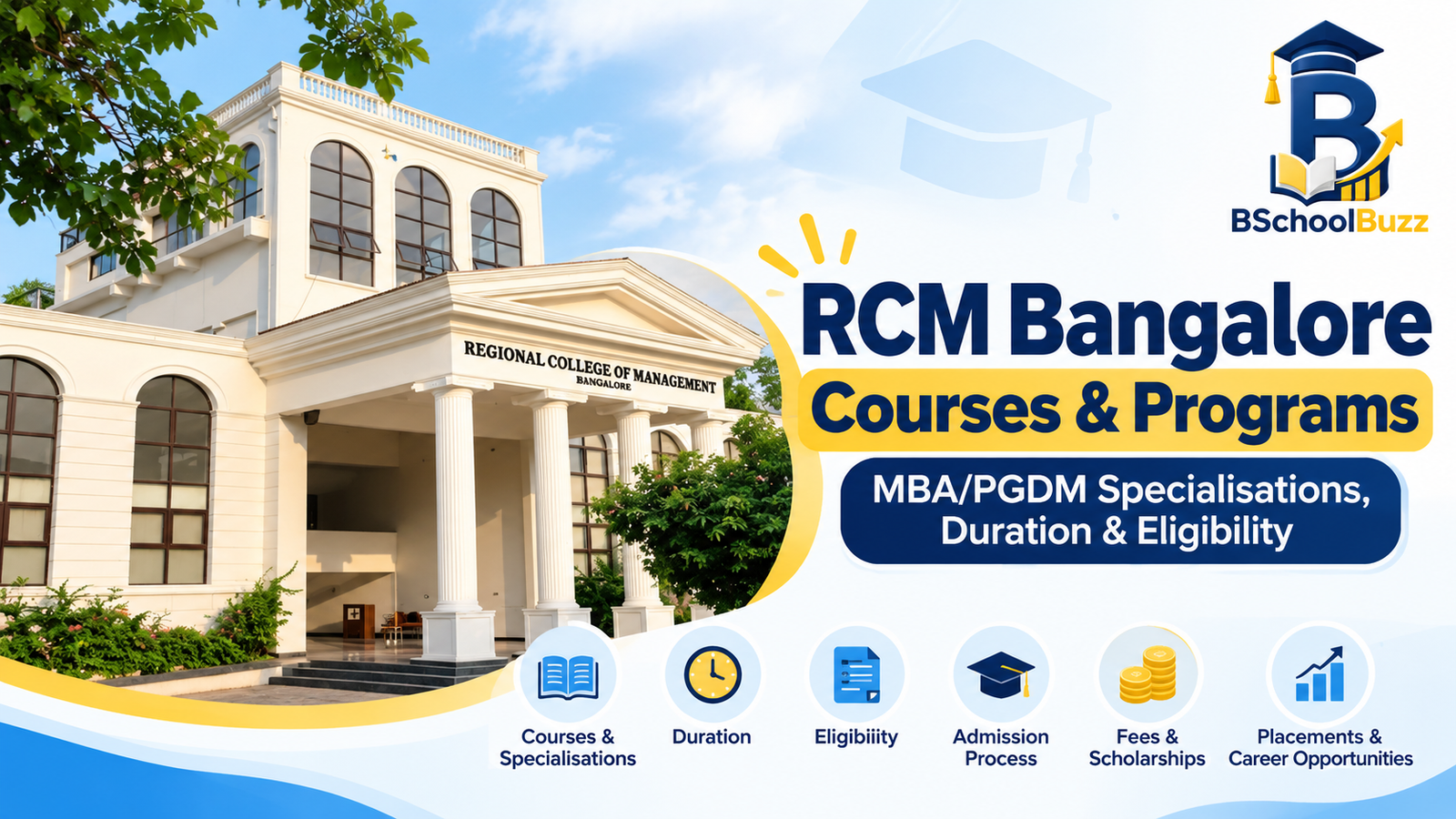
RCM Bangalore Courses & Programs: MBA/PGDM Specialisations, Duration & Eligibility
Regional College of Management Bangalore (RCM Bangalore or RCMB) offers postgraduate management education through its Master of Business Administration (MBA) and Post Graduate Diploma in Management (PGDM) programmes. Both are full-time courses with a published duration of two years. Students can compare them based on the qualification awarded, specialisation options, admission requirements, curriculum orientation, and overall cost.
For the 2027 intake, the college lists a standard programme fee of ₹9,70,000 for the two-year MBA and ₹9,70,000 for the two-year PGDM. The official fee page also advertises an early-bird fee of ₹9,00,000 for eligible admissions confirmed on or before 31 October 2026. University registration and examination fees, as well as hostel fees, are additional. Applicants should verify the final amount and payment schedule directly with the college before paying.
This article focuses on RCM Bangalore's management programmes—not similarly named institutions elsewhere. It explains the MBA and PGDM options, their specialisations, course duration, eligibility criteria, entrance assessment, selection process, fee considerations, and the questions students should ask before applying.
Table of Contents
RCM Bangalore Courses Overview
MBA at RCM Bangalore
PGDM at RCM Bangalore
MBA vs PGDM: Key Differences
RCM Bangalore Specialisations
Course Duration and Learning Approach
RCM Bangalore Eligibility Criteria
Entrance Exams and Selection Process
Application Process and Documents
RCM Bangalore Fees and Scholarships
How to Choose the Right Programme
Career Direction and Practical Considerations
Conclusion
1. RCM Bangalore Courses Overview
RCM Bangalore's School of Management lists two postgraduate management programmes: MBA and PGDM. Both are designed for graduates who want to build business knowledge, develop professional skills, and prepare for management-related roles.
| Programme | Full name | Duration | Programme format | Main purpose |
|---|---|---|---|---|
| MBA | Master of Business Administration | 2 years | Full-time postgraduate degree | Broad management education through a university-affiliated degree |
| PGDM | Post Graduate Diploma in Management | 2 years | Full-time postgraduate diploma | Applied management education through an AICTE-approved diploma |
The college identifies the MBA as affiliated with Bengaluru North University and the PGDM as AICTE-approved. These are different academic routes, so candidates should compare the qualification they will receive rather than assuming the two credentials are identical.
Which programmes should applicants compare?
The MBA may suit students who prefer a university-affiliated management degree. The PGDM may suit those who want a management diploma with an applied, industry-oriented format. The most appropriate choice depends on the candidate's intended career, preference for a degree or diploma, preferred specialisation, and eligibility for any future study or employment requirements.
Before making a final decision, check the programme-specific curriculum and the current official admission information. Course titles and broad descriptions alone do not explain every subject, elective, assessment, internship requirement, or specialisation combination.
2. MBA at RCM Bangalore
The MBA at RCM Bangalore is a two-year, full-time postgraduate management programme affiliated with Bengaluru North University, according to the college's current programme and fee information.
An MBA generally builds knowledge across business functions, helping students understand how organisations manage people, money, customers, operations, and strategic decisions. At RCMB, the listed specialisation areas include Business Analytics, Finance, Healthcare Management, Human Resources, Marketing, and Supply Chain & Logistics.
MBA specialisations
| Specialisation listed by RCMB | Learning direction | Potential career areas to explore |
|---|---|---|
| Business Analytics | Using business information to support decisions | Business analysis, reporting, analytics support |
| Finance | Financial planning, analysis, and business finance | Financial analysis, banking-related roles, corporate finance |
| Healthcare Management | Management within healthcare organisations | Hospital administration, healthcare operations |
| Human Resources (HR) | People management and workplace practices | HR operations, recruitment, learning and development |
| Marketing | Customer needs, markets, and brand development | Marketing, sales, market research, brand support |
| Supply Chain & Logistics | Movement, sourcing, inventory, and delivery systems | Logistics coordination, procurement, supply chain operations |
The career areas in the table are examples of fields related to these subjects, not guaranteed job outcomes. Actual opportunities depend on the curriculum, internships, candidate skills, experience, recruitment conditions, and employer requirements.
Who may consider the MBA?
The MBA can be worth considering if you want a broad management qualification and are interested in developing expertise in one of the listed business areas. It may also be relevant if you expect to pursue roles that value a postgraduate management degree.
Candidates should check the programme's current curriculum, elective structure, university registration requirements, and examination arrangements. If a future employer, professional body, or further-study institution requires a specific type of qualification, confirm that the MBA meets that requirement before enrolling.
3. PGDM at RCM Bangalore
The PGDM at RCM Bangalore is a two-year, full-time postgraduate diploma. The college identifies the programme as AICTE-approved and describes its management learning as applied and connected to industry.
The listed PGDM specialisations cover business analytics and IT, entrepreneurship, finance, human resources, international business, marketing, and operations and supply chain. This range gives applicants several ways to connect management studies with a preferred business function.
PGDM specialisations
| Specialisation listed by RCMB | Main subject direction | Potential career areas to explore |
|---|---|---|
| Business Analytics & IT | Business data, technology, and decision support | Business analysis, IT-business coordination, reporting |
| Entrepreneurship | Business planning and venture development | Start-ups, family businesses, business development |
| Finance | Financial management and analysis | Finance support, banking-related roles, financial operations |
| Human Resources (HR) | Recruitment, employee development, and HR processes | HR operations, recruitment, talent support |
| International Business | Cross-border business and global markets | Export-import support, international sales, trade operations |
| Marketing | Customer behaviour, sales, and market development | Sales, marketing, brand support, market research |
| Operations & Supply Chain | Process, sourcing, inventory, and distribution | Operations coordination, logistics, procurement |
These are broad career directions rather than promises of employment. Applicants should ask the admissions team for the current subject-wise curriculum, how specialisations are allocated, and whether all listed areas will run for their intended intake.
What distinguishes the PGDM route?
A PGDM is a postgraduate diploma rather than the same university degree awarded through an MBA. At RCMB, the official site presents the PGDM as AICTE-approved and industry-oriented. Students comparing it with the MBA should review the exact programme structure and qualification details.
Do not assume that every PGDM has the same recognition or academic standing. Approval and recognition must be checked for the particular institution, programme, and intake. For RCM Bangalore, verify the current approval documentation and the exact qualification stated in the admission offer.
4. MBA vs PGDM at RCM Bangalore
The MBA and PGDM at RCMB have the same published duration and standard 2027 programme fee. Their most important distinction is the type of qualification and the specialisation menu listed by the college.
| Comparison point | MBA | PGDM |
|---|---|---|
| Full form | Master of Business Administration | Post Graduate Diploma in Management |
| Duration | 2 years | 2 years |
| Mode | Full-time | Full-time |
| Academic status listed by RCMB | Affiliated with Bengaluru North University | AICTE-approved |
| Specialisation examples | Business Analytics, Finance, Healthcare Management, HR, Marketing, Supply Chain & Logistics | Business Analytics & IT, Entrepreneurship, Finance, HR, International Business, Marketing, Operations & Supply Chain |
| Standard 2027 programme fee | ₹9,70,000 for both years | ₹9,70,000 for both years |
| Hostel and university registration/examination charges | Additional; confirm applicable amount | Additional; confirm applicable amount |
How should students decide?
Start with the qualification you need. If you prefer a university-affiliated degree, examine the MBA's university affiliation and requirements. If you prefer the diploma route, review the PGDM's AICTE approval and programme details.
Next, compare the curriculum rather than selecting solely on the programme name. A candidate interested in healthcare management, for example, should check the MBA's listed Healthcare Management option. A student interested in entrepreneurship or international business should check the PGDM's listed specialisations and confirm their availability for the relevant intake.
Finally, compare total cost, payment dates, scholarship eligibility, and additional expenses. The standard fee may be the same for both programmes, but the specialisation, academic requirements, and personal career goals can still make one route a better fit.
5. RCM Bangalore Specialisations: How to Choose
Specialisation is the part of management study that lets students focus on a particular business function. It can help organise elective choices and guide projects or career exploration. It does not, by itself, guarantee a job in that field.
RCMB's published MBA and PGDM options overlap in areas such as Business Analytics, Finance, HR, and Marketing. Other options differ between the two programme lists.
Business Analytics and IT
Business analytics focuses on interpreting information to support decisions. The PGDM list specifically names Business Analytics & IT, while the MBA list names Business Analytics. Students considering this area should ask about data tools, quantitative subjects, projects, and the balance between business and technical content.
This path may interest candidates who like working with data, identifying patterns, preparing reports, and explaining findings to decision-makers. Strong analytical thinking and comfort with numerical information can be useful.
Finance
Finance deals with how organisations plan, allocate, manage, and evaluate money. Students should check which finance subjects are taught, how much quantitative work is involved, and whether the programme offers relevant projects or professional-development opportunities.
This area may be relevant to candidates exploring financial operations, corporate finance, banking-related work, or financial analysis. Specific roles can require additional technical skills, certifications, or experience.
Human Resources
Human Resources concerns recruitment, employee relations, training, performance processes, and organisational development. Students interested in HR should review the curriculum for people-management subjects and opportunities to practise communication, interviewing, and workplace problem-solving.
HR-related roles can involve both employee interaction and detailed administrative work. Applicants should consider whether they enjoy working with people, handling confidential information, and applying policies consistently.
Marketing
Marketing examines customers, markets, products, positioning, promotion, and sales. A useful marketing education should help students understand customer needs, communicate value, analyse market information, and evaluate business results.
Candidates should ask whether the curriculum includes digital channels, market research, brand strategy, sales, and practical assignments. The exact subjects offered must be confirmed from the current syllabus rather than assumed from the specialisation name.
Supply Chain, Logistics, and Operations
Supply chain and operations focus on how products and services are planned, sourced, produced, moved, and delivered. The MBA lists Supply Chain & Logistics, while the PGDM lists Operations & Supply Chain.
This area may suit candidates interested in process improvement, coordination, inventory, procurement, distribution, and operational planning. Students should examine whether the programme includes practical cases, process analysis, or projects related to logistics and operations.
Healthcare Management
Healthcare Management is listed among the MBA specialisations. It concerns the administrative and operational side of healthcare organisations, rather than clinical training. Applicants interested in hospitals or healthcare services should verify the subjects and practical exposure included in the current curriculum.
International Business
International Business appears in the PGDM specialisation list. It may be relevant to students interested in global markets, cross-border trade, international sales, and business operations involving multiple countries. Candidates should check the curriculum's treatment of trade, international markets, and related business processes.
Entrepreneurship
Entrepreneurship is listed among the PGDM specialisations. It may interest students who want to explore launching a venture, joining an early-stage business, or working in business development. A specialisation can provide structured learning, but building a viable business also requires market understanding, financial planning, execution, and risk management.
A practical specialisation checklist
Before selecting a specialisation, ask the college:
Is the specialisation available for the intake I am applying to?
What compulsory and elective subjects are included?
How is the specialisation assigned or selected?
Are there minimum student numbers for an elective to run?
What projects, internships, or industry assignments are available?
Which skills should students build before the course begins?
What kinds of roles have graduates explored, and what official evidence is available?
These questions help distinguish a programme's advertised subject areas from the specific learning experience offered to a particular batch.
6. Course Duration and Learning Approach
Both the MBA and PGDM at RCM Bangalore are listed as two-year, full-time postgraduate programmes. Applicants should confirm the academic calendar, term structure, internship timing, examinations, and joining date with admissions for their own intake.
A management programme normally combines several kinds of learning:
Core management subjects: Foundational concepts across business functions.
Specialisation subjects: More focused study in the chosen area.
Projects and assignments: Opportunities to apply concepts to a business problem.
Presentations and teamwork: Practice in communication, collaboration, and explaining recommendations.
Industry exposure: Activities that may connect classroom concepts with organisational settings.
Assessment: Examinations, coursework, presentations, or other requirements specified by the institution.
The exact combination and timing of these activities should be verified in the current syllabus. Applicants should not assume that an internship, overseas visit, certification, or elective is included unless the college confirms it for the selected programme and batch.
Why duration alone is not enough
Two programmes can both last two years and still differ in academic structure, elective choices, evaluation, and practical exposure. Before applying, compare the actual curriculum and the support available for projects, internships, and career preparation.
Ask for the latest programme brochure or academic plan. A clear written answer is more useful than relying on a general promotional description.
7. RCM Bangalore Eligibility Criteria
The college's current admissions information states that applicants for postgraduate management study should hold a bachelor's degree from a recognised university and have at least 50% marks. The official admissions page also says final-year students may apply if they complete graduation before the programme begins.
The college's 2026 admission-process page lists a 45% threshold for SC/ST/OBC candidates for PGDM. Since category-specific rules can depend on the programme and intake, candidates should confirm the current rule directly with admissions rather than automatically applying the 2026 condition to the 2027 intake.
Eligibility overview
| Requirement | What applicants should check |
|---|---|
| Academic qualification | Bachelor's degree from a recognised university |
| General minimum marks | Current admissions page lists at least 50% |
| Final-year applicants | May apply, subject to completing graduation before the programme begins |
| Category-specific relaxation | The 2026 process page lists 45% for SC/ST/OBC applicants for PGDM; confirm the applicable rule for the intended intake |
| Work experience | The college FAQ says prior work experience is not mandatory |
| Entrance assessment | Follow the current instructions for accepted scores, RMAT, and interview |
Can final-year students apply?
Yes. RCMB's admissions page says final-year students can apply provided they complete their graduation before the programme begins. Applicants should ask which documents are accepted during application and when final marksheets or degree certificates must be submitted.
Is work experience required?
The college FAQ states that work experience is not mandatory for MBA or PGDM admission. Applicants with work experience should still provide accurate details if requested, but they should not assume that experience automatically changes selection outcomes.
Does a particular undergraduate stream matter?
The published eligibility information refers to graduates from any stream. However, candidates must still satisfy the required academic percentage and any programme-specific conditions in force for their intake. If a degree is incomplete, awarded through a different system, or subject to pending results, obtain written clarification from admissions.
8. Entrance Exams and Selection Process
RCMB's 2026 admission-process page lists RMAT, CAT, MAT, XAT, ATMA, CMAT, or a state-level entrance-test score among the routes referenced for MBA and PGDM admissions. The college also describes a selection process involving an introductory call, a personal interview, RMAT, and evaluation of academics, test scores, and interview performance.
Because admission rules may change between intakes, applicants should check the current 2027 instructions to determine which tests are accepted, whether an external test score is required, and how the internal assessment is administered.
Selection process described by the college
| Stage | What the candidate should do |
|---|---|
| Online application | Register and complete the application form |
| Application payment | Pay the applicable fee so the application can be considered |
| Admissions interaction | Attend the introductory call or follow the instructions provided |
| Assessment | Complete the required entrance assessment, including RMAT where instructed |
| Personal interview | Attend the interview in the format communicated by the college |
| Evaluation | The college evaluates academic background, test performance, and interview performance |
| Selection and confirmation | Review the selection letter and pay the required amount by the stated deadline |
The college's FAQ lists an application fee of ₹950, but candidates should verify the amount displayed in the live application portal before paying. Do not transfer money based only on an old page or an unofficial message.
How to prepare for the entrance assessment and interview
Start by confirming which assessment applies to your application. If you are using CAT, MAT, XAT, ATMA, CMAT, or another accepted test, verify the relevant score-submission process and any deadline.
For an interview, prepare to explain:
Why you want to study management.
Why you are considering RCM Bangalore.
Which programme and specialisation interest you.
How your academic background connects to your intended career.
What you have learned from projects, internships, work, or extracurricular activities.
What business or industry developments you have been following.
Answers should be specific and honest. Applicants do not need to claim certainty about a long-term career; they should demonstrate that they have thought carefully about their interests and the reasons for applying.
9. Application Process and Documents
The college directs postgraduate applicants to its online application portal. The published process asks candidates to register, complete the application, and pay the application fee. Applicants then follow the assessment and interview instructions provided by the admissions team.
Step-by-step application guide
Choose the programme. Decide whether the MBA or PGDM and its listed specialisation options fit your academic and career goals.
Review eligibility. Check graduation marks, final-year conditions, entrance requirements, and any applicable category rules.
Register online. Use the official RCMB application portal and enter accurate contact details.
Complete the form. Fill in academic history and other required information carefully.
Upload the requested documents. Follow the portal's current file-format and document instructions.
Pay the application fee. Use the payment method shown on the official portal and retain the receipt.
Attend the required assessment and interview. Check email and portal messages for instructions.
Review the offer. Confirm programme name, fee, scholarship conditions, payment schedule, and joining requirements before accepting.
Complete enrolment. Submit any remaining documents and payments by the deadlines in the offer.
Documents to prepare
The exact list should come from the live application portal. Commonly requested documents for postgraduate applications can include:
Class 10 and Class 12 marksheets or certificates.
Graduation marksheets and degree certificate, if already awarded.
Current semester marksheets for final-year candidates.
Entrance-test scorecard, where applicable.
Government-issued identity document.
Recent photograph and signature, if requested.
Category certificate, where a category-based benefit is being claimed.
Any additional declarations or documents requested by the college.
This is a preparation list, not a guarantee that every item is required in every case. Check the official checklist and provide documents in the format requested.
10. RCM Bangalore Fees and Scholarships
Fees are an important part of comparing postgraduate programmes. The current official fee page lists the standard 2027 MBA and PGDM programme fee as ₹9,70,000 for both years. It also advertises an early-bird programme fee of ₹9,00,000 for admissions confirmed on or before 31 October 2026.
Published 2027 programme fees
| Fee item | MBA | PGDM |
|---|---|---|
| Standard programme fee for both years | ₹9,70,000 | ₹9,70,000 |
| Early-bird programme fee, subject to stated deadline and conditions | ₹9,00,000 | ₹9,00,000 |
| University registration and examination fees | Additional; confirm amount | Additional; confirm amount |
| Hostel fees | Additional; confirm amount | Additional; confirm amount |
| Optional Malaysia Global Immersion | ₹75,000 | ₹75,000 |
| Optional Chartered Wealth Manager (CWM) programme | ₹80,000 | ₹80,000 |
The college lists the Malaysia Global Immersion and CWM programmes as optional additions. The fee page states that the early-bird and scholarship-adjusted payment schedule should be confirmed with admissions. Confirm whether any optional component is relevant to your course before adding it to your budget.
Payment schedule
The standard fee page lists the following instalments for the 2027 MBA or PGDM fee:
| Payment stage | Amount |
|---|---|
| At registration | ₹60,000 |
| Within 30 days of admission | ₹2,50,000 |
| Before programme commencement | ₹4,40,000 |
| Before 10 August 2028 | ₹2,20,000 |
| Total | ₹9,70,000 |
These instalments relate to the standard programme fee. Candidates offered an early-bird rate or scholarship-adjusted fee should request a written payment schedule that matches their offer.
Scholarships
RCMB's current fee page describes scholarships based on entrance-test percentiles, academic performance, and Armed Forces family status. The college states that students receive the highest applicable award rather than combining all scholarship categories.
The published entrance-test scholarship table includes CAT and XAT thresholds of 75, 80, and 90 percentile for awards of ₹1,00,000, ₹2,00,000, and ₹4,00,000 respectively. For CMAT and MAT, the listed thresholds are 90, 95, and 99 percentile; for NMAT, they are 80, 90, and 95 percentile. The same page lists academic awards based on achieving the threshold in each of Class 10, Class 12, and graduation: ₹50,000 for 70% or above, ₹60,000 for 80% or above, and ₹70,000 for 90% or above. It also lists a ₹50,000 award for eligible Armed Forces families.
Scholarship rules can include conditions and documentation requirements. Ask admissions to confirm the award applicable to your test, marks, category, and programme. Do not assume that two separate awards can be added together.
Estimate the full cost before accepting an offer
The programme fee is not necessarily the complete amount you will spend while studying. Build a personal budget that accounts for:
The confirmed tuition or programme fee after any applicable award.
University registration and examination charges.
Hostel and daily living costs, if applicable.
Travel and personal expenses.
Optional global immersion or CWM costs, only if you choose them.
Any other charge explicitly mentioned in the admission offer.
Ask the college for the complete written fee schedule, refund and cancellation terms, and the due dates for each instalment. Save receipts and official correspondence.
11. How to Choose the Right Programme
A useful decision should combine academic fit, qualification type, specialisation, budget, and the quality of information available about the programme.
Start with your preferred qualification
First, decide whether you want the MBA degree route or the PGDM diploma route. Confirm the exact qualification, affiliation or approval, and the documents you will receive after successful completion.
Compare the actual specialisation
Do not select a programme solely because its name sounds familiar. Compare the current syllabus, subject list, electives, projects, and the way specialisations are chosen. If you are interested in a particular area, ask whether it is confirmed for your intake.
Compare the total financial commitment
Use the official fee page as a starting point, then obtain an individual written offer. Check the conditions attached to early-bird rates and scholarships. Include hostel, registration, examination, and optional programme costs separately rather than assuming they are included.
Consider how you learn
Some students prefer structured theoretical study; others learn well through projects, presentations, and practical assignments. Ask how the programme balances classroom teaching, applied work, internships, and assessment. Use specific curriculum information rather than general marketing statements to evaluate this point.
Ask about career support in concrete terms
If placements are important to your decision, ask for the latest programme- and batch-specific placement report. Look for batch size, number of students seeking placement, number placed, median salary, average salary, highest salary, and the definition of each reported figure. Ask whether the data refers to MBA, PGDM, or both.
A headline salary or placement percentage is difficult to interpret without its year, denominator, and methodology. Treat placement information as one input into your decision, not as a guaranteed personal outcome.
12. Career Direction and Practical Considerations
MBA and PGDM programmes can help students build a foundation for management-related careers, but outcomes depend on more than the course title. Employers may consider academic performance, communication, analytical ability, internship experience, domain knowledge, interview performance, and the role's specific requirements.
The specialisation can help you identify relevant skills to build. A student interested in Business Analytics may benefit from practising data interpretation and clear reporting. A student interested in Finance may need to strengthen quantitative analysis. A Marketing candidate can work on customer research and communication, while an Operations candidate can develop process thinking and planning skills.
Build evidence of your skills
During the programme, look for opportunities to create concrete examples of your work, such as:
A well-documented project based on a business problem.
A presentation that explains data or recommends an action.
An internship assignment with clearly described responsibilities.
A case analysis that shows structured problem-solving.
A practical project relevant to the chosen specialisation.
These examples can help you discuss your abilities in interviews. They do not guarantee a job, but they give employers more information than a programme title alone.
Verify placement claims carefully
The official college website has a placement section, but applicants should review the most recent detailed report available for their programme and batch. Confirm whether reported figures are for the entire college or a particular programme, whether salary figures are annual CTC, and whether they refer to all students or only placed students.
If a figure is not clearly explained in an official report, ask the placement team for the methodology. Avoid comparing one institution's highest package with another institution's average package, because those numbers describe different outcomes.
13. Conclusion
RCM Bangalore offers two-year, full-time MBA and PGDM programmes for graduates seeking postgraduate management education. The MBA is listed as affiliated with Bengaluru North University, while the PGDM is listed as AICTE-approved. Their specialisation menus overlap in areas such as Finance, Business Analytics, HR, and Marketing, while the published lists also include programme-specific options such as Healthcare Management for the MBA and Entrepreneurship and International Business for the PGDM.
For the 2027 intake, the standard programme fee published by RCMB is ₹9,70,000 for both years, with an advertised early-bird rate subject to the stated deadline and conditions. Additional expenses apply, and scholarship eligibility should be confirmed individually.
Before applying, review the current eligibility requirements, accepted entrance tests, assessment and interview process, programme syllabus, specialisation availability, full payment schedule, and latest placement report. A decision based on official documents and your own academic and career priorities will be more reliable than choosing solely by programme name or promotional claims.
Key Takeaways
Compare the MBA degree and PGDM diploma before choosing a programme.
Review the current specialisation list and confirm that your preferred option is available for your intake.
Check the latest eligibility rules, including any applicable category-based conditions.
Confirm which entrance tests and internal assessments apply to your application.
Prepare academic documents and entrance-test details before completing the online form.
Check the standard fee, any early-bird offer, scholarship conditions, and payment dates in writing.
Budget separately for hostel, university registration, examination, and optional programme costs.
Request the latest programme-specific placement report and review how its figures are calculated.
Verify the programme's approval or affiliation and the exact qualification awarded.
Use official RCMB information to confirm final admission requirements before paying.
Frequently Asked Questions
What courses does RCM Bangalore offer?
RCM Bangalore offers two postgraduate management programmes: a Master of Business Administration (MBA) and a Post Graduate Diploma in Management (PGDM).
What is the duration of MBA and PGDM at RCM Bangalore?
Both the MBA and PGDM are listed as two-year, full-time programmes.
What are the MBA specialisations at RCM Bangalore?
The listed MBA specialisations are Business Analytics, Finance, Healthcare Management, Human Resources, Marketing, and Supply Chain & Logistics.
What are the PGDM specialisations at RCM Bangalore?
The listed PGDM specialisations are Business Analytics & IT, Entrepreneurship, Finance, Human Resources, International Business, Marketing, and Operations & Supply Chain.
What is the eligibility for RCM Bangalore MBA and PGDM?
The college's current admissions information lists a bachelor's degree from a recognised university with at least 50% marks. Applicants should verify the current programme-specific rules before applying.
Can final-year students apply to RCM Bangalore?
Yes. The college says final-year students can apply if they complete graduation before the programme begins.
Which entrance exams are accepted by RCM Bangalore?
The college's published admission information lists RMAT, CAT, MAT, XAT, ATMA, CMAT, or a state-level entrance-test score. Confirm the accepted routes for your intended intake.
What is the RCM Bangalore MBA and PGDM fee for 2027?
The standard published programme fee is ₹9,70,000 for both years for each programme. Hostel, university registration, and examination fees are additional.
Does RCM Bangalore offer scholarships?
Yes. The college lists scholarships based on eligible entrance-test percentiles, academic performance, and Armed Forces family status. The award and conditions should be confirmed with admissions.
How can I apply for RCM Bangalore courses?
Candidates can apply online through the official RCMB application portal, complete the form, pay the applicable application fee, and follow the required assessment and interview instructions.
Ask a question
Still confused? Leave your question and our team will help you.