
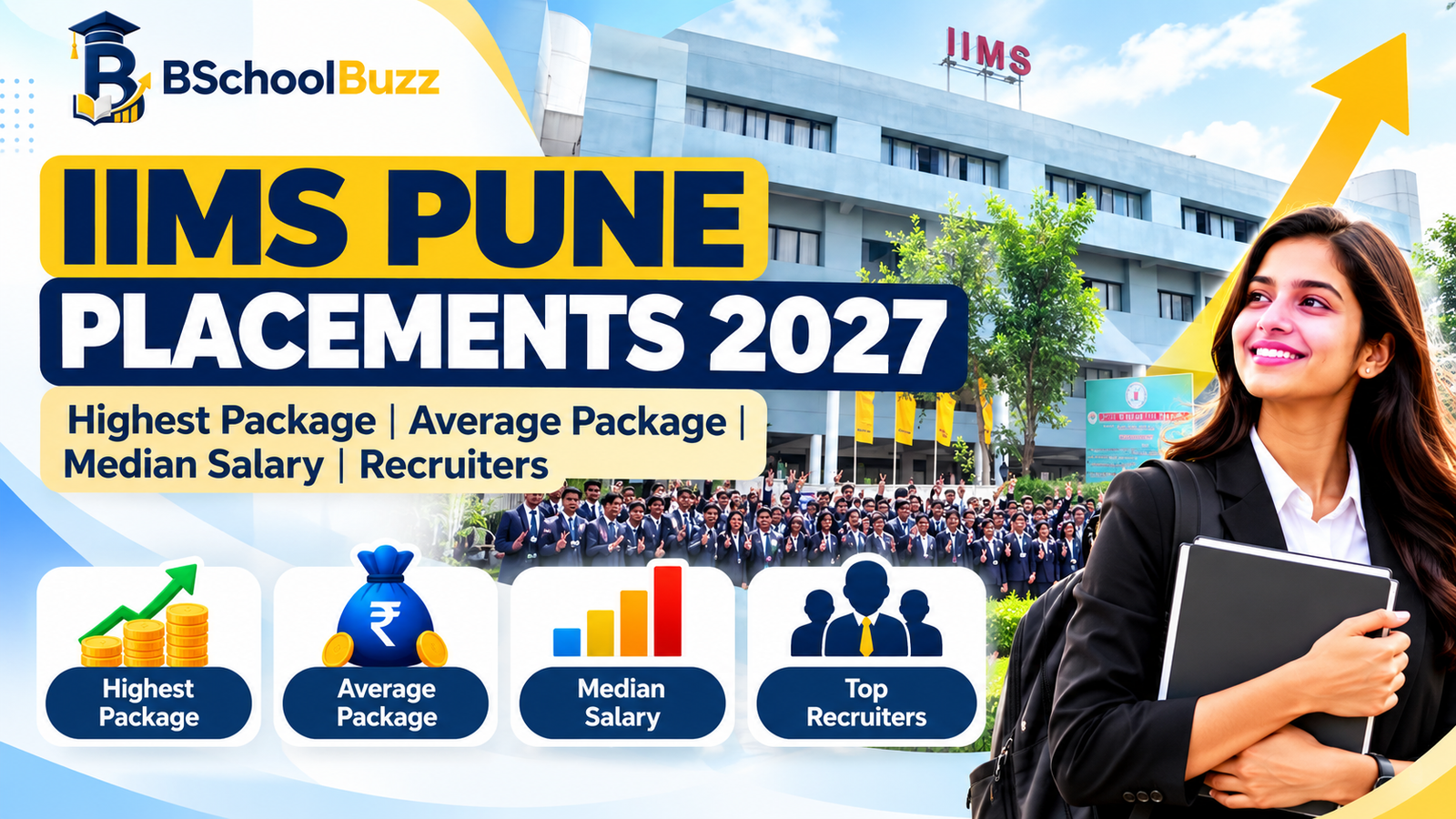
Quick Summary
- IIMS Pune's official 2024–26 placement page reports a highest package of ₹26.10 LPA.
- The reported average package for the 2024–26 placement cycle is ₹7.50 LPA.
- A separate IIMS Pune page lists a median package of ₹6.50 LPA; verify the relevant batch before comparing it with other figures.
- The institute identifies IT, FMCG, consulting, banking and manufacturing as recruiting sectors.
- Published placement records include employers such as Deloitte USI Tax, PwC AC India, Mondelez International, Haleon, Coca-Cola, BergerPaints and Indigo Paints.
- The institute publishes placement information separately for different batches, including 2024–26 and 2023–25.
- The figures from the 2024–26 cycle should not be described as final 2027 placement results.
- Students should compare average and median salary, placement rate, eligible batch size, role types and total programme cost.
- Confirm the latest placement report and its methodology directly with IIMS Pune before making a decision.
IIMS Pune Placements 2027: Highest Package, Average Package, Median Salary & Recruiters
Introduction
Students researching management colleges often begin with one practical question: what kind of career opportunities can they expect after graduation? For applicants considering the International Institute of Management Studies (IIMS), Pune, placement statistics can help them assess salary outcomes, recruiter participation and the types of roles they might pursue after completing a management programme.
IIMS Pune offers postgraduate management programmes, including its flagship PGDM and specialised PGDM options. The institute publishes placement information on its official website, including salary highlights and lists of students placed with employers. However, it is important to distinguish the placement year named in a search query from the actual year covered by published results.
For the 2027 placement search, the official IIMS Pune page titled PGDM Placements – 2024–26 reports a highest package of ₹26.10 lakh per annum (LPA) and an average package of ₹7.50 LPA. It also identifies IT, FMCG, consulting, banking and manufacturing as recruiting sectors. These figures are published for the 2024–26 placement cycle; they should not be presented as confirmed final results for a separate 2027 graduating batch. Official IIMS Pune placement page.
This article examines the available figures, the meaning of each placement metric, examples of employers appearing in the institute's published placement information, and the questions prospective students should ask before deciding whether IIMS Pune is the right fit.
Table of Contents
IIMS Pune Placements 2027: What the Published Data Says
IIMS Pune Placement Highlights
Highest Package at IIMS Pune
Average Package at IIMS Pune
Median Salary: What Students Should Know
Placement Trends and Year-Specific Reporting
Top Recruiters at IIMS Pune
Sectors and Specialisations Linked to Placements
Placement Process and Career Preparation
Internship Experience and Pre-Placement Offers
How to Evaluate Placement Statistics
Return on Investment: How to Assess the Cost
Questions to Ask the Placement Office
How to Prepare for Placements at IIMS Pune
Is IIMS Pune Worth Considering for Placements?
Frequently Asked Questions
Conclusion
About MBA Compass
Related Search Keywords
1. IIMS Pune Placements 2027: What the Published Data Says
The International Institute of Management Studies Pune, commonly called IIMS Pune, publishes placement details through its official website. The information includes a placement page for the 2024–26 cycle and separate pages for earlier batches. This year-wise structure matters because placement statistics can change with the graduating cohort, market conditions, employer demand and the programmes included in a report.
The institute's official 2024–26 placement page reports the following headline figures:
| Placement metric | Published figure | Reporting context |
|---|---|---|
| Highest package | ₹26.10 LPA | IIMS Pune PGDM placements, 2024–26 |
| Average package | ₹7.50 LPA | IIMS Pune PGDM placements, 2024–26 |
| Recruiting sectors | IT, FMCG, consulting, banking and manufacturing | Listed on the same official page |
| Placement activity | 300+ campus placements | Wording used by the institute for the 2024–26 cycle |
| Median package | Confirm the applicable batch | A separate institute page lists ₹6.50 LPA, but its batch context should be verified before comparison |
| Final 2027 graduating-batch result | Not established by the figures above | The 2024–26 figures must not be relabelled as 2027 results |
Source: IIMS Pune – PGDM Placements 2024–26 and IIMS Pune – Placement overview.
These figures offer a starting point for understanding the institute's published placement performance. They do not, by themselves, tell a student everything needed to evaluate a programme. The number of students eligible for placements, the number who received offers, the distribution of salaries, job functions, fixed versus variable pay and the number of offers accepted are also important.
Why the year matters
The title IIMS Pune Placements 2027 is useful for readers researching career prospects around the 2027 cycle. However, an article must not imply that a particular salary was earned by a 2027 graduating batch unless the institute has released data explicitly covering that cohort.
A placement page can include students graduating in a named year, students placed through pre-placement offers, or a two-year batch label. These are not necessarily interchangeable. The safest approach is to retain the original label from the institute's source and identify the reporting period beside every figure.
Students should revisit the official placements section for updates and request the latest dated placement report if they need figures for a specific graduating batch.
2. IIMS Pune Placement Highlights
Placement highlights are often the first figures prospective students compare across management colleges. They can help narrow a shortlist, but only if the numbers are interpreted consistently.
| Highlight | What the published information indicates | How to interpret it |
|---|---|---|
| Highest salary | ₹26.10 LPA for the 2024–26 cycle | Represents the top reported package, not the typical salary for every student |
| Average salary | ₹7.50 LPA for the 2024–26 cycle | Indicates the arithmetic average reported by the institute; the underlying distribution is needed for fuller context |
| Median salary | ₹6.50 LPA on a separate institute page | Confirm the relevant cohort and date before comparing it with the 2024–26 figures |
| Recruiter sectors | IT, FMCG, consulting, banking and manufacturing | Shows the broad sectors named by the institute, not the number of offers from each sector |
| Employers listed | Examples include Deloitte, Mondelez International, PwC AC India, Berger Paints and others | An employer appearing in a list does not establish that every student can obtain a role there |
| Placement rate | A separate institute page reports 96%+ for the PGDM batch of 2024 | This is a batch-specific claim and should not automatically be applied to other batches |
| Number of placements | The current placement page says 300+ campus placements | Confirm whether this means students placed, offers made or another measure before comparing it with other colleges |
Sources: Official 2024–26 placements page and IIMS Pune placement overview.
The key distinction is between a headline figure and a complete placement report. A headline can provide a useful overview, but it may not explain how the result was calculated or whether the figures include all programmes. For a sound comparison, ask for the reporting year, programme name, eligible batch size, students placed, total offers and median compensation.
3. Highest Package at IIMS Pune
The official IIMS Pune placement page for 2024–26 lists a highest package of ₹26.10 LPA. This is the largest package reported on that page for the specified placement cycle.
A highest package attracts attention because it illustrates the upper end of the compensation reported by a college. However, it should not be treated as a forecast of what an incoming student will earn. One high offer can differ considerably from the outcomes experienced by most students.
What does a highest package mean?
A highest package is the largest reported compensation package within a defined group of placement outcomes. The term “package” commonly refers to cost to company (CTC), which can include several components. Depending on the employer's offer structure, these may include fixed salary, variable pay, joining bonuses, performance-linked incentives, retirement contributions or other benefits.
A headline CTC should therefore not automatically be interpreted as monthly take-home pay. Students should ask whether the published amount represents total CTC, fixed annual compensation or another measure.
Questions to ask about the ₹26.10 LPA figure
Before using the highest package to compare IIMS Pune with another institution, check the following:
Reporting period: Does the figure apply to the 2024–26 placement cycle or another cohort?
Programme: Is it specifically for the general PGDM, or does it include other PGDM programmes?
Compensation structure: Is ₹26.10 LPA total CTC or fixed pay?
Offer status: Was the offer accepted, and did the student join the employer?
Job location and function: What role and location were associated with the offer?
Distribution: How many other students received offers in a similar salary range?
These questions do not diminish the significance of a high package. They help applicants understand what the number actually measures.
Why the highest package is not enough
Imagine two colleges reporting the same highest package. One might have a larger proportion of students earning salaries close to that figure, while the other might have only one student at the top and a much lower median. The highest salary alone would not reveal that difference.
For this reason, students should evaluate the highest package alongside the average and median salary, the placement rate and the distribution of offers. The latest published IIMS Pune figure is a useful reference point, but the rest of the placement picture is just as important.
4. Average Package at IIMS Pune
IIMS Pune's official 2024–26 placement page reports an average package of ₹7.50 LPA. This is a more useful indicator of overall salary outcomes than the highest package alone, but it still needs context.
The arithmetic average is calculated by adding the values in a dataset and dividing the total by the number of observations. In a placement report, the exact calculation depends on which students and offers the institute includes. A high salary at the top end can pull the average upward, even if many students earn less than the average.
How to read the ₹7.50 LPA average
The reported average can help applicants establish an initial benchmark. It does not mean that each student receives ₹7.50 LPA, nor does it guarantee that a new student will receive a job at that salary.
A useful placement report should clarify:
Whether the average is based on students placed or on offers made.
Whether the report includes only the flagship PGDM or multiple programmes.
Whether all salary packages are annualised on the same basis.
Whether the average uses CTC or fixed salary.
How many students were included in the calculation.
Whether students without offers are excluded from the average.
The institute's headline page does not provide all of these details alongside the ₹7.50 LPA figure. Applicants who need a precise comparison should request the methodology and batch-level report.
Average salary versus expected salary
An average is a historical statistic, not a promise. The salary a student eventually earns can depend on specialisation, previous experience, interview performance, role, location, employer requirements and market conditions.
A candidate with strong analytical skills and relevant internships may be considered for different roles from a candidate whose interests lie in sales or human resources. These differences make it risky to use one institute-wide average as a personal salary prediction.
Students should also consider their own goals. Someone seeking a particular job function may care more about the number and quality of relevant roles than about the college-wide average alone.
5. Median Salary: What Students Should Know
The median is often one of the most useful placement metrics because it describes the middle of a salary distribution. If all salaries are arranged from lowest to highest, the median is the middle value—or the average of the two middle values when the number of observations is even.
An IIMS Pune institute page titled What makes IIMS the best choice for your post graduation? lists a median package of ₹6.50 LPA. The page also mentions a 96%+ placement figure for the PGDM batch of 2024, a highest package of ₹26.10 LPA and an average package of ₹7.50 LPA. Because the page's reporting context differs from the separate 2024–26 placement page, applicants should verify the median's exact batch and methodology before presenting all these numbers as one consistent dataset. Official IIMS Pune placement overview.
Why median salary matters
The median can help a student understand what the middle of a cohort's salary outcomes looks like. It is less affected by a single unusually high package than the average.
For example, if a small number of graduates receive exceptionally high offers, the average may rise noticeably. The median is less sensitive to those top-end results. That makes it valuable when assessing the likely range of outcomes for a broad group of students.
How to compare average and median
| Metric | What it measures | What it can tell a student |
|---|---|---|
| Highest package | Largest reported package | The upper end of reported compensation |
| Average package | Arithmetic mean of the included packages | A broad measure of the overall salary level |
| Median package | Middle value in the salary distribution | A better sense of the central outcome |
| Placement rate | Share of a defined eligible group placed, when properly specified | How widespread placement outcomes were within that group |
| Number of students placed | Count of students receiving placements under the stated definition | The scale of placement outcomes |
| Total offers | Number of offers recorded | Recruiting activity, which may exceed the number of students placed |
A comparison is only fair when the figures relate to the same cohort, programme and reporting period. If the average comes from one year and the median from another, placing them side by side without explanation may create a misleading impression.
6. Placement Trends and Year-Specific Reporting
IIMS Pune maintains separate placement pages for different batches, including 2024–26, 2023–25 and earlier cycles. The existence of these pages is helpful because it allows students to examine placement activity over time rather than relying on a single headline.
The official 2023–25 placements page lists student placements and employers. The 2024–26 page provides headline compensation figures and a placement list for students graduating in 2026.
However, a list of individual placement records is not the same as a consolidated statistical report. It may show employer names, disciplines, graduation years and whether a placement was on campus or through a pre-placement offer. It does not necessarily show the full eligible batch, the number of students who did not receive offers, or the salary distribution.
How students should interpret placement trends
When reviewing year-wise data, compare the same measures for each batch. A valid comparison could look at the highest package across two cohorts, provided the programme and definitions remain consistent. It is less useful to compare one year's highest package with another year's average salary.
A sound year-on-year analysis should ideally include:
The same programme across both years.
The same definition of “placed student.”
The same salary measure, such as annual CTC.
The number of students eligible for placements.
The number of students placed and the number of offers.
The median and average package.
A clear indication of whether the report is final or ongoing.
If these details are not presented together, students should avoid drawing strong conclusions about whether placement performance has improved or declined.
What does the 2024–26 cycle tell applicants considering 2027?
The published figures give applicants a reference point for the institute's reported recent placement outcomes. They do not establish what the 2027 batch will earn. Placement conditions can change due to the economic environment, recruitment budgets, the sectors hiring, students' skills and the mix of roles available.
For a student joining a programme before a future placement cycle, historical information is best used to generate questions and set expectations—not as a guarantee of future compensation.
7. Top Recruiters at IIMS Pune
Recruiter names are another major part of placement research. They can help students identify the types of organisations that have appeared in the institute's placement activity. However, a recruiter list should be read as evidence of reported employer participation, not as a promise that every listed company will hire in every year.
IIMS Pune's official placement page for 2024–26 includes employers such as Mondelez International, Haleon, Coca-Cola, Berger Paints, Deloitte USI Tax, PwC AC India, Qapita EquityTech, Indigo Paints, NoBroker.com, Pattern Technology and Hafele India. These names appear in the published student placement records. Official employer and placement records.
Other IIMS Pune material refers to organisations including PwC, EY, Deloitte, Kellogg’s, Accenture, Mondelez, Britannia and Berger Paints. These examples come from the institute's wider published information and may relate to different placement periods. IIMS Pune placement overview.
Examples of employers appearing in official placement material
| Employer | What the published material establishes | What applicants should verify |
|---|---|---|
| Deloitte USI Tax | Listed in the 2024–26 student placement records | Role, compensation and number of hires for the current cycle |
| PwC AC India | Listed in the 2024–26 placement records | Job function, selection requirements and offer details |
| Mondelez International | Listed in the 2024–26 placement records, including pre-placement offers | Whether comparable roles are offered in the next cycle |
| Berger Paints | Appears in the 2024–26 records and wider institute material | Role type, location and current recruitment activity |
| Coca-Cola | Appears in the 2024–26 records | Available positions and hiring requirements |
| Haleon | Appears in the 2024–26 records | Function and role-specific eligibility |
| Indigo Paints | Appears in the 2024–26 records | Current openings and role details |
| Accenture | Named in wider institute placement material | Whether it is recruiting for the target programme and batch |
| Britannia | Named in wider institute placement material | Current participation and the types of roles offered |
| EY | Named in wider institute placement material | Current hiring status and role requirements |
The table is deliberately cautious: an employer name does not confirm a salary package, hiring volume or guaranteed future participation. For those details, ask for the placement report that applies to the exact batch.
Why recruiter quality matters
The number of employers alone does not fully describe placement quality. A student should also consider whether companies recruit for relevant roles, whether positions match the student's preferred specialisation, and whether the opportunities involve meaningful professional development.
A large recruiter list can contain employers from very different industries and role categories. Applicants interested in finance, for example, may prioritise relevant financial-services and corporate-finance roles. A student targeting marketing may instead focus on brand management, sales, category management and market research opportunities.
The best recruiter list for an individual applicant is therefore the one that provides credible opportunities in the career areas the applicant wants to pursue.
8. Sectors and Specialisations Linked to Placements
IIMS Pune's official 2024–26 placement page names IT, FMCG, consulting, banking and manufacturing as top recruiting sectors. The same placement records identify disciplines such as Marketing, Finance, Human Resource and Business Analytics. These references show that placement activity spans more than one functional area. Official IIMS Pune placement information.
Marketing
Marketing roles can involve sales, brand support, business development, market research, category management, customer acquisition and account management. The exact responsibilities depend on the employer and position.
Candidates interested in marketing should build communication skills, learn to interpret market data, understand consumer behaviour and practise structured presentations. Internships and live projects can also provide examples of work to discuss during interviews.
Finance
Finance-related roles can include reporting, tax, financial analysis, risk support, audit-related work and other positions depending on the employer's requirements. The presence of Deloitte USI Tax and PwC AC India in the published placement records provides examples of employers associated with finance-related placement entries; it does not mean that all available roles are investment-banking or core-finance positions.
Students should read job descriptions carefully. A role within a large professional-services organisation may focus on tax, compliance, consulting, analytics or another business function. The employer name alone does not identify the job.
Human resources
HR roles may involve recruitment, learning and development, employee engagement, HR operations and talent management. Applicants can prepare by understanding hiring processes, workplace policies, communication and the use of data in HR decisions.
Business analytics and technology-linked work
Analytics-oriented roles may require comfort with data, spreadsheets, reporting, dashboards, business problem-solving and analytical communication. The actual technical requirements differ across employers. Students should not assume that every analytics role requires the same tools or programming skills.
Banking, FMCG and manufacturing
The institute identifies banking, FMCG and manufacturing among its recruiting sectors. These industries include many kinds of roles, from sales and operations to finance, customer management, supply chain and business analysis.
A student should therefore evaluate the role rather than making a decision based on the sector name alone. A relevant job with clear learning opportunities can be a better fit than a more familiar employer name attached to a role that does not support the student's career plans.
9. Placement Process and Career Preparation
The placement process usually involves several stages, although the exact steps, eligibility rules and schedules vary by institution, programme and employer. Applicants should obtain the current IIMS Pune placement policy rather than assume that every recruitment process follows an identical format.
A typical management-campus recruitment sequence may include:
Placement registration: Eligible students register with the placement office and submit required information.
Role announcements: Participating employers share job descriptions, eligibility criteria and selection procedures.
Application and screening: Students apply, and employers shortlist candidates according to their requirements.
Assessment: The process may include aptitude tests, case exercises, technical assessments or other evaluations.
Interviews and group exercises: Candidates may be assessed on communication, business knowledge, problem-solving and role fit.
Offer communication: Selected candidates receive offers under the employer's process.
Acceptance and joining: Students review offer conditions, accept where appropriate and follow the employer's joining instructions.
This is a general description of common campus recruitment stages, not a claim that IIMS Pune uses every step for every employer. The institute's placement office is the appropriate source for the applicable process and rules.
Why preparation should start early
Waiting until the final placement season can leave students with limited time to improve communication, develop role-specific knowledge or gain relevant experience. Students can use the programme period to build a consistent preparation routine.
A practical plan includes:
Maintaining an accurate and concise résumé.
Practising clear introductions and behavioural interview answers.
Learning how to explain academic projects and internship work.
Building Excel, presentation and analytical skills relevant to target roles.
Following developments in the industries they want to enter.
Practising aptitude questions and case-based problem-solving where relevant.
Reviewing job descriptions before applying.
Seeking feedback after mock interviews.
A student's preparation cannot guarantee an offer, but it can help them present their experience and capabilities more effectively.
10. Internship Experience and Pre-Placement Offers
Internships can help management students understand how classroom concepts translate into workplace responsibilities. They can also give students practical examples to discuss in interviews and help them decide which functions suit their strengths.
The IIMS Pune 2024–26 placement page includes entries marked “PPO,” meaning pre-placement offer, alongside regular on-campus placements. The list identifies examples of pre-placement offers with employers including Mondelez International and Haleon. The presence of these entries confirms that PPOs appear in the published records; it does not establish the total number of PPOs or the probability that any individual intern will receive one. Official placement records.
What is a pre-placement offer?
A pre-placement offer is an employment offer extended to a student before or outside the usual final placement process, often following an internship or another employer interaction. The specific criteria depend on the organisation and the internship arrangement.
Students should ask whether an internship is paid, how performance is evaluated, whether a PPO is possible and what conditions apply. A PPO should never be assumed to be automatic merely because a student completes an internship.
Making internships more useful
Students can get more value from an internship by agreeing on objectives, asking for feedback and keeping a record of their responsibilities. Where permitted, they should be able to describe the problem they worked on, their contribution and the outcome without revealing confidential company information.
For example, a marketing intern might discuss a research task, customer analysis or campaign-support project. A finance intern might explain a reporting or reconciliation task. An analytics intern might describe how they organised data and communicated findings. The relevance and depth of the experience matter more than simply listing a company name.
11. How to Evaluate Placement Statistics
Placement statistics are most useful when they are considered as a group. A student should not base a college decision entirely on the highest salary, a recruiter logo or a placement percentage without knowing how it was calculated.
Highest, average and median packages
Each figure answers a different question. The highest package shows the upper end of reported compensation. The average summarises the mean of the included salaries. The median identifies the middle salary outcome. If all three figures are published for the same cohort, they provide a stronger picture than any one metric on its own.
Placement rate
A placement rate should be interpreted alongside its denominator. The relevant questions include how many students were eligible, how many participated, how many were placed and whether students who opted out or pursued other options were included.
For example, a percentage based on students actively participating in placements may not be directly comparable with a percentage based on the entire graduating batch. Ask for the calculation rather than comparing percentages in isolation.
Students placed versus offers made
One student can receive more than one offer, depending on the institute's rules and the sequence of recruitment. Therefore, total offers and total students placed are not necessarily the same. A report should clearly label both measures.
Recruiter count
The number of recruiters can indicate the breadth of employer participation, but it does not tell you how many positions each employer offered. Ten companies making one offer each would represent a different hiring scale from ten companies making multiple offers each.
Role quality
A placement figure is only one part of a career outcome. Role responsibilities, learning opportunities, location, working conditions, training, future mobility and alignment with the student's interests also matter.
Before accepting an offer, students should review its written terms, compensation structure, probation requirements, location and any conditions attached to joining.
A placement-data checklist
| Question | Why it matters |
|---|---|
| Which batch does the report cover? | Prevents mixing results from different years |
| Is it the flagship PGDM or another programme? | Ensures a fair programme-level comparison |
| How many students were eligible? | Provides context for placement percentages |
| How many students were placed? | Helps establish the scale of outcomes |
| How many offers were made? | Separates hiring activity from student count |
| Is the salary CTC or fixed pay? | Helps interpret the actual compensation |
| Is the median published? | Adds context beyond the average and highest salary |
| Which roles and sectors hired? | Shows whether opportunities match career goals |
| Is the report final or ongoing? | Prevents provisional results being treated as complete |
| Are all figures from the same reporting period? | Avoids misleading comparisons |
12. Return on Investment: How to Assess the Cost
Return on investment (ROI) is a way to consider the relationship between the cost of a programme and its potential financial and career benefits. It is not simply a calculation of the highest package divided by the tuition fee.
To assess the financial side of studying at IIMS Pune, students should obtain the latest official fee structure for their exact programme and include any applicable accommodation, meals, travel, learning materials and other expenses. The fee can differ across programmes, and an applicant should not assume that one PGDM fee applies to every specialised programme.
Costs to include
A realistic budget may include:
Tuition and programme charges.
Hostel or accommodation charges, if applicable.
Meals and daily living costs.
Travel and local transport.
Books, equipment and other learning expenses.
Personal expenses during the programme.
Loan interest, if the student borrows money.
Use the official fee schedule for confirmed amounts. Do not substitute estimates from an unrelated programme or an older admission cycle.
A simple way to assess ROI
Start by calculating the total cost of attendance for the full programme. Then compare that cost with realistic career scenarios based on relevant placement data—not just the highest package.
The average and median package can be useful reference points, but they are not take-home salary figures and do not establish an individual's likely outcome. A student should also consider taxes, living costs after graduation, loan repayment, location and the time needed to secure a suitable job.
A more useful financial decision compares several scenarios: a conservative salary outcome, a middle-of-the-range outcome and a stronger outcome. The assumptions should be explicit rather than treated as guaranteed results.
Why the highest package is not an ROI calculation
If a student uses the highest package as the expected salary for every graduate, the resulting ROI may be unrealistic. A high package may belong to one student and may include variable compensation or benefits. The student's actual compensation and take-home pay could be quite different.
For a better comparison, request the latest batch-specific average and median, clarify whether the salary is CTC or fixed pay, and compare the figures with the total cost of the exact programme.
13. Questions to Ask the Placement Office
The placement office can help clarify details that may not appear on a summary webpage. Students should ask direct, specific questions and request written or published documentation where possible.
Questions about salary figures
What is the latest completed placement cycle for the PGDM programme?
What are the highest, average and median packages for that batch?
Is the average calculated from students placed or from offers made?
Does the salary represent total CTC or fixed annual compensation?
Is the median based on the same cohort as the average and highest package?
Questions about placement coverage
How many students were eligible for placement?
How many participated, and how many received offers?
How many students were placed through campus recruitment?
Does the published placement rate exclude students pursuing higher studies, entrepreneurship or other pathways?
Are the figures programme-specific or consolidated across multiple PGDM programmes?
Questions about recruiters and roles
Which employers recruited for the most recent completed batch?
What roles were offered to students in each specialisation?
Are role descriptions and compensation bands available?
Which employers offered internships or pre-placement offers?
Are recruiters expected to participate in the next cycle, or is participation confirmed only when the process begins?
Questions about policy and support
What are the placement eligibility requirements?
Are students required to follow restrictions after accepting an offer?
What training and career support are provided?
How are students supported if they do not receive an offer during the main placement season?
Where can applicants review the latest placement policy?
These questions help students move from general claims to evidence relevant to their own goals.
14. How to Prepare for Placements at IIMS Pune
Placement preparation is more effective when it is linked to a target role. A student interested in marketing should not prepare exactly like someone targeting finance or business analytics. Core communication and problem-solving skills are useful across functions, but role-specific preparation makes the effort more focused.
Build a role-oriented résumé
A résumé should present education, internships, projects, achievements and relevant skills clearly. Every claim should be accurate and something the student can explain during an interview. Use concise descriptions of responsibilities and outcomes instead of long lists of generic qualities.
Prepare examples from actual experience
Interviewers may ask candidates to explain a challenge, describe a team experience or talk through a decision. Students can prepare examples from academic projects, internships, part-time work, volunteering or student activities. The objective is to show how they think and work, not to memorise scripted answers.
Improve business communication
Management roles frequently involve presentations, written communication, client interaction or collaboration across teams. Students can practise explaining a business problem in a structured way, summarising data and presenting a recommendation with supporting reasons.
Understand the employer and the role
Before an interview, read the job description and learn what the organisation does. Identify the skills the role requires and prepare examples that demonstrate relevant experience. Research should be accurate and should not rely only on the company's brand recognition.
Strengthen analytical skills
Depending on the target role, students may benefit from improving spreadsheet skills, numerical reasoning, data interpretation, business analysis or case-solving. The relevant skills should be based on the employer's requirements rather than assumptions about the job.
Track applications and feedback
Keep a simple record of applications, assessments, interviews and follow-up actions. After an unsuccessful interview, identify what can be improved, such as the clarity of an answer or knowledge of a role. Repeated practice with specific feedback is more useful than simply attending many interviews without reviewing performance.
15. Is IIMS Pune Worth Considering for Placements?
IIMS Pune is worth evaluating through its published placement information, programme fit and the career goals of the individual applicant. The institute's official 2024–26 placement page reports a highest package of ₹26.10 LPA and an average package of ₹7.50 LPA. It also identifies several recruiting sectors and provides student-level placement entries. These details give applicants a concrete starting point for further evaluation. Official placement page.
However, no placement statistic can determine whether the institute is right for every student. A useful decision depends on more than a top salary. Applicants should consider the full programme fee, the roles offered, the salary distribution, placement eligibility, faculty and curriculum, internship opportunities, location and their own career preferences.
IIMS Pune may merit a closer look if:
The institute's PGDM curriculum matches the applicant's academic and career interests.
The reported recruiting sectors include industries the applicant wants to enter.
The student can obtain a clear, current placement report for the programme they intend to join.
The total cost is manageable under realistic salary assumptions.
The student is prepared to participate actively in skill-building, internships and recruitment preparation.
What should be verified before applying?
The most important step is to confirm the current information directly with the institute. Ask for the latest completed placement report and check the batch label, salary definitions, eligible student count, placement rate methodology, role types and programme coverage. Also verify the current admission brochure and fee structure rather than relying on old pages or figures from a different PGDM programme.
A well-informed decision is based on the match between a student's goals, the institute's programme and the evidence available—not on a single headline salary.
16. Frequently Asked Questions
What is the highest package at IIMS Pune for 2027?
The published figures reviewed do not establish a final placement result for the 2027 graduating batch. IIMS Pune's official page for the 2024–26 placement cycle reports a highest package of ₹26.10 LPA. Readers should check the institute's website for the latest batch-specific update.
What is the average package at IIMS Pune?
The official IIMS Pune page titled PGDM Placements – 2024–26 reports an average package of ₹7.50 LPA. This is a historical published figure for that stated cycle, not a guarantee of future salary outcomes.
What is the median salary at IIMS Pune?
A separate IIMS Pune institute page lists a median package of ₹6.50 LPA. Because the reporting period needs to be matched carefully with the other placement figures, students should ask the institute to confirm the applicable batch and calculation.
Which recruiters hire from IIMS Pune?
The official 2024–26 placement records include names such as Deloitte USI Tax, PwC AC India, Mondelez International, Haleon, Coca-Cola, Berger Paints, Indigo Paints and Qapita EquityTech. The employers participating in future cycles and the roles available can change.
Does IIMS Pune guarantee placement to every PGDM student?
Students should not assume that a placement is guaranteed. They should read the current placement policy and ask how eligibility, participation, placement rates and students who do not receive offers are handled.
What sectors recruit at IIMS Pune?
The institute's official 2024–26 placement page identifies IT, FMCG, consulting, banking and manufacturing as recruiting sectors. Individual roles and hiring volumes vary by employer and cycle.
Are IIMS Pune placements 2027 figures final?
The figures presented in this article relate to previously published placement information, particularly the 2024–26 cycle. They should not be represented as final results for a separate 2027 batch unless the institute releases a report explicitly covering that cohort.
What should I compare besides the highest package?
Compare the average and median packages, placement rate, eligible batch size, number of students placed, number of offers, role types, recruiting sectors, total programme cost and the methodology used in the placement report. The figures should relate to the same programme and reporting year wherever possible.
Does IIMS Pune publish student placement records?
Yes. The institute publishes year-specific placement pages that include student placement entries and employer names. These lists are useful for seeing examples of recruitment activity, but they are not a substitute for a consolidated report covering the entire eligible cohort and salary distribution.
How can I verify the latest IIMS Pune placement information?
Visit the official IIMS Pune website and open the placements section. Look for the most recent completed batch, read the programme label and reporting period, and contact the placement office if the median salary, eligible batch size or other details are not clear.
17. Conclusion
IIMS Pune placements are an important consideration for students comparing postgraduate management programmes. The institute's official placement page for 2024–26 reports a highest package of ₹26.10 LPA and an average package of ₹7.50 LPA, while its published records name employers across sectors including IT, FMCG, consulting, banking and manufacturing. A separate institute page lists a median package of ₹6.50 LPA, but applicants should verify the relevant cohort before combining that figure with other statistics.
For students searching for IIMS Pune Placements 2027, the essential distinction is between the year used in the search and the placement period covered by the available report. Historical results can help establish a reference point, but they cannot guarantee the salary or job that a future graduate will receive.
Before making a decision, obtain the latest dated placement report for the exact PGDM programme, verify how the average and median were calculated, and compare the figures with total study costs and the roles that interest you. The most useful placement decision is one grounded in clear evidence, realistic expectations and a good match between the programme and your long-term career goals.
18. About MBA Compass
MBA Compass helps prospective management students research programmes, admissions, fees, specialisations and career outcomes. Its education guides are designed to make college comparisons easier by organising relevant information and highlighting questions students should verify before applying.
Placement data can change by batch and programme. Readers should consult the institution's official website and current admission or placement documents for the latest applicable information before making an education or financial decision.
19. Related Search Keywords
IIMS Pune placements 2027, International Institute of Management Studies Pune placements, IIMS Pune placement report, IIMS Pune highest package, IIMS Pune average package, IIMS Pune median salary, IIMS Pune recruiters, IIMS Pune placement statistics, IIMS Pune PGDM placements, IIMS Pune MBA placements, IIMS Pune salary package, IIMS Pune placement data, IIMS Pune placement record, IIMS Pune campus placements, IIMS Pune latest placements, IIMS Pune 2024-26 placements, IIMS Pune 2023-25 placements, IIMS Pune placement year, IIMS Pune placement process, IIMS Pune placement policy, IIMS Pune placement rate, IIMS Pune students placed, IIMS Pune recruiter list, IIMS Pune top recruiters, IIMS Pune career opportunities, IIMS Pune PGDM average salary, IIMS Pune PGDM highest salary, IIMS Pune PGDM median package, IIMS Pune CTC, IIMS Pune cost to company, IIMS Pune salary trends, IIMS Pune placement analysis, IIMS Pune placement review, IIMS Pune career outcomes, IIMS Pune placement cell, IIMS Pune corporate relations, IIMS Pune internship opportunities, IIMS Pune pre-placement offers, IIMS Pune PPO, IIMS Pune placement eligibility, IIMS Pune placement preparation, IIMS Pune placement support, IIMS Pune job opportunities, IIMS Pune job roles, IIMS Pune finance placements, IIMS Pune marketing placements, IIMS Pune HR placements, IIMS Pune business analytics placements, IIMS Pune IT placements, IIMS Pune FMCG placements, IIMS Pune banking placements, IIMS Pune consulting placements, IIMS Pune manufacturing placements, IIMS Pune Deloitte placements, IIMS Pune PwC placements, IIMS Pune Mondelez placements, IIMS Pune Berger Paints placements, IIMS Pune Coca-Cola placements, IIMS Pune Haleon placements, IIMS Pune Indigo Paints placements, IIMS Pune placement companies, IIMS Pune placement trends, IIMS Pune placement package 2027, IIMS Pune placement news, IIMS Pune latest salary data, IIMS Pune package details, IIMS Pune salary details, IIMS Pune placement comparison, IIMS Pune PGDM career prospects, IIMS Pune graduate employment, IIMS Pune recruiter participation, IIMS Pune salary distribution, IIMS Pune average CTC 2027, IIMS Pune highest CTC 2027, IIMS Pune median CTC, IIMS Pune placement batch 2024-26, IIMS Pune batch placements 2026, IIMS Pune graduating batch placements, IIMS Pune placement outcomes, IIMS Pune placement results, IIMS Pune annual placement report, IIMS Pune placement statistics by batch, IIMS Pune campus recruitment, IIMS Pune final placements, IIMS Pune hiring companies, IIMS Pune employer list, IIMS Pune salary comparison, IIMS Pune return on investment, IIMS Pune PGDM ROI, IIMS Pune fees and placements, IIMS Pune fees versus salary, IIMS Pune placement average versus median, IIMS Pune placement report official, IIMS Pune verified placement data, IIMS Pune placement figures by programme, IIMS Pune placement report PDF, IIMS Pune job placement record, IIMS Pune salary after PGDM, IIMS Pune expected salary, IIMS Pune placement eligibility criteria, IIMS Pune internship to job, IIMS Pune business school placements, IIMS Pune management placements, International Institute of Management Studies placement package, International Institute of Management Studies highest salary, International Institute of Management Studies average salary, International Institute of Management Studies recruiters, IIMS Pune placement FAQ, IIMS Pune career guidance, IIMS Pune placement interview preparation, IIMS Pune recruitment process, IIMS Pune job offer details, IIMS Pune campus recruitment process, IIMS Pune corporate recruiters, IIMS Pune employment outcomes, IIMS Pune PGDM salary statistics, IIMS Pune placement data 2027, IIMS Pune salary report 2027, IIMS Pune placement information, IIMS Pune recent placement cycle, IIMS Pune latest completed placements, IIMS Pune employer-wise placements, IIMS Pune role-wise placements, IIMS Pune salary methodology, IIMS Pune median salary report, IIMS Pune student placement list, IIMS Pune placement package details, IIMS Pune placement success factors, IIMS Pune management career options, MBA Compass IIMS Pune placements
Key Takeaways
IIMS Pune's published highest package for the 2024–26 placement cycle is ₹26.10 LPA.
The official page reports an average package of ₹7.50 LPA for the same cycle.
The median figure of ₹6.50 LPA appears on a separate institute page and should be checked against the applicable batch.
Recruiter names provide useful examples of hiring activity but do not guarantee participation in future placement cycles.
The highest package should not be treated as the expected salary for every graduate.
Average and median packages are more informative when their calculation methods and reporting periods are clear.
Placement rates must be assessed alongside the number of eligible students and the number actually placed.
Students should verify whether compensation figures represent total CTC or fixed salary.
The 2024–26 data provides historical context for 2027 applicants, not a guarantee of future outcomes.
The best decision combines verified placement information, programme suitability, total cost and individual career goals.
Frequently Asked Questions
What is the highest package at IIMS Pune for 2027?
The 2027 placement outcome has not been established by the published data reviewed. IIMS Pune's official placement page for the 2024–26 cycle lists a highest package of ₹26.10 LPA.
What is the average package at IIMS Pune?
IIMS Pune's official placement page for the 2024–26 cycle reports an average package of ₹7.50 LPA.
What is the median salary at IIMS Pune?
An institute page titled “What makes IIMS the best choice for your post graduation?” lists a median package of ₹6.50 LPA. Students should confirm the batch and reporting period directly with the institute before using this as a current placement figure.
Which companies recruit from IIMS Pune?
The institute's published placement material names employers including Deloitte and Mondelez International. Its wider recruiter references also include PwC, EY, Accenture, Britannia, Berger Paints and Kellogg’s.
Does IIMS Pune guarantee 100% placements?
Do not assume a guaranteed placement for every student. Published placement percentages should be read alongside their specific batch, eligibility conditions, and the institute's placement policy.
Which programme is covered by IIMS Pune placement figures?
The figures discussed in this article relate primarily to IIMS Pune's PGDM placements. The institute offers multiple management programmes, so applicants should check whether a statistic applies to their specific programme.
What sectors recruit IIMS Pune students?
The institute's 2024–26 placement page identifies IT, FMCG, consulting, banking and manufacturing among the recruiting sectors.
Are IIMS Pune placement figures for 2027 final?
The title refers to the 2027 search and planning cycle, but the figures cited here are from published earlier placement information. They should not be interpreted as final 2027 results.
Does IIMS Pune publish a complete median salary report?
The official pages reviewed do not provide a clearly dated, comprehensive median-salary table for the 2027 cycle. Confirm the latest batch-specific median with the placement office.
How should students evaluate IIMS Pune placements?
Compare the average and median salary, highest package, number of students placed, eligible batch size, recruiter and role mix, and the placement year. Ask the institute for a dated report before making a final decision.
Ask a question
Still confused? Leave your question and our team will help you.