
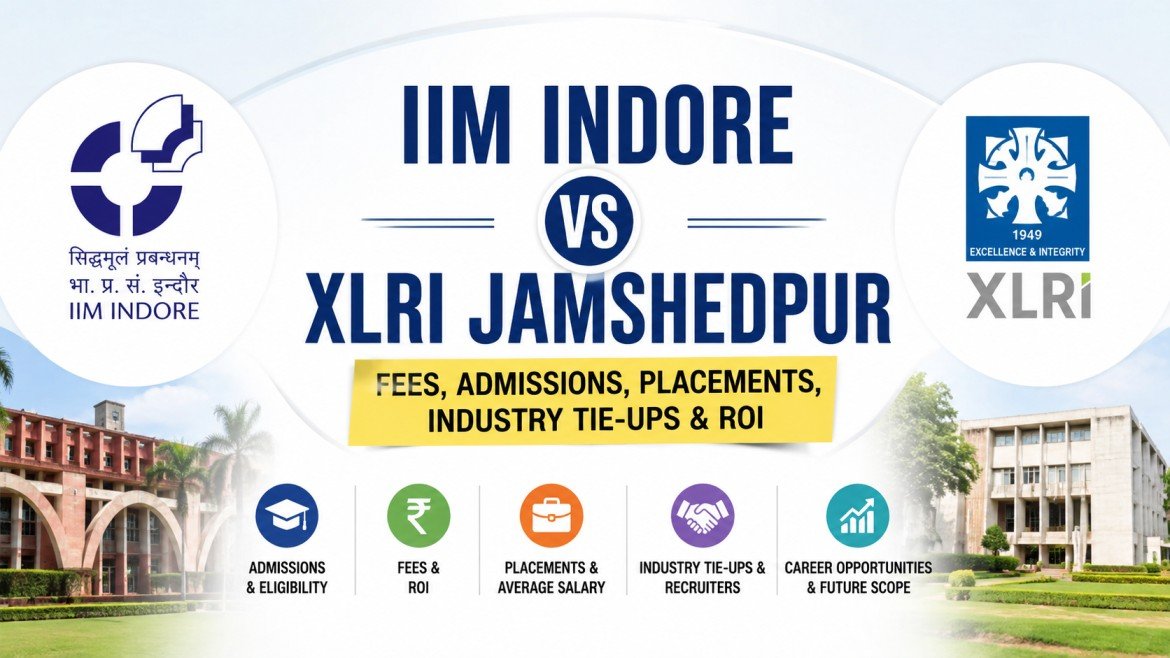
Quick Summary
- IIM Indore offers the IIM ecosystem and broad management opportunities, while XLRI stands out for corporate connections and HR strength. Fees, placements and career goals should guide your choice.
Choosing between two established management institutes is rarely as simple as comparing one placement figure or one college ranking. For MBA aspirants, the decision usually comes down to a combination of entrance exam, admission criteria, programme structure, fees, placement opportunities, recruiter profile, alumni network, industry exposure and long-term career value.
That is exactly why the IIM Indore vs XLRI comparison attracts so much attention among MBA aspirants.
Both institutions have strong reputations, but they are not identical in what they offer. IIM Indore is one of the established Indian Institutes of Management and admits students to its flagship PGP through the CAT-based admission route. XLRI Jamshedpur, meanwhile, has a particularly strong identity in management education, with the XAT route and a long-standing reputation in business management and human resource management.
So, which is better: IIM Indore or XLRI Jamshedpur?
The answer depends on what you want from your MBA.
If your priority is a broad management career with the IIM ecosystem, IIM Indore can be an excellent choice. If you want the XLRI brand, strong corporate connections and particularly strong opportunities in HR and business management, XLRI can be compelling.
This detailed IIM Indore vs XLRI comparison looks at fees, admissions, placements, industry exposure, ROI, career opportunities, campus experience and the factors that should actually influence your final decision.
IIM Indore vs XLRI at a Glance
| Factor | IIM Indore | XLRI Jamshedpur |
|---|---|---|
| Institution | Indian Institute of Management Indore | XLRI – Xavier School of Management |
| Location | Indore, Madhya Pradesh | Jamshedpur, Jharkhand |
| Flagship two-year management programme | PGP leading to MBA | PGDM in Business Management / Human Resource Management |
| Major entrance route | CAT | XAT |
| Programme duration | Two years | Two years |
| Major career areas | Consulting, finance, marketing, product, operations, general management and others | Consulting, finance, marketing, operations, general management, HR and others |
| 2026 PGP fee reference | Official fee structure lists ₹12 lakh course fee per academic year before other listed charges | Official 2026 admission information lists ₹15.25 lakh per annum for the relevant PGDM admission information, with mess and hostel expenses extra |
| Latest official placement information | 2026 placement information should be checked against IIM Indore's latest placement release before publication | XLRI has published final placement results for the 2024–26 batch |
| Entrance exam identity | CAT | XAT |
| Strongest differentiator | IIM ecosystem and broad management positioning | XLRI brand, corporate relationships and particularly strong HR legacy |
| Best suited for | Aspirants seeking a broad management career and IIM ecosystem | Aspirants seeking strong management careers, especially those interested in HR or XLRI's corporate ecosystem |
IIM Indore's official website identifies the 2026–28 PGP batch and provides the corresponding fee structure. The institute's published fee page lists a course fee of ₹12 lakh for each academic year for Indian students entering through CAT, along with other charges such as the refundable caution deposit and mess deposit.
XLRI's official admission information for its two-year PGDM programmes lists a fee of ₹15.25 lakh per annum, with hostel and mess expenses charged separately.
IIM Indore vs XLRI: Which College Has the Better Brand?
Brand value is one of the first things students consider when comparing business schools, but brand should not be treated as a single universal ranking.
IIM Indore benefits from the Indian Institute of Management network and the broader recognition attached to the IIM name. The institute has built a strong reputation across management education, consulting, finance, marketing, operations, analytics and general management.
XLRI has a different but equally distinctive positioning. It is one of India's oldest and most recognised management institutions and has a particularly strong association with human resource management. Its corporate relationships and alumni network are also important parts of its identity.
For an MBA aspirant, the practical question is therefore not simply:
“Which brand is bigger?”
A better question is:
“Which brand is stronger for the career I want to build?”
For example, a student targeting HR leadership may naturally place greater value on XLRI's long-standing HR ecosystem. A student looking for broad management opportunities may place greater weight on IIM Indore's IIM identity and the flexibility of its flagship PGP.
That makes the IIM Indore vs XLRI decision more nuanced than a simple ranking comparison.
IIM Indore: Overview of the MBA Programme
IIM Indore's flagship Post Graduate Programme in Management leads to the award of an MBA. The programme is designed as a full-time management education programme and exposes students to areas such as finance, marketing, operations, strategy, economics, organisational behaviour and other management disciplines.
IIM Indore also has an international exchange ecosystem. Its international relations information states that the institute has established relationships with universities and business schools around the world and facilitates student exchange opportunities.
This matters because an MBA is not only about classroom learning. Exposure to different industries, organisations, business cases, peer groups and international institutions can influence the quality of the overall experience.
XLRI Jamshedpur: Overview of the MBA-Equivalent Programmes
XLRI's flagship two-year management offerings include its PGDM in Business Management and PGDM in Human Resource Management.
The Business Management programme is aimed at preparing students for careers across management functions. HRM, meanwhile, is one of XLRI's most distinctive areas and has historically been one of the institute's strongest academic and professional identities.
XLRI's official placement report for the 2024–26 batch covers the PGDM Business Management and PGDM Human Resource Management cohorts across the Jamshedpur and Delhi-NCR campuses.
For students interested specifically in HR, the IIM Indore vs XLRI comparison therefore becomes quite different from a student choosing between the two for finance, consulting or general management.
IIM Indore vs XLRI: Admission Process
Admission is one of the biggest differences between the two institutions.
IIM Indore Admission Through CAT
For the 2026–28 PGP batch, IIM Indore's official admission page identifies CAT as the entrance route for domestic applicants. The institute has published its 2026–28 admission information and provisional shortlist/admission-status information through its official admission portal.
The broad journey for an aspirant is:
CAT registration → CAT examination → IIM application/selection consideration → shortlist → Personal Interview → final admission decision.
However, candidates should not assume that clearing a particular CAT percentile automatically guarantees admission.
IIM admissions involve multiple components, and the institute's admission policy should always be checked for the relevant admission cycle.
XLRI Admission Through XAT
XLRI has traditionally used XAT as its principal entrance examination for its flagship two-year management programmes.
Its official admission information for the relevant 2026 admission cycle lists XAT registration and describes the selection process for its programmes. The official page also states that Indian candidates can appear for XAT, while certain international categories can apply through GMAT or XAT depending on the programme and eligibility conditions.
This creates an important difference:
IIM Indore vs XLRI is also a CAT vs XAT decision.
Students deciding between the two should understand the differences in exam format, preparation strategy and programme-specific selection criteria before choosing their target schools.
CAT vs XAT: Which Exam Should You Prepare For?
CAT and XAT are both highly competitive management entrance examinations, but their structures are not identical.
CAT preparation generally revolves around:
Quantitative Ability
Data Interpretation
Logical Reasoning
Verbal Ability and Reading Comprehension
XAT also tests core aptitude areas but has its own examination structure and historically includes additional decision-making-oriented assessment.
For an aspirant targeting both IIM Indore and XLRI, preparing for both examinations can therefore be a practical strategy.
A strong CAT preparation base can help with XAT, but candidates should still spend dedicated time understanding the XAT pattern and its decision-making component.
IIM Indore vs XLRI: Eligibility
Eligibility requirements can change between admission cycles, so candidates should always verify the current official notification before applying.
For the flagship two-year programmes, candidates generally need a recognised bachelor's degree and must satisfy the relevant academic and examination requirements.
The most important point is that eligibility and selection are not the same thing.
Meeting the minimum academic eligibility does not mean a student will receive an interview call or admission offer.
For highly competitive institutions such as IIM Indore and XLRI, the quality of the overall application and performance in the applicable selection stages matters.
IIM Indore vs XLRI: Fees
Fees are one of the most searched aspects of the comparison.
For IIM Indore's PGP 2026–28 batch, the official fee structure for Indian students entering through CAT lists a course fee of ₹12 lakh for the first academic year and ₹12 lakh for the second academic year. The published structure also lists a refundable caution deposit of ₹50,000 and a mess deposit of ₹54,000 for the first academic year, along with other applicable charges.
That means students should not interpret the ₹12 lakh course fee as the complete out-of-pocket cost of the MBA. Accommodation, food, insurance, books and other personal expenses may affect the actual cost.
For XLRI, the official admission information lists ₹15.25 lakh per annum for the relevant PGDM admission information, with hostel and mess expenses charged separately.
Approximate Fee Comparison
| Cost component | IIM Indore | XLRI |
|---|---|---|
| Published annual course/programme fee reference | ₹12 lakh | ₹15.25 lakh |
| Two-year course fee reference | ₹24 lakh | About ₹30.50 lakh |
| Hostel/mess | Additional components apply | Hostel and mess extra according to official admission information |
| Caution deposit | ₹50,000 listed for first year | Depends on applicable institute fee structure |
| Other expenses | Books, insurance and personal expenses may apply | Personal and campus-related expenses may apply |
The comparison above is based on the official published fee information and should not be interpreted as a final all-inclusive cost calculation. IIM Indore's official fee page specifically separates course fee, caution deposit and mess deposit.
Which Is More Expensive: IIM Indore or XLRI?
Based purely on the published programme-fee figures, XLRI's annual programme fee is higher than IIM Indore's published annual course fee for the 2026–28 PGP reference.
However, comparing fees alone can be misleading.
Suppose College A costs ₹5 lakh less but produces substantially weaker career opportunities for your chosen sector. The lower fee does not necessarily mean better ROI.
Conversely, if two colleges provide similar career outcomes for your profile, the lower total cost can make a meaningful difference.
This is why the IIM Indore vs XLRI ROI calculation should include:
Total programme cost
Living expenses
Opportunity cost
Average compensation
Median compensation
Career function
Industry
Location
Long-term career progression
Alumni network
Student's existing work experience
Financing cost if an education loan is used
IIM Indore vs XLRI: Placement Comparison
Placements are probably the most important part of the comparison for students focused on ROI.
But there is an important data issue.
Placement reports are associated with particular graduating batches. Therefore, a placement number should always be identified by the relevant batch rather than simply labelled “2026 placement.”
XLRI's Latest Official Placement Data
XLRI has published its final placement report for the 2024–26 PGDM Business Management and PGDM Human Resource Management batch.
According to XLRI's official report, the recruitment process covered 576 students from the Jamshedpur and Delhi-NCR campuses and involved 145 recruiting organisations. The report says that 25 organisations partnered with XLRI for the first time. It also reports 576 domestic offers and two international offers.
The official report gives:
Average salary: ₹31.40 lakh per annum
Median salary: ₹29 lakh per annum
Top 10 percentile average: ₹49.2 lakh per annum
Top 25 percentile average: ₹44.18 lakh per annum
Highest domestic offer: ₹59 lakh per annum
Highest international offer: ₹1.10 crore per annum
PPO rate: 42.5%
These figures are for the 2024–26 graduating cohort reported by XLRI and should not be presented as the salary of every XLRI graduate.
What About IIM Indore?
IIM Indore also has a strong placement ecosystem, with students participating in recruitment across multiple management functions.
However, the latest verified placement figure should always be taken from the institute's latest official placement release rather than combining figures from different years or third-party websites.
This distinction is especially important for an article published in 2026.
A common mistake in college comparison articles is to take an old placement report from one institution and compare it with a newer report from another. That creates a misleading comparison.
For an accurate IIM Indore vs XLRI decision, compare the same type of metric from the same placement cycle wherever possible.
Why Average Salary Should Not Be Your Only Metric
Imagine two students:
Student A receives a ₹30 lakh package in consulting.
Student B receives a ₹27 lakh package in a finance role that provides better alignment with their long-term goals.
Which student made the better decision?
There is no universal answer.
Salary is important, but the role itself matters.
When comparing placements, look at:
Average salary
Median salary
Salary distribution
Consulting roles
Finance roles
Marketing roles
Product roles
Operations roles
HR roles
Technology roles
Recruiter diversity
Number of companies
PPO opportunities
International opportunities
Median salary can be particularly useful because it gives a better indication of the middle of the placement distribution than the highest package.
IIM Indore vs XLRI: Industry Tie-Ups
Industry exposure is another major factor in management education.
A business school creates value not only through lectures but through interaction with companies, recruiters, alumni, case competitions, live projects, internships and corporate events.
XLRI's latest placement report demonstrates the scale of its recruiter ecosystem. The 2024–26 final placement process involved 145 recruiting organisations across the two campuses, including 25 new recruiting organisations.
IIM Indore similarly emphasises industry interaction and international exposure. Its official website highlights engagement with industry leaders and its international relations ecosystem includes partnerships with universities and business schools around the world.
The nature of industry exposure may differ depending on the programme, year and sector.
Therefore, students should investigate recruiter lists and role profiles rather than judging an institute only by the number of companies that visit campus.
Consulting Opportunities: IIM Indore vs XLRI
Consulting is one of the most attractive career paths for MBA students.
Both institutions can provide access to consulting careers, but the actual opportunities available to a student depend on:
Academic performance
Previous work experience
Internship
Interview performance
CV quality
Case interview preparation
Communication skills
Leadership experience
Recruiter requirements
Students targeting consulting should therefore compare the consulting companies and roles offered during the latest placement season rather than relying only on overall average salary.
Finance Opportunities
Finance is another area where both institutions can offer attractive career paths.
Potential areas include:
Investment banking
Corporate finance
Financial services
Risk management
Asset management
Fintech
Commercial banking
Corporate strategy
The best choice depends heavily on the student's academic profile and career target.
Candidates aiming for finance should examine the actual roles offered in recent placement reports and determine whether they align with their desired function.
Marketing and General Management
Students interested in marketing or general management should also look beyond the overall placement average.
General management roles can involve:
Business strategy
Category management
Sales
Brand management
Product management
Business development
Operations
Leadership programmes
IIM Indore's broad management positioning can be attractive for students who have not yet specialised in one narrow career path.
XLRI's Business Management programme also provides a broad management route, making the decision dependent on the student's preferred ecosystem, entrance route and career goals.
HR Career: XLRI Has a Distinct Advantage
If HR is your primary career target, the IIM Indore vs XLRI comparison becomes much easier.
XLRI has one of India's strongest institutional identities in human resource management.
Its PGDM-HRM programme has been a defining part of the institute's reputation for decades.
Students targeting careers such as:
Human resources
Talent management
Compensation and benefits
Employee relations
HR consulting
Organisation development
People analytics
Leadership development
should seriously consider XLRI.
This does not mean IIM Indore cannot lead to an HR career. It can.
The difference is that XLRI's institutional ecosystem and legacy make HR one of its most obvious areas of differentiation.
ROI: IIM Indore vs XLRI
ROI is often misunderstood.
ROI does not simply mean:
Salary ÷ Fees
A more useful MBA ROI framework is:
Career value = Compensation + Career growth + Brand value + Network + Learning + Role quality – Total cost
For a student taking an education loan, the calculation should also consider interest costs and the repayment period.
IIM Indore ROI
IIM Indore's published course fee for the 2026–28 PGP is relatively lower than XLRI's published annual programme fee reference.
This can make the cost side of the ROI equation attractive.
The IIM ecosystem can also contribute to long-term value through alumni networks, brand recognition and career mobility.
XLRI ROI
XLRI's latest official placement report for the 2024–26 batch reports an average salary of ₹31.40 lakh and median salary of ₹29 lakh for the reported cohort across the covered PGDM programmes and campuses.
Those numbers demonstrate why XLRI can remain financially attractive despite a higher programme fee.
But again, the reported average is not a guarantee of an individual student's salary.
IIM Indore vs XLRI: Which Has Better ROI?
There is no single winner for every student.
IIM Indore may offer stronger fee efficiency for a student who wants broad management opportunities while keeping programme cost comparatively controlled.
XLRI can offer very strong ROI for students who take advantage of its corporate ecosystem and enter high-value management roles, particularly when their career target matches XLRI's strengths.
For HR-focused students, the ROI equation can favour XLRI because institutional fit matters.
For students comparing general management programmes, the decision requires a broader assessment of placement outcomes, cost and career preferences.
Campus Life: IIM Indore vs XLRI
Campus experience matters because a two-year residential MBA is an intense social and academic environment.
At both institutions, students experience:
Classroom discussions
Case studies
Student clubs
Committees
Competitions
Corporate events
Alumni interaction
Peer learning
Internships
Placement preparation
The difference is more about institutional culture and student experience than a simple “better/worse” ranking.
Students should speak to current students and recent alumni whenever possible.
Alumni Network
A strong alumni network can remain valuable long after graduation.
Alumni can help with:
Career transitions
Referrals
Industry insights
Mentoring
Entrepreneurship
International opportunities
Hiring
Networking
IIM Indore benefits from its IIM identity and alumni network.
XLRI benefits from a large and highly established alumni community with a strong presence across management functions and particularly in HR.
For an MBA aspirant, alumni quality is more important than simply counting alumni.
Ask:
Are alumni working in the industry and role I want?
That is a much better question than:
Which college has more alumni?
International Exposure
International exposure can add value through exchange programmes, global projects and interaction with international institutions.
IIM Indore's international relations information specifically highlights its relationships with international universities and business schools and the opportunity for PGP students to participate in exchange programmes.
Students considering international careers should investigate:
Partner universities
Exchange eligibility
Exchange duration
Additional costs
Scholarships
International recruiters
Global alumni network
International exposure should be evaluated based on actual accessibility rather than simply whether a college advertises international partnerships.
IIM Indore vs XLRI for Freshers
Freshers often ask whether they should prefer one school over the other.
For a fresher, the most important considerations include:
Brand
Placement opportunities
Internship
Peer group
Career flexibility
Academic profile
Entrance score
Preferred function
A fresher who is still exploring career options may benefit from a broad management programme.
A fresher who already knows that HR is the desired career path may find XLRI particularly attractive.
IIM Indore vs XLRI for Working Professionals
Working professionals may evaluate the two institutions differently.
They may care more about:
Career switch potential
Previous experience relevance
Salary jump
Specialisation
Network
Role quality
Opportunity cost
Both institutions also offer executive and alternative management programmes, but these should not be confused with the flagship two-year programmes.
For example, IIM Indore publishes separate information for its executive programmes, while XLRI also offers programmes designed specifically for experienced professionals.
Therefore, an experienced professional should compare the exact programme rather than simply comparing the institution's overall brand.
IIM Indore vs XLRI: Academic Experience
An MBA is not only about placement.
A strong academic environment helps students understand:
Business strategy
Economics
Finance
Marketing
Operations
Human behaviour
Leadership
Data-driven decision-making
Corporate governance
Business communication
The value of an institution's academic environment is partly determined by faculty, curriculum, peer quality and the intensity of classroom discussions.
Students should therefore consider whether they prefer a highly competitive environment and whether they are prepared for the workload.
Peer Group
The peer group is one of the less visible but most valuable parts of a top MBA.
Your classmates can become:
Future co-founders
Colleagues
Investors
Clients
Recruiters
Industry contacts
Lifelong professional friends
IIM Indore and XLRI both attract high-performing candidates.
The exact peer profile changes every year, so aspirants should examine the latest batch profile rather than relying on old assumptions.
IIM Indore vs XLRI: Which Is Better for Entrepreneurship?
Both institutions can support entrepreneurship, but the experience depends on the student's ability to use the ecosystem.
An entrepreneur can benefit from:
Alumni contacts
Mentors
Student peers
Faculty
Competitions
Incubation support
Investor networks
Industry connections
For entrepreneurship, there is no simple placement-based winner because founders may intentionally choose not to participate in campus placements.
If entrepreneurship is your priority, compare incubation facilities, startup networks and alumni founders instead of focusing only on average placement salary.
IIM Indore vs XLRI: Pros and Cons
IIM Indore Advantages
Strong IIM brand
Broad management career opportunities
CAT-based admission route
Competitive programme fee compared with the published XLRI annual fee reference
Strong alumni ecosystem
International exchange opportunities
Suitable for multiple management functions
Strong academic environment
IIM Indore Limitations
Extremely competitive admission
CAT preparation required for the flagship route
Total cost is higher than tuition alone
High academic and placement pressure
Career outcome depends heavily on individual performance
XLRI Advantages
Strong and distinctive management brand
XAT-based admission route
Exceptional reputation in HR
Strong corporate ecosystem
Broad Business Management career opportunities
Strong alumni network
Excellent placement performance in the latest official 2024–26 report
Strong recruiter participation
XLRI Limitations
Higher published annual programme fee than IIM Indore's PGP course fee
XAT requires dedicated preparation
Hostel and mess expenses are additional
Admission remains highly competitive
High placement and academic competition
IIM Indore vs XLRI: Who Should Choose IIM Indore?
IIM Indore can be a strong choice if you:
Want the IIM brand
Are comfortable preparing for CAT
Want broad management opportunities
Are considering consulting
Are considering finance
Are considering marketing
Want flexibility across management functions
Value international exchange opportunities
Want a comparatively lower published course-fee reference
Prefer the IIM ecosystem
If your long-term goal is broad business leadership rather than a narrowly defined specialisation, IIM Indore can make a lot of sense.
Who Should Choose XLRI?
XLRI can be the better fit if you:
Want the XLRI brand
Prefer the XAT route
Are interested in HR
Want strong corporate exposure
Are targeting consulting or general management
Value a strong alumni network
Want a business school with a distinctive HR legacy
Are comfortable with a higher programme fee
Want to benefit from XLRI's corporate ecosystem
For an HR aspirant, XLRI deserves especially serious consideration.
IIM Indore vs XLRI for HR
If the question is specifically:
“IIM Indore vs XLRI for HR—which is better?”
XLRI is generally the more natural choice.
The reason is not that IIM Indore lacks HR education. The reason is that HR is one of XLRI's defining strengths.
XLRI's HR ecosystem, alumni base, corporate relationships and institutional legacy make it particularly attractive for students targeting HR leadership.
If HR is not your target and you want a broader management career, the comparison becomes more balanced.
IIM Indore vs XLRI for Consulting
For consulting, both can be strong choices.
Your decision should depend on:
Consulting recruiters
Role types
Previous work experience
Academic performance
Case interview preparation
Internship
Location preference
Alumni network
Do not select a college solely because its highest package is larger.
Consulting career outcomes can vary significantly between students.
IIM Indore vs XLRI for Finance
For finance, both institutions can provide strong opportunities.
Students should investigate the latest recruiter and role data for:
Investment banking
Corporate finance
Private equity
Financial services
Risk
Fintech
Treasury
Banking
Candidates with a clear finance goal should also consider their undergraduate background, certifications and prior experience.
IIM Indore vs XLRI for Marketing
Marketing candidates should examine:
Brand management roles
Product marketing
Sales
Category management
Digital marketing
Consumer insights
Business development
Both institutions can provide broad management exposure, but the student's profile and interview performance remain important.
How to Decide Between IIM Indore and XLRI
Instead of asking only which college is better, create a personal scorecard.
Give each school a score from 1 to 10 for:
| Decision Factor | Weight |
|---|---|
| Career target alignment | 25% |
| Placement quality | 20% |
| Brand value | 15% |
| Total cost | 10% |
| ROI | 10% |
| Alumni network | 5% |
| Industry exposure | 5% |
| International exposure | 5% |
| Campus experience | 5% |
Then calculate your weighted score.
For example, if HR is your target, increase the weight for career alignment.
If consulting is your goal, increase the importance of consulting placements.
If you need an education loan, increase the weight of total cost and expected repayment.
This approach is more useful than blindly following a generic “college A is better than college B” recommendation.
Is XLRI Worth the Higher Fee?
It can be.
The latest official XLRI placement report for the 2024–26 batch reports a ₹31.40 lakh average salary and ₹29 lakh median salary for the covered PGDM cohort.
Those outcomes can make the higher programme cost financially reasonable for many students.
But “worth it” depends on the student.
A student who receives a strong role in a preferred sector may achieve excellent ROI.
Another student may prioritise a lower loan burden and choose a different institution.
Therefore, the answer should always consider the student's expected career path rather than treating the average salary as a guarantee.
Is IIM Indore Worth It?
For many MBA aspirants, yes.
IIM Indore combines:
IIM brand recognition
Broad management education
Competitive programme fee relative to the published XLRI annual fee
Strong peer group
Alumni network
Industry exposure
International exchange opportunities
Multiple career pathways
Its 2026–28 official fee structure provides a clear reference for the current PGP cost.
The biggest value comes when the student actively uses the academic, peer and recruiting ecosystem.
What About the Highest Package?
Highest salary is one of the least reliable metrics for choosing an MBA.
A highest package may represent only one candidate.
A better comparison uses:
Median + Average + Role Distribution + Recruiter Quality + Career Function
For example, XLRI's official placement report provides both average and median salary, which gives a more useful picture than looking only at its highest offer.
Students should ask:
What roles are available?
How many recruiters participated?
What is the median salary?
How many students received offers?
What industries hired?
Are PPOs available?
What career paths do alumni follow?
Education Loan Considerations
Many MBA aspirants finance their education through loans.
When comparing IIM Indore and XLRI, calculate:
Tuition
Hostel
Mess
Books
Laptop
Travel
Personal expenses
Loan interest
Repayment period
Do not borrow based only on the highest advertised package.
Your repayment plan should be based on a realistic expected salary range.
IIM Indore vs XLRI: Final Verdict
There is no universal winner in the IIM Indore vs XLRI comparison.
The better option depends on the student's career objective.
Choose IIM Indore if:
You want the IIM ecosystem, a broad management career, CAT-based admission, strong academic exposure and a comparatively lower published course-fee reference.
Choose XLRI if:
You want the XLRI brand, strong corporate exposure, XAT-based admission, excellent management opportunities or a particularly strong HR ecosystem.
If HR is your priority:
XLRI deserves a strong preference because of its distinctive HR legacy and ecosystem.
If broad management is your priority:
Both deserve serious consideration. Compare the exact placement roles, total cost, recruiter mix and your personal career goals.
If ROI is your priority:
Do not calculate ROI using only the highest package. Compare total programme cost against realistic median and average outcomes, then consider career progression and role quality.
Frequently Asked Questions
Which is better, IIM Indore or XLRI?
Neither is universally better. IIM Indore is attractive for students seeking the IIM ecosystem and broad management opportunities, while XLRI is particularly strong for students seeking its corporate ecosystem and HR legacy.
Is IIM Indore cheaper than XLRI?
Based on the published 2026 fee references, IIM Indore's PGP course fee is ₹12 lakh per academic year, while XLRI's relevant two-year PGDM admission information lists ₹15.25 lakh per annum, with hostel and mess expenses extra.
Is XLRI better for HR?
XLRI is widely recognised for its HR ecosystem and is a particularly strong choice for students whose primary career goal is human resource management.
Does IIM Indore accept XAT?
For the flagship domestic PGP route discussed here, IIM Indore's admission process is CAT-based. Candidates should check the official admission policy for the exact programme and admission year.
Does XLRI accept CAT?
For its flagship two-year programmes, XAT is the principal examination route for Indian candidates. The exact examination requirements should be checked in the applicable XLRI admission notification.
What is XLRI's average salary?
XLRI's official final placement report for the 2024–26 PGDM BM and HRM batch reports an average salary of ₹31.40 lakh per annum and a median salary of ₹29 lakh per annum.
What is XLRI's highest package?
The latest official placement report for the 2024–26 batch reports a highest domestic offer of ₹59 lakh per annum and a highest international offer of ₹1.10 crore per annum.
Is IIM Indore good for consulting?
Yes. IIM Indore offers broad management education and can provide opportunities across consulting and other management functions. Actual opportunities depend on the recruitment cycle and individual student profile.
Is XLRI good for consulting?
Yes. XLRI's Business Management programme provides a broad management route and the institute has a strong corporate recruiter ecosystem.
Which is better for freshers?
Both can be excellent for freshers. The decision should depend on career goals, entrance performance, programme fit and the student's preferred industry.
Which has better ROI?
ROI depends on the individual. XLRI's latest official placement report shows strong salary outcomes, while IIM Indore has a lower published annual course-fee reference for its 2026–28 PGP. The best ROI depends on total cost, salary, role and long-term career progression.
Should I choose IIM Indore or XLRI based only on salary?
No. Salary should be considered alongside median salary, role quality, recruiter profile, career growth, programme cost, alumni network and personal career goals.
Which entrance exam is required for IIM Indore?
The flagship domestic PGP admission route uses CAT. IIM Indore has published its admission information for the 2026–28 batch on its official website.
Which entrance exam is required for XLRI?
XAT is the principal entrance route for Indian candidates applying to XLRI's flagship two-year programmes.
Is XLRI's placement data for 2026 available?
XLRI has published final placement information for the graduating 2024–26 PGDM BM and HRM batch. It should be identified as the 2024–26 placement cycle rather than incorrectly labelled as a generic 2026 salary figure.
Conclusion
The IIM Indore vs XLRI decision should ultimately be based on fit rather than hype.
IIM Indore offers the strength of the IIM brand, broad management positioning, international exposure and a published 2026–28 PGP course-fee structure that is lower than XLRI's published annual programme-fee reference.
XLRI brings a distinctive management identity, a particularly strong HR legacy and a corporate ecosystem supported by a large recruiter network. Its latest official 2024–26 placement report shows an average salary of ₹31.40 lakh and median salary of ₹29 lakh for the reported PGDM cohort.
For an HR aspirant, XLRI may be the more natural fit.
For a student looking for broad management opportunities and the IIM ecosystem, IIM Indore can be an excellent option.
For students targeting consulting, finance, marketing or general management, the decision should be made after comparing the latest role-level placement information, total cost and individual career goals.
The smartest MBA decision is not simply about getting into the college with the biggest headline.
It is about choosing the institution where your career goals, financial situation, skills and long-term ambitions fit best.
Before paying an admission fee, candidates should always verify the latest official admission notice, fee structure and placement report because these details can change between admission cycles.
Official Sources
IIM Indore official admissions and fee information: IIM Indore PGP Admissions
IIM Indore official PGP fee structure: IIM Indore PGP Fee Structure
XLRI official admission information: XLRI Admission Procedure
XLRI official placement reports: XLRI Placement Reports
Search Keywords
iim indore vs xlri, IIMI vs XLRI, IIM Indore vs XLRI Jamshedpur, IIM Indore or XLRI, IIM Indore vs XLRI which is better, IIM Indore vs XLRI fees, IIM Indore vs XLRI placements, IIM Indore vs XLRI ROI, IIM Indore fees, XLRI fees, IIM Indore MBA fees, XLRI MBA fees, IIM Indore placement, XLRI placement, IIM Indore average package, XLRI average package, IIM Indore highest package, XLRI highest package, IIM Indore admission, XLRI admission, IIM Indore CAT, XLRI XAT, CAT vs XAT, IIM Indore MBA, XLRI MBA, IIM Indore PGP, XLRI PGDM, IIM Indore Business Management, XLRI Business Management, XLRI HRM, IIM Indore HR, XLRI HR, best MBA college India, best MBA college comparison, IIM vs XLRI, top MBA colleges India, MBA college fees, MBA placement comparison, MBA ROI India, MBA salary comparison, IIM Indore ROI, XLRI ROI, IIM Indore career, XLRI career, IIM Indore recruiters, XLRI recruiters, IIM Indore industry tie ups, XLRI industry tie ups, IIM Indore corporate exposure, XLRI corporate exposure, IIM Indore alumni, XLRI alumni, IIM Indore international exposure, XLRI international exposure, IIM Indore consulting, XLRI consulting, IIM Indore finance, XLRI finance, IIM Indore marketing, XLRI marketing, IIM Indore HRM, XLRI HRM, best college for HR, best MBA college for HR, best college for consulting, best MBA for consulting, best MBA college for finance, best MBA college for marketing, CAT MBA colleges, XAT MBA colleges, CAT vs XAT MBA, MBA admission 2026, IIM admission 2026, XLRI admission 2026, IIM Indore admission 2026, XLRI admission 2026, IIM Indore fees 2026, XLRI fees 2026, IIM Indore placement 2026, XLRI placement 2026, IIM Indore vs XLRI 2026, IIM Indore vs XLRI salary, IIM Indore vs XLRI package, IIM Indore vs XLRI comparison, IIM Indore vs XLRI career, IIM Indore vs XLRI HR, IIM Indore vs XLRI consulting, IIM Indore vs XLRI finance, IIM Indore vs XLRI marketing, IIM Indore vs XLRI general management, IIM Indore vs XLRI for freshers, IIM Indore vs XLRI for working professionals, IIM Indore vs XLRI for HR, IIM Indore vs XLRI for consulting, IIM Indore vs XLRI for finance, IIM Indore vs XLRI for marketing, IIM Indore vs XLRI for freshers, IIM Indore vs XLRI for experienced professionals, IIM Indore vs XLRI salary comparison, IIM Indore vs XLRI fee comparison, IIM Indore vs XLRI placement comparison, IIM Indore vs XLRI admission comparison, IIM Indore vs XLRI ROI comparison, IIM Indore vs XLRI recruiter comparison, IIM Indore vs XLRI alumni comparison, IIM Indore vs XLRI brand comparison, IIM Indore vs XLRI campus comparison, IIM Indore vs XLRI programme comparison, IIM Indore vs XLRI course comparison, IIM Indore vs XLRI CAT XAT, IIM Indore vs XLRI XAT, IIM Indore CAT percentile, XLRI XAT percentile, XLRI XAT cutoff, IIM Indore CAT cutoff, MBA ROI, MBA fees India, MBA placements India, MBA salary India, top IIM comparison, XLRI vs IIM, IIM Indore vs top MBA colleges
Long-Tail & Short-Tail Searches
which is better IIM Indore or XLRI, IIM Indore vs XLRI which college should I choose, IIM Indore vs XLRI for MBA, IIM Indore vs XLRI for HR career, IIM Indore vs XLRI for consulting career, IIM Indore vs XLRI for finance career, IIM Indore vs XLRI for marketing career, IIM Indore vs XLRI for freshers, IIM Indore vs XLRI for working professionals, IIM Indore vs XLRI fees and placements, IIM Indore vs XLRI complete comparison, IIM Indore vs XLRI detailed comparison, IIM Indore vs XLRI admission process, IIM Indore vs XLRI entrance exam, IIM Indore vs XLRI CAT XAT difference, IIM Indore vs XLRI MBA fees 2026, IIM Indore vs XLRI placement 2026, IIM Indore vs XLRI ROI 2026, IIM Indore vs XLRI average salary, IIM Indore vs XLRI median salary, IIM Indore vs XLRI highest package, IIM Indore vs XLRI recruiter list, IIM Indore vs XLRI industry exposure, IIM Indore vs XLRI corporate exposure, IIM Indore vs XLRI alumni network, IIM Indore vs XLRI campus life, IIM Indore vs XLRI international exposure, IIM Indore vs XLRI entrepreneurship, IIM Indore vs XLRI general management, is XLRI worth the fees, is IIM Indore worth it, is XLRI better than IIM Indore, should I choose IIM Indore or XLRI, which has better ROI IIM Indore or XLRI, which has better placements IIM Indore or XLRI, which has better salary IIM Indore or XLRI, which is better for HR XLRI or IIM Indore, which is better for consulting XLRI or IIM Indore, which is better for finance XLRI or IIM Indore, which is better for marketing XLRI or IIM Indore, which MBA has better ROI, how much does IIM Indore MBA cost, how much does XLRI MBA cost, what is IIM Indore average salary, what is XLRI average salary, what is XLRI median salary, what is IIM Indore placement package, how to get admission into IIM Indore, how to get admission into XLRI, what exam is required for IIM Indore, what exam is required for XLRI, CAT or XAT which is better, should I prepare CAT and XAT together, IIM Indore vs XLRI for MBA aspirants, best MBA college between IIM Indore and XLRI, IIM Indore or XLRI for career growth, IIM Indore or XLRI for salary growth, IIM Indore or XLRI for corporate jobs, IIM Indore or XLRI for management consulting, IIM Indore or XLRI for investment banking, IIM Indore or XLRI for product management, IIM Indore or XLRI for general management, IIM Indore or XLRI for HR management, IIM Indore or XLRI total cost, IIM Indore or XLRI education loan, IIM Indore or XLRI return on investment, IIM Indore or XLRI placement statistics.
Key Takeaways
IIM Indore offers the established IIM brand and broad management career opportunities.
XLRI has a particularly strong reputation in Human Resource Management.
IIM Indore's 2026–28 PGP course fee is ₹12 lakh per academic year.
XLRI's latest 2024–26 final placement report shows an average salary of ₹31.40 lakh and median salary of ₹29 lakh.
XLRI's 2024–26 placement process involved 145 recruiting organisations across its Jamshedpur and Delhi-NCR campuses.
XLRI reported 42.5% Pre-Placement Offers for the 2024–26 cohort.
CAT is the primary entrance route for IIM Indore's flagship PGP.
XAT is the primary entrance route for XLRI's flagship PGDM programmes.
Students targeting HR should give XLRI particularly serious consideration.
Students seeking broad management careers should compare IIM Indore and XLRI based on role, recruiter profile and career goals.
MBA ROI should be evaluated using total cost, median salary, career growth and role quality—not just the highest package.
Placement figures should always be compared using the same graduating batch and clearly identified year.
Ask a question
Still confused? Leave your question and our team will help you.