
Quick Summary
- IBA Bangalore's official website reports an average placement figure of ₹8.66 LPA for the highlighted 2024–26 final-placement cycle.
- The highest placement figure published on the official homepage is ₹18.36 LPA.
- IBA's PGDM 2026–28 brochure lists a top 10% average CTC of ₹12.82 LPA.
- The same brochure lists a top 25% average CTC of ₹10.77 LPA.
- A current median salary for the same batch is not confirmed in the cited homepage information.
- Recruiters listed in IBA's placement material include Deloitte, PwC, KPMG, Federal Bank, ICICI Securities, Axis Bank, HDFC Bank, Godrej, Colgate, ITC, Siemens, TCS, and Accenture.
- Placement opportunities can span finance, consulting, marketing, human resources, analytics, operations, and technology-enabled services.
- The availability of specific employers and job roles can vary by placement cycle.
- Historical placement figures are not guaranteed salary outcomes for the 2027 graduating batch.
- Applicants should verify the latest official report, placement methodology, total programme fee, and role-specific opportunities before making an admission decision.
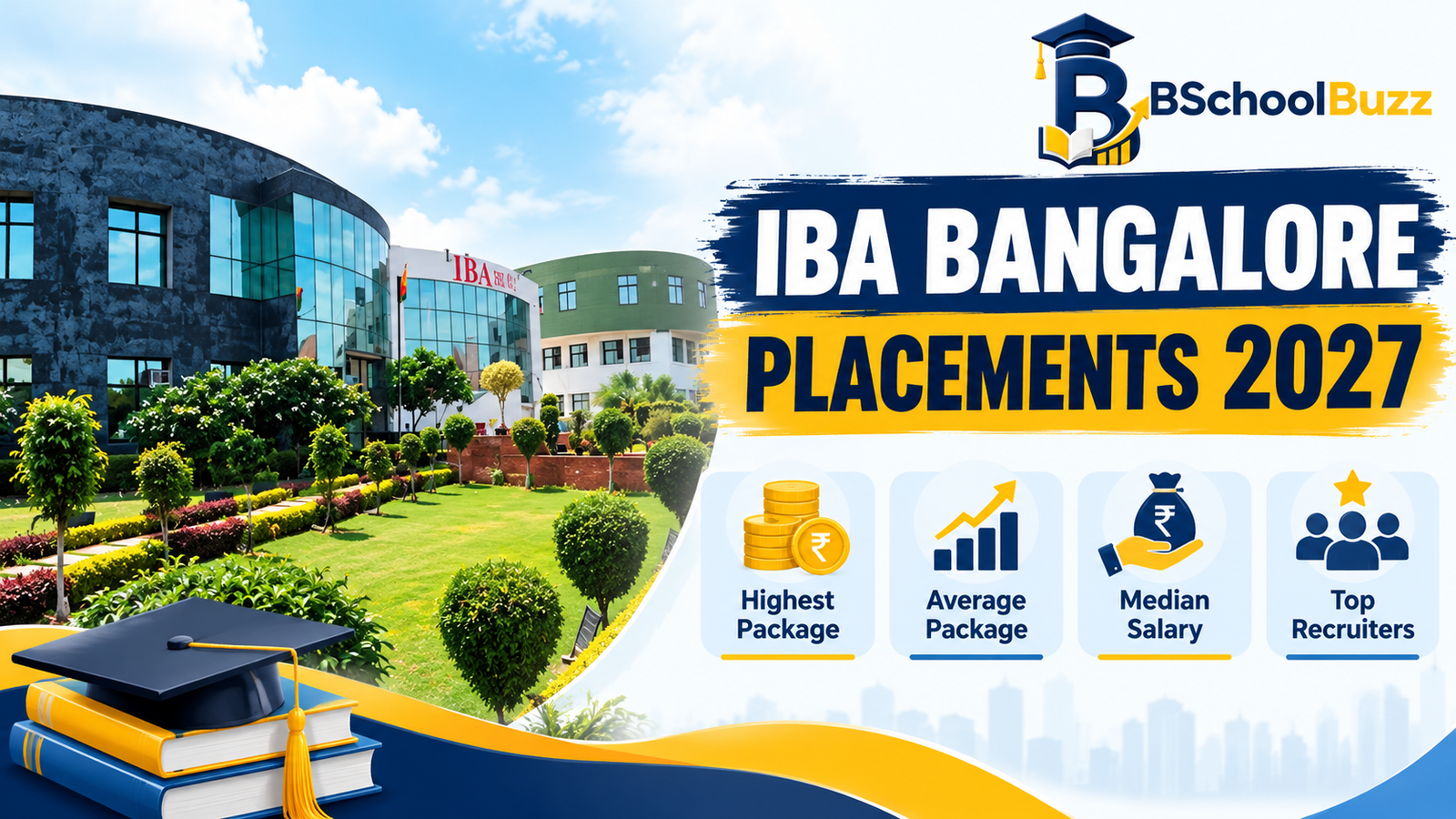
IBA Bangalore Placements 2027: Highest Package, Average Salary, Median Salary & Top Recruiters
Overview of IBA Bangalore Placements 2027
Indus Business Academy (IBA), Bengaluru, is a management institute offering a Post Graduate Diploma in Management (PGDM). For prospective students, placement performance is an important factor when evaluating a business school because it provides insight into employers, salary outcomes, industry exposure, and career opportunities after graduation.
IBA Bangalore placements 2027 is a useful search topic for applicants planning their management education and researching the institute's employment outcomes. However, students should distinguish between the latest published placement figures and the final results of the 2027 graduating batch. The 2027 placement outcome should not be treated as confirmed unless IBA publishes a final report specifically covering that batch.
IBA's official website currently highlights final placement results for the 2024–26 batch, reporting an average placement figure of ₹8.66 lakh per annum and a highest placement figure of ₹18.36 lakh per annum. The official website also describes placement assistance for students. These figures offer a reference point for applicants, but historical results cannot guarantee future salary offers. Official IBA website
IBA Bangalore Placements: Key Highlights
| Placement parameter | Latest relevant information found |
|---|---|
| Institute name | Indus Business Academy (IBA), Bengaluru |
| Programme | PGDM |
| Latest final-placement batch highlighted on the official homepage | 2024–26 |
| Highest placement figure | ₹18.36 LPA |
| Average placement figure | ₹8.66 LPA |
| Placement assistance | Advertised by the institute |
| Top 10% average CTC | ₹12.82 LPA, as shown in IBA's PGDM 2026–28 brochure |
| Top 25% average CTC | ₹10.77 LPA, as shown in the same brochure |
| Recruiters | Companies across multiple business sectors |
| Confirmed final results for the 2027 graduating batch | Not established by the cited final-placement figures |
Sources: IBA official homepage and IBA PGDM 2026–28 brochure.
Important note: The official homepage's final-placement figures and the figures in a programme brochure may refer to different reporting periods or use different presentation methods. The ₹18.36 LPA figure appears in both sources, but applicants should verify the relevant batch and calculation method before comparing every statistic. The top 10% and top 25% averages above are specifically taken from the cited brochure.
Latest Placement Report: What Do the Figures Show?
The latest published figures are a useful starting point for evaluating IBA Bangalore placements. However, a good placement analysis should look beyond the highest package and consider the average salary, median salary, recruiter participation, placement methodology, and roles offered.
IBA's homepage lists ₹8.66 LPA as the average placement figure and ₹18.36 LPA as the highest placement figure for its highlighted 2024–26 final-placement cycle. The brochure for the PGDM 2026–28 programme separately lists a top 10% average CTC of ₹12.82 LPA and a top 25% average CTC of ₹10.77 LPA.
These measures are not interchangeable. The highest package indicates the upper end of the reported results, while averages for the top 10% and top 25% describe particular groups of students. Neither figure tells applicants what every student earns.
Understanding the average package
Average CTC is calculated by adding the compensation figures included in the dataset and dividing the total by the number of students or offers counted, depending on the reporting methodology. A small number of high offers can influence the average.
IBA's homepage currently displays ₹8.66 LPA as the average placement figure for the 2024–26 batch. Applicants should confirm whether the institute's detailed final report gives a more precise figure, explains the calculation method, or updates this headline value.
Understanding the highest package
IBA reports a highest placement figure of ₹18.36 LPA. This is a useful indicator of the upper end of the published results, but it should not be treated as the expected salary for the average student.
A highest-package figure alone does not reveal how many students received offers near that amount, whether the compensation included variable pay, or which job function the offer represented. Students should review the full placement report before drawing conclusions about typical career outcomes.
What about the median salary?
The median salary is the middle salary when the relevant salaries are arranged from lowest to highest. It can help describe the central outcome without being influenced as strongly by a small number of very high offers.
The cited official homepage does not provide a median salary alongside its headline ₹8.66 LPA average and ₹18.36 LPA highest figure. Therefore, a current median salary for the same batch should be treated as not officially confirmed in the cited headline information unless a detailed official placement report or relevant official disclosure establishes it.
Older NIRF data may provide a median salary for a previous graduating year, but it should be labelled with that year and not presented as the median salary for the 2027 graduating batch.
IBA Bangalore Highest Package
The highest placement figure currently highlighted by IBA is ₹18.36 lakh per annum. It is an important reference for students exploring the potential upper range of compensation associated with the institute's published placement outcomes.
However, the highest package represents an individual or small group of top outcomes, rather than a salary that all students can expect. Placement results vary with employers' hiring requirements, job profiles, student performance, market conditions, and the composition of each graduating batch.
What does CTC mean?
CTC stands for cost to company. It may include fixed salary, variable compensation, employer contributions, bonuses, benefits, or other components. As a result, a package of ₹18.36 LPA does not necessarily mean that the employee receives ₹1.53 lakh every month as take-home pay.
Before accepting an offer, students should examine the compensation breakup, including:
Annual fixed salary.
Variable or performance-linked pay.
Joining or retention bonuses.
Employer contributions and benefits.
Conditions attached to incentives.
Probation terms and appraisal policies.
Location, working hours, and job responsibilities.
The details of an offer matter because two roles with similar CTCs may have very different fixed salaries and variable components.
How should students use the highest package?
Use it as one comparison point, alongside the average, median, placement percentage, and quality of available roles. Students should also check which programme and graduating batch the figure covers.
For applicants researching IBA Bangalore placements 2027, ₹18.36 LPA is a reported historical placement figure, not a guarantee of what the next graduating batch will receive.
IBA Bangalore Average Package
IBA's official homepage currently reports an average placement figure of ₹8.66 LPA for its highlighted 2024–26 final-placement cycle. This figure provides a useful initial benchmark for prospective PGDM students.
The average package is generally more informative than the highest package when applicants want to understand the overall compensation reported by an institute. Nevertheless, it should be read alongside the median salary and placement methodology to understand how representative it is.
Why is the average package important?
The average offers a broad view of compensation across the included set of placements. However, it may be affected by a small number of high-value offers, and the meaning of the average depends on the data included.
Applicants should ask whether the published figure is calculated using all placed students, all accepted offers, or another group. They should also establish whether the calculation includes only domestic roles and whether the compensation is reported as CTC or fixed salary.
Average package versus highest package
| Measure | What it tells applicants |
|---|---|
| Highest package | The top reported compensation outcome |
| Average package | The arithmetic average of the included salary figures |
| Median salary | The midpoint of the relevant salary distribution |
| Top 10% average | The average for the highest-paid 10% of the included group, if defined that way in the report |
| Top 25% average | The average for the highest-paid quarter of the included group, if defined that way in the report |
IBA's cited brochure lists a top 10% average CTC of ₹12.82 LPA and a top 25% average CTC of ₹10.77 LPA. These figures help provide additional context about higher salary bands, but they should not be mistaken for the average package of the entire batch.
Is ₹8.66 LPA guaranteed after completing the PGDM?
No. A published average is a historical outcome, not a guaranteed salary for every student. Individual results depend on factors such as academic performance, internship experience, communication skills, technical capabilities, job preferences, interview performance, and employer requirements.
Students should use the average as a benchmark and ask for the latest official report, salary distribution, and placement eligibility criteria before making a decision.
IBA Bangalore Median Salary
Median salary is an important metric when comparing management institutes because it helps explain the middle of a batch's reported salary distribution.
For IBA Bangalore, the median salary for the latest highlighted final-placement batch is not shown alongside the headline figures on the cited official homepage. Unless the detailed official report or a matching official disclosure provides that number, it is better to state that the median is not confirmed in the available headline data than to substitute an unrelated figure.
Average salary and median salary are different
Suppose a group of graduates receives salaries across a wide range. A small number of high offers can raise the average, even when many salaries remain closer to the middle of the distribution. The median helps identify that midpoint.
For this reason, applicants should ideally compare the average and median for the same programme and graduating batch. A comparison that mixes a historical median from one year with a current average from another can create a misleading impression of salary growth or decline.
Questions to ask about the median
When reviewing IBA Bangalore placement information, applicants can ask:
What is the median salary for the latest completed PGDM batch?
Does the figure cover all placed students or a narrower group?
Is the median based on accepted offers or offers made?
Does the report distinguish fixed salary from total CTC?
How does the median compare with the average for the same batch?
These questions help students assess the data more meaningfully than focusing on the highest package alone.
IBA Bangalore Placement Percentage and Placement Assistance
IBA advertises placement assistance and publishes final-placement highlights on its official website. The precise meaning of a placement percentage, however, depends on the institute's reporting method and the group of students included in the calculation.
Applicants should distinguish between a statement about placement assistance, a claim about the percentage of students placed, and a verified placement report that explains the number of eligible students and the number who received offers.
What does placement assistance mean?
Placement assistance can include coordinating employer visits, sharing job opportunities, organising pre-placement talks, arranging selection processes, and helping students prepare for interviews. It does not mean that every student is guaranteed a particular job, salary, company, or location.
IBA describes its placement process as a coordinated process involving the institute's placement team and student participation. Its official page explains that students receive information about opportunities, communicate their interest, and are informed about recruitment schedules. The selection process may include pre-placement talks, aptitude tests, group discussions, and personal interviews, depending on the employer. IBA placement process.
What should applicants verify about placement percentage?
A placement percentage is only meaningful when its denominator is clear. Institutes may calculate it using all enrolled students, students eligible for placements, students who registered, or students actively seeking employment.
Before comparing IBA with another business school, applicants should ask:
How many students were eligible for placements?
How many registered and actively participated?
How many received offers?
How many accepted offers?
Were any students pursuing higher studies or other options excluded?
Does the published report cover one programme or multiple programmes?
This information helps applicants understand what a placement claim represents and avoid comparing percentages that were calculated differently.
Top Recruiters at IBA Bangalore
IBA's placement material lists employers across a variety of industries and business functions. Recruiters shown in the institute's placement materials include professional-services firms, banks, financial-services organisations, consumer businesses, manufacturing companies, technology firms, and retail organisations.
Examples appearing in IBA's official placement material include Deloitte, PwC, KPMG, Federal Bank, ICICI Securities, Axis Bank, HDFC Bank, J.P. Morgan, Bajaj, Godrej, Colgate, ITC, Tata Consumer Products, Siemens, TCS, Accenture, London Stock Exchange, and Reliance Retail. IBA placement brochure.
The list is illustrative rather than a guarantee that each employer will recruit from every batch. Recruiter participation and available roles can change from year to year.
Consulting and professional services
Consulting and professional-services firms can offer opportunities in business analysis, risk, advisory, audit-related functions, research, and client delivery. The exact job depends on the company's hiring needs and the student's qualifications.
Candidates interested in these positions should develop structured problem-solving, presentation skills, business writing, spreadsheet analysis, and the ability to explain recommendations with evidence. Students should check the job description carefully rather than assuming every consulting recruiter offers strategy-consulting roles.
Banking and financial services
The recruiter examples in IBA's material include banks and financial-services firms. Possible entry-level work across this sector can involve relationship management, financial operations, credit support, research, sales, client service, or analysis.
Students interested in finance should build a strong foundation in accounting, financial statements, Excel, business analysis, and financial concepts relevant to their target roles. They should also check whether a job is primarily analytical, operational, client-facing, or sales-oriented.
FMCG and consumer businesses
Companies in consumer goods, retail, and manufacturing can recruit management graduates for sales, marketing, brand support, customer development, supply chain, and business operations roles.
Students interested in these areas can prepare through market research projects, customer analysis, sales experience, digital marketing exercises, and presentations. When evaluating an offer, applicants should understand its targets, variable pay, territory, travel expectations, and career progression.
Technology and business services
Technology and business-services employers may recruit management graduates for business development, operations, analytics, implementation support, research, or client-service functions. The requirements vary considerably by role.
Candidates should review whether a position requires advanced technical skills, spreadsheet proficiency, analytical ability, communication skills, or experience with specific business tools. The company name alone does not establish the exact nature of the work.
Sector-Wise Placement Opportunities
The range of recruiters listed by IBA suggests that management graduates may encounter opportunities in several business sectors. However, the availability of any particular role depends on the placement cycle, employer demand, and the student's profile.
Finance
Finance-related roles may include banking operations, financial analysis, credit support, research, risk-related functions, and client-facing financial services. Students should check the job description to understand the actual responsibilities and technical expectations.
Marketing and sales
Marketing and sales roles can include customer acquisition, brand support, digital marketing, market research, business development, and channel management. These jobs may involve targets and performance-linked compensation, so applicants should review both responsibilities and salary structure.
Human resources
HR roles may involve recruitment, talent acquisition, HR operations, learning and development, or employee engagement. Students can improve their readiness by developing professional communication, organisational skills, interview coordination experience, and familiarity with HR processes.
Operations and supply chain
Operations roles can involve process improvement, logistics, planning, procurement, distribution, and performance monitoring. Analytical skills, spreadsheet proficiency, process understanding, and the ability to coordinate across teams can be useful.
Analytics and business research
Analytics and research roles may involve data preparation, reporting, market analysis, business insights, or decision support. Candidates should build practical examples of analytical work and learn the tools mentioned in relevant job descriptions.
Consulting and advisory
Consulting-related roles often require structured thinking, clear communication, business research, and the ability to analyse problems. Students can practise case discussions, presentations, and evidence-based recommendations to improve interview readiness.
Placement Opportunities by Specialisation
IBA's PGDM programme includes management learning across business functions, and its official materials identify specialisation options. Placement opportunities for each specialisation depend on employers' hiring requirements and the student's skills.
Marketing
Students interested in marketing should develop a working understanding of customer behaviour, brand positioning, market research, digital channels, sales strategy, and campaign measurement. Practical projects can help candidates demonstrate their skills.
Finance
Finance students should strengthen accounting, financial statement analysis, Excel, business valuation fundamentals, and financial research. The most suitable preparation depends on whether the target role is in banking, corporate finance, analysis, operations, or sales.
Human resources
HR candidates can prepare by learning recruitment processes, professional communication, employee engagement, HR operations, and basic people analytics. They should be able to describe how they organise work, handle sensitive information responsibly, and communicate with different stakeholders.
Operations
Operations-focused candidates can build skills in process analysis, logistics, supply chain concepts, planning, and performance measurement. Spreadsheet analysis and examples of process improvement can support their applications.
Business analytics
Analytics candidates can strengthen Excel, data interpretation, visualisation, and business reporting. SQL, Power BI, Python, or other tools may be relevant where job descriptions specifically request them. Students should not assume every analytics-related role requires the same technical depth.
How should students choose a specialisation?
Students should consider their interests, strengths, prior experience, and target roles. They should also ask for the latest placement information broken down by job function or specialisation, where available. The best choice is not necessarily the one associated with the most recognisable company names; it is the one that supports a realistic career direction.
Internship Opportunities and Their Importance
Internships help management students apply classroom learning in a professional environment. They can provide experience in research, marketing, finance, human resources, analytics, operations, or other business functions.
Internship opportunities should be assessed on more than the stipend. The project scope, quality of supervision, practical responsibilities, learning outcomes, and relevance to a student's intended career can all affect the value of an internship.
How internships support final placements
An internship can help students build practical examples for job interviews. It may also help them understand workplace expectations, improve professional communication, and decide whether a particular career path suits them.
Some employers may make pre-placement offers to interns, depending on performance and hiring needs. However, a pre-placement offer is not guaranteed, and internship participation should not be treated as a promise of a final job.
What to check before accepting an internship
Students should confirm the duration, stipend, location, responsibilities, working arrangements, and reporting manager. They should also understand whether the employer expects a project presentation or evaluation and whether the work offers relevant learning opportunities.
IBA Bangalore Placement Process
IBA's official placement process describes a sequence through which students receive information about opportunities, express interest, and participate in company selection procedures. The process can vary according to the recruiting organisation.
Step 1: Placement opportunity is communicated
The institute's placement team or relevant committee communicates available opportunities to students through its designated channels.
Step 2: Students express interest
Students who wish to apply follow the institute's stated process and submit their applications or resumes within the specified timeframe.
Step 3: The recruitment schedule is shared
The placement team communicates the selection schedule after receiving details from the employer.
Step 4: Students participate in the selection process
Depending on the employer, selection may include a pre-placement talk, aptitude assessment, group discussion, personal interview, technical interview, case exercise, or other assessment.
Step 5: Offer and joining formalities
Students who receive offers should review the job description, compensation breakup, location, joining date, and employment conditions. They should also follow the institute's placement rules and the employer's offer terms.
Source: IBA official final-placement process.
Applicants should read the current placement policy directly from IBA, since rules and procedures may be revised.
Placement Training and Career Preparation
Placement outcomes depend on several factors, including employer demand and the student's preparedness. Students can use the PGDM period to build skills that match the roles they want to pursue.
Aptitude and analytical preparation
Many selection processes include numerical reasoning, logical reasoning, data interpretation, or problem-solving exercises. Regular practice can improve speed and accuracy.
Communication skills
Management graduates may need to present information, explain decisions, work with teams, or communicate with clients. Students should practise concise professional writing, presentations, structured answers, and active listening.
Interview preparation
Candidates should prepare examples that demonstrate initiative, teamwork, problem-solving, and learning from setbacks. Responses are more convincing when they describe a real situation, the candidate's actions, and the result.
Technical skills
Technical preparation should match the target role. Finance candidates may need Excel and financial analysis; analytics candidates may need data tools; marketing candidates may benefit from campaign measurement and market research; and operations candidates may need process and supply-chain fundamentals.
Résumé and professional profile
Students should create a clear résumé that accurately represents their education, projects, internships, achievements, and skills. It should be tailored to the role and avoid unsupported claims.
Practical projects
A project can provide evidence of ability. Examples include a market-research report, business dashboard, financial analysis, operations improvement proposal, or digital campaign review. Candidates should be able to explain the problem, methodology, findings, and limitations of their work.
How to Evaluate IBA Bangalore Placement ROI
Return on investment (ROI) is a common consideration for students comparing management programmes. A useful analysis compares the total cost of education with realistic salary outcomes and the longer-term value of the skills and experience gained.
A simple salary-to-fee ratio can be informative, but it does not account for living expenses, taxes, loan interest, fixed versus variable compensation, or the time needed to repay an education loan.
Calculate the full programme cost
Students should confirm the latest official PGDM fee for their admission year. They should also determine whether accommodation, meals, deposits, examination charges, learning materials, and other expenses are included.
Do not rely on an outdated fee figure when calculating ROI. Fee structures may change, and the total cost can vary according to a student's living arrangements and other choices.
Use realistic salary figures
The highest package is not an appropriate default for estimating expected earnings because it represents the top reported outcome. The average may provide another reference point, while the median can help explain the central salary outcome when officially disclosed for the same batch.
IBA's current homepage headline figures include an average placement figure of ₹8.66 LPA and a highest figure of ₹18.36 LPA. Applicants should verify the detailed report and median salary for the relevant graduating batch before building a financial plan.
Consider take-home pay
Annual CTC is not the same as monthly take-home salary. Students should check fixed compensation, variable pay, statutory deductions, employer contributions, bonuses, and any conditions attached to incentives.
Questions to ask before enrolling
What is the total programme cost for the relevant admission year?
What is the latest officially reported median salary for the same programme?
How many students were eligible and how many were placed?
What percentage of the salary package is fixed?
Which roles and sectors recruited from the latest batch?
What monthly loan repayment would be manageable?
Does the programme fit the student's intended career path?
What alternative colleges offer comparable programmes within the same budget?
A careful ROI assessment should balance affordability, career fit, and realistic employment outcomes rather than relying on a single headline number.
How to Improve Your Placement Prospects at IBA Bangalore
Students can improve their preparation by making deliberate use of the PGDM programme, internships, projects, and placement opportunities.
Identify target roles early
Explore several related job profiles and read actual job descriptions. Identify recurring skills and qualifications, then plan preparation around those requirements.
Build demonstrable skills
Practical projects, internships, case competitions, research work, and presentations can provide examples of a student's capabilities. The strongest examples explain what the student did, how the work was completed, and what was learned.
Practise interviews
Mock interviews help students identify unclear answers and improve how they communicate their experience. Candidates should practise common questions as well as role-specific technical or case-based questions.
Develop professional communication
Clear writing, structured presentations, teamwork, and the ability to explain numerical information can help in many management roles. Students should seek feedback and practise regularly.
Use internships purposefully
Choose internships that provide relevant experience and clearly defined responsibilities. Keep a record of projects and outcomes while respecting employer confidentiality.
Track applications and feedback
A simple tracker can record applications, interview stages, required skills, feedback, and follow-up tasks. Reviewing the information can help students identify recurring weaknesses and focus their preparation.
No particular preparation plan guarantees a placement. However, targeted skill development and realistic career planning can help students make better use of available opportunities.
Placement Trends and the 2027 Outlook
Historical placement figures can help applicants understand the context of an institute's reported outcomes. They should not be treated as a reliable prediction of the next graduating batch's salary or placement rate.
IBA's official website currently highlights final-placement figures for the 2024–26 batch, including a highest placement figure of ₹18.36 LPA and an average placement figure of ₹8.66 LPA. The PGDM 2026–28 brochure lists top 10% and top 25% average CTC figures of ₹12.82 LPA and ₹10.77 LPA respectively.
These statistics should be cited with their applicable reporting period and source. A brochure for an incoming programme batch may include historical placement results, not results for students who will graduate in that future year.
What could affect future placements?
Placement outcomes can change because of economic conditions, employer budgets, hiring demand, sector growth, job automation, and the skills companies seek. Individual outcomes also depend on student performance, prior experience, internships, communication, and interview readiness.
Applicants should review the latest placement report when it becomes available and confirm whether it is final or provisional. Interim updates can be useful, but they should not be described as final placement outcomes.
How should the article be updated?
When IBA publishes a report specifically covering the 2027 graduating batch, update the highest package, average package, median salary, placement percentage, recruiter count, and role information from that report. Keep the reporting year next to each number and remove superseded figures where appropriate.
Conclusion
IBA Bangalore placements 2027 is an important research topic for students considering the institute's PGDM programme. The latest figures highlighted on IBA's official website report an average placement figure of ₹8.66 LPA and a highest placement figure of ₹18.36 LPA for the 2024–26 final-placement cycle.
The official PGDM 2026–28 brochure also lists a top 10% average CTC of ₹12.82 LPA and a top 25% average CTC of ₹10.77 LPA. These measures provide additional context, but they should not be confused with the average for the entire batch or presented as final results for the 2027 graduating class.
IBA's placement material identifies recruiters across consulting, banking, finance, consumer businesses, technology, manufacturing, and other sectors. Actual opportunities can vary by batch, job function, employer requirements, and student profile.
Students should compare the highest and average package with median salary where available, placement methodology, recruiter participation, job quality, and the total cost of the programme. Before making an admission or financial decision, consult the latest official IBA placement report and confirm which batch each statistic covers.
Official Sources
IBA Bangalore official website: https://www.iba.ac.in/
IBA final-placement process: https://iba.ac.in/placements/final-placements
IBA PGDM 2026–28 brochure: https://api.iba.ac.in/uploads/IBA_Bangalore_PGDM_2026_28_47c51a9ba6.pdf
IBA placement brochure for the PGDM 2025–27 programme: https://iba.ac.in/wp-content/uploads/2024/12/IBA-Bangalore-PGDM-2025-27-1.pdf
Use the official sources to confirm the latest figures before publishing updates or making decisions based on placement statistics.
Key Takeaways
IBA Bangalore's official homepage currently highlights a highest placement figure of ₹18.36 LPA and an average placement figure of ₹8.66 LPA for the 2024–26 cycle.
The PGDM 2026–28 brochure lists a top 10% average CTC of ₹12.82 LPA and a top 25% average CTC of ₹10.77 LPA.
These figures relate to published placement material and should not be represented as final results for the 2027 graduating batch.
The median salary should be confirmed from a detailed official report or disclosure for the relevant batch.
IBA's placement material lists recruiters across consulting, banking, financial services, FMCG, technology, manufacturing, and retail.
Placement assistance does not guarantee a particular job, employer, salary, or location.
Highest CTC, average CTC, median salary, placement percentage, and recruiter count measure different aspects of placement outcomes.
Students should check fixed pay, variable compensation, job responsibilities, and location before comparing offers.
Internships and practical projects can help students build experience relevant to their target roles.
For a realistic ROI assessment, compare the full programme cost with relevant salary statistics and likely take-home pay.
Always check IBA's official placement page for updated, batch-specific figures before publishing or relying on placement claims.
Frequently Asked Questions
What is the highest package at IBA Bangalore for 2027?
IBA's official homepage highlights a highest placement figure of ₹18.36 LPA for its reported final-placement cycle. This is a historical figure, not a confirmed result for the 2027 graduating batch.
What is the average package at IBA Bangalore?
IBA's official homepage currently reports an average placement figure of ₹8.66 LPA for the highlighted 2024–26 final-placement cycle. Check the detailed official report for the applicable batch and calculation method.
What is the median salary at IBA Bangalore?
A current median salary for the same batch is not confirmed in the cited homepage information. Applicants should check the latest detailed placement report or relevant official disclosure.
Does IBA Bangalore guarantee 100% placements?
Placement assistance does not guarantee a job or a particular salary for every student. Applicants should verify the latest official placement percentage and the institute's definition of eligible and participating students.
Which companies recruit from IBA Bangalore?
IBA's placement material lists organisations including Deloitte, PwC, KPMG, Federal Bank, ICICI Securities, Axis Bank, HDFC Bank, Godrej, Colgate, ITC, Siemens, TCS, and Accenture. Recruiter participation may vary by batch.
What is the average package for the top students at IBA Bangalore?
IBA's PGDM 2026–28 brochure lists a top 10% average CTC of ₹12.82 LPA and a top 25% average CTC of ₹10.77 LPA. These figures should be interpreted according to the brochure's applicable placement data.
Which sectors offer placement opportunities at IBA Bangalore?
IBA's placement materials show recruiters across consulting, finance, banking, marketing, consumer goods, technology-enabled services, manufacturing, retail, and other business areas. Actual roles depend on the employer and placement cycle.
Does IBA Bangalore provide placement training?
IBA describes a placement process that includes communication of opportunities and employer selection activities. Students should confirm the current training schedule, eligibility rules, and available career-development support directly with the institute.
Are internship opportunities available at IBA Bangalore?
IBA's programme and placement materials describe industry exposure and placement support. Applicants should consult the latest official information for internship availability, stipend details, participating employers, and any applicable conditions.
How can I evaluate the ROI of IBA Bangalore's PGDM programme?
Compare the full programme cost with relevant average and median salary figures, placement methodology, job quality, and likely take-home pay. Consider living expenses and education-loan repayments as well.
Ask a question
Still confused? Leave your question and our team will help you.