
Quick Summary
- FMS Delhi offers significantly stronger ROI through low fees and higher placements, while GIM provides specialized PGDM programmes, making the better choice dependent on budget, career goals and preferences.
Choosing between the Goa Institute of Management (GIM) and the Faculty of Management Studies, Delhi, can be difficult because both institutions have strong reputations but offer very different value propositions. The GIM vs FMS decision is not simply about which college has the higher placement package. It also involves programme fees, specialization choices, location, peer group, corporate exposure, career goals and the type of MBA or PGDM experience a student wants.
For many MBA aspirants, the biggest difference in the GIM vs FMS comparison is ROI. FMS Delhi has one of the lowest programme fees among India's highly regarded management institutions, while GIM offers a significantly broader set of specialized full-time PGDM programmes but requires a much larger financial investment.
The latest verified 2026 placement data makes the comparison even more interesting. FMS Delhi's 2026 final placement report recorded an average CTC of ₹32.27 lakh and a median CTC of ₹29.59 lakh. GIM's flagship PGDM Class of 2026 recorded an average CTC of ₹16.27 lakh and a median CTC of ₹15 lakh. However, these figures must be interpreted alongside programme cost and programme structure rather than used as a standalone measure of quality.
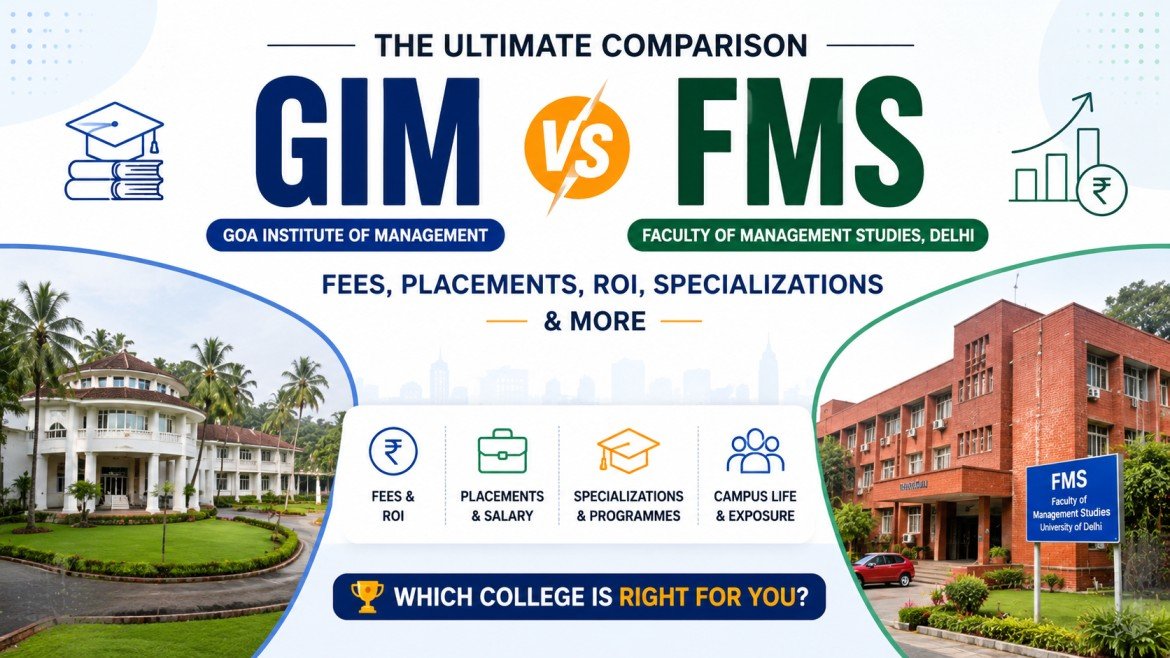
This GIM vs FMS comparison examines the two institutions from the perspective of fees, placements, specializations, ROI, admissions, campus experience and career opportunities.
Table of Contents
GIM vs FMS: Quick Comparison
GIM vs FMS: Institution and Programme Structure
Fees and Financial Investment
Placements and Salary Outcomes
Specializations and Academic Options
ROI Comparison
Admission Process and Exam Requirements
Campus Life and Location
Recruiters and Career Opportunities
Which College Is Better for Different Types of Students?
Final Verdict
Frequently Asked Questions
GIM vs FMS: Quick Comparison
| Comparison Factor | GIM Goa | FMS Delhi |
|---|---|---|
| Institution | Goa Institute of Management | Faculty of Management Studies, University of Delhi |
| Main full-time programme | PGDM | MBA Full-Time |
| 2026 programme academic fee | ₹21.45 lakh for the listed full-time PGDM programmes | Approximately ₹2.43 lakh for the two-year MBA based on the current semester fee |
| Programme structure | Flagship PGDM plus specialized PGDM programmes | Broad MBA programme with functional career opportunities |
| Latest verified flagship/overall placement comparison | PGDM average CTC ₹16.27 lakh; median ₹15 lakh | Average CTC ₹32.27 lakh; median ₹29.59 lakh |
| Highest reported latest package | ₹35 lakh for flagship PGDM Class of 2026 | ₹1.1 crore in the 2026 final placement report |
| Major location advantage | Residential campus experience in Goa | Delhi-NCR corporate ecosystem |
| Specialization breadth | PGDM, Healthcare Management, Big Data Analytics, BIFS | MBA with career choices across functions and sectors |
| Primary strength | Specialized management education and residential campus experience | Exceptional ROI and strong placement outcomes |
| Best suited for | Students seeking specialization and a full residential PGDM experience | Students prioritizing ROI, placements and Delhi-NCR exposure |
The official 2026 fee information from GIM lists ₹21.45 lakh as the academic fee for its full-time PGDM, HCM, BDA and BIFS programmes. FMS's 2026 MBA information lists a semester fee of approximately ₹60,818, which results in an approximate two-year academic cost of ₹2.43 lakh across four semesters. Hostel and personal expenses should be evaluated separately.
GIM vs FMS: Understanding the Basic Difference
The most important thing to understand in the GIM vs FMS comparison is that the institutions are built around different academic and financial models.
FMS Delhi is associated with the University of Delhi and is particularly well known for offering a highly affordable MBA relative to its placement outcomes. Its low programme fee creates an unusually strong ROI proposition.
GIM, on the other hand, offers multiple full-time management programmes aimed at different industries and career paths. Along with its flagship PGDM, students can choose programmes in Healthcare Management, Big Data Analytics and Banking, Insurance and Financial Services.
Therefore, the decision should begin with a simple question:
Do you want the strongest possible financial ROI from a general MBA, or do you want a specialized PGDM programme and a residential management education experience?
For students focused heavily on cost-to-placement value, the GIM vs FMS comparison usually favours FMS. For students with a specific interest in healthcare, analytics or financial services, GIM's programme portfolio can make it a more relevant academic choice.
GIM vs FMS Fees: How Much Does Each Programme Cost?
Fees are one of the biggest deciding factors in the GIM vs FMS debate.
GIM Goa Fees
For the 2026–28 batch, GIM's official fee page lists a total academic fee of ₹21.45 lakh for:
PGDM
PGDM Healthcare Management
PGDM Big Data Analytics
PGDM Banking, Insurance and Financial Services
GIM also states that the tuition fee component for the 2026–28 batch is ₹13.80 lakh, while the total academic fee includes other applicable academic and institutional charges listed in the fee structure.
Students should also budget for accommodation and personal expenses. GIM's admissions information states that the hostel charge for non-AC accommodation for the entire programme is ₹2.28 lakh, subject to the institution's applicable terms and programme arrangements.
This means that the actual financial investment in a GIM education can be materially higher than the ₹21.45 lakh academic fee once accommodation, travel, personal expenses and other costs are considered.
FMS Delhi Fees
FMS Delhi's MBA 2026 information lists the semester fee at approximately ₹60,818. Across four semesters, that works out to approximately ₹2.43 lakh for the two-year programme, subject to revision by the University of Delhi.
This fee difference is central to the GIM vs FMS ROI discussion.
GIM vs FMS Fee Comparison
| Expense Category | GIM Goa | FMS Delhi |
|---|---|---|
| Approximate academic programme fee | ₹21.45 lakh | Approximately ₹2.43 lakh |
| Programme duration | Two years | Two years |
| Hostel costs | Additional; GIM lists ₹2.28 lakh for the stated non-AC accommodation arrangement | Depends on University of Delhi accommodation availability and student arrangements |
| Living expenses | Residential campus and personal expenses | Delhi living costs vary by accommodation choice |
| Financial pressure | Higher | Significantly lower |
The difference between the two academic fee structures is substantial. This does not automatically mean GIM provides poor value. It means students must evaluate GIM based on the relevance of the programme they choose and their expected career outcome.
GIM vs FMS Placements: Which College Has Better Placement Outcomes?
Placement performance is where the difference between GIM and FMS becomes particularly visible.
FMS Delhi Placement Results
The official FMS Delhi Final Placement Report for the 2024–26 batch reports:
Average CTC: ₹32.27 lakh
Median CTC: ₹29.59 lakh
Average CTC for the Top 100 students: approximately ₹45.19 lakh
Highest CTC: ₹1.1 crore
Offers above ₹25 lakh: 74.9% of the batch
The placement process included 119 participating companies, with 103 companies rolling out offers according to the official report.
These numbers explain why FMS has such a strong reputation for MBA ROI.
GIM Goa Placement Results
According to GIM's official 2026 placement update, the flagship PGDM programme recorded:
Highest CTC: ₹35 lakh
Average CTC: ₹16.27 lakh
Median CTC: ₹15 lakh
More than 110 recruiters
GIM also reported different outcomes across its specialized programmes.
For Healthcare Management:
Highest CTC: ₹29 lakh
Average CTC: ₹15.51 lakh
For Banking, Insurance and Financial Services:
Highest CTC: ₹28.60 lakh
Average CTC: ₹15.34 lakh
Median CTC: ₹14.45 lakh
The GIM placement data demonstrates that specialization matters. A student should not compare every GIM programme using only the flagship PGDM average because the programmes have different industry focus areas and recruiter pools.
GIM vs FMS Placement Comparison
| Placement Metric | GIM Flagship PGDM Class of 2026 | FMS Delhi 2024–26 Batch |
|---|---|---|
| Average CTC | ₹16.27 lakh | ₹32.27 lakh |
| Median CTC | ₹15 lakh | ₹29.59 lakh |
| Highest CTC | ₹35 lakh | ₹1.1 crore |
| Recruiter participation | 110+ recruiters reported for flagship PGDM | 119 participating companies |
| Career ecosystem | Multi-sector with specialized programmes | Strong concentration across consulting, product/IT/analytics, marketing and finance |
The latest verified figures clearly show stronger salary outcomes at FMS. However, salary alone should not be used as the only factor in the GIM vs FMS decision.
Different batch profiles, programme structures, work-experience distributions, industries and recruiting opportunities can influence placement statistics.
GIM vs FMS Specializations
One major advantage of GIM is the breadth of its specialized full-time programmes.
GIM PGDM
The flagship PGDM programme is designed for students seeking a broad management education with exposure to multiple functional areas.
The latest placement information shows opportunities across:
Finance
Marketing
IT and Operations
Human Resources
Financial Services
Banking
Consulting
FMCG and FMCD
Technology
For a student who wants flexibility without committing to a narrow industry specialization immediately, the flagship PGDM is the most general option at GIM.
GIM PGDM Healthcare Management
Healthcare Management is one of the most distinctive programme options in the GIM vs FMS comparison.
Students interested in healthcare can pursue careers in areas such as:
Medical devices
Health technology
Pharmaceuticals
Diagnostics
Healthcare consulting
Health insurance
Hospital and healthcare operations
The 2026 placement update reported medical devices as the largest recruiting sector for the programme, followed by health technology and healthcare IT.
Students specifically committed to healthcare management may therefore find GIM more academically aligned with their career objective than a general MBA.
GIM PGDM Big Data Analytics
GIM's Big Data Analytics programme is designed for students interested in the combination of management, data and technology.
The programme exposes students to areas including:
Statistical theory
Data management
Business intelligence
Machine learning
Artificial intelligence
Deep learning
Analytical tools and business applications
The placement ecosystem for the programme includes IT and ITES, operations, engineering and design, consulting and finance.
For candidates interested in analytics-focused management careers, this specialization is a significant differentiator in the GIM vs FMS comparison.
GIM PGDM Banking, Insurance and Financial Services
The BIFS programme focuses on the financial services ecosystem.
Career opportunities can include:
Banking
Financial services
Financial analytics
Insurance
Consulting
Fintech
Risk-related roles
GIM's 2026 placement update listed recruiters and opportunities involving organizations such as Goldman Sachs, Wells Fargo, Barclays and Moody's Analytics for the programme.
FMS Delhi Academic and Career Flexibility
FMS offers a broad MBA experience rather than the same programme-specific structure offered by GIM's HCM, BDA and BIFS programmes.
Its placement report shows strong opportunities across:
Consulting
Product, IT and Analytics
Marketing
Finance
General Management
This can be highly attractive for students who do not want to lock themselves into a specialized management degree before beginning their MBA.
GIM vs FMS ROI: Which College Offers Better Return on Investment?
For most students, FMS is the stronger choice on pure financial ROI.
The reasoning is straightforward.
FMS's approximate two-year academic fee is around ₹2.43 lakh based on the 2026 semester fee information, while its official 2026 placement report records an average CTC of ₹32.27 lakh.
GIM's academic fee for the 2026–28 batch is ₹21.45 lakh, while the flagship PGDM Class of 2026 recorded an average CTC of ₹16.27 lakh.
This does not mean every FMS student will receive ₹32.27 lakh or every GIM student will receive ₹16.27 lakh. Placement outcomes depend on individual performance, role preferences, previous experience and market conditions.
However, at an institutional comparison level, the fee-to-placement relationship strongly favours FMS.
A Simple ROI Perspective
Suppose two students graduate from their respective programmes and receive salaries close to the reported average CTC.
The FMS student enters the market with a substantially smaller academic fee burden.
The GIM student has invested significantly more in academic fees and potentially accommodation.
Therefore, the FMS graduate may have more financial flexibility early in their career.
This is the biggest reason why FMS is regularly considered one of the strongest MBA ROI opportunities in India.
Does GIM Still Offer Good ROI?
Yes, but GIM's ROI must be evaluated differently.
A student may choose GIM because:
The specialized programme directly matches their career goal.
They want a residential management education.
They prefer the Goa campus environment.
They value GIM's corporate network in a particular industry.
They receive financial assistance or scholarships.
They want a structured transition into analytics, healthcare or financial services.
GIM also offers financial aid and full tuition fee waivers for eligible students under its published policies. For the 2026–28 batch, the institution states that students with family income below ₹8 lakh per annum may be eligible for financial assessment, with awards subject to institutional terms and a maximum number of recipients.
For a student receiving substantial financial support, the GIM vs FMS financial comparison can change significantly.
GIM vs FMS Admission Process
Both institutions are highly competitive, but the admission pathways and selection frameworks are different.
GIM Admissions
For the 2026 admission cycle, GIM's published eligibility information states that applicants need a minimum of 50% aggregate in a bachelor's degree, with 45% for eligible SC/ST candidates under the published criteria.
GIM accepted:
CAT 2025
XAT 2026
Eligible GMAT scores within the stated acceptance window
The institution also published programme-specific selection processes, including its Achiever's Round and regular admission processes.
GIM's admission model may therefore provide applicants with multiple routes depending on programme and profile.
FMS Delhi Admissions
FMS MBA Full-Time admissions are closely associated with the CAT examination and the selection process published by the institution and the University of Delhi.
Because admission policies and score requirements can change between cycles, aspirants should always verify the current official information before applying.
FMS's MBA 2026 information also states that the programme has 251 sanctioned seats, with additional supernumerary categories listed separately in the official information document.
GIM vs FMS CAT Difficulty
The GIM vs FMS decision may also depend on your expected CAT performance.
FMS is one of the most competitive MBA destinations in India. A strong CAT performance is generally essential for candidates targeting admission.
GIM accepts multiple entrance examination routes under its published 2026 criteria, including CAT, XAT and eligible GMAT scores.
Therefore:
If you have an exceptionally strong CAT performance and want maximum ROI, FMS should be a major target.
If your profile aligns strongly with one of GIM's programmes, GIM may provide a more suitable programme-specific option.
If you are considering XAT or GMAT alongside CAT, GIM's accepted test options can provide additional flexibility.
GIM vs FMS Campus Experience
The academic experience at these two institutions can feel very different.
Life at GIM Goa
GIM offers a residential campus environment in Goa.
The institution describes its campus ecosystem as involving students from different parts of India and abroad, student clubs and numerous events during the year. Its academic environment combines management education with a residential campus experience.
For students who want a traditional residential B-school experience, this can be a major advantage.
The lifestyle factor should not be dismissed as unimportant. The people students interact with, the campus community and the daily academic environment can influence networking and personal development.
Life at FMS Delhi
FMS is located in Delhi and benefits from its position within the wider University of Delhi ecosystem and the Delhi-NCR corporate environment.
For students interested in:
Corporate networking
Live projects
Industry events
Consulting opportunities
Finance and banking
Product and technology
Start-up exposure
Delhi-NCR can provide significant professional access.
The FMS experience may feel more connected to a large metropolitan business environment than a fully residential standalone campus model.
GIM vs FMS Location Advantage
Location can influence career opportunities, although it should not be treated as a guarantee of placement.
GIM Goa
GIM offers:
A residential environment
A distinctive campus setting
A focused management-school community
Distance from major metropolitan corporate centres
Opportunities through its established placement ecosystem
FMS Delhi
FMS offers access to:
Delhi-NCR corporate offices
Consulting firms
Financial institutions
Technology companies
Start-ups
Corporate events and networking opportunities
For students planning careers in industries heavily concentrated in Delhi-NCR, FMS's location can provide additional professional advantages.
GIM vs FMS Recruiters and Career Opportunities
GIM's latest placement information shows recruitment across financial services, IT, banking, consulting and FMCG/FMCD for the flagship programme.
Its official pages also list recruiters across different programmes, including organizations such as Deloitte, Accenture, Godrej, Barclays, Axis Bank, IBM and HDFC in the broader recruiter ecosystem.
The specialized programmes also attract industry-specific recruiters.
FMS's 2026 placement report shows offers across consulting, product/IT/analytics, marketing, finance and general management. Consulting recorded the largest domain total in the report, followed by product, IT and analytics.
The decision should therefore depend on the type of career you want.
Choose GIM if you are primarily interested in:
Healthcare management
Big data analytics
Banking and financial services
A specialized PGDM
A residential management programme
Choose FMS if you are primarily interested in:
Consulting
Product management
Technology and analytics
Marketing
Finance
General management
Maximum financial ROI
GIM vs FMS for Consulting
FMS generally has the stronger placement profile for students targeting consulting.
The 2026 placement report shows consulting as the largest domain by total offers and PPOs in the reported domain distribution.
GIM also has consulting opportunities, particularly across its broader placement ecosystem. However, the salary scale and overall placement profile reported by FMS make it the stronger option for a student whose primary objective is to maximize access to high-paying consulting roles.
GIM vs FMS for Finance
Both institutions can be relevant for finance careers, but the programme experience differs.
FMS offers a broad MBA route with strong finance placement opportunities.
GIM offers both its flagship PGDM and a dedicated Banking, Insurance and Financial Services programme.
A student interested specifically in:
Banking
Insurance
Financial services
Financial analytics
Fintech
may find GIM's BIFS programme academically attractive.
A student seeking broader flexibility across finance, consulting and general management may prefer FMS.
GIM vs FMS for Marketing
FMS offers strong marketing opportunities through its broad MBA placement ecosystem.
GIM's flagship PGDM also offers marketing roles and recruits across multiple consumer and business sectors.
For a student who wants a high-ROI general MBA with broad corporate placement opportunities, FMS is likely to have an advantage.
For a student who values GIM's campus experience or has a strong programme-specific reason for choosing GIM, the flagship PGDM can still be relevant.
GIM vs FMS for Analytics
This comparison is more balanced than the overall ROI comparison.
FMS has strong opportunities in Product, IT and Analytics.
GIM offers a dedicated Big Data Analytics programme focused on statistical theory, data management, business intelligence and modern analytical technologies.
The better option depends on your objective.
Choose GIM BDA if you want:
A degree explicitly centred on analytics.
Structured exposure to data and analytical tools.
A specialized academic identity.
Choose FMS if you want:
A broader MBA.
The flexibility to move between analytics, product, consulting and other functions.
Stronger overall reported placement compensation.
GIM vs FMS for Healthcare Management
GIM is the more direct choice.
Its Healthcare Management programme is specifically designed around healthcare industry requirements and has a dedicated placement ecosystem.
The latest official 2026 placement update reported opportunities across:
Medical devices
Health technology
Pharmaceuticals
Diagnostics
Consulting
Insurance
For a student who is certain about building a career in healthcare management, GIM's HCM programme provides a more focused academic route than a general MBA.
GIM vs FMS for Freshers
Both institutions admit candidates with different levels of work experience.
The decision for a fresher should depend on career clarity.
FMS may be better for a fresher who:
Has a strong CAT score.
Wants broad career flexibility.
Prioritizes ROI.
Wants exposure to multiple corporate functions.
GIM may be better for a fresher who:
Wants a residential B-school experience.
Has a clear interest in healthcare, analytics or financial services.
Wants a programme designed around a specific industry.
Values a smaller, focused campus environment.
GIM vs FMS for Students With Work Experience
Students with work experience should evaluate whether an MBA will help them change function, industry or career trajectory.
FMS can be attractive for professionals seeking a high-value MBA brand with strong placement outcomes.
GIM can be attractive for professionals seeking a transition into a specialized sector.
For example:
An IT professional moving into business analytics may consider GIM BDA.
A healthcare professional seeking management roles may consider GIM HCM.
A banking or finance professional may consider GIM BIFS.
A professional seeking broader consulting, finance, marketing or leadership roles may prefer FMS.
GIM vs FMS: Batch Size and Peer Learning
Peer learning is an important but often overlooked factor.
FMS's official 2026 placement report states that the batch had 307 students, with 304 appearing for placements.
GIM's official placement page lists a flagship PGDM batch profile of 284 students for the 2024–26 batch, while its specialized programmes have different batch sizes.
Students should not assume that a larger or smaller batch is automatically better.
A larger batch can mean:
More diverse peer learning.
A larger alumni network.
More competition.
A smaller programme can mean:
Greater specialization.
More focused networking.
A more concentrated academic community.
GIM vs FMS: Brand Value
Both institutions have strong recognition, but their market positioning is different.
FMS is particularly associated with:
Strong MBA ROI.
High placement outcomes.
Delhi corporate exposure.
A competitive student cohort.
GIM is associated with:
Established management education.
Specialized PGDM programmes.
A residential campus experience.
Industry-specific management education.
Brand perception also depends on the role and industry.
For a general MBA recruiter, FMS may have a stronger value proposition because of its placement track record and highly competitive admissions.
For specialized sectors, the specific GIM programme can be highly relevant.
GIM vs FMS: Which Is Better Overall?
There is no single answer for every student.
FMS is the better choice if your priorities are:
Maximum ROI
Very low academic fees
Higher reported placement compensation
Strong consulting opportunities
Finance and marketing careers
Product, IT and analytics
Delhi-NCR corporate exposure
A broad MBA
GIM is the better choice if your priorities are:
Specialized management education
Healthcare Management
Big Data Analytics
Banking, Insurance and Financial Services
A residential B-school experience
A Goa campus environment
Programme-specific career alignment
The Biggest Mistake Students Make in the GIM vs FMS Comparison
The biggest mistake is comparing only the highest package.
A highest package may represent a single exceptional outcome.
Students should examine:
Average CTC
Median CTC
Programme fees
Total cost of attendance
Recruiter diversity
Career domains
Specialization relevance
Batch profile
Location
Long-term career goals
The median salary can be particularly useful because it gives a different view of the middle of the placement distribution.
For the latest verified figures discussed in this article, FMS reported a median CTC of ₹29.59 lakh, while GIM's flagship PGDM reported a median CTC of ₹15 lakh.
GIM vs FMS: A Decision Framework for MBA Aspirants
Before choosing between GIM and FMS, answer these questions honestly.
What is your financial situation?
If financing your MBA would require a large loan, FMS's low academic fee can be a major advantage.
Do you want a specialized programme?
If you already know that you want healthcare management, business analytics or financial services, GIM's programme portfolio deserves serious consideration.
What is your CAT performance?
A very strong CAT score can make FMS an important target.
If your profile and entrance scores align better with GIM's admission process, GIM may provide a more suitable opportunity.
Do you want a residential campus?
Campus experience matters to many students.
GIM provides a more traditional residential management-school environment.
What industry do you want to enter?
Your target industry should influence the decision more than general college rankings or social-media opinions.
Final Verdict: GIM vs FMS
In a direct GIM vs FMS comparison, FMS Delhi is the stronger option for students prioritizing fees, placement outcomes and financial ROI.
Its approximate two-year academic cost is dramatically lower than GIM's listed full-time academic fee, while the latest verified 2026 placement figures show substantially higher average and median compensation.
However, the GIM vs FMS decision should not end there.
GIM offers something structurally different: multiple specialized management programmes. For students committed to healthcare, analytics or the banking and financial services ecosystem, the relevant GIM programme may provide a more direct academic and career pathway.
The practical choice is therefore simple:
Choose FMS Delhi if you want one of the strongest MBA ROI opportunities in India and broad access to high-paying corporate careers.
Choose GIM if a specific specialization, residential management education and the GIM programme ecosystem align more closely with your career plan.
Before making a final decision, verify the current admission and fee information directly with the official institutions because programme fees, selection processes and placement figures can change between admission cycles.
Frequently Asked Questions
Is FMS better than GIM?
For pure ROI, fees and the latest reported placement compensation, FMS has a clear advantage. GIM may be the better choice for students who specifically want Healthcare Management, Big Data Analytics or Banking, Insurance and Financial Services.
Which has better placements, GIM or FMS?
Based on the latest verified placement information used in this comparison, FMS reported an average CTC of ₹32.27 lakh and a median CTC of ₹29.59 lakh for the 2024–26 batch. GIM's flagship PGDM Class of 2026 reported an average CTC of ₹16.27 lakh and a median CTC of ₹15 lakh.
What is the fee difference between GIM and FMS?
GIM's official fee page lists ₹21.45 lakh as the academic fee for the 2026–28 full-time PGDM programmes covered in this comparison. FMS's 2026 MBA information lists approximately ₹60,818 per semester, or around ₹2.43 lakh across four semesters.
Is GIM worth the fees?
GIM can be worth the investment if the selected programme aligns closely with the student's career objective. Students should compare the total cost, expected financing, specialization value and realistic placement outcomes before deciding.
Which is better for ROI, GIM or FMS?
FMS is significantly stronger on pure financial ROI because of its much lower academic fees and higher reported placement compensation.
Which is better for business analytics, GIM or FMS?
GIM offers a dedicated PGDM in Big Data Analytics, making it attractive for students seeking a specialized analytics programme. FMS may be better for students who want a broad MBA with flexibility across analytics, product, consulting and other functions.
Which is better for healthcare management?
GIM is the more direct choice because it offers a dedicated PGDM in Healthcare Management.
Does GIM offer a general PGDM?
Yes. GIM offers a flagship full-time PGDM in addition to specialized programmes.
Does FMS have good consulting placements?
Yes. Consulting is one of the major domains in the official FMS 2026 placement report.
Should I choose GIM over FMS for campus life?
If a residential campus experience is a major priority, GIM's Goa-based management-school environment may be more attractive. If corporate exposure in Delhi-NCR is more important, FMS has a location advantage.
Sources
Goa Institute of Management official fee structure and financial aid information, GIM official placement reports and 2026 placement update, GIM official admissions information, FMS Delhi MBA 2026 information, and the official FMS Final Placement Report for the 2024–26 batch.
Search Keywords
gim vs fms, GIM vs FMS Delhi, GIM Goa vs FMS Delhi, GIM placements, FMS placements, GIM fees, FMS fees, GIM ROI, FMS ROI, GIM vs FMS placements, GIM vs FMS fees, GIM vs FMS ROI, GIM Goa placements 2026, FMS Delhi placements 2026, GIM Goa fees 2026, FMS Delhi fees 2026, GIM MBA vs FMS MBA, GIM PGDM vs FMS MBA, Goa Institute of Management vs FMS Delhi, GIM or FMS, which is better GIM or FMS, FMS Delhi average package, GIM Goa average package, FMS Delhi median package, GIM median package, FMS highest package, GIM highest package, FMS Delhi MBA fee, GIM PGDM fee, GIM hostel fee, FMS MBA ROI, GIM MBA ROI, GIM BDA vs FMS, GIM healthcare management vs FMS, GIM BIFS vs FMS, GIM specializations, FMS Delhi specialization options, GIM PGDM placements, GIM HCM placements, GIM BDA placements, GIM BIFS placements, FMS consulting placements, FMS finance placements, FMS marketing placements, FMS analytics placements, GIM consulting placements, GIM finance placements, GIM marketing placements, GIM analytics placements, GIM admission 2026, FMS admission 2026, GIM CAT cutoff, FMS CAT cutoff, GIM XAT admission, FMS CAT admission, GIM GMAT admission, GIM vs FMS for freshers, GIM vs FMS for work experience, GIM vs FMS for finance, GIM vs FMS for consulting, GIM vs FMS for marketing, GIM vs FMS for analytics, GIM vs FMS for healthcare, GIM vs FMS for BFSI, GIM campus life, FMS Delhi campus life, GIM Goa campus, FMS Delhi campus, GIM location advantage, FMS Delhi location advantage, GIM recruiter list, FMS recruiter list, GIM placement report 2026, FMS placement report 2026, best MBA college for ROI, best PGDM college for ROI, low fee MBA with high package, MBA colleges with best ROI India, GIM Goa review, FMS Delhi review, GIM Goa ranking and placements, FMS Delhi ranking and placements, GIM fees and placements, FMS fees and placements, GIM return on investment, FMS return on investment, GIM vs FMS salary comparison, GIM vs FMS placement comparison, GIM vs FMS college comparison, GIM vs FMS MBA comparison, GIM vs FMS PGDM comparison, GIM vs FMS 2026, MBA colleges Goa vs Delhi, best MBA college for consulting, best MBA college for finance, best MBA college for business analytics, best MBA college for healthcare management, best MBA college for marketing, GIM flagship PGDM, FMS full time MBA, GIM BDA fee, GIM HCM fee, GIM BIFS fee, FMS MBA total fee, GIM total cost, FMS total cost, GIM financial aid, GIM scholarship, FMS low fees MBA, GIM vs FMS career opportunities, GIM vs FMS alumni network, GIM vs FMS corporate exposure, GIM vs FMS student life, GIM vs FMS final decision, GIM vs FMS which should I choose
Long-Tail & Short-Tail Searches
Is GIM better than FMS Delhi, is FMS Delhi worth it for MBA, should I choose GIM or FMS, which college has better ROI GIM or FMS, GIM vs FMS for CAT aspirants, GIM vs FMS for XAT aspirants, GIM vs FMS for fresh graduates, GIM vs FMS for experienced professionals, what is the total fee of GIM Goa PGDM, what is the total fee of FMS Delhi MBA, which college has the highest average package GIM or FMS, how good are GIM placements in 2026, how good are FMS placements in 2026, what is the median package at FMS Delhi, what is the median package at GIM Goa, which college is better for consulting GIM or FMS, which college is better for finance GIM or FMS, which college is better for marketing GIM or FMS, which college is better for analytics GIM or FMS, which college is better for healthcare management, should I take an education loan for GIM, is FMS the best ROI MBA college, GIM Goa PGDM worth the investment, FMS Delhi MBA worth the investment, GIM BDA placement opportunities, GIM HCM placement opportunities, GIM BIFS placement opportunities, FMS consulting salary, FMS finance placement salary, FMS product management opportunities, GIM data analytics career opportunities, GIM healthcare management career opportunities, GIM financial services career opportunities, GIM Goa residential campus experience, FMS Delhi corporate exposure, GIM vs FMS placement package difference, GIM vs FMS fee difference, GIM vs FMS specialization comparison, GIM vs FMS admission difficulty, GIM vs FMS CAT score requirement, can I get into GIM with XAT, does FMS accept XAT, which MBA college has lower fees GIM or FMS, which MBA college offers better salary after graduation, GIM Goa vs FMS Delhi for MBA in 2026, best choice between GIM and FMS for long term career, GIM or FMS for product management, GIM or FMS for investment banking, GIM or FMS for BFSI careers, GIM or FMS for corporate jobs, GIM or FMS for consulting career, GIM or FMS for analytics career, which MBA should I choose after CAT GIM or FMS, GIM Goa versus FMS Delhi complete comparison, GIM vs FMS fees placements ROI and specializations, which college should I choose for best return on investment, GIM vs FMS salary after MBA, FMS Delhi MBA fee versus average package, GIM Goa fee versus average package, is GIM good enough compared with FMS Delhi.
Key Takeaways
FMS Delhi offers significantly lower programme fees than GIM Goa.
FMS has stronger reported average and median placement outcomes.
FMS is generally the better choice for students prioritizing ROI.
GIM offers specialized programmes in Healthcare Management, Big Data Analytics and BIFS.
GIM can be a better fit for students with specific industry-focused career goals.
FMS provides strong opportunities across consulting, finance, marketing and analytics.
GIM offers a residential management education experience in Goa.
The best choice depends on career specialization, financial capacity and long-term professional goals.

Ask a question
Still confused? Leave your question and our team will help you.