
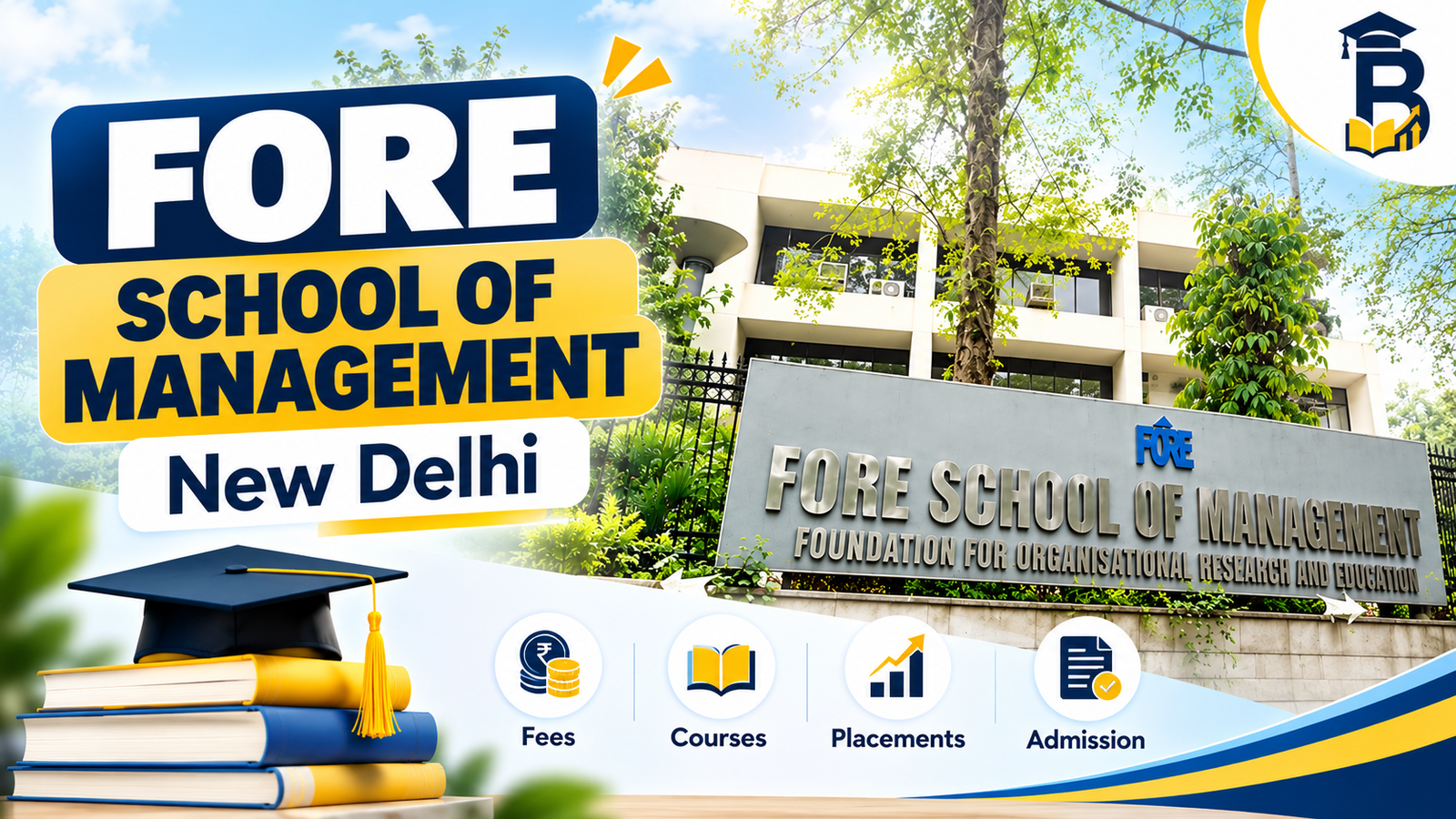
Quick Summary
- FORE School of Management offers five regular PGDM programmes and one programme for working professionals.
- The flagship PGDM focuses on general management and core business functions.
- PGDM (International Business) focuses on global markets and cross-border business.
- PGDM (Financial Management) focuses on finance, financial markets and financial decision-making.
- PGDM (Big Data Analytics) emphasises data-led business decisions and analytics.
- PGDM (Healthcare & Hospital Management) focuses on healthcare systems, hospital administration and health management.
- PGDM (Working Professionals) is an 18-month programme for experienced professionals.
- The regular PGDM programmes are listed as 24 months long.
- The current admissions portal lists New Delhi and Gurugram as programme locations.
- Published fees are ₹23.24 lakh for regular PGDM programmes and ₹11.50 lakh for PGDM (Working Professionals).
- Applicants should verify eligibility, entrance exams, course details and fees on the official FSM website before applying.
FORE School of Management Courses & Programs: Complete Guide
FORE School of Management (FSM) offers postgraduate management programmes designed for different career interests, including general management, international business, financial management, big data analytics and healthcare management. Its Gurugram campus also offers a programme for working professionals.
For students exploring FORE School of Management courses, an important distinction is that the institute's main postgraduate management qualifications are Post Graduate Diplomas in Management (PGDM) rather than a conventional MBA degree. The programmes have different academic focuses, but students should compare more than the course title: campus location, curriculum, elective options, eligibility, duration, fees and intended career path all matter.
The institute's official admissions website currently lists admissions for the 2027–29 batch. It provides programme details, seat counts, fees and admission criteria for the current cycle. Details below are based primarily on FSM's official academic and admissions pages. <Cite refs={["turn240138search1","turn851838search0"]}/>
Table of Contents
FORE School of Management: Overview
Courses and Programmes Offered
FORE PGDM Programme Comparison
PGDM: General Management
PGDM (International Business)
PGDM (Financial Management)
PGDM (Big Data Analytics)
PGDM (Healthcare & Hospital Management)
PGDM (Working Professionals)
Course Duration and Learning Structure
Specialisations and Electives
Eligibility Criteria
Admission Process and Entrance Exams
Campus Locations
Programme Fees and Application Charges
How to Choose the Right FORE Programme
Career Relevance and Skills
Scholarships and Financial Assistance
Documents and Application Preparation
Common Questions Before Choosing a Course
Conclusion
About MBA Compass
Also Read
1. FORE School of Management: Overview
FORE School of Management, also known as FSM, is a management institute with a campus in New Delhi and an off-campus location in Gurugram, Haryana. Its official academic pages list full-time PGDM programmes and a programme designed for working professionals. The institute also offers research and executive education opportunities, which serve a different purpose from its main postgraduate management courses. <Cite refs={["turn240138search0","turn851838search7"]}/>
Institute profile
| Detail | Information |
|---|---|
| Name | FORE School of Management (FSM) |
| New Delhi campus | B-18, Qutub Institutional Area, New Delhi – 110016 |
| Gurugram campus | Plot No. 47, Sector-32, Gurugram – 122001 |
| Main postgraduate qualification | Post Graduate Diploma in Management (PGDM) |
| Regular PGDM duration | Two years, full-time |
| Working Professionals programme | 18 months, full-time programme format described for working professionals |
| Current admissions cycle shown online | 2027–29 |
| Official academic programmes page | FSM Academic Programmes |
| Official admissions website | FSM Admissions 2027–29 |
The New Delhi campus is the location for the flagship PGDM, PGDM (International Business) and PGDM (Financial Management) in the current admissions listing. The Gurugram off-campus location is listed for PGDM (Big Data Analytics), PGDM (Healthcare & Hospital Management) and PGDM (Working Professionals). <Cite refs={["turn240138search1","turn240138search3"]}/>
Does FORE offer an MBA or a PGDM?
FORE's main management programmes are titled PGDM, PGDM (IB), PGDM (FM), PGDM (BDA) and PGDM (HHM). The working-professional course is called PGDM (WP). These are the titles applicants should use when checking course details and completing an application. <Cite refs={["turn240138search0","turn240138search1"]}/>
Students often search for “FORE School of Management MBA courses” because MBA is a familiar term for postgraduate business education. However, the institute's published programme titles use PGDM. Applicants should check the qualification title and recognition details in the official programme information rather than assuming that the word MBA appears on the final diploma.
2. FORE School of Management Courses and Programmes Offered
FSM's current admissions portal lists five regular PGDM options and one programme for working professionals. The main difference between them is the management domain they emphasise, alongside campus and duration. <Cite refs={["turn240138search1","turn240138search3"]}/>
Programme list
| Programme | Main academic focus | Campus shown by FSM | Duration |
|---|---|---|---|
| PGDM | General management and core business functions | New Delhi | 24 months |
| PGDM (International Business) | International business, global markets and cross-border management | New Delhi | 24 months |
| PGDM (Financial Management) | Finance, financial markets and financial decision-making | New Delhi | 24 months |
| PGDM (Big Data Analytics) | Business analytics, data and technology-enabled decisions | Gurugram | 24 months |
| PGDM (Healthcare & Hospital Management) | Healthcare systems, hospital administration and health management | Gurugram | 24 months |
| PGDM (Working Professionals) | Career-focused management education for experienced professionals | Gurugram | 18 months |
The programme durations and locations above are drawn from the current admissions listing. Applicants should check the programme-specific page and offer documentation for any updates before enrolling. <Cite refs={["turn240138search1","turn240138search3"]}/>
Which course should you explore first?
Choose PGDM if you want a broad foundation across business functions and the flexibility to explore electives.
Explore PGDM (IB) if you are interested in international business, global trade, cross-cultural management or international markets.
Consider PGDM (FM) if your interests are centred on finance, banking, financial analysis, investments or corporate finance.
Look at PGDM (BDA) if you want to build skills related to data analysis and business decision-making.
Explore PGDM (HHM) if you are interested in management roles in hospitals, healthcare organisations or digital health.
Consider PGDM (WP) if you already have relevant professional experience and need a programme structured around continued employment.
These descriptions explain the general academic orientation of each programme. They are not guarantees of a particular job, salary or placement outcome.
3. FORE PGDM Programme Comparison: Duration, Seats and Fees
FSM's admissions website publishes programme-level information for the 2027–29 cycle. The following table summarises the seat counts and programme fees displayed on that portal. <Cite refs={["turn240138search1","turn240138search3"]}/>
| Programme | Campus | Published intake | Duration | Programme fee displayed |
|---|---|---|---|---|
| PGDM | New Delhi | 360 seats | 24 months | ₹23.24 lakh |
| PGDM (International Business) | New Delhi | 60 seats | 24 months | ₹23.24 lakh |
| PGDM (Financial Management) | New Delhi | 180 seats | 24 months | ₹23.24 lakh |
| PGDM (Big Data Analytics) | Gurugram | 120 seats | 24 months | ₹23.24 lakh |
| PGDM (Healthcare & Hospital Management) | Gurugram | 30 seats | 24 months | ₹23.24 lakh |
| PGDM (Working Professionals) | Gurugram | 30 seats | 18 months | ₹11.50 lakh |
How to interpret this table: the programme fee shown is the published programme amount, not an estimate of every expense a student may incur. Before accepting an offer, check the latest fee schedule for payment instalments, refundable deposits, accommodation, meals, travel and other personal costs. The admissions portal should be treated as the controlling source if a later fee notice changes the amount. <Cite refs={["turn240138search1","turn240138search3"]}/>
The seat counts are published programme-level intakes, not a guarantee that every seat will remain available throughout the application period. Admission remains subject to the institute's selection procedure and the availability of seats.
4. PGDM: General Management
The flagship PGDM is designed to provide students with a broad grounding in management. Rather than focusing only on one function from the beginning, the curriculum includes courses from areas such as communication, economics, finance, marketing, organisational behaviour, analytics, operations and strategy.
FSM's current PGDM course page lists subjects such as Managerial Economics, Financial Accounting, Marketing Management & Consumer Insights, Leadership Lab and Data Analytics & AI Fundamentals in the first term. Later first-year terms include subjects such as Corporate Finance, Human Resource Management, Operations & Agile Project Management, Strategic Management, International Business & Cross-Cultural Management and Sales, Distribution & Retail Management. <Cite refs={["turn851838search2"]}/>
What does the curriculum cover?
The exact elective menu can change by academic year, but the published course structure shows several important learning areas:
Management fundamentals: Students build an understanding of how organisations work and how managers make decisions across departments.
Finance and accounting: These subjects help students interpret financial information, understand business performance and assess the financial implications of decisions.
Marketing and consumer insights: The curriculum introduces marketing concepts, customer understanding and the processes involved in selling and positioning products or services.
People and leadership: Organisational behaviour, human resource management and leadership-related subjects help students understand teams, workplace dynamics and management responsibilities.
Analytics and technology: Data analytics, AI fundamentals and technology-related courses introduce the role of data and digital systems in management decisions.
Operations and strategy: Operations, project management and strategic management help students examine efficiency, resource allocation, business models and competitive choices.
<Cite refs={["turn851838search2"]}/>
Who may find the flagship PGDM suitable?
This programme can be worth exploring if you want to understand several management functions before choosing a more focused career direction. It may be relevant to students considering marketing, general management, operations, human resources, consulting, business development or other business roles, depending on their elective choices and experience.
The course title alone does not determine the student's eventual career. Electives, internships, projects, prior education, communication skills and the hiring market all influence the options available after graduation.
How does specialisation work?
FSM's academic pages describe elective-based specialisation, including the option to build a dual specialisation. The specific electives available to a student may depend on the programme, academic area, course availability and other institute rules. Review the current curriculum before assuming that a particular combination will be offered. <Cite refs={["turn851838search2","turn851838search4","turn851838search5"]}/>
5. PGDM (International Business)
The PGDM (International Business), commonly abbreviated as PGDM (IB), is intended for students who want to study management with a global business perspective. It combines core management subjects with international-business learning and electives from different academic areas.
FSM's programme information identifies International Business as a required specialisation for students enrolled in PGDM (IB). The academic page also explains that the institute's elective system can allow students to develop a second area of specialisation, subject to its credit and course rules. <Cite refs={["turn851838search4"]}/>
What topics may students study?
The programme's academic material lists core subjects across business functions and electives such as International Management, Geopolitics, Trade Policy and Cross-Border Risk, Business in the Indo-Pacific Region, Export-Import Management and Japanese Business Culture and Management. The elective list is described as indicative and subject to availability and programme requirements. <Cite refs={["turn851838search4"]}/>
The broader learning areas include:
International business environments and global markets
Cross-cultural management and communication
International trade and policy
Global business risks and opportunities
Finance, marketing, operations and strategy
Business decision-making across different markets
Who should consider PGDM (IB)?
This programme may appeal to students interested in international trade, global marketing, export-import operations, international business development, multinational organisations or cross-border projects. It can also be relevant to candidates who want a general management foundation while making international business a central area of study.
However, the programme does not automatically lead to an overseas job or an international posting. Career opportunities depend on employer requirements, language and analytical skills, experience, recruitment conditions and the student's overall profile.
What should applicants check?
Before choosing PGDM (IB), review the current elective list, programme structure, international immersion details and any additional costs associated with travel or programme activities. FSM describes its International Immersion Programme as a component of its regular PGDM programmes, but candidates should verify the current arrangements and applicable conditions for their intake. <Cite refs={["turn240138search4","turn851838search4"]}/>
6. PGDM (Financial Management)
PGDM (Financial Management), or PGDM (FM), is designed for students who want to develop deeper knowledge of finance while learning the broader functions of business management.
FSM's official course page lists subjects such as Financial Markets and Institutions, Corporate Finance, Management Accounting, Financial Reporting and Analysis, Business Valuation and Spreadsheet Modelling, Security Analysis and Portfolio Management, and Banking in the Digital Era. <Cite refs={["turn851838search5"]}/>
Main learning areas
Financial analysis: Students learn to interpret financial statements, assess performance and use financial information to support decisions.
Corporate finance: This area covers how businesses consider investment, funding and financial resource allocation.
Financial markets and institutions: Students study the environment in which banks, financial institutions and markets operate.
Investment and portfolio concepts: Courses such as Security Analysis and Portfolio Management introduce the analysis of securities and investment decisions.
Digital finance and analytics: Courses connecting finance with data and technology help students understand how digital tools influence financial services and analysis.
<Cite refs={["turn851838search5"]}/>
Does PGDM (FM) offer only finance electives?
The published elective framework describes a dual-specialisation model. Finance is required as one area for PGDM (FM), while students may select a second specialisation from the areas allowed under the programme's rules. The institute states that elective availability and specialisation requirements apply. <Cite refs={["turn851838search5"]}/>
This means students should not assume that every learner follows an identical elective combination. The final selection depends on the curriculum and the options available in the relevant academic year.
Who may benefit from PGDM (FM)?
The programme may be suitable for candidates interested in finance-related roles in banking, corporate finance, financial services, investment analysis or financial planning functions. It may also be useful to students who want to combine finance with another management area.
An undergraduate degree in commerce or finance may provide useful background, but applicants should check the official eligibility rules rather than assume that only commerce graduates can apply. The current admissions portal states a bachelor's degree in any discipline as the general minimum academic qualification for the listed PGDM programmes. <Cite refs={["turn240138search1"]}/>
7. PGDM (Big Data Analytics)
PGDM (Big Data Analytics), abbreviated as PGDM (BDA), is focused on the relationship between business management, data and analytical decision-making. It is listed at FSM's Gurugram off-campus location, with a two-year duration and a published intake of 120 seats for the current admissions cycle. <Cite refs={["turn240138search1","turn240138search3"]}/>
What is the focus of Big Data Analytics?
Businesses use data to understand customers, monitor operations, evaluate performance and make decisions. A management programme focused on analytics helps students understand how analytical tools and business knowledge can work together.
Depending on the curriculum and electives available, the learning may connect with areas such as:
Data analysis for business decisions
Business intelligence and reporting
Analytics for marketing and customer behaviour
Operational performance and process improvement
Technology and digital business
Strategic decision-making using evidence
The precise course list should be checked on the official programme page for the relevant intake. These themes explain the field's broad scope; they should not be interpreted as a guaranteed list of every course offered in a particular term.
Who should consider PGDM (BDA)?
It may suit students who enjoy analytical problem-solving and want to understand how data supports business strategy. Candidates interested in business analytics, data-driven marketing, operations analytics, digital transformation or technology-linked management roles may wish to compare this programme with the flagship PGDM.
Applicants should examine the programme's current technical content, practical projects and elective options. Students should also consider whether they are comfortable working with quantitative information and learning analytical tools.
Is a technical undergraduate degree required?
The current admissions portal lists a bachelor's degree in any discipline with the stated minimum marks for its PGDM programmes. Candidates should nevertheless verify the programme-specific instructions and any changes announced for the 2027–29 intake. <Cite refs={["turn240138search1"]}/>
8. PGDM (Healthcare & Hospital Management)
PGDM (Healthcare & Hospital Management), or PGDM (HHM), focuses on management in healthcare systems and related organisations. FSM lists the programme at its Gurugram off-campus location, with a two-year duration and a published intake of 30 seats. <Cite refs={["turn240138search1","turn851838search1"]}/>
What does the curriculum include?
FSM's official programme page lists healthcare-related subjects such as Basic Principles of Epidemiology, Public Health Policy & Management, Biostatistics in Public Health, Healthcare Economics and Policy, Healthcare Marketing, Healthcare Quality and Safety, Health Services Administration, Health Budgeting & Financial Management, Public Health Law and Ethics, and Health Systems Delivery.
The curriculum also lists technology-oriented subjects such as Foundations of Smart Hospitals, AI in Healthcare, IoMT and Connected Care, Telehealth and Patient Experience, Cybersecurity, ROI & Transformation Strategy, and Health Analytics and Data Visualization. The page describes the curriculum as a mix of core and elective courses and notes that it may be revised based on industry experts. <Cite refs={["turn851838search1"]}/>
Who should consider this programme?
The programme may be relevant to candidates interested in hospital administration, healthcare operations, health services, health insurance, digital health, healthcare consulting or management roles in health-related organisations.
Healthcare management combines business decisions with sector-specific constraints. Students should therefore consider whether they want to work in an environment shaped by patient needs, service quality, regulation, budgets, technology and healthcare delivery.
What should you verify before applying?
Review the current course list, internship or project structure, eligibility criteria, faculty profile and career-support information. Applicants should also check whether the programme includes any field exposure or practical requirements and whether additional costs apply.
The existence of a healthcare-focused programme does not guarantee a specific role or salary. Career outcomes depend on individual performance, recruitment opportunities, prior experience and the wider healthcare employment market.
9. PGDM (Working Professionals)
PGDM (Working Professionals), or PGDM (WP), is designed for people who want to pursue management education while continuing their careers. FSM describes it as an 18-month, AICTE-approved programme delivered through evening and weekend learning, with a structure intended to avoid a career break. <Cite refs={["turn240138search5"]}/>
Programme structure and focus
The programme page describes four terms and 20 courses, along with certifications, a capstone project and an international immersion component. It also lists five career tracks:
Finance & Capital Intelligence
Marketing & Growth
Supply Chain & Flow Intelligence
Strategy & Consulting
People & Leadership Excellence
The page describes the programme as a non-residential course with a total programme fee of ₹11.50 lakh. Applicants should check the current admission page for the applicable intake, deadlines and fee conditions. <Cite refs={["turn240138search5","turn240138search1"]}/>
Eligibility for working professionals
The programme page states that applicants should have a bachelor's degree from a recognised university, with the stated minimum marks, and at least three years of full-time post-qualification managerial or supervisory experience. It lists CAT, XAT, CMAT, GMAT, GRE or the FORE Aptitude Test as entrance-test options for the programme. <Cite refs={["turn240138search5"]}/>
Because this programme has distinct experience and scheduling requirements, applicants should not assume that its eligibility rules are identical to those of the regular full-time PGDM programmes.
Who is this programme for?
It may suit managers, functional specialists, entrepreneurs and experienced professionals who want to strengthen business knowledge, prepare for broader responsibilities or build management skills without leaving their jobs.
Before enrolling, check the weekly timetable, attendance requirements, employer support, travel requirements and how the capstone project fits around work. The programme's schedule may be convenient for some roles but difficult for professionals with frequent travel or unpredictable shifts.
10. Course Duration and Learning Structure
The duration of a course determines the time commitment required, but it does not explain the entire learning experience. Students should also consider the term structure, elective choices, practical work, international immersion and any programme-specific projects.
Duration at a glance
| Programme | Duration published by FSM | Format/location |
|---|---|---|
| PGDM | 24 months | Full-time, New Delhi |
| PGDM (IB) | 24 months | Full-time, New Delhi |
| PGDM (FM) | 24 months | Full-time, New Delhi |
| PGDM (BDA) | 24 months | Full-time, Gurugram |
| PGDM (HHM) | 24 months | Full-time, Gurugram |
| PGDM (WP) | 18 months | Working-professional programme, Gurugram |
<Cite refs={["turn240138search1","turn240138search3","turn240138search5"]}/>
Core courses and electives
The regular PGDM curriculum starts with core subjects that build a foundation in management. Later terms include electives that allow students to develop expertise in selected areas. The official programme pages explain that elective choices depend on specialisation requirements, course availability and programme rules. <Cite refs={["turn851838search2","turn851838search4","turn851838search5"]}/>
For applicants, this structure has two implications. First, the programme's core courses help students understand business beyond one function. Second, the elective system gives students a way to align their learning with specific interests, subject to the options actually offered.
Practical learning
The published programme descriptions include projects, case-based learning and experiential components. The working-professional programme, for example, identifies a capstone project, certifications and international immersion as components of its structure. <Cite refs={["turn240138search5"]}/>
Before applying, ask how projects are assessed, whether internships are required, what elective options were offered in the latest academic year and how the institute supports practical exposure. This is more useful than relying on a programme title alone.
11. FORE School of Management Specialisations and Electives
A specialisation is a focused area of study within a broader management qualification. At FSM, students can choose electives across academic areas, subject to the rules and options of their programme.
The official pages identify academic areas including Communication, Economics and Business Policy, Finance and Accounting, International Business, Information Systems and Analytics, Marketing, Organisational Behaviour and Human Resource Management, Operations Management and Decision Sciences, and Strategy. <Cite refs={["turn851838search4","turn851838search5"]}/>
Examples of elective areas
| Academic area | Example topics listed by FSM | Potential relevance |
|---|---|---|
| Finance & Accounting | Corporate finance, financial analysis, business valuation, financial markets | Financial decision-making and financial services |
| Marketing | Advertising and brand management, consumer behaviour, product management, sales and distribution | Brand, marketing, sales and customer-focused roles |
| International Business | International management, trade policy, export-import management, cross-cultural business | Global business and cross-border operations |
| Information Systems & Analytics | Data and analytics-related electives, digital innovation and technology topics | Data-informed management and digital business |
| Operations Management & Decision Sciences | Operations planning, supply chain management, project management and analytics | Operations, logistics and process improvement |
| Organisational Behaviour & Human Resources | Leadership, HR analytics, talent acquisition and performance management | People management and organisational development |
| Strategy | Strategic management and business-model-related topics | General management, planning and consulting-related work |
| Communication | Business communication, presentation, corporate reputation and digital storytelling | Professional communication and stakeholder engagement |
The examples above are drawn from FSM's published elective pages, where applicable. The available courses can change, and an elective appearing on a webpage does not guarantee that it will run in every academic year. <Cite refs={["turn851838search4","turn851838search5"]}/>
Can students choose two specialisations?
FSM's official programme pages describe dual specialisation for students in its programmes, with programme-specific conditions. PGDM (IB) requires International Business as one specialisation, while PGDM (FM) requires Finance under the stated framework. Applicants should read the rules for their specific programme before planning an elective combination. <Cite refs={["turn851838search4","turn851838search5"]}/>
How should you select electives?
Choose electives based on the skills you want to build and the roles you may pursue, not only on course names that sound popular. Consider the subject content, prerequisites, workload, faculty availability and how the elective fits with your other courses.
For example, a student interested in marketing analytics may want to examine the overlap between marketing, research methods and data analysis. A student interested in operations may compare supply chain, project management and analytics-related options. These are planning examples rather than guarantees that a particular combination will be available.
12. FORE School of Management Eligibility Criteria
Eligibility depends on the programme and admission cycle. For the regular PGDM programmes, the current 2027–29 admissions portal states a minimum of 50% marks in a bachelor's degree in any discipline and lists CAT-2026, XAT-2027 or a qualifying GMAT score within the stated test-date window. <Cite refs={["turn240138search1"]}/>
Regular PGDM programmes
| Requirement | Current admissions information |
|---|---|
| Academic qualification | Bachelor's degree in any discipline |
| Minimum marks | 50% |
| Entrance-test options shown | CAT-2026, XAT-2027 or GMAT |
| GMAT test-date window shown | 1 January 2025 to 31 January 2027 |
| Shortlisting | Based on entrance-test score |
| Interview | Personal Interview |
| Final selection | Merit-based process |
<Cite refs={["turn240138search1"]}/>
Applicants should read the current programme-specific rules carefully. A candidate who meets the academic threshold may still need an eligible entrance-test score and must complete the remaining selection stages.
Healthcare & Hospital Management and Working Professionals
The admissions portal lists CAT, XAT, GMAT, GRE or the FORE Aptitude Test for PGDM (Healthcare & Hospital Management) and PGDM (Working Professionals). It also specifies a minimum of three years of full-time post-qualification managerial or supervisory experience for PGDM (WP). <Cite refs={["turn240138search1","turn240138search5"]}/>
| Programme | Academic requirement shown | Additional requirement |
|---|---|---|
| PGDM (HHM) | Bachelor's degree with at least 50% marks | Accepted entrance test and selection process |
| PGDM (WP) | Bachelor's degree with at least 50% marks, subject to programme-specific rules | Minimum three years of full-time post-qualification managerial or supervisory experience |
Can final-year students apply?
Applicants who are still completing their undergraduate degree should check the current admission instructions for the applicable intake. The official page may set conditions for provisional consideration, final result submission and the minimum marks required after graduation. Do not rely on deadlines from a previous admission cycle.
Does eligibility guarantee admission?
No. Eligibility establishes whether a candidate can be considered; it does not guarantee selection. The admissions portal describes shortlisting, a Personal Interview and final merit-based selection. <Cite refs={["turn240138search1"]}/>
13. Admission Process and Entrance Exams
FSM's admissions portal describes a process that starts with the application, followed by shortlisting, a Personal Interview, final selection and admission confirmation. Applicants should use the current portal to complete the form and follow the instructions for their selected programme. <Cite refs={["turn240138search1"]}/>
Step 1: Select the programme
Compare the available programmes and choose the option that best matches your academic interests, career plans and campus preference. Confirm that the programme is listed for the 2027–29 intake.
Step 2: Register online
The portal instructs applicants to create an account using a mobile number and personal email address, then verify the mobile number through an OTP. Use contact details that you can access throughout the admission process. <Cite refs={["turn240138search1"]}/>
Step 3: Complete the application form
Enter personal, academic and experience details accurately. Check names, dates, marks and entrance-exam information against the relevant records before proceeding.
Step 4: Pay the application fee
Review the programme selection and fee before paying. The current portal lists application fees based on the number of programmes selected; these are discussed in the fee section below. Save the payment acknowledgement after the transaction. <Cite refs={["turn240138search1"]}/>
Step 5: Upload documents and submit
Attach the photograph, marksheets, signature and other documents requested by the live application form. Follow the portal's file-size and format guidance. Submit the application and keep a copy of the confirmation.
Step 6: Shortlisting and Personal Interview
FSM states that shortlisting is based on the entrance-test score, followed by a Personal Interview. The final decision is merit-based and should be read in the context of the current selection instructions. <Cite refs={["turn240138search1"]}/>
Step 7: Offer and admission confirmation
Candidates who receive an offer should check the deadline, payment instructions and document-verification conditions in the offer communication. Do not assume that an interview invitation or a submitted application is equivalent to final admission.
Important dates for the 2027–29 cycle
The current admissions page displays the following schedule:
| Admission event | Date shown on the portal |
|---|---|
| Last date to apply | 15 December 2026 |
| Shortlisting email | Second week of January 2027 |
| Selection process begins | Third week of January 2027 |
| Final result | Third week of March 2027 |
<Cite refs={["turn240138search1"]}/>
These dates are the schedule currently published on the admissions portal. Applicants should recheck the portal in case the institute announces a revision, additional round or programme-specific instruction.
14. FORE School of Management Campus Locations
FSM lists two study locations: New Delhi and Gurugram. Campus matters because it affects commuting, accommodation planning, local living expenses and the programme options available at each location.
New Delhi campus
Address: B-18, Qutub Institutional Area, New Delhi – 110016.
The current admissions listing places the flagship PGDM, PGDM (International Business) and PGDM (Financial Management) at the New Delhi campus. <Cite refs={["turn240138search1","turn240138search3"]}/>
Applicants should consider travel time, accommodation arrangements and their personal budget when evaluating this location. If they plan to live off campus, they should check commuting options and estimate transport costs in addition to tuition.
Gurugram campus
Address: Plot No. 47, Sector-32, Gurugram – 122001.
FSM's current admissions portal lists PGDM (Big Data Analytics), PGDM (Healthcare & Hospital Management) and PGDM (Working Professionals) at its Gurugram off-campus location. <Cite refs={["turn240138search1","turn240138search5"]}/>
Students should verify the exact teaching location, schedule and any attendance requirements for their chosen programme. This is especially important for working professionals who need to coordinate classes with employment.
Should campus influence your decision?
Campus is one factor, but it should not be the only one. Compare the programme curriculum, elective options, eligibility, cost and learning format first. Then consider location and whether the campus fits your practical requirements.
15. FORE School of Management Programme Fees and Application Charges
The official admissions portal lists the programme fee as ₹23.24 lakh for each of the five regular two-year PGDM programmes and ₹11.50 lakh for the 18-month PGDM (Working Professionals). <Cite refs={["turn240138search1","turn240138search3"]}/>
Programme fee comparison
| Programme | Programme fee displayed |
|---|---|
| PGDM | ₹23.24 lakh |
| PGDM (International Business) | ₹23.24 lakh |
| PGDM (Financial Management) | ₹23.24 lakh |
| PGDM (Big Data Analytics) | ₹23.24 lakh |
| PGDM (Healthcare & Hospital Management) | ₹23.24 lakh |
| PGDM (Working Professionals) | ₹11.50 lakh |
<Cite refs={["turn240138search1","turn240138search3"]}/>
The figures above are the programme fees shown on the admissions portal, not a full estimate of living expenses. Applicants should check whether accommodation, meals, deposits, travel, books, a laptop or other personal expenses are separate. The current fee schedule and offer letter should govern the amount payable.
Application fee
The portal displays the following application-fee structure for the current admission cycle:
| Application choice | Fee before GST | GST shown | Amount payable |
|---|---|---|---|
| One programme | ₹1,500 | ₹270 | ₹1,770 |
| Each additional programme | ₹500 | ₹90 | ₹590 extra |
| All five regular programmes | ₹3,000 | ₹540 | ₹3,540 |
| Add PGDM (Working Professionals) to the all-five option | ₹500 | ₹90 | ₹590 extra |
<Cite refs={["turn240138search1"]}/>
The fee is described as non-refundable on the admissions portal. Before paying, confirm that the selected programmes are correct and that you understand the applicable fee. If you select multiple programmes, review the total shown by the portal before completing the transaction.
What other costs should applicants budget for?
Even when a programme fee is published, the total cost of attendance can vary based on a student's living arrangements and personal spending. Prepare a budget for:
Tuition and any scheduled instalments
Accommodation and meals, if not included
Local transport and travel to campus
Books, study materials and equipment
Personal expenses
Any programme-related activity or travel charges that the official schedule identifies separately
Do not add an unverified amount to the official programme fee and describe it as an institute charge. Request the current fee schedule if the portal does not clearly explain a particular cost.
16. How to Choose the Right FORE Programme
Choosing among FORE School of Management courses becomes easier when you start with your intended career direction and then compare the curriculum and practical requirements.
Match the course with your interests
| Your interest | Programme to investigate | What to review |
|---|---|---|
| Broad business and management | PGDM | Core courses, elective areas and career support |
| Global markets and international trade | PGDM (IB) | International Business requirements and electives |
| Finance and financial services | PGDM (FM) | Finance curriculum, electives and quantitative content |
| Analytics and data-led decisions | PGDM (BDA) | Analytics curriculum, technical learning and projects |
| Healthcare and hospital administration | PGDM (HHM) | Healthcare-specific courses and practical exposure |
| Management education while working | PGDM (WP) | Experience requirements, class schedule and workload |
Consider your academic background
The current portal states a bachelor's degree with at least 50% marks for the listed PGDM admissions. However, candidates should still verify the programme-specific conditions and accepted entrance exams before applying. Working professionals must also check the stated experience requirement. <Cite refs={["turn240138search1","turn240138search5"]}/>
Compare the curriculum rather than the title alone
Two programmes can share core management subjects while differing in their required courses and electives. Read the official curriculum to understand the topics you will actually study. Look for the balance between management fundamentals, quantitative subjects, applied projects and your preferred specialisation.
Check total cost and location
The same published fee across several regular programmes does not mean the total cost of living will be identical. Accommodation, transport and personal expenses depend on where you live and how you commute. Compare the full budget with your financial plans before accepting an offer.
Evaluate career goals realistically
Do not choose a programme based only on a perceived salary trend or a broad claim about job prospects. Examine the course content, your own strengths, the types of roles you want to pursue and the skills employers ask for. Placement reports can provide useful context, but they do not guarantee an individual outcome.
17. Career Relevance and Skills
Each FORE programme has a different academic emphasis, so the skills students develop will depend on the courses, electives and practical work they complete.
Skills associated with the flagship PGDM
The broad management curriculum covers finance, marketing, operations, analytics, communication, leadership and strategy. This range can help students understand how business functions connect and prepare them to explore different management roles. <Cite refs={["turn851838search2"]}/>
Skills associated with PGDM (IB)
International business coursework can help students understand global markets, trade, cross-cultural management and international business risks. The relevance of these skills depends on the role and industry a graduate enters. <Cite refs={["turn851838search4"]}/>
Skills associated with PGDM (FM)
The finance curriculum includes subjects related to financial markets, corporate finance, financial analysis and investment decisions. Students should compare the course list with the quantitative and analytical skills expected in their target roles. <Cite refs={["turn851838search5"]}/>
Skills associated with PGDM (BDA)
An analytics-oriented management programme can be relevant to roles involving data-informed decisions, reporting, business intelligence or operational analysis. Students should review the programme's current technical coursework and projects to understand the depth of analytical training. <Cite refs={["turn240138search1","turn851838search0"]}/>
Skills associated with PGDM (HHM)
The healthcare curriculum includes hospital systems, health policy, healthcare finance, quality and safety, and health technology. These topics can support an understanding of management challenges in healthcare organisations. <Cite refs={["turn851838search1"]}/>
Skills associated with PGDM (WP)
The working-professional programme lists career tracks in finance, marketing, supply chain, strategy and people leadership. It is structured for experienced professionals who want to apply management learning while continuing to work. <Cite refs={["turn240138search5"]}/>
Important: These are descriptions of academic relevance, not assurances of placement, promotion or salary. Candidates should consult the latest official placement information and assess their own experience and goals.
18. Scholarships and Financial Assistance
FSM publishes scholarship information, including a FORE Elite Scholarship for CAT achievers and means-based financial assistance for eligible students in specified programmes. Applicants should check the current scholarship page for eligibility, the number of awards, application requirements and the conditions for continuation. <Cite refs={["turn851838search8"]}/>
FORE Elite Scholarship
The official scholarship page describes a tuition-fee waiver for candidates who have secured 95 percentile or above in CAT, with the award subject to the institute's evaluation criteria. It states that only the top 25 candidates receive this scholarship and that selection also considers academic performance, CAT score, Personal Interview and the overall profile. <Cite refs={["turn851838search8"]}/>
Means Scholarship
FSM also describes means-based financial assistance for students in the first and second years of the PGDM, PGDM (IB), PGDM (FM) and PGDM (BDA) programmes. Candidates should read the current policy for income documentation, application deadlines, award conditions and whether assistance is renewed term by term. <Cite refs={["turn851838search8"]}/>
What should applicants do?
Check whether the scholarship applies to the programme you have selected.
Verify the current eligibility criteria and documents.
Confirm whether the award covers tuition only or other charges.
Read the conditions for continuation and academic performance.
Do not subtract a scholarship from the programme fee in your budget until you know you qualify and have received confirmation.
Scholarship policies can change between admission cycles, so use the latest official policy rather than an older summary.
19. Documents and Application Preparation
The admissions portal asks candidates to complete personal, academic and experience details and upload documents such as a photograph, marksheets and signature. The exact checklist and permitted formats are displayed in the live application form. <Cite refs={["turn240138search1"]}/>
Preparation checklist
| Item | Before submission |
|---|---|
| Personal details | Ensure your name and contact information are correct |
| Academic records | Keep marksheets and degree details available |
| Entrance-exam information | Confirm the test name, score and validity period |
| Photograph and signature | Follow the portal's file-format and size requirements |
| Work-experience documents | Prepare evidence if experience is required or claimed |
| Application fee | Verify the programme selection and total payable amount |
| Acknowledgement | Save the application number and payment receipt |
Final checks before applying
Read the current eligibility and admission instructions for your programme. Check the application deadline, entrance-test rules, fee and interview schedule. Keep the email address and mobile number you register with active so that you can receive shortlisting and admission updates.
If you are applying to more than one programme, review the additional application charges and ensure that your selections reflect your actual preferences. Save the submitted application and all official communications.
20. Common Questions Before Choosing a Course
Is the flagship PGDM different from the specialised PGDM programmes?
Yes. The flagship PGDM provides a broad management foundation, while PGDM (IB), PGDM (FM), PGDM (BDA) and PGDM (HHM) have distinct academic focuses. Their exact course structures and elective rules should be compared on the official pages. <Cite refs={["turn851838search0","turn851838search1","turn851838search4","turn851838search5"]}/>
Should you choose a programme based only on specialisation?
No. The specialisation matters, but so do the curriculum, campus, eligibility, programme cost, learning format and your career goals. Review all of these factors before deciding.
Is the working-professional programme suitable for fresh graduates?
The current programme page specifies at least three years of full-time post-qualification managerial or supervisory experience. A fresh graduate who does not meet that requirement should review the regular PGDM options instead. <Cite refs={["turn240138search5"]}/>
Should applicants assume that all electives will be offered?
No. FSM's elective pages state that the list is indicative and subject to requirements, availability, eligibility and class-size limitations. Check the latest programme information before planning a specific elective combination. <Cite refs={["turn851838search4","turn851838search5"]}/>
What is the safest way to verify course details?
Use FSM's official academic pages and current admissions portal. If there is a conflict between an older brochure and the current portal, confirm the applicable rule directly with the admissions office before paying or accepting an offer. <Cite refs={["turn240138search0","turn240138search1"]}/>
Conclusion
FORE School of Management offers different PGDM pathways for students interested in general management, international business, finance, analytics and healthcare, as well as a separate programme for working professionals. The regular programmes listed for the 2027–29 cycle run for 24 months, while PGDM (Working Professionals) is listed as an 18-month programme. The published programme fees are ₹23.24 lakh for the five regular programmes and ₹11.50 lakh for the working-professional programme. <Cite refs={["turn240138search1","turn240138search3"]}/>
The right choice depends on your preferred subject area, campus, eligibility, entrance-test score, budget and long-term goals. Review the official course pages and current admissions instructions carefully, especially for fees, electives, deadlines and selection criteria. A programme's title can help narrow your choices, but the curriculum and the fit with your goals should guide the final decision.
About MBA Compass
MBA Compass helps students explore management programmes, understand admission requirements and compare business-school options. Use its guides to organise your research, then confirm course details, eligibility, fees, scholarships and application dates through the institution's current official information.
Also Read
Explore related MBA Compass articles on PGDM admissions, management entrance examinations, finance and analytics programmes, and how to compare postgraduate management courses. Add internal links to published articles that directly support the reader's next step.
Key Takeaways
FORE School of Management offers six PGDM programmes across its New Delhi and Gurugram campuses.
The regular PGDM programmes have a duration of 24 months, while PGDM (Working Professionals) runs for 18 months.
The listed fee is ₹23.24 lakh for each regular programme and ₹11.50 lakh for PGDM (Working Professionals).
Eligibility, entrance exams and selection requirements vary by programme.
Applicants should check the official FORE admissions portal for the latest deadlines, eligibility criteria and application updates.
Compare the specialisations, campus locations, programme fees and career goals before selecting a course.
Frequently Asked Questions
What courses are offered by FORE School of Management?
FORE School of Management lists PGDM, PGDM (International Business), PGDM (Financial Management), PGDM (Big Data Analytics), PGDM (Healthcare & Hospital Management) and PGDM (Working Professionals).
Does FORE School of Management offer an MBA or PGDM?
The institute's main management programmes are titled Post Graduate Diploma in Management (PGDM) and specialised PGDM programmes. Applicants should check the official programme information for the exact qualification title.
What is the duration of FORE School of Management courses?
The regular PGDM programmes are listed as 24 months, or two years. The PGDM (Working Professionals) programme is listed as 18 months.
What is the fee for FORE School of Management PGDM courses?
The current admissions portal lists ₹23.24 lakh for each of the five regular PGDM programmes and ₹11.50 lakh for PGDM (Working Professionals). Confirm the latest fee schedule before accepting an offer.
What specialisations are available at FORE School of Management?
The specialised programmes focus on International Business, Financial Management, Big Data Analytics and Healthcare & Hospital Management. The flagship PGDM also offers elective-based specialisation options subject to programme rules.
What is the eligibility criteria for FORE School of Management?
The current admissions portal states a minimum of 50% marks in a bachelor's degree for its listed PGDM programmes. Entrance-test requirements and additional conditions depend on the programme.
Which entrance exams does FORE School of Management accept?
For regular PGDM programmes, the current admissions portal lists CAT-2026, XAT-2027 or a qualifying GMAT score within the stated test-date window. PGDM (HHM) and PGDM (WP) list CAT, XAT, GMAT, GRE or the FORE Aptitude Test.
Which campus offers FORE School of Management courses?
The New Delhi campus lists PGDM, PGDM (International Business) and PGDM (Financial Management). The Gurugram location lists PGDM (Big Data Analytics), PGDM (Healthcare & Hospital Management) and PGDM (Working Professionals).
Does FORE School of Management offer scholarships?
FSM publishes information about the FORE Elite Scholarship for qualifying CAT achievers and means-based financial assistance for eligible students in specified programmes. Applicants should verify current eligibility and award conditions on the official scholarship page.
How can I apply for FORE School of Management courses for 2027–29?
Visit the official admissions portal, select the programme, register with your contact details, complete the application, pay the applicable fee and upload the required documents. Follow the portal for shortlisting, interview and admission updates.
Ask a question
Still confused? Leave your question and our team will help you.