
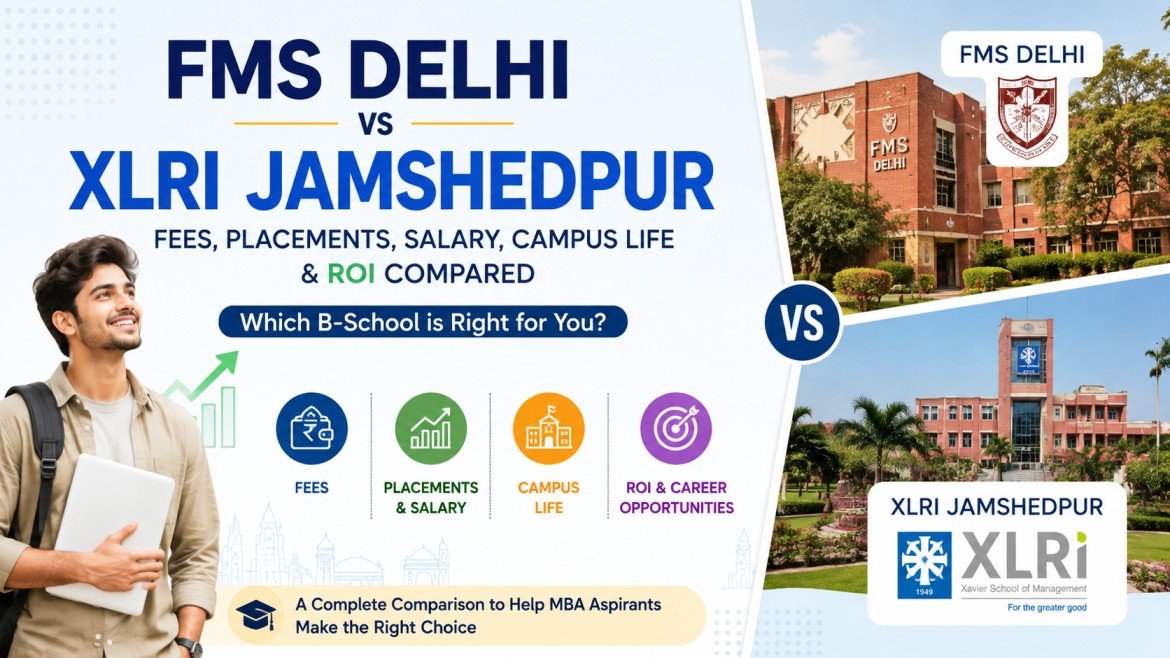
Quick Summary
- FMS offers exceptional ROI through significantly lower fees, while XLRI stands out for HRM, Business Management, strong placements and its established corporate reputation. Both offer excellent career opportunities.
Choosing between the Faculty of Management Studies (FMS), Delhi and XLRI – Xavier School of Management, Jamshedpur is one of the most difficult decisions for an MBA aspirant in India.
Both institutions have a powerful brand, a strong alumni network, competitive management programmes and access to leading recruiters. But they are not identical. Their admission routes, fee structures, academic environments, campus experiences, programme strengths and return on investment are different.
So, when students search for FMS vs XLRI, the real question is not simply which college has the higher salary package.
The better question is:
Which B-school gives you the right combination of career opportunities, programme fit, fees, learning environment, alumni network and long-term value for your specific goals?
For a student primarily focused on finance, consulting, marketing, general management and an exceptionally high return on the money invested in an MBA, FMS Delhi can be extraordinarily attractive because its published 2026–28 MBA fee is approximately ₹60,818 per semester. That makes the academic fee dramatically lower than the cost of most elite private B-schools.
XLRI, meanwhile, has a particularly strong reputation in Human Resources and also offers a highly competitive Business Management programme. Its latest official final placement report for the 2024–26 cohort reports an average salary of ₹31.40 lakh per annum and a median salary of ₹29 lakh.
FMS's official website lists its final placement report for the 2024–26 batch among its current placement reports, while its 2026–28 information bulletin confirms that the full-time MBA is a two-year programme.
This comparison therefore looks at FMS vs XLRI from the perspective that matters most to an MBA applicant: academics, admissions, fees, placements, salary, campus environment, specialisation, career options and ROI.
FMS vs XLRI: Quick Comparison
| Parameter | FMS Delhi | XLRI Jamshedpur |
|---|---|---|
| Full name | Faculty of Management Studies, University of Delhi | XLRI – Xavier School of Management |
| Location | Delhi | Jamshedpur, Jharkhand |
| Flagship programme considered | MBA Full-Time | PGDM Business Management / PGDM Human Resource Management |
| Programme duration | 2 years | 2 years |
| Main entrance route | CAT | XAT |
| Major programme strengths | General management, consulting, finance, marketing, strategy | HRM, business management, consulting, general management |
| 2026 FMS academic fee | Approximately ₹60,818 per semester | Significantly higher than FMS; programme-specific fee structure applies |
| Latest reported average placement salary | See official 2024–26 placement report | ₹31.40 LPA |
| Latest reported median salary | See official 2024–26 placement report | ₹29 LPA |
| Highest reported offer | See official 2024–26 placement report | ₹1.10 crore international; ₹59 lakh domestic |
| Campus environment | Delhi university ecosystem | Residential B-school campus in Jamshedpur |
| ROI | Exceptional because of low academic fee | Strong, but initial investment is substantially higher |
| Best known for | Low-cost elite MBA with strong corporate outcomes | HRM legacy and broad management careers |
XLRI's 2026 placement report covers students from its Jamshedpur and Delhi-NCR campuses in a combined recruitment process. The institute reported 576 students, 145 recruiting organisations, 576+ domestic offers and two international offers, with 42.5% of the cohort receiving pre-placement offers.
The most important point is that a comparison of FMS vs XLRI should not be reduced to one placement number. Salary packages vary by batch, role, company, market conditions and compensation structure.
What Makes FMS Delhi Different?
FMS Delhi is part of the University of Delhi and has been a management institution since 1954. Its full-time MBA programme began in 1967. The institute's official 2026–28 bulletin describes the MBA as a two-year full-time programme combining a strong analytical foundation with substantial academic flexibility.
That university connection is one of FMS's biggest differentiators.
Students do not experience FMS as an isolated private business school. They are part of the larger University of Delhi ecosystem, with access to a broad academic environment and the wider social and professional network associated with Delhi.
FMS itself describes its MBA as having a strong foundation in management disciplines while allowing students significant flexibility in shaping their academic experience. The first year focuses on core management concepts and concludes with a summer internship, while the second year provides opportunities to build a professional direction through electives and corporate interaction.
This structure makes FMS particularly attractive to students who want a broad MBA rather than a narrowly defined specialisation.
FMS's biggest advantage: ROI
The most obvious reason FMS appears so frequently in discussions about MBA ROI is its fee.
The official 2026 FMS information bulletin states that the semester fee for the MBA programme is approximately ₹60,818 per semester, although the institute explicitly notes that fees can be revised.
For a four-semester MBA, that works out to approximately ₹2.43 lakh in academic fees before considering living expenses and other costs.
That is an extraordinary difference when compared with the tuition investment required at many private B-schools.
The low fee does not mean that FMS operates like a low-cost college with limited corporate exposure. Its placement reports demonstrate access to major recruiters and high-paying roles. The institute maintains a dedicated corporate-relations and placement function and publishes its placement reports publicly.
For students evaluating FMS vs XLRI primarily on financial returns, this is perhaps the single biggest argument in favour of FMS.
What Makes XLRI Jamshedpur Different?
XLRI has a very different identity.
Founded in 1949, XLRI has more than seven decades of history in management education. Its strongest historical association is with Human Resource Management, but the institute has developed a much broader management identity through its Business Management programme.
For an aspirant interested in HR leadership, XLRI is particularly difficult to ignore.
The institute's Business Management programme, however, should not be viewed simply as an HR alternative. Students interested in consulting, marketing, finance, operations, strategy and general management also consider XLRI BM.
XLRI's current placement outcomes show that the institute has strong corporate demand across several sectors. Its 2026 placement report mentions recruiters and roles across consulting, finance, general management, sales and marketing, technology, FMCG, manufacturing and other sectors.
The institute also reported participation from major organisations in general management and PSU hiring, including firms such as ABG, Capgemini, GMR Group, JSW, L&T, Mahindra, Reliance, RPG Group, TAS and Vedanta, along with public-sector organisations such as BPCL, GAIL, IOCL and ONGC.
That breadth matters.
A student selecting FMS vs XLRI should therefore distinguish between the two questions:
Which college has the better ROI?
Which college is better suited to my career?
Those questions can have different answers.
FMS vs XLRI: Fees Comparison
Fees are one of the clearest areas where FMS and XLRI are fundamentally different.
FMS Delhi MBA Fees
The official FMS 2026–28 information bulletin states that the semester fee for the MBA programme is approximately ₹60,818. It also says fees can be revised before or during the programme.
Across four semesters, the academic fee is therefore approximately:
₹60,818 × 4 = ₹2,43,272
This does not represent the complete cost of living.
A student must also account for:
Accommodation
Food
Transportation
Books and study material
Laptop and technology
Personal expenses
Student activities
Travel
Miscellaneous academic expenses
Even after these costs are included, however, FMS's overall investment can remain dramatically below that of a premium private B-school.
XLRI Fees
XLRI's full-time PGDM programmes involve a substantially larger financial investment than FMS.
Students should always check the current official fee document for the specific XLRI programme and admission batch because fee structures can change and may differ according to programme, accommodation and other components.
This difference is one reason the FMS vs XLRI ROI comparison often produces such a striking result.
A high salary after graduation is valuable.
A high salary after graduation combined with a very low education cost is even more powerful.
FMS vs XLRI: Which Has Better ROI?
If ROI is defined simply as career outcome relative to academic tuition, FMS has an exceptional advantage.
Consider the basic relationship:
ROI is influenced by salary, total education cost, living expenses, opportunity cost and the duration required to recover the investment.
Because FMS's published academic fee is approximately ₹2.43 lakh for four semesters at the current stated rate, the tuition component is very small relative to the compensation available through its placement ecosystem.
XLRI offers strong salary outcomes as well, but the initial financial investment is much higher.
That does not automatically make FMS better.
For example, imagine two students:
Student A wants HR consulting, people strategy and a long-term HR leadership career.
Student B wants the lowest possible MBA cost while targeting consulting, finance, marketing or general management.
Student A may reasonably prefer XLRI.
Student B may reasonably prefer FMS.
This is why an ROI calculation should not be separated from career goals.
FMS vs XLRI: Placement Comparison
Placements are one of the most searched aspects of this comparison.
And this is where students need to be careful with online numbers.
Different websites may report:
Average salary
Median salary
Highest salary
Top 10% average
Top 25% average
Domestic salary
International salary
Fixed compensation
Total compensation
Previous-year placement numbers
These figures are not interchangeable.
The safest approach is to prioritise official institute placement reports.
FMS publishes its placement reports through its corporate-relations section. Its website currently lists the final placement report for the 2024–26 batch alongside earlier reports.
XLRI's official 2026 report states:
Average salary: ₹31.40 LPA
Median salary: ₹29 LPA
Top 10 percentile average: ₹49.20 LPA
Top 25 percentile average: ₹44.18 LPA
Highest international offer: ₹1.10 crore
Highest domestic offer: ₹59 lakh
PPOs: 42.5% of the cohort
Recruiting organisations: 145
Students in the combined placement process: 576
The important takeaway is that XLRI's placement performance is not dependent on one unusually high package.
The median salary of ₹29 lakh indicates that the central outcome is also strong.
FMS vs XLRI: Average Salary
Salary comparisons can be misleading if only the highest package is considered.
A student is much more likely to care about:
What does a typical graduate earn?
That is why median salary is particularly useful.
XLRI's 2026 placement report puts the median at ₹29 lakh and the average at ₹31.40 lakh.
For FMS, students should refer to the institute's official 2024–26 placement report rather than mixing numbers from older batches with the latest XLRI data. The official FMS website confirms that the 2024–26 final report is available.
The broader conclusion is clear:
Both FMS and XLRI provide access to high-quality corporate careers.
The difference is more meaningful when you examine programme preference, fees, recruitment mix and career goals.
FMS vs XLRI: Consulting Careers
Consulting is one of the most attractive career paths for MBA graduates.
Both FMS and XLRI provide opportunities in consulting.
At FMS, the Delhi location and established alumni network provide exposure to a large corporate market. Students interested in strategy consulting, management consulting, business transformation and related roles can target consulting firms during summer internships and final placements.
XLRI also has strong consulting recruitment.
Its latest placement report lists consulting among the major recruitment domains and highlights participation from leading organisations.
If consulting is your target, the decision should therefore depend less on whether one institute has consulting and more on:
Your entrance score
Academic profile
Interview performance
Internship performance
Case preparation
Communication skills
Leadership experience
Prior work experience
Target consulting firm
Campus recruitment dynamics
A student should not choose between FMS vs XLRI based solely on the assumption that one campus "has consulting" and the other does not.
Both do.
FMS vs XLRI: Finance Careers
Finance is another area where FMS has a strong reputation.
FMS students can target:
Investment banking
Corporate finance
Financial consulting
Equity research
Sales and trading
Corporate strategy
Banking
Fintech
Risk management
General management
XLRI also offers finance-related opportunities through its Business Management programme and recruiter ecosystem.
The better choice depends on the specific role.
If your objective is a highly specialised finance career, investigate the actual companies, job descriptions and roles offered during the latest placement cycle rather than relying only on overall college rankings.
For a student who is equally comfortable with several management functions, FMS's low cost can make it particularly attractive.
FMS vs XLRI: Marketing Careers
Marketing remains one of the most popular MBA career paths.
Both colleges provide access to marketing and sales roles.
Students can pursue:
Brand management
Product marketing
Sales
Category management
Digital marketing
Consumer insights
Market research
Growth roles
Business development
Product management
Delhi's location also provides FMS students access to a large ecosystem of companies, agencies, startups and corporate offices.
XLRI's alumni network and national recruiter base provide similar advantages from a different campus environment.
For marketing, there is no simple universal winner in FMS vs XLRI.
The deciding factors should include:
Role + recruiter + compensation + career trajectory + personal fit.
FMS vs XLRI: Human Resource Management
This is where the comparison becomes more straightforward.
If your primary goal is HR, XLRI has a major advantage in brand association and programme heritage.
XLRI's PGDM HRM programme is one of the institute's defining strengths.
Students interested in:
Human Resource Management
Talent management
Organisation development
Compensation and benefits
People analytics
Industrial relations
HR consulting
Leadership development
HR strategy
often place XLRI near the top of their list.
FMS also provides management education that can lead to HR careers, but the institutional identity is broader.
Therefore, if the question is:
FMS vs XLRI for HR?
XLRI is generally the more natural choice for a student whose career objective is specifically HR.
FMS vs XLRI: General Management
For general management, both are strong options.
FMS's MBA is deliberately broad and provides exposure to multiple management disciplines.
Its official programme description emphasises a strong analytical foundation and academic flexibility, with students able to shape their professional development as they progress through the programme.
XLRI Business Management similarly prepares students for broad corporate careers.
The latest placement report includes general management opportunities across large Indian and multinational organisations.
The choice therefore comes down to:
FMS if you heavily value low cost and Delhi exposure.
XLRI if you value XLRI's distinctive residential ecosystem, alumni network and broader programme identity, particularly where BM or HRM fits your goals.
FMS vs XLRI: Campus Life
Campus experience is often ignored in MBA comparisons.
It should not be.
You spend two intense years with your classmates. Your peers can become co-founders, colleagues, clients, investors and lifelong friends.
FMS campus environment
FMS is embedded in the University of Delhi ecosystem.
That creates a different kind of student experience.
Students interact with the wider university environment and benefit from being located in Delhi.
The city itself becomes part of the MBA experience.
Delhi offers access to:
Corporate offices
Consulting firms
Government institutions
Startups
Entrepreneurs
Industry events
Alumni networks
Conferences
Professional communities
The FMS experience is therefore closely connected to a major metropolitan ecosystem.
XLRI campus environment
XLRI Jamshedpur offers a more traditional residential B-school environment.
Students live and learn together in a concentrated campus community.
This can create a strong sense of institutional identity.
The Jamshedpur campus experience is different from studying in central Delhi. It can be more immersive and residential, with the institute and student community forming a larger part of daily life.
For some students, this is a major advantage.
For others, the metropolitan exposure of Delhi is more attractive.
FMS vs XLRI: Location Comparison
Location affects MBA life in several ways.
| Factor | FMS Delhi | XLRI Jamshedpur |
|---|---|---|
| City | Delhi | Jamshedpur |
| Corporate ecosystem | Very large | Strong but smaller city ecosystem |
| Metropolitan exposure | Very high | Moderate |
| Residential campus experience | Different from traditional residential B-schools | Strong residential identity |
| Networking | Delhi + DU + alumni ecosystem | XLRI alumni + national corporate network |
| Lifestyle | Large metropolitan city | Smaller industrial city |
| Travel connectivity | Extensive | Good but less metropolitan |
There is no objectively superior city.
A student who thrives on a busy metropolitan environment may prefer Delhi.
Someone who wants a focused residential B-school experience may prefer Jamshedpur.
FMS vs XLRI: Admission Process
Admission route is another major difference.
FMS admission
FMS uses CAT as the principal entrance examination for its full-time MBA admission process.
For the 2026–28 programme, the official FMS information bulletin specifies a sanctioned intake of 251 seats, with category-wise allocation and supernumerary categories.
This makes FMS highly competitive.
A strong CAT score is necessary, but the complete selection process also matters.
XLRI admission
XLRI's flagship two-year programmes use the XAT route for Indian candidates.
XAT is therefore central to the XLRI application strategy.
The candidate should understand the differences between CAT and XAT before deciding how to allocate preparation time.
XAT also places particular importance on sections and decision-making skills that require dedicated preparation.
FMS vs XLRI: CAT or XAT?
If you are targeting both institutions, examination strategy becomes important.
A candidate targeting FMS must take CAT.
A candidate targeting XLRI should take XAT.
The two examinations overlap in areas such as:
Quantitative aptitude
Verbal ability
Reading comprehension
Logical reasoning
But their patterns and testing styles differ.
Therefore, preparing for CAT alone is not an automatic substitute for XAT preparation.
Likewise, XAT preparation alone does not guarantee the CAT performance needed for FMS.
A student who wants both options should ideally prepare for both examinations strategically.
FMS vs XLRI: Which Entrance Exam Is Harder?
There is no useful universal answer to "which is harder?"
The difficulty depends on:
Candidate strengths
Sectional performance
Competition
Exam-day difficulty
Number of applicants
Institute-specific shortlisting
Interview performance
Instead of asking which examination is harder, students should ask:
Which examination can I prepare for most effectively?
If FMS is your target, CAT preparation must be taken seriously.
If XLRI is your target, XAT preparation needs dedicated attention.
If both are targets, prepare for both.
FMS vs XLRI: Eligibility
MBA eligibility should always be checked against the official admission notification for the relevant batch.
Generally, candidates need a recognised bachelor's degree and must satisfy the institute's academic and examination requirements.
The important point is that eligibility and shortlisting are not the same thing.
Meeting the minimum eligibility requirement does not mean that a candidate will receive an interview call.
Top B-schools operate in a highly competitive selection environment.
Therefore, candidates should distinguish between:
Eligibility
and
Competitive shortlist profile.
FMS vs XLRI: Academic Experience
FMS describes its MBA curriculum as combining analytical foundations with flexibility. The first year develops core business knowledge, while the second year allows greater professional customisation.
That flexibility can be useful for students who enter an MBA without having finalised their long-term career path.
For example, a student may enter interested in finance but discover during the first year that consulting or product management is a better fit.
A broad MBA allows that transition.
XLRI also provides a strong management education but has distinct programme identities.
Its HRM programme is more directly aligned with HR careers, while Business Management provides broader managerial preparation.
This distinction matters when choosing FMS vs XLRI.
FMS vs XLRI: Faculty and Learning
A strong MBA is not simply about lectures.
The learning experience comes from a combination of:
Faculty
Peer group
Case discussions
Projects
Internships
Clubs
Competitions
Corporate interaction
Alumni
Independent learning
FMS's official programme material emphasises its faculty, mentorship, corporate interaction and interdisciplinary university environment.
XLRI has built its own academic identity around rigorous management education and leadership development.
For students, the practical lesson is simple:
Do not choose a B-school solely because of a ranking.
Look at what you will actually learn and which peer group you will join.
FMS vs XLRI: Alumni Network
Alumni are one of the hidden assets of an MBA.
A strong alumni network can help with:
Job referrals
Industry knowledge
Mentoring
Career transitions
Entrepreneurship
Business development
International opportunities
Long-term networking
FMS benefits from both its own alumni community and its connection with the University of Delhi.
XLRI has developed a distinctive alumni identity over decades, particularly across HR, consulting, management, corporate leadership and entrepreneurship.
Neither network should be judged purely by size.
The quality and relevance of alumni to your intended industry matter more.
FMS vs XLRI: Brand Value
Both brands are highly respected in Indian management education.
But their brand associations are slightly different.
FMS brand association
FMS is strongly associated with:
Elite management education
University of Delhi
Exceptional ROI
Consulting
Finance
Marketing
General management
Strong corporate placements
XLRI brand association
XLRI is particularly associated with:
HR
Leadership
Business Management
Ethical management
Strong alumni
Consulting
General management
Corporate leadership
The better brand is therefore partly determined by your career.
For HR, XLRI's brand can carry exceptional relevance.
For a candidate focused on cost-efficient elite management education, FMS is extraordinarily compelling.
FMS vs XLRI: Which Is Better for Freshers?
Both colleges admit fresh graduates.
For a fresher, the decision should focus on:
Career interest
Entrance score
Academic record
Internship opportunities
Placement preferences
Financial constraints
Campus preference
FMS can be particularly attractive to freshers because the lower fee substantially reduces the financial burden of pursuing an MBA.
XLRI can be attractive to freshers who want its particular programme ecosystem and career opportunities.
Neither college requires a candidate to have extensive work experience for the flagship two-year programmes simply to be considered as a fresher.
FMS vs XLRI: Which Is Better for Work-Experienced Candidates?
Work experience can change how a student evaluates an MBA.
An experienced professional may place greater emphasis on:
Career transition
Specialisation
Salary growth
Brand
Alumni
Leadership development
Opportunity cost
XLRI's Business Management and HRM programmes can be attractive for experienced professionals, particularly where their prior career aligns with the target function.
FMS can be attractive for professionals who want a powerful MBA brand combined with a relatively low tuition investment.
FMS vs XLRI: Return on Investment in Detail
ROI is more complicated than:
Salary ÷ Fees
A realistic MBA ROI calculation should consider:
Total investment = tuition + accommodation + food + travel + other expenses + opportunity cost
And:
Career return = post-MBA compensation + career progression + brand value + network + future opportunities
This is why FMS has such a strong financial proposition.
Its tuition is unusually low for a school with elite placement outcomes.
XLRI requires a larger initial investment, but that investment can still be financially rational because of its salary outcomes and long-term career value.
XLRI's latest official placement report records an average salary of ₹31.40 lakh and a median of ₹29 lakh.
The right question is therefore not:
"Which MBA is cheaper?"
It is:
"Which MBA gives me the strongest combination of career outcome and investment for my personal situation?"
FMS vs XLRI: Is FMS Better Because It Is Cheaper?
Not automatically.
Low fees are a huge advantage.
But they do not make FMS universally superior.
Suppose a candidate wants HR.
If that candidate chooses FMS solely because it costs less and ignores the specialised HR ecosystem of XLRI, the lower fee may not compensate for a mismatch between the programme and career objective.
On the other hand, if the candidate wants consulting or general management and is equally comfortable at both schools, the lower FMS fee can become a decisive factor.
This is the central principle of the FMS vs XLRI debate:
Cost matters, but career fit matters more.
FMS vs XLRI: Placements and Recruiter Diversity
Recruiter diversity provides another way to assess an MBA.
XLRI's 2026 report says 145 recruiting organisations participated across the combined placement process, including 25 organisations that were first-time recruiters.
The report also highlights opportunities across:
Consulting
General management
Finance
Sales and marketing
Technology
Manufacturing
FMCG
Banking and financial services
Public sector
That demonstrates the breadth of the XLRI ecosystem.
FMS similarly maintains a dedicated placement system and publishes final and summer placement reports.
When comparing placement records, students should look beyond the highest salary.
A healthier checklist is:
Average + median + recruiter quality + role quality + sector diversity + internship conversion + long-term alumni outcomes.
FMS vs XLRI: Highest Package
The highest package is one of the most visible numbers on MBA websites.
But it is also one of the least useful numbers for most applicants.
A highest package tells you what happened to one or a small number of students.
It does not tell you what the typical graduate earned.
XLRI's 2026 report, for example, lists a highest international offer of ₹1.10 crore and highest domestic offer of ₹59 lakh, while also reporting a median salary of ₹29 lakh.
The median provides much more useful information about the middle of the class.
For this reason, students should not select between FMS vs XLRI based only on the highest package.
FMS vs XLRI: Median Salary Matters More
Suppose College A reports:
Highest package: ₹1 crore
Median package: ₹18 lakh
And College B reports:
Highest package: ₹70 lakh
Median package: ₹27 lakh
For most students, College B's placement outcome is more relevant.
This is why XLRI's ₹29 lakh median salary is an important statistic in evaluating its 2026 placement outcome.
When FMS's latest placement report is evaluated, the same principle should be applied.
Do not ask only:
"What is the highest package?"
Ask:
"What does the distribution of outcomes look like?"
FMS vs XLRI: Which Has Better Career Opportunities?
Both provide excellent career opportunities.
The difference lies in emphasis.
FMS is particularly attractive for:
Consulting
Finance
Marketing
General management
Strategy
Product and business roles
Corporate leadership
XLRI is particularly attractive for:
Human resources
HR consulting
Business management
Consulting
General management
Sales and marketing
Finance
Leadership roles
These categories overlap significantly.
Therefore, students should not treat them as completely separate career universes.
FMS vs XLRI: Pros and Cons
FMS Delhi Advantages
Extremely attractive tuition cost
Exceptional potential ROI
University of Delhi ecosystem
Strong corporate placements
Broad MBA curriculum
Strong alumni network
Delhi location
Good opportunities across consulting, finance, marketing and general management
Strong brand among Indian MBA recruiters
FMS Delhi Limitations
Extremely competitive admission
CAT performance is crucial
Campus environment differs from a conventional residential private B-school
Limited ability to choose FMS simply based on preference because admission is highly competitive
Delhi living costs must still be considered
XLRI Advantages
Strong national and international management brand
Exceptional HRM reputation
Strong Business Management programme
High-quality placement outcomes
Broad recruiter base
Strong alumni network
Residential campus experience
Strong consulting and general management opportunities
Strong leadership orientation
XLRI Limitations
Much higher financial investment than FMS
Jamshedpur is a smaller city than Delhi
XAT competition is intense
Programme choice should be made carefully between BM and HRM
ROI remains strong but the initial cost is significantly higher than FMS
FMS vs XLRI: Which One Should You Choose?
There is no single answer for every student.
Use this decision framework.
Choose FMS if:
You want an elite MBA with exceptionally low tuition.
You are targeting consulting, finance, marketing, strategy or general management.
You value Delhi's corporate ecosystem.
You want to maximise financial ROI.
You are comfortable with the University of Delhi environment.
You are preparing seriously for CAT.
Choose XLRI if:
You are strongly interested in HR.
You want the XLRI Business Management programme.
You value its residential campus culture.
You want the XLRI alumni ecosystem.
You are targeting consulting, general management, marketing, finance or HR.
You are comfortable with the higher financial investment.
You are preparing for XAT.
FMS vs XLRI for HR
Winner: XLRI
For a student specifically targeting HR, XLRI's historical strength and programme positioning make it the more natural choice.
FMS vs XLRI for ROI
Winner: FMS
FMS's exceptionally low published MBA fee gives it a major advantage in tuition-based ROI calculations. The 2026–28 bulletin lists approximately ₹60,818 per semester.
FMS vs XLRI for Consulting
Very close
Both provide access to consulting careers.
The final decision should depend on the offer you receive, your target firms and your individual career goals.
FMS vs XLRI for Finance
Slight edge to FMS for a cost-conscious general MBA aspirant
FMS's low cost combined with strong corporate outcomes makes it extremely attractive.
But the right choice can change depending on the exact finance role.
FMS vs XLRI for Marketing
Close
Both provide strong marketing opportunities.
Look at the latest recruiter list and roles rather than relying on generalised rankings.
FMS vs XLRI for General Management
Close
Both are strong.
FMS offers a flexible University of Delhi MBA ecosystem, while XLRI provides a distinctive residential B-school experience and strong Business Management identity.
FMS vs XLRI for HRM
XLRI
This is the clearest category where XLRI has a distinctive advantage.
FMS vs XLRI: What About Campus Life?
Campus life is subjective.
Some students prefer:
Delhi
because of its metropolitan environment, social life, corporate proximity and University of Delhi ecosystem.
Others prefer:
Jamshedpur
because a residential B-school campus can create a more concentrated peer community.
Neither preference is academically wrong.
The right choice depends on how you want to spend two important years of your life.
FMS vs XLRI: What About Alumni?
Both institutions have powerful alumni networks.
For a long-term career, alumni can become more valuable than the initial placement package.
An alumnus can help you:
Understand an industry
Prepare for interviews
Find a role
Switch careers
Build a startup
Enter a new geography
Develop leadership opportunities
The value of the network increases over time.
This is one reason an MBA should be viewed as a 10–20 year career investment rather than simply a two-year academic programme.
FMS vs XLRI: How Much Does Location Matter?
Location matters less after graduation than during the MBA, but it still influences student life and networking.
Delhi gives FMS students immediate access to one of India's largest corporate and institutional ecosystems.
Jamshedpur provides XLRI students with a more focused residential environment and a strong institutional identity.
If you expect to attend numerous external industry events, networking sessions and corporate programmes during your MBA, Delhi can be particularly convenient.
If you prefer a concentrated campus environment where your peer group forms the centre of your MBA life, XLRI's campus may appeal more.
FMS vs XLRI: Which Has the Better Peer Group?
Both attract high-performing students.
Peer quality is one of the strongest reasons to attend either institution.
Your classmates can become:
Consultants
Investment bankers
Product managers
Entrepreneurs
HR leaders
Marketers
Founders
CXOs
The question is not whether the peer group is good.
It is whether the peer group matches the environment in which you want to grow.
FMS vs XLRI: Competition After Graduation
An MBA does not guarantee a particular salary.
Your outcome depends on:
Academic performance
Internship
Placement preparation
Communication
Case-solving ability
Technical knowledge
Leadership
Prior experience
Interview performance
Market conditions
Even at the best B-schools, students graduate into different roles and compensation levels.
That is why placement averages should be treated as indicators, not promises.
FMS vs XLRI: Is the MBA Worth It?
For a student who gets into either institution, the MBA can be a strong career investment.
But the value is highest when the degree solves a real career problem.
An MBA can help someone:
Change industry
Change function
Enter consulting
Move into management
Build a corporate network
Accelerate career progression
Gain structured business knowledge
Access campus recruitment
Develop leadership skills
If you already have a strong career and do not need these benefits, the opportunity cost deserves more consideration.
How to Compare Your Actual FMS and XLRI Offers
Suppose you receive admission offers from both.
Do not make the decision based on a single social-media post.
Create a personal comparison using:
| Factor | Weight |
|---|---|
| Target career fit | Very High |
| Placement quality | Very High |
| Fees and total cost | Very High |
| Programme fit | Very High |
| Alumni network | High |
| Location | Medium |
| Campus life | Medium |
| Peer group | High |
| International opportunities | Medium |
| Personal preference | High |
Then score each institution.
This makes the decision more rational.
The Financial Calculation Students Often Miss
Students frequently calculate:
Average package – tuition fee
That is not an accurate ROI calculation.
Suppose tuition is ₹2.43 lakh.
You still need:
Food
Accommodation
Transportation
Laptop
Personal expenses
Books
Travel
Other costs
More importantly, if you leave a job to study, you lose two years of salary.
That is your opportunity cost.
Therefore, your real investment is larger than tuition.
Even so, FMS remains exceptionally attractive because the tuition component is unusually low.
Should You Pick FMS Over XLRI Only Because of Fees?
No.
Pick FMS because:
Career fit + placement opportunities + low cost + location + personal preference
all make sense for you.
Similarly, pick XLRI because:
Career fit + programme strength + brand + placement opportunities + campus experience
make sense for you.
The fee difference is significant, but it should be one part of the decision.
What 2026 Placement Data Tells MBA Aspirants
The latest official XLRI 2026 placement report provides a useful picture of the current market.
The institute reported an average salary of ₹31.40 lakh and a median salary of ₹29 lakh. The top 10 percentile averaged ₹49.20 lakh, while the top 25 percentile averaged ₹44.18 lakh.
The report also recorded 42.5% PPOs, showing the importance of summer internships in converting students into full-time employees.
This tells future MBA students something important:
The MBA placement process begins long before final placements.
Summer internships matter.
Academic performance matters.
Competitions matter.
Networking matters.
Interview preparation matters.
Communication matters.
Why Summer Internships Matter in FMS vs XLRI
The summer internship is often the first major corporate test during an MBA.
A good internship can lead to:
PPO
Better final placement position
Stronger resume
Industry exposure
Career clarity
Better interview answers
Professional references
XLRI's latest placement report explicitly states that 42.5% of the cohort received PPOs.
That illustrates how important the internship-to-placement pipeline can be.
Students joining either FMS or XLRI should therefore treat summer placement preparation seriously from the beginning.
FMS vs XLRI: What Students Should Not Compare
There are several comparisons that look attractive online but are not particularly useful.
Do not compare only:
Highest package
One ranking
One student review
One LinkedIn profile
One placement story
One celebrity alumnus
One viral post
Instead compare:
Median salary
Average salary
Recruiter diversity
Programme fit
Fees
Career outcomes
Alumni
Internship opportunities
Long-term reputation
FMS vs XLRI: A Practical Decision Matrix
| Your Priority | Better Fit |
|---|---|
| Lowest MBA tuition | FMS |
| Maximum tuition ROI | FMS |
| HR career | XLRI |
| HR consulting | XLRI |
| Broad management career | Both |
| Consulting | Both |
| Finance | Both, with FMS highly attractive on ROI |
| Marketing | Both |
| Delhi corporate ecosystem | FMS |
| Residential B-school experience | XLRI |
| XAT aspirant | XLRI |
| CAT aspirant | FMS |
| Strong specialised HR identity | XLRI |
| University ecosystem | FMS |
| Long-term management career | Both |
FMS vs XLRI: Final Verdict
If the question is:
"Which college has better ROI?"
FMS Delhi has the stronger case because its official 2026–28 MBA fee is approximately ₹60,818 per semester, creating an exceptionally low academic investment relative to the career outcomes associated with the institute.
If the question is:
"Which is better for HR?"
XLRI is the stronger choice because HRM is one of its defining areas of institutional expertise.
If the question is:
"Which is better for consulting or general management?"
The answer is much closer. Both offer strong opportunities, and the actual admission offer, programme fit and personal priorities should decide the outcome.
If the question is:
"Which gives the better overall MBA experience?"
There is no universal answer.
FMS offers the University of Delhi ecosystem, metropolitan Delhi exposure, broad management education and extraordinary financial efficiency.
XLRI offers a powerful management brand, a distinctive residential environment, strong Business Management and HRM programmes, a deep alumni network and excellent corporate outcomes.
The right decision is therefore not simply FMS vs XLRI.
It is:
FMS vs XLRI for your career.
That is the comparison that matters.
Frequently Asked Questions
Is FMS better than XLRI?
FMS can be better for students who prioritise low fees, exceptional ROI, Delhi exposure and careers in consulting, finance, marketing or general management. XLRI can be better for students interested in HR or those who prefer its Business Management programme, residential environment and institutional ecosystem.
Which has better ROI, FMS or XLRI?
FMS generally has the stronger tuition-based ROI because its official 2026–28 MBA information bulletin lists approximately ₹60,818 per semester. XLRI also offers strong ROI because of its placement outcomes, but the initial financial investment is substantially higher.
Which is better for HR, FMS or XLRI?
XLRI is generally the preferred option for a student specifically targeting Human Resource Management.
Which is better for consulting, FMS or XLRI?
Both are strong choices for consulting. Students should compare the specific consulting roles, recruiters, compensation and career goals rather than assuming one institution is universally better.
Which exam is required for FMS Delhi?
CAT is the principal entrance examination used for admission to the FMS full-time MBA.
Which exam is required for XLRI?
XAT is the principal entrance examination for XLRI's flagship two-year management programmes for Indian applicants.
What is the FMS Delhi MBA fee in 2026?
The official FMS 2026–28 information bulletin states that the semester fee is currently approximately ₹60,818.
What is XLRI's average salary in 2026?
XLRI's official final placement report for the 2024–26 cohort reports an average salary of ₹31.40 lakh per annum.
What is XLRI's median salary?
The latest official XLRI placement report reports a median salary of ₹29 lakh per annum for the 2024–26 cohort.
What is the highest package at XLRI in 2026?
XLRI's 2026 placement report states that the highest international offer was ₹1.10 crore and the highest domestic offer was ₹59 lakh per annum.
Is FMS difficult to get into?
Yes. FMS is highly competitive because it combines a strong management brand, limited seats and unusually low fees.
Is XLRI difficult to get into?
Yes. XLRI is also highly competitive, particularly for its flagship Business Management and Human Resource Management programmes.
Is FMS good for freshers?
Yes. FMS can be an excellent option for fresh graduates who want a high-quality MBA while keeping the financial investment relatively low.
Is XLRI good for freshers?
Yes. XLRI's two-year programmes are suitable for candidates at the beginning of their management careers as well as other eligible applicants.
Which is better for finance?
Both can lead to finance careers. FMS is especially attractive when ROI and low tuition are important considerations.
Which is better for marketing?
Both FMS and XLRI offer strong marketing and sales career opportunities. The actual recruiter and role mix should be checked for the relevant placement year.
Which is better for general management?
Both are excellent options. FMS provides a broad MBA within the University of Delhi ecosystem, while XLRI provides Business Management through a specialised management-school environment.
Which has better campus life?
This depends on personal preference. FMS provides a Delhi and University of Delhi environment, while XLRI offers a more concentrated residential B-school campus experience.
Should I choose FMS because it is cheaper?
Only if the programme and career fit your goals. Low fees are a major advantage, but career fit should come first.
Should I choose XLRI because its package is high?
Not solely because of the average or highest package. Evaluate the programme, recruiter mix, career path, total cost and your personal goals.
Is FMS worth it in 2026?
For a candidate who receives admission and wants a high-quality MBA at an unusually low academic cost, FMS can offer exceptional value.
Is XLRI worth the higher fee?
For candidates who value XLRI's programme strengths, particularly HRM and Business Management, and who can justify the larger financial investment, the institute can offer strong career value.
Conclusion
The FMS vs XLRI debate does not have one universal winner.
FMS Delhi stands out because of its combination of elite management education, corporate placements, Delhi location and extraordinarily low academic fees. The official 2026–28 bulletin puts the current semester fee at approximately ₹60,818, making the tuition investment unusually low for a school of its standing.
XLRI Jamshedpur stands out for a different reason. Its Business Management and Human Resource Management programmes, long institutional history, alumni network and corporate relationships make it one of India's most respected management institutions. Its latest official placement report reports an average salary of ₹31.40 lakh and a median salary of ₹29 lakh for the 2024–26 cohort.
So, if you are deciding between the two, start with your career goal.
Choose FMS when exceptional ROI, broad management education and Delhi exposure are major priorities.
Choose XLRI when HR, Business Management, its residential campus experience or its distinctive institutional ecosystem aligns more closely with your ambitions.
If you receive both offers, you are already in an enviable position. At that stage, the best choice is not the college with the loudest marketing claim. It is the institution whose programme, cost, career opportunities and environment best match the professional life you want to build.
Official and Reference Sources
FMS Delhi – MBA 2026–28 Information Bulletin
FMS Delhi – Official Placement Reports
XLRI – Official Placement Reports
XLRI – Official Placement Overview
Search Keywords
fms vs xlri, FMS vs XLRI, FMS Delhi vs XLRI Jamshedpur, FMS vs XLRI fees, FMS vs XLRI placements, FMS vs XLRI ROI, FMS Delhi fees 2026, XLRI fees 2026, FMS Delhi placements, XLRI placements 2026, FMS average package, XLRI average package, FMS median salary, XLRI median salary, FMS highest package, XLRI highest package, FMS MBA fees, XLRI MBA fees, FMS Delhi MBA, XLRI Jamshedpur MBA, FMS Delhi MBA 2026, XLRI MBA 2026, FMS admission 2026, XLRI admission 2026, FMS CAT, XLRI XAT, FMS CAT cutoff, XLRI XAT cutoff, FMS vs XLRI CAT XAT, FMS vs XLRI HR, FMS vs XLRI finance, FMS vs XLRI marketing, FMS vs XLRI consulting, FMS vs XLRI business management, FMS vs XLRI general management, FMS vs XLRI campus, FMS vs XLRI campus life, FMS vs XLRI alumni, FMS vs XLRI career, FMS vs XLRI salary, FMS vs XLRI average salary, FMS vs XLRI highest salary, FMS vs XLRI median salary, FMS vs XLRI fees and placements, FMS vs XLRI placement comparison, FMS vs XLRI MBA comparison, FMS Delhi or XLRI, FMS or XLRI which is better, FMS vs XLRI which is better, should I choose FMS or XLRI, FMS Delhi vs XLRI which is better, FMS ROI, XLRI ROI, best MBA ROI India, highest ROI MBA college India, FMS low fees MBA, FMS MBA ROI, XLRI MBA ROI, FMS Delhi placement report, XLRI placement report 2026, FMS 2026 placement, XLRI 2026 placement, FMS 2024-26 placements, XLRI 2024-26 placements, FMS Delhi salary package, XLRI salary package, FMS Delhi average CTC, XLRI average CTC, FMS Delhi median CTC, XLRI median CTC, FMS Delhi highest CTC, XLRI highest CTC, FMS MBA career opportunities, XLRI career opportunities, FMS consulting placements, XLRI consulting placements, FMS finance placements, XLRI finance placements, FMS marketing placements, XLRI marketing placements, FMS HR placements, XLRI HR placements, best MBA for HR, best MBA for consulting, best MBA for finance, best MBA for marketing, FMS vs XLRI for HR, FMS vs XLRI for finance, FMS vs XLRI for consulting, FMS vs XLRI for marketing, FMS vs XLRI for freshers, FMS vs XLRI for experienced candidates, FMS vs XLRI for general management, FMS vs XLRI residential campus, FMS Delhi campus, XLRI Jamshedpur campus, FMS University of Delhi, XLRI Xavier School of Management, FMS MBA admission, XLRI PGDM BM, XLRI PGDM HRM, FMS full time MBA, XLRI Business Management, XLRI Human Resource Management, FMS Delhi eligibility, XLRI eligibility, FMS MBA eligibility 2026, XLRI eligibility 2026, FMS Delhi selection process, XLRI selection process, FMS Delhi CAT admission, XLRI XAT admission, FMS vs XLRI admission, FMS vs XLRI entrance exam, FMS vs XLRI peer group, FMS vs XLRI faculty, FMS vs XLRI academic experience, FMS vs XLRI recruiter comparison, FMS vs XLRI career comparison, FMS vs XLRI investment, FMS vs XLRI education cost, FMS vs XLRI total cost, FMS vs XLRI opportunity cost, FMS Delhi low MBA fees, XLRI Jamshedpur fees and placements, FMS Delhi placement salary 2026, XLRI placement salary 2026, FMS Delhi MBA ROI 2026, XLRI MBA ROI 2026, FMS vs XLRI 2026, FMS vs XLRI comparison 2026, FMS vs XLRI latest comparison, FMS vs XLRI latest fees, FMS vs XLRI latest placements
Long-Tail & Short-Tail Searches
FMS vs XLRI which one should I choose, FMS Delhi vs XLRI Jamshedpur which is better, is FMS better than XLRI, is XLRI better than FMS, FMS vs XLRI for MBA, FMS vs XLRI for HR career, FMS vs XLRI for consulting career, FMS vs XLRI for finance career, FMS vs XLRI for marketing career, FMS vs XLRI for general management, FMS vs XLRI fees comparison 2026, FMS vs XLRI placement comparison 2026, FMS vs XLRI ROI comparison 2026, FMS Delhi MBA fees versus XLRI fees, FMS Delhi average salary versus XLRI, FMS Delhi median salary versus XLRI, FMS Delhi placement versus XLRI placement, which has better ROI FMS or XLRI, which has better placements FMS or XLRI, which has better salary FMS or XLRI, which is better for HR FMS or XLRI, which is better for consulting FMS or XLRI, which is better for finance FMS or XLRI, which is better for marketing FMS or XLRI, should I choose FMS Delhi or XLRI Jamshedpur, FMS or XLRI for freshers, FMS or XLRI for experienced professionals, FMS Delhi or XLRI for CAT aspirants, XLRI or FMS for MBA aspirants, CAT FMS versus XAT XLRI, CAT vs XAT for FMS and XLRI, FMS Delhi CAT cutoff versus XLRI XAT cutoff, FMS Delhi MBA total cost, XLRI Jamshedpur MBA total cost, FMS Delhi ROI after MBA, XLRI Jamshedpur ROI after MBA, FMS Delhi salary after MBA, XLRI salary after MBA, FMS Delhi placement report latest, XLRI placement report latest, FMS Delhi 2026 MBA admission, XLRI 2026 MBA admission, FMS Delhi MBA admission process, XLRI MBA admission process, FMS Delhi eligibility criteria, XLRI eligibility criteria, FMS Delhi MBA campus life, XLRI Jamshedpur campus life, FMS Delhi versus XLRI campus comparison, FMS Delhi alumni network versus XLRI, FMS Delhi recruiter list versus XLRI, FMS Delhi consulting opportunities, XLRI consulting opportunities, FMS Delhi finance opportunities, XLRI finance opportunities, FMS Delhi HR opportunities, XLRI HR opportunities, FMS Delhi marketing opportunities, XLRI marketing opportunities, best college between FMS and XLRI, FMS vs XLRI final decision, FMS vs XLRI career prospects, FMS vs XLRI long term career value, FMS vs XLRI investment decision, FMS vs XLRI education ROI, FMS vs XLRI salary package comparison, FMS vs XLRI median package comparison, FMS vs XLRI average CTC comparison, FMS vs XLRI highest package comparison, FMS vs XLRI placement statistics, FMS vs XLRI 2026 fees placements ROI, FMS vs XLRI complete comparison, FMS vs XLRI MBA fees salary placements, FMS vs XLRI best MBA college, FMS vs XLRI which MBA is better, FMS vs XLRI for CAT students, FMS vs XLRI for XAT students, FMS Delhi vs XLRI Jamshedpur for HRM, FMS Delhi vs XLRI Jamshedpur for BM, FMS vs XLRI business management comparison, FMS vs XLRI human resource management comparison, FMS vs XLRI career decision, FMS vs XLRI placement trends, FMS vs XLRI latest salary data, FMS vs XLRI 2026 placement data.
Key Takeaways
FMS Delhi offers one of the strongest fee-to-placement ROI propositions among leading Indian B-schools.
XLRI Jamshedpur has a particularly strong reputation for Human Resource Management.
FMS Delhi accepts candidates through CAT, while XLRI primarily uses XAT for its flagship programmes.
FMS's 2026–28 MBA academic fee is approximately ₹2.43 lakh for four semesters.
XLRI's current two-year PGDM fee is substantially higher than FMS's fee.
FMS reported an average CTC of ₹32.27 LPA for its 2024–26 placement cycle.
XLRI's latest reported average salary is ₹31.40 LPA, with a median of ₹29 LPA.
FMS is particularly attractive for students prioritising finance, marketing, consulting and overall ROI.
XLRI is particularly attractive for students targeting HR, consulting and broader Business Management careers.
Both institutes offer strong corporate exposure and access to leading recruiters.
The better choice ultimately depends on career goals, programme preference, financial investment and individual priorities.

Ask a question
Still confused? Leave your question and our team will help you.