
Quick Summary
- FMS offers exceptional ROI through very low fees and strong placements, while SPJIMR provides structured specialisations, residential learning and competitive compensation, making both strong but different choices.
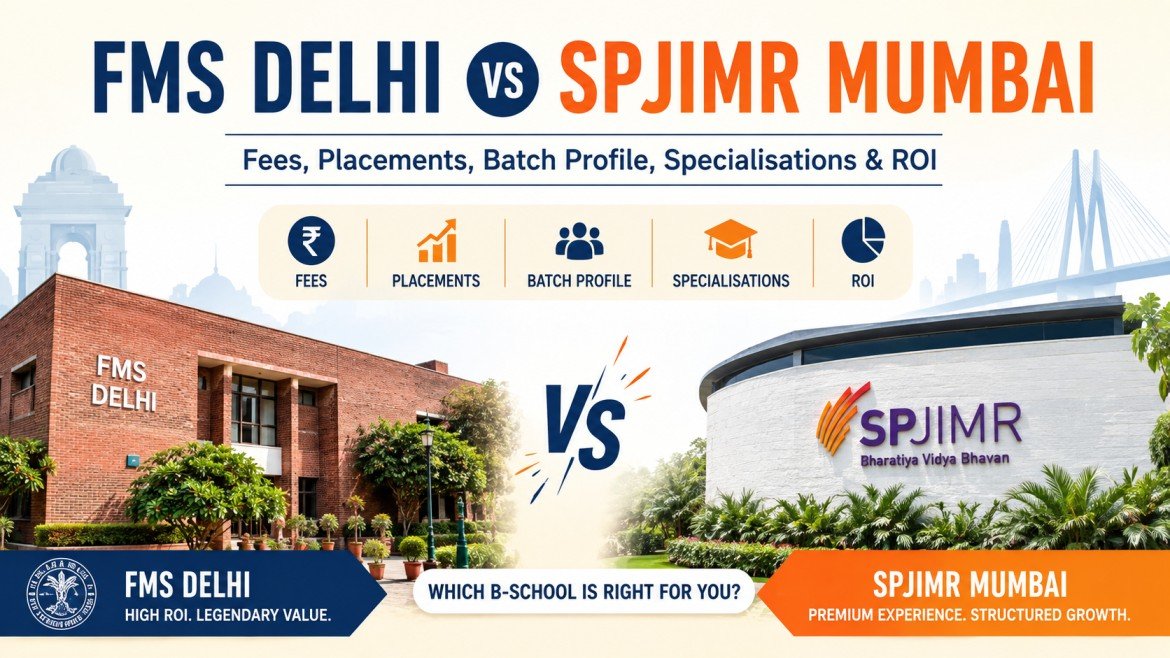
Choosing between FMS Delhi and SPJIMR Mumbai is one of the more difficult decisions for an MBA aspirant who has the option of targeting both institutes. Both schools have strong corporate reputations, but they offer very different value propositions.
FMS Delhi is particularly famous for its exceptionally low MBA fee and strong placements, making its return on investment difficult to match. SPJIMR Mumbai, on the other hand, offers a higher-fee residential management experience with structured specialisations, immersive learning, a strong recruiter base and a distinctive pedagogy.
So, when students search for FMS vs SPJIMR, the real question is not simply which college has the higher average package. The better question is: Which institute gives you the stronger combination of career opportunities, learning experience, specialisation flexibility, cost and long-term value for your particular profile?
For the latest verified information available in 2026, FMS's official MBA information bulletin lists the semester fee at approximately ₹60,818, while SPJIMR currently lists an indicative Indian participant fee of ₹24.86 lakh for its PGDM, including tuition and basic hostel accommodation.
The placement comparison is also close. FMS Delhi's latest final placement report for the 2024–26 batch reports an average compensation of about ₹32.3 lakh, while SPJIMR's Class of 2026 reported an average CTC of ₹33.75 lakh and a median CTC of ₹32.85 lakh across its PGDM and PGDM (BM) programmes.
That creates the central FMS vs SPJIMR debate:
FMS gives you extraordinarily high financial ROI, while SPJIMR gives you a premium residential B-school experience with a broader structured specialisation ecosystem.
This article compares the two institutes across fees, placements, batch profile, specialisations, admission, career opportunities, campus experience and ROI so that you can make a more informed decision.
FMS vs SPJIMR: Quick Comparison
| Parameter | FMS Delhi | SPJIMR Mumbai |
|---|---|---|
| Full name | Faculty of Management Studies, University of Delhi | S. P. Jain Institute of Management & Research |
| Location | New Delhi | Mumbai |
| Programme compared | MBA Full-Time | PGDM |
| Programme duration | 2 years | 2 years |
| Approx. programme fee | ₹2.43 lakh for 2026–28 based on the current semester fee | ₹24.86 lakh indicative fee for Indian participants |
| Hostel | Separate | Basic hostel/accommodation included in listed PGDM fee |
| Latest average package/CTC | About ₹32.27 LPA in latest reported placement cycle | ₹33.75 LPA for Class of 2026 across PGDM and PGDM (BM) |
| Latest median reported | About ₹29.59 LPA | ₹32.85 LPA |
| Highest reported CTC | ₹1.10 crore in latest reported FMS placement data | ₹75 LPA for Class of 2026 |
| Major career areas | Consulting, finance, FMCG, technology, product, analytics, general management | Consulting, finance, FMCG, marketing, operations, technology, analytics, general management |
| Specialisation structure | Broad MBA curriculum rather than the same four-major specialisation structure as SPJIMR | Finance, Information Management, Marketing, Operations & Supply Chain |
| Entrance route | CAT | CAT/GMAT depending on programme and intake |
| Residential | No | PGDM is residential |
| Major advantage | Exceptional ROI and Delhi corporate ecosystem | Specialisation flexibility, residential experience and structured immersive learning |
FMS's official 2026 information bulletin states that the MBA Full-Time programme has 251 sanctioned seats, while SPJIMR's official 2026–28 information states 240 Indian PGDM seats plus seats for foreign/OCI/PIO participants.
The figures in the table should not be interpreted as a perfectly like-for-like placement comparison because the institutes may define cohorts and placement reporting differently. In particular, SPJIMR's Class of 2026 placement announcement covers its PGDM and PGDM (BM) cohorts together, while FMS reports its MBA placement outcomes separately.
FMS Delhi vs SPJIMR Mumbai: Which College Is Better?
There is no universal winner in the FMS vs SPJIMR comparison.
If your primary objective is maximum ROI at minimum tuition cost, FMS Delhi has an enormous advantage.
If you want a premium residential B-school environment, structured specialisations and a highly immersive management programme, SPJIMR becomes a very compelling option.
For example, FMS's current semester fee of approximately ₹60,818 translates to roughly ₹2.43 lakh across four semesters, subject to the institute's fee revisions.
SPJIMR's listed PGDM fee for Indian participants is ₹24.86 lakh and includes tuition and basic hostel/accommodation. The institute describes this fee as indicative and subject to revision.
That means the fee difference is enormous.
At the same time, SPJIMR's latest Class of 2026 placement announcement reported an average CTC of ₹33.75 lakh and a median CTC of ₹32.85 lakh.
The result is an interesting FMS vs SPJIMR situation: the difference in reported average compensation is relatively small compared with the difference in programme fees.
This is why FMS is frequently considered one of India's strongest ROI-focused management schools.
However, ROI should not be reduced to a simple formula of salary divided by tuition. A student also needs to consider hostel and living expenses, opportunity cost, career preferences, campus experience, alumni network, learning environment and the type of role they want after graduation.
FMS Delhi Fees
One of the biggest reasons students consider FMS Delhi is its exceptionally low programme fee.
According to the official FMS MBA 2026 information bulletin, the semester fee for the MBA programme is currently approximately ₹60,818 per semester. Across four semesters, that works out to approximately ₹2.43 lakh, although FMS clearly states that fees can be revised.
The tuition figure does not mean that the total cost of living in Delhi will be only ₹2.43 lakh.
Students also need to budget for:
Hostel or accommodation
Food
Transportation
Laptop and academic expenses
Personal expenses
Books and other learning resources
Internship-related expenses
Miscellaneous campus expenses
Therefore, when calculating actual MBA ROI, students should compare total cost of attendance, not only tuition.
Even after considering these additional expenses, FMS remains dramatically cheaper than most top private B-schools.
Why FMS Fees Matter So Much in the FMS vs SPJIMR Decision
Suppose two students receive comparable job offers after graduation.
One has paid approximately ₹2.43 lakh in programme fees.
The other has paid approximately ₹24.86 lakh for the programme, including basic hostel/accommodation at SPJIMR.
The difference in initial financial commitment is substantial.
This does not automatically make FMS a better business school in every dimension. It does, however, make the financial ROI argument for FMS extremely strong.
For students who may need education loans, this difference becomes even more significant.
A lower education loan can mean:
Lower EMI after graduation
Less financial pressure
Greater flexibility when selecting the first job
More freedom to pursue entrepreneurship
Faster savings after graduation
Less dependence on a very high initial salary
This is one of the strongest arguments in favour of FMS Delhi.
SPJIMR Mumbai Fees
SPJIMR operates with a completely different fee model.
The official SPJIMR fee page currently lists the PGDM fee for Indian participants at ₹24,86,000. The stated amount includes tuition and basic hostel/accommodation. The institute also notes that the figure is indicative and subject to revision.
The fee does not include expenses associated with optional international components such as the Global Fast Track and International Exchange.
This means applicants should distinguish between:
Programme fee
and
Total cost of the MBA experience.
The latter can be higher depending on lifestyle, travel, international programmes and personal expenses.
SPJIMR also offers financial assistance and scholarships, including merit-cum-means-based assistance. The institute states that financial assistance can involve reimbursement of the tuition component based on need, academic performance, extracurricular activities and conduct.
For students who receive substantial financial assistance, the effective cost of SPJIMR can therefore be lower than the headline programme fee.
FMS vs SPJIMR Fees: How Big Is the Difference?
The fee difference is one of the clearest points in the comparison.
| Fee factor | FMS Delhi | SPJIMR Mumbai |
|---|---|---|
| Approx. programme fee | ₹2.43 lakh | ₹24.86 lakh |
| Basic hostel included? | No; separate arrangements | Yes, basic hostel/accommodation included in listed PGDM fee |
| International programme expenses | Not comparable to SPJIMR's optional GFT/INTEX structure | Additional for optional components |
| Financial assistance | University/institutional provisions | Merit and need-based assistance available |
| Financial ROI | Extremely high | Strong, but substantially higher initial investment |
The important point is that FMS vs SPJIMR cannot be judged on salary alone.
If the two schools deliver similar compensation for a particular career path, the lower cost of FMS can materially change your post-MBA financial position.
On the other hand, a candidate who values SPJIMR's residential environment, structured specialisation system and immersive learning may consider the higher investment worthwhile.
FMS Delhi Placements
FMS has a long-standing reputation for strong placements across consulting, finance, FMCG, technology, product and general management.
The institute's official placement website states that the placement process includes summer internships and final placements, with final placements conducted through lateral and main placement processes. FMS also describes a 100% placement record on its recruiter page.
The latest final placement report available from FMS for the 2024–26 batch shows strong compensation across different experience categories and reports growth in recruiter participation. The report highlights consulting and general management as major recruiting areas and also reports significant growth in product, IT, analytics and operations offers.
Third-party reporting based on the latest FMS placement data reports an average package of approximately ₹32.27 LPA, median compensation of approximately ₹29.59 LPA, and a highest domestic CTC of approximately ₹1.10 crore.
When considering these numbers, aspirants should pay more attention to average and median compensation than to the highest package.
A highest package is typically received by a small number of students and can be influenced by international or specialised roles.
The median gives a better indication of what the middle of the placed cohort receives.
SPJIMR Placements
SPJIMR's latest official Class of 2026 placement announcement is particularly strong.
The institute reported:
100% placements
₹33.75 LPA average CTC
₹32.85 LPA median CTC
₹75 LPA highest CTC
46% of the batch receiving PPOs
₹39 LPA average for the top 50%
₹43.75 LPA average for the top 25%
80 participating companies
31 new recruiters
These figures are for the PGDM and PGDM (BM) Class of 2026 together.
SPJIMR also reported that:
15% of offers were at least ₹40 lakh
31% of offers were at least ₹35 lakh
68% of offers were at least ₹30 lakh
94% of offers were at least ₹25 lakh
These figures provide more context than simply quoting the highest package.
Major Recruiting Areas at SPJIMR
Consulting represented the largest recruiting domain in the Class of 2026, accounting for 40% of offers according to SPJIMR's announcement. Recruiters included companies such as Accenture Strategy, BCG, Deloitte, EY-Parthenon, Kearney, KPMG, McKinsey and PwC.
SPJIMR also reported significant activity in FMCG, general management, BFSI, investment banking/private equity and technology/product/analytics roles.
This breadth is important for the FMS vs SPJIMR comparison because both schools can support careers beyond a single function.
FMS vs SPJIMR Placements
If we look only at average compensation, the two schools are surprisingly close.
FMS's latest reported average is around ₹32.27 LPA, while SPJIMR's Class of 2026 combined average is ₹33.75 LPA.
However, the fee difference is huge.
That creates the following simplified picture:
| Placement factor | FMS Delhi | SPJIMR Mumbai |
|---|---|---|
| Latest average reported | ~₹32.27 LPA | ₹33.75 LPA |
| Latest median reported | ~₹29.59 LPA | ₹32.85 LPA |
| Highest reported | ~₹1.10 crore | ₹75 LPA |
| Placement outcome | Strong/100% placement record stated by institute | 100% for Class of 2026 |
| Consulting | Strong | Very strong |
| Finance | Strong | Very strong |
| FMCG/Marketing | Strong | Particularly strong |
| Technology/Product | Strong and growing | Strong |
| ROI | Exceptional | Strong but fee-dependent |
There is an important methodological warning here.
Do not treat the two average salary figures as perfectly equivalent.
FMS's figure is from its MBA final placement reporting, while SPJIMR's ₹33.75 lakh figure is for the combined PGDM and PGDM (BM) Class of 2026.
For a serious college decision, you should therefore compare the specific programme you are applying to and the career function you want.
FMS vs SPJIMR: ROI Comparison
ROI is where the FMS vs SPJIMR debate becomes especially interesting.
A simple financial comparison can be expressed as:
ROI indicator = Average CTC ÷ Programme Fee
Using approximate reported figures:
FMS
Average CTC: ~₹32.27 lakh
Programme fee: ~₹2.43 lakh
Simple CTC-to-fee ratio: roughly 13.3x
SPJIMR
Average CTC: ₹33.75 lakh
Programme fee: ₹24.86 lakh
Simple CTC-to-fee ratio: roughly 1.36x
These are not investment returns and should not be interpreted as take-home salary or actual post-tax ROI. They are simply a rough way to illustrate the difference between reported annual CTC and programme fee.
Actual ROI depends on:
Net salary
Taxes
Loan interest
Living costs
Lost salary during the MBA
Bonuses
Salary growth
Career progression
Future switches
Personal expenses
Even with these limitations, the calculation illustrates why FMS has such a strong financial reputation.
Why FMS Has Exceptional ROI
The average placement compensation is many times higher than the tuition fee.
That means an FMS graduate can potentially recover the programme fee very quickly after entering the workforce.
For students who want to minimise debt, this is a major advantage.
Why SPJIMR Can Still Have Strong ROI
SPJIMR requires a much larger initial investment, but its placement outcomes are also among the strongest in the Indian management-school ecosystem.
The latest Class of 2026 figures show an average CTC of ₹33.75 lakh and median CTC of ₹32.85 lakh.
Therefore, the question is not whether SPJIMR has good ROI. It clearly has strong placement outcomes.
The question is whether the additional cost is justified for your goals.
For some candidates, the answer will be yes.
For others, particularly candidates who already have an FMS convert, the financial argument may strongly favour FMS.
FMS Delhi Batch Profile
Batch diversity is another important component of the FMS vs SPJIMR comparison.
FMS attracts students from a wide range of academic and professional backgrounds, including commerce, engineering, science, humanities and other undergraduate disciplines.
Its location within the University of Delhi ecosystem also creates a distinctive student environment.
The MBA programme is relatively compact compared with some large private B-school cohorts, which contributes to a highly competitive peer environment.
When evaluating the batch, aspirants should not focus only on the percentage of engineers or freshers.
More useful questions are:
How many students have work experience?
What industries do they come from?
How diverse are academic backgrounds?
What is the gender mix?
What kind of extracurricular achievements do students bring?
How competitive is the peer group?
What kind of roles do students eventually target?
The latest official FMS materials should be preferred whenever exact batch-profile numbers are required.
SPJIMR Batch Profile
SPJIMR's PGDM is designed for a mix of recent graduates and professionals.
For the 2026–28 intake, SPJIMR stated that work experience is not mandatory and that recent graduates as well as professionals with up to five years of experience are encouraged to apply.
The official 2026–28 programme information lists 240 seats for Indian nationals and 36 seats for foreign nationals, OCI and PIO candidates in PGDM.
SPJIMR's admissions approach is also notable because the institute does not rely exclusively on an examination score.
The selection philosophy considers the broader applicant profile, including academic record, work experience and other aspects of the candidate profile.
That makes the FMS vs SPJIMR application strategy different.
FMS vs SPJIMR: Freshers
A fresher can target both institutions, but the admission strategy is different.
At SPJIMR, work experience is not mandatory. The institute explicitly states that recent graduates and candidates with up to five years of experience can apply.
At FMS, the CAT score plays a central role in the admission process.
For a fresher, FMS can be extremely attractive because the institute's placement outcomes do not require students to have several years of work experience before entering the MBA.
However, a fresher should not assume that a strong CAT score alone guarantees admission.
Academic performance, category, selection criteria, interview performance and the applicable admission rules all matter.
FMS vs SPJIMR: Work Experience
Candidates with work experience should look at the two programmes differently.
SPJIMR explicitly accommodates candidates with professional experience and has a pedagogy that makes extensive use of experiential and non-classroom learning. Its 2026–28 admissions communication states that work experience is not mandatory but that candidates with up to five years of experience are encouraged to apply.
FMS also attracts candidates across experience levels.
The latest FMS placement report provides compensation data segmented by work-experience categories, demonstrating that the final cohort includes students with different levels of professional experience.
For a candidate with two or three years of strong work experience, the decision should therefore focus on:
Desired post-MBA function
Existing industry
Career switch requirements
Role quality
Leadership opportunities
Specialisation
Alumni network
Cost
SPJIMR Specialisations
Specialisation is one of SPJIMR's strongest differentiators.
The PGDM currently offers four major specialisation areas:
Finance
Information Management
Marketing
Operations & Supply Chain
The curriculum also provides minor specialisation options, including areas such as Analytics, Consulting, Finance, Marketing, Information Management and Operations & Supply Chain.
SPJIMR's current programme information also highlights that PGDM participants can select specialisation preferences from Finance, Information Management, Marketing and Operations & Supply Chain.
Finance
The Finance specialisation is suitable for students targeting careers such as:
Investment banking
Corporate finance
Financial services
Equity research
Risk
Banking
Private equity-related roles
Financial consulting
SPJIMR's Class of 2026 placement announcement reported substantial BFSI and investment-banking/private-equity participation among Finance students.
Information Management
Information Management is particularly relevant for students interested in:
Technology
Product management
Analytics
Digital transformation
Technology consulting
Business intelligence
Data-driven management
SPJIMR describes Information Management as a distinctive area designed to develop managers capable of connecting business and technology.
Marketing
Marketing remains one of SPJIMR's strongest traditional areas.
Students interested in:
Brand management
FMCG
Sales
Consumer marketing
Product marketing
Digital marketing
can find a strong fit in this pathway.
SPJIMR's latest placement communication reports significant FMCG recruiting activity and identifies marketing-related hiring across major consumer businesses.
Operations & Supply Chain
This specialisation is relevant for careers in:
Supply chain
Procurement
Operations
Manufacturing
Logistics
Planning
E-commerce operations
Operations consulting
It is especially useful for students who want a career connected to physical products, manufacturing, logistics or large-scale operations.
Does FMS Have Specialisations Like SPJIMR?
This is an important distinction in the FMS vs SPJIMR comparison.
FMS's MBA is a broad management programme and should not be treated as an identical four-major specialisation model to SPJIMR's PGDM.
Students can build functional expertise through electives, coursework, projects, internships and the roles they pursue during placements.
SPJIMR, by contrast, explicitly structures its PGDM around major specialisation areas.
Therefore:
If you want an explicitly structured specialisation pathway, SPJIMR has an advantage.
If you want broad management education combined with flexibility and exceptionally strong ROI, FMS is highly attractive.
FMS vs SPJIMR for Consulting
Consulting is one of the strongest common career paths for both institutes.
FMS has strong access to consulting and strategy recruiters, and its latest placement report highlights consulting and general management as major recruiting areas.
SPJIMR's Class of 2026 reported consulting as the largest recruiting domain, accounting for 40% of all offers.
The institute reported recruiters including BCG, McKinsey, Kearney, Accenture Strategy, Deloitte, EY-Parthenon, KPMG and PwC.
If consulting is your target, both schools are credible choices.
Your individual profile still matters enormously.
Recruiters evaluate:
Academic performance
Entrance scores
Internship experience
Work experience
Case competition performance
Leadership
Communication
Problem-solving
Interview performance
A college name helps open doors, but it does not replace preparation.
FMS vs SPJIMR for Finance
Both schools can support finance careers.
FMS has a strong legacy in finance and attracts recruiters across banking, financial services and related functions.
SPJIMR has a dedicated Finance specialisation and reported substantial BFSI and investment banking/private equity hiring in its Class of 2026.
For students who already know they want a structured Finance major, SPJIMR offers a clear academic route.
For students who want a broad MBA with a lower financial commitment and strong finance placement opportunities, FMS remains highly compelling.
FMS vs SPJIMR for Marketing
Marketing is another area where SPJIMR has a particularly distinctive identity.
Its PGDM includes a dedicated Marketing specialisation, and SPJIMR has a strong history of FMCG recruiting.
The Class of 2026 placement announcement reported recruiters including HUL, ITC, P&G, Nestlé, Marico, Asian Paints, Colgate-Palmolive, L'Oréal, Pidilite and several other major consumer businesses.
FMS also has strong marketing and FMCG opportunities.
For a candidate whose primary goal is brand management or FMCG marketing, the FMS vs SPJIMR decision should therefore include factors such as:
Preferred campus environment
Cost
Desired recruiter set
Specialisation structure
Location
Alumni network
Career goals
FMS vs SPJIMR for Technology and Analytics
Technology and analytics careers are becoming increasingly important for MBA graduates.
FMS's latest placement report highlights strong growth in Product, IT, Analytics and Operations offers.
SPJIMR has Information Management as one of its four major specialisations, and its Class of 2026 placement announcement reports technology, product and analytics recruitment involving companies such as American Express, GE Vernova, MakeMyTrip and others.
For students with a technology background who want to move into product management, consulting, analytics or digital transformation, both schools can be strong options.
SPJIMR has the advantage of a formal Information Management pathway.
FMS has the advantage of lower cost and strong placement opportunities across functions.
Campus and Student Experience
The campus experience is another major difference.
FMS is part of the University of Delhi and offers a very different environment from a residential private B-school.
The FMS experience is closely connected with Delhi's academic ecosystem and the broader corporate environment of the National Capital Region.
SPJIMR's PGDM is a two-year full-time residential programme. The residential model encourages students to spend much of their academic life within the campus community and facilitates peer learning and immersive activities.
This distinction matters more than it may initially appear.
A residential programme can provide:
Greater peer interaction
More structured extracurricular activities
Stronger day-to-day cohort bonding
More campus-based learning
Easier access to faculty and peers
A more concentrated MBA experience
FMS offers a different advantage: its location and integration with Delhi can provide strong access to the wider city and corporate ecosystem.
Learning Experience: FMS vs SPJIMR
SPJIMR places considerable emphasis on non-classroom learning and immersive experiences.
Its 2026 placement communication highlights learning experiences including rural internships and global fast-track opportunities.
The programme also includes:
Summer internships
Global Fast Track
International Exchange
Non-classroom learning
according to the current PGDM programme information.
FMS also combines classroom learning with internships, corporate interaction, competitions, clubs and placement activities.
Its placement report describes experiential learning and engagement with business leaders through initiatives and industry interactions.
The difference is therefore less about whether experiential learning exists and more about how the two institutions structure it.
Alumni Network and Location
Location can influence your MBA experience and early career.
FMS is based in Delhi, which gives students proximity to:
Government and public-sector institutions
Consulting firms
Corporate headquarters
NCR startups
Financial services
Media
Technology companies
SPJIMR is located in Mumbai, one of India's most important corporate and financial centres.
Mumbai provides access to:
Financial services
Consulting
FMCG
Media
Entertainment
Startups
Corporate headquarters
Investment banking
For students targeting finance, Mumbai can be particularly attractive.
For consulting, FMCG, government-linked opportunities and NCR-based companies, Delhi can also be highly useful.
FMS vs SPJIMR: Admission
Admission is another area where the two schools differ.
FMS Admission
FMS primarily uses CAT as the entrance route for its MBA Full-Time programme.
The 2026–28 information bulletin provides the official programme and reservation framework. The programme has 251 sanctioned seats before accounting for supernumerary categories.
Because FMS is one of the most sought-after ROI-focused MBA programmes in India, the competition is intense.
A high CAT score is therefore important, but candidates should also pay attention to the complete selection criteria applicable to the admission cycle.
SPJIMR Admission
SPJIMR's PGDM accepts CAT and GMAT scores.
For the 2026–28 programme, the institute stated that candidates could submit CAT 2025 or eligible GMAT scores.
SPJIMR also considers the candidate profile beyond the entrance examination.
This can include:
Academic performance
Work experience
Leadership
Extracurricular achievements
Personal qualities
Interview performance
Programme fit
That makes SPJIMR attractive to candidates with a strong overall profile, not merely a strong test score.
FMS vs SPJIMR: CAT Score
For candidates preparing for CAT, the distinction is important.
FMS is strongly associated with extremely competitive CAT performance.
SPJIMR also requires a strong CAT performance, but its selection process evaluates a wider candidate profile.
Therefore, a student should not think:
"My CAT percentile is high, so FMS is automatically better."
Nor should a student think:
"SPJIMR considers profiles, so CAT does not matter."
Both require serious preparation.
The difference lies in the way the final selection process evaluates candidates.
FMS vs SPJIMR for ROI: Who Should Choose What?
Choose FMS Delhi if:
ROI is your highest priority.
You want to minimise education debt.
You want a very strong placement outcome at a very low programme fee.
You are comfortable with a non-residential MBA environment.
You want flexibility across consulting, finance, FMCG, technology and general management.
You value the Delhi/NCR location.
You want to preserve capital for future investments or entrepreneurship.
Choose SPJIMR Mumbai if:
You prefer a residential B-school experience.
You want a structured specialisation.
You value experiential and non-classroom learning.
You are particularly interested in Marketing, Finance, Information Management or Operations & Supply Chain.
Mumbai's corporate ecosystem fits your career goals.
You value international exposure and immersive programme components.
You are comfortable making a significantly larger financial investment.
FMS vs SPJIMR: Which Has Better Placements?
If the question is purely about placement quality, it is difficult to declare an absolute winner.
Both institutions report very strong placement outcomes.
FMS's latest reported average CTC is around ₹32.27 lakh, while SPJIMR's Class of 2026 reported ₹33.75 lakh across PGDM and PGDM (BM).
SPJIMR's median CTC was ₹32.85 lakh.
FMS's latest reported median was approximately ₹29.59 lakh.
So SPJIMR currently has a stronger reported median and slightly higher reported average in these particular datasets.
But that does not automatically make SPJIMR the better choice.
The reason is the massive fee difference.
FMS vs SPJIMR: Which Has Better ROI?
For ROI, FMS Delhi has the clear advantage.
The current FMS programme fee is approximately ₹2.43 lakh based on the listed semester fee.
SPJIMR's listed PGDM fee is ₹24.86 lakh.
If average compensation is in a similar broad range, the financial burden of attending FMS is dramatically lower.
For a student who wants to maximise financial efficiency, FMS is therefore difficult to beat.
FMS vs SPJIMR: Which Is Better for Specialisation?
SPJIMR has the advantage.
Its PGDM explicitly offers:
Finance
Information Management
Marketing
Operations & Supply Chain
and also provides minor specialisation options.
FMS provides a broad MBA curriculum and allows students to develop functional expertise through courses and career choices, but its structure is not identical to SPJIMR's formal major-specialisation system.
If specialisation is central to your MBA decision, SPJIMR deserves serious consideration.
FMS vs SPJIMR: Which Is Better for Finance?
Both are strong.
A student who wants:
Investment banking
BFSI
Corporate finance
Financial services
Finance consulting
can target either institution.
SPJIMR has a dedicated Finance major and substantial finance-sector recruiting.
FMS has strong finance placements combined with a much lower fee.
Verdict: SPJIMR for structured specialisation; FMS for ROI.
FMS vs SPJIMR: Which Is Better for Marketing?
SPJIMR is particularly attractive for marketing and FMCG careers because Marketing is a dedicated major and the school has a strong FMCG recruiter ecosystem.
FMS also has strong marketing opportunities.
Verdict: slight edge to SPJIMR for a student specifically targeting structured marketing/FMCG career development; FMS remains highly competitive and has a much stronger fee advantage.
FMS vs SPJIMR: Which Is Better for Consulting?
Both are excellent options.
FMS has a strong consulting and general-management recruiter base.
SPJIMR reported consulting as 40% of all Class of 2026 offers.
Verdict: very close.
Your personal profile, preparation and interview performance may matter more than the difference between the two brands.
FMS vs SPJIMR: Which Is Better for Technology and Analytics?
SPJIMR has a natural advantage in structured Information Management because it offers IM as a major specialisation.
FMS has also seen growth in Product, IT, Analytics and Operations offers.
Verdict: SPJIMR for structured technology-management specialisation; FMS for cost-efficient access to technology and analytics careers.
FMS vs SPJIMR: Which Is Better for a Fresher?
Both can be good for freshers.
SPJIMR explicitly states that work experience is not mandatory and that recent graduates can apply.
FMS also has a significant fresher population and provides access to major corporate roles after the MBA.
For a fresher with an excellent CAT profile and a strong preference for ROI, FMS is particularly attractive.
For a fresher with a broader profile and strong extracurricular or leadership achievements who values a residential learning environment, SPJIMR may be appealing.
FMS vs SPJIMR: Which Is Better for Work-Ex Candidates?
For candidates with meaningful work experience, SPJIMR's immersive pedagogy and profile-based selection can be attractive.
However, FMS should not be ruled out.
A candidate with two to three years of experience should compare:
Current salary
Expected post-MBA salary
Opportunity cost
Education loan
Desired career switch
Role quality
Long-term progression
If the candidate is already earning a strong salary, the opportunity cost of a two-year MBA becomes important.
Is SPJIMR Worth the Higher Fees Than FMS?
For some candidates, yes.
For others, no.
SPJIMR's higher fee buys a different educational experience rather than simply a higher salary.
The programme provides:
Residential learning
Structured specialisations
Immersive learning
Global Fast Track opportunities
International Exchange options
Strong corporate engagement
Extensive peer interaction
SPJIMR's official programme information highlights these immersive components as part of the PGDM experience.
But if your main goal is simply to maximise the financial return from your MBA, the FMS proposition is extraordinarily strong.
Is FMS Better Than SPJIMR?
It depends on what "better" means.
For fees and ROI, FMS is better.
For structured specialisations, SPJIMR has an advantage.
For residential experience, SPJIMR is better suited.
For average placement compensation, recent reported numbers are close, with SPJIMR's Class of 2026 reporting ₹33.75 lakh and FMS's latest reported figure around ₹32.27 lakh.
For financial efficiency, FMS is the clear winner.
For marketing/FMCG and structured specialisation, SPJIMR is particularly attractive.
For overall career outcomes, both belong in the serious consideration set of a strong MBA aspirant.
FMS vs SPJIMR: Pros and Cons
FMS Delhi Advantages
Extremely low MBA fee
Exceptional financial ROI
Strong placement outcomes
Strong consulting opportunities
Strong finance opportunities
Strong FMCG opportunities
Strong technology/product opportunities
University of Delhi ecosystem
Delhi/NCR location
Lower education-loan burden
FMS Delhi Limitations
Highly competitive admission
Non-residential environment
Fewer of the structured residential experiences associated with private B-schools
Students seeking a formal major-specialisation structure may prefer SPJIMR
Delhi living and accommodation costs are additional
SPJIMR Advantages
Strong placement outcomes
Dedicated major specialisations
Residential programme
Strong consulting presence
Strong FMCG and marketing ecosystem
Strong finance recruitment
Information Management pathway
Operations & Supply Chain pathway
Global Fast Track and exchange opportunities
Immersive learning
Strong peer environment
Scholarships and financial assistance
SPJIMR Limitations
Significantly higher programme fee
Larger initial financial commitment
Potentially higher education-loan burden
Optional international experiences can involve additional expenses
The financial ROI is less extreme than FMS because the fee is much higher
Final Verdict: FMS vs SPJIMR
The FMS vs SPJIMR decision becomes much easier when you identify your priority.
If your priority is:
Low fees + high salary + exceptional ROI → FMS Delhi
If your priority is:
Residential MBA + structured specialisation + immersive learning → SPJIMR Mumbai
If your priority is:
Consulting → Both are excellent
If your priority is:
Finance → Both are excellent; SPJIMR offers a formal Finance major
If your priority is:
Marketing/FMCG → SPJIMR is especially attractive
If your priority is:
Technology/Product/Analytics → Both are strong; SPJIMR has the dedicated Information Management route
If your priority is:
Minimum education loan → FMS Delhi
If your priority is:
International and immersive B-school experience → SPJIMR Mumbai
The most important point is that you should not choose between these two schools based only on the highest package.
The latest placement data show that both can deliver excellent compensation. FMS's latest reported average is around ₹32.27 lakh, while SPJIMR's Class of 2026 reported an average CTC of ₹33.75 lakh.
The difference is that FMS delivers those outcomes at a dramatically lower programme fee.
That is why FMS has one of the strongest ROI propositions in Indian management education.
SPJIMR, meanwhile, justifies its higher cost through a different model: residential education, formal specialisations, immersive learning, international exposure and a strong corporate ecosystem.
So, if you have converts from both colleges, do not ask only:
"Which college has the higher package?"
Ask:
"Which college gives me the career I want at a cost I am comfortable paying?"
For a student who wants maximum financial efficiency, FMS Delhi is an exceptionally difficult offer to reject.
For a student who values the full residential B-school experience and wants a structured specialisation in Finance, Marketing, Information Management or Operations & Supply Chain, SPJIMR Mumbai can justify the additional investment.
In short:
FMS Delhi is the ROI champion. SPJIMR Mumbai is the structured, immersive B-school choice.
Your career goal, financial situation, preferred learning environment and target function should determine the final decision.
Frequently Asked Questions
Is FMS better than SPJIMR?
FMS is better if your primary criteria are low fees and ROI. SPJIMR may be better if you value residential education, structured specialisations and immersive learning. Both have strong placement outcomes.
Which has higher fees, FMS or SPJIMR?
SPJIMR has substantially higher fees. FMS's current MBA semester fee is approximately ₹60,818, or about ₹2.43 lakh across four semesters at the current rate. SPJIMR currently lists ₹24.86 lakh for Indian PGDM participants, including tuition and basic hostel/accommodation.
Which has better ROI, FMS or SPJIMR?
FMS has the stronger ROI proposition because its programme fee is dramatically lower while placement compensation remains very high.
What is the average package at FMS Delhi?
The latest reported FMS placement data cited by Careers360 gives an average package of approximately ₹32.27 LPA and a median of approximately ₹29.59 LPA.
What is the average package at SPJIMR?
SPJIMR reported an average CTC of ₹33.75 LPA for the Class of 2026 across PGDM and PGDM (BM), with a median CTC of ₹32.85 LPA.
What is the highest package at FMS Delhi?
The latest reported FMS placement data cited by Careers360 reports a highest package of approximately ₹110 lakh.
What is the highest package at SPJIMR?
SPJIMR's official Class of 2026 placement announcement reports a highest CTC of ₹75 lakh.
Does SPJIMR have specialisations?
Yes. The PGDM offers specialisation areas in Finance, Information Management, Marketing, and Operations & Supply Chain.
Does FMS Delhi have a specialisation system like SPJIMR?
FMS offers a broad MBA curriculum rather than the same four-major specialisation structure used by SPJIMR's PGDM.
Which is better for consulting, FMS or SPJIMR?
Both are strong. FMS has a strong consulting and general-management placement base, while SPJIMR reported consulting as 40% of Class of 2026 offers.
Which is better for finance?
Both are strong. SPJIMR has the advantage of a dedicated Finance specialisation, while FMS has the advantage of exceptional ROI and strong finance placements.
Which is better for marketing?
SPJIMR is particularly attractive for candidates focused on Marketing and FMCG because Marketing is a dedicated specialisation and the institute has a strong consumer-sector recruiter base.
Is work experience compulsory for SPJIMR PGDM?
No. SPJIMR states that work experience is not mandatory and that recent graduates as well as professionals with up to five years of experience can apply.
Is SPJIMR residential?
Yes. SPJIMR's PGDM is a two-year full-time residential programme, and the listed programme fee includes basic hostel/accommodation.
Which college is better for a fresher?
Both can be excellent. FMS is particularly attractive for a fresher who prioritises ROI, while SPJIMR can be attractive for a fresher who values a residential environment, profile-based selection and structured specialisation.
Which college should I choose if I have both FMS and SPJIMR converts?
Choose FMS if cost and ROI dominate your decision. Choose SPJIMR if you strongly value the residential experience, structured specialisation and immersive learning environment.
Is the FMS vs SPJIMR placement comparison completely like-for-like?
No. Placement reports cover different cohorts and reporting structures. For example, SPJIMR's Class of 2026 announcement combines PGDM and PGDM (BM), whereas FMS's final placement report is for its MBA cohort.
Should I choose FMS only because it is cheaper?
Not automatically. Cost is a major advantage, but your preferred career function, learning style, campus preference and long-term goals also matter.
Should I choose SPJIMR because its average CTC is slightly higher?
Not solely on that basis. The difference in average CTC is much smaller than the difference in programme fees.
Conclusion
The FMS vs SPJIMR comparison is ultimately a choice between two different approaches to management education.
FMS Delhi stands out because it combines a very low programme fee with strong placement outcomes. That combination creates an exceptional financial proposition and can significantly reduce the debt and opportunity cost associated with an MBA.
SPJIMR Mumbai takes a different approach. Its higher programme fee supports a residential management experience, structured major specialisations, immersive learning, international opportunities and strong corporate engagement. Its latest placement results also demonstrate that the institute can deliver excellent career outcomes.
For an aspirant who wants maximum ROI, FMS Delhi is the stronger choice.
For an aspirant who wants structured specialisation and a premium residential MBA experience, SPJIMR Mumbai is a compelling choice.
Neither college is universally better.
The right choice is the one that matches your career goal, financial capacity and preferred way of learning.
Sources and Further Reading
FMS Delhi's official MBA 2026 information bulletin and placement reports should be used for the latest programme fee and placement information.
SPJIMR's official PGDM fee page provides the current indicative fee and scholarship information.
SPJIMR's official Class of 2026 placement announcement provides the latest average CTC, median CTC, highest CTC, recruiter participation and sector-level placement information.
SPJIMR's official curriculum page provides information on its Finance, Information Management, Marketing and Operations & Supply Chain specialisations.
The article follows the requested publication structure and topic brief supplied in the source material.
Search Keywords
fms vs spjimr, FMS vs SPJIMR, FMS Delhi vs SPJIMR Mumbai, FMS vs SPJIMR fees, FMS vs SPJIMR placements, FMS vs SPJIMR ROI, FMS vs SPJIMR average package, FMS Delhi fees, FMS Delhi placements, FMS Delhi average package, FMS Delhi MBA fees, FMS Delhi ROI, SPJIMR fees, SPJIMR placements, SPJIMR average package, SPJIMR ROI, SPJIMR Mumbai fees, SPJIMR Mumbai placements, FMS Delhi package, SPJIMR package, FMS MBA, SPJIMR PGDM, FMS MBA fees, SPJIMR PGDM fees, FMS Delhi MBA placement, SPJIMR PGDM placement, FMS Delhi vs SPJIMR MBA, FMS Delhi or SPJIMR, FMS or SPJIMR, FMS vs SPJIMR which is better, FMS vs SPJIMR for consulting, FMS vs SPJIMR for finance, FMS vs SPJIMR for marketing, FMS vs SPJIMR for freshers, FMS vs SPJIMR for work experience, FMS vs SPJIMR for MBA, FMS vs SPJIMR specialisation, FMS vs SPJIMR batch profile, FMS vs SPJIMR admission, FMS vs SPJIMR CAT, FMS vs SPJIMR CAT percentile, FMS vs SPJIMR salary, FMS vs SPJIMR highest package, FMS vs SPJIMR median package, FMS vs SPJIMR placement report, FMS vs SPJIMR career, FMS vs SPJIMR comparison, FMS Delhi placement report, SPJIMR placement report, FMS Delhi latest placement, SPJIMR latest placement, FMS Delhi 2026, SPJIMR 2026, FMS Delhi 2026 fees, SPJIMR 2026 fees, FMS Delhi 2026 placements, SPJIMR 2026 placements, FMS Delhi MBA 2026, SPJIMR PGDM 2026, FMS Delhi admission 2026, SPJIMR admission 2026, FMS Delhi CAT, SPJIMR CAT, FMS Delhi specialisation, SPJIMR specialisation, SPJIMR finance, SPJIMR marketing, SPJIMR information management, SPJIMR operations supply chain, FMS finance placements, FMS consulting placements, FMS marketing placements, FMS technology placements, SPJIMR consulting placements, SPJIMR finance placements, SPJIMR marketing placements, SPJIMR FMCG placements, FMS Delhi ROI comparison, SPJIMR ROI comparison, FMS low fees high package, FMS Delhi low fees, SPJIMR high fees, best ROI MBA college, best MBA ROI India, top MBA colleges ROI, FMS Delhi vs top B schools, SPJIMR vs FMS, FMS vs SP Jain, FMS Delhi or SP Jain, SP Jain Mumbai vs FMS Delhi, FMS Delhi versus SPJIMR, FMS vs SPJIMR salary comparison, FMS vs SPJIMR fee comparison, FMS vs SPJIMR placement comparison, FMS vs SPJIMR career comparison, FMS vs SPJIMR MBA comparison, FMS vs SPJIMR specializations, FMS vs SPJIMR residential campus, FMS vs SPJIMR student life, FMS vs SPJIMR alumni, FMS vs SPJIMR recruiters, FMS vs SPJIMR consulting career, FMS vs SPJIMR finance career, FMS vs SPJIMR marketing career, FMS vs SPJIMR technology career, FMS vs SPJIMR fresher comparison, FMS vs SPJIMR work experience, FMS vs SPJIMR education loan, FMS vs SPJIMR total cost, FMS vs SPJIMR salary after MBA, FMS vs SPJIMR job opportunities, FMS vs SPJIMR career opportunities, FMS vs SPJIMR value for money, FMS vs SPJIMR worth it, FMS Delhi worth it, SPJIMR worth it, FMS Delhi MBA ROI, SPJIMR PGDM ROI, FMS Delhi average CTC, SPJIMR average CTC, FMS Delhi median salary, SPJIMR median salary, FMS Delhi highest CTC, SPJIMR highest CTC, FMS Delhi batch profile, SPJIMR batch profile, FMS Delhi fresher, SPJIMR fresher, FMS Delhi work experience, SPJIMR work experience, FMS Delhi consulting, SPJIMR consulting, FMS Delhi finance, SPJIMR finance, FMS Delhi marketing, SPJIMR marketing, FMS Delhi analytics, SPJIMR analytics, FMS Delhi product management, SPJIMR product management, FMS Delhi operations, SPJIMR operations, MBA ROI FMS Delhi, MBA ROI SPJIMR Mumbai, FMS Delhi vs SPJIMR 2026
Long-Tail & Short-Tail Searches
which is better FMS Delhi or SPJIMR Mumbai, FMS vs SPJIMR which one should I choose, is FMS better than SPJIMR, is SPJIMR better than FMS, FMS Delhi vs SPJIMR which has better placements, FMS vs SPJIMR which has better ROI, FMS vs SPJIMR fee difference, how much does FMS Delhi MBA cost, how much does SPJIMR PGDM cost, what is FMS Delhi average package, what is SPJIMR average package, what is FMS Delhi median package, what is SPJIMR median package, what is FMS Delhi highest package, what is SPJIMR highest package, FMS Delhi vs SPJIMR for CAT aspirants, FMS vs SPJIMR for MBA freshers, FMS vs SPJIMR for experienced candidates, FMS vs SPJIMR for finance careers, FMS vs SPJIMR for consulting careers, FMS vs SPJIMR for marketing careers, FMS vs SPJIMR for product management, FMS vs SPJIMR for analytics, FMS vs SPJIMR for FMCG, FMS vs SPJIMR for investment banking, FMS vs SPJIMR for technology careers, FMS vs SPJIMR for operations, FMS vs SPJIMR for supply chain, does SPJIMR have specialisations, does FMS have MBA specialisations, FMS Delhi specialisation options, SPJIMR specialisation options, FMS Delhi placement statistics, SPJIMR placement statistics, FMS Delhi 2026 admission criteria, SPJIMR 2026 admission criteria, FMS Delhi CAT requirement, SPJIMR CAT requirement, can freshers apply to SPJIMR, can freshers apply to FMS Delhi, is work experience required for SPJIMR, is FMS Delhi residential, is SPJIMR residential, FMS Delhi hostel cost, SPJIMR hostel fee, FMS Delhi total MBA cost, SPJIMR total MBA cost, FMS vs SPJIMR education loan, FMS vs SPJIMR financial ROI, FMS vs SPJIMR return on investment, FMS Delhi low fee MBA, SPJIMR MBA worth the fees, should I choose FMS Delhi or SPJIMR Mumbai, FMS Delhi or SPJIMR for consulting, FMS Delhi or SPJIMR for finance, FMS Delhi or SPJIMR for marketing, FMS Delhi or SPJIMR for technology, FMS Delhi or SPJIMR for freshers, FMS Delhi or SPJIMR with work experience, FMS vs SPJIMR campus life, FMS vs SPJIMR student experience, FMS vs SPJIMR alumni network, FMS vs SPJIMR recruiter comparison, FMS vs SPJIMR placement comparison 2026, FMS vs SPJIMR fees 2026, FMS vs SPJIMR packages 2026, FMS vs SPJIMR ROI 2026.
Key Takeaways
FMS Delhi offers exceptionally low MBA fees compared with SPJIMR.
FMS has a strong placement record and reported average CTC of ₹32.27 LPA for 2024–26.
SPJIMR reported ₹33.6 LPA average CTC and ₹32.85 LPA median CTC for PGDM 2024–26.
FMS provides one of the strongest ROI propositions among leading Indian B-schools.
SPJIMR offers structured specialisations in Finance, Marketing, Information Management, and Operations & Supply Chain.
SPJIMR provides a residential and immersive management education experience.
Both institutes offer strong opportunities in consulting, finance, marketing, FMCG, technology and general management.
FMS is particularly attractive for students prioritising low costs and high financial ROI.
SPJIMR can be preferable for students seeking specialisation flexibility and a residential campus experience.
The right choice depends on career goals, financial capacity, preferred specialisation and learning environment.

Ask a question
Still confused? Leave your question and our team will help you.