
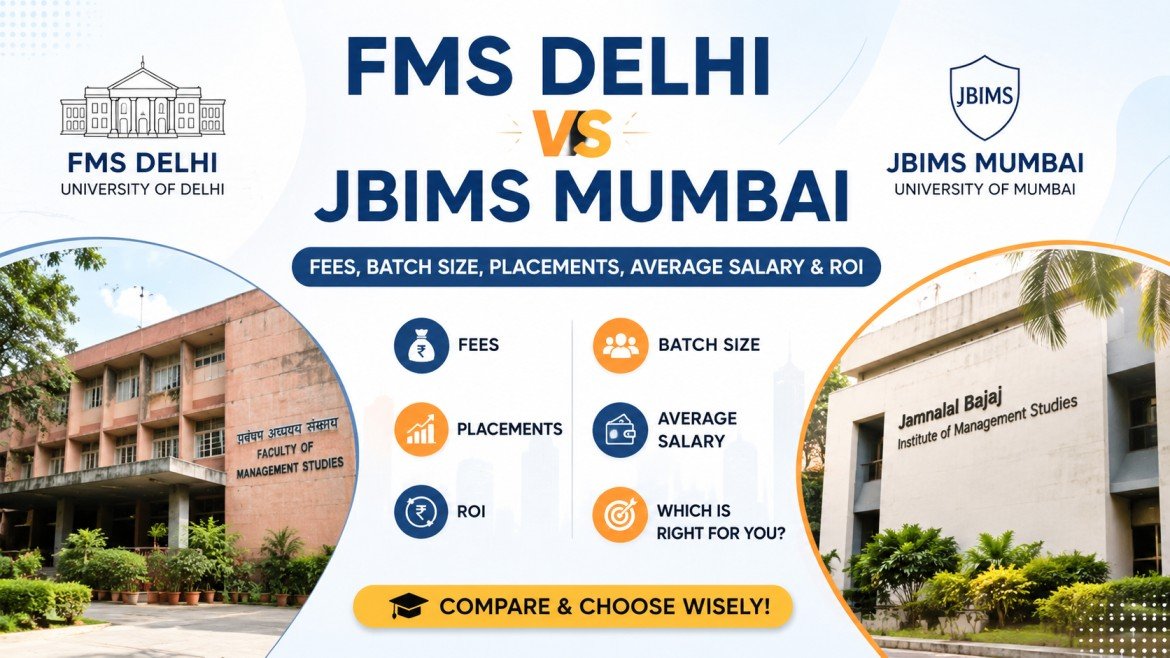
Quick Summary
- FMS offers exceptional ROI with very low fees and strong placements, while JBIMS provides excellent outcomes and a major Mumbai advantage, particularly for finance and corporate careers.
Choosing between FMS Delhi and JBIMS Mumbai is one of the most difficult decisions for MBA aspirants who are targeting a top management institute without taking on the fee burden associated with many private B-schools.
Both institutes have strong brand recognition, influential alumni networks, competitive peer groups and excellent corporate exposure. Yet they are not identical. FMS offers a two-year full-time MBA under the University of Delhi, while JBIMS offers its flagship two-year MMS programme under the University of Mumbai. Their admission routes, academic environment, location, fee structures and placement profiles are different.
So, FMS vs JBIMS is not simply a question of which college has the higher average package.
The more useful question is: Which institute gives you the better combination of career opportunities, cost, location, programme fit and return on investment?
For 2026 aspirants, this comparison becomes even more relevant because current official information is available for the FMS MBA 2026–28 programme and JBIMS has published its 2026–27 admission notices. FMS lists 251 sanctioned seats for its MBA 2026–28 programme and an approximately ₹60,818 semester fee, while JBIMS continues to conduct admissions for its MMS programme for the 2026–27 academic year.
The short answer is this:
FMS Delhi is particularly attractive if your priority is extremely low tuition, strong consulting and general-management opportunities, Delhi-based networking and an exceptional fee-to-placement ratio. JBIMS Mumbai is particularly attractive if you want to build your career in Mumbai, especially around finance, banking, consulting, conglomerates and the wider Mumbai corporate ecosystem.
But there is much more to the FMS vs JBIMS decision.
FMS Delhi vs JBIMS Mumbai at a Glance
| Parameter | FMS Delhi | JBIMS Mumbai |
|---|---|---|
| Full name | Faculty of Management Studies, University of Delhi | Jamnalal Bajaj Institute of Management Studies |
| Location | Delhi | Mumbai |
| Flagship programme | MBA Full Time | MMS |
| Programme duration | 2 years | 2 years |
| University affiliation | University of Delhi | University of Mumbai |
| 2026 programme status | MBA 2026–28 | MMS admissions 2026–27 |
| FMS/JBIMS fee advantage | Extremely low academic fee | Low compared with many premier B-schools |
| Sanctioned seats | 251 for MBA 2026–28 | Admission intake is governed by the applicable JBIMS/University of Mumbai framework |
| Placement strength | Consulting, general management, finance, product/IT and analytics | BFSI, investment banking, consulting, manufacturing, conglomerates, FMCG/pharma and technology |
| Location advantage | Delhi-NCR | Mumbai |
| Major ROI advantage | Very low fee relative to compensation | Strong compensation combined with comparatively modest fees |
| Best suited for | Aspirants prioritising ROI, consulting, general management and Delhi | Aspirants targeting Mumbai, finance and the Mumbai corporate ecosystem |
FMS officially describes its flagship MBA as a two-year full-time programme. The institute's 2026–28 information bulletin lists 251 sanctioned seats.
JBIMS's official website lists its MMS placement reports separately and currently provides its 2026–27 admission announcements.
FMS vs JBIMS: Which College Is Better?
There is no universal answer because the two schools provide different advantages.
If you compare only fees and placement outcomes, FMS has an extraordinary ROI proposition. Its official 2026 bulletin puts the MBA semester fee at approximately ₹60,818, subject to revision.
If you compare location and finance ecosystem, JBIMS has a major advantage because of its Mumbai location and long-standing proximity to India's financial and corporate centre.
If your goal is consulting, general management, finance, product, analytics or technology-related roles, both institutes can provide excellent opportunities.
If your goal is specifically to work in Mumbai's finance ecosystem, JBIMS Mumbai can be a particularly compelling choice.
If your priority is obtaining a top-tier management education while keeping the direct academic fee exceptionally low, FMS Delhi is difficult to beat.
That is why the answer to FMS vs JBIMS depends heavily on what you intend to do after graduation.
About FMS Delhi
The Faculty of Management Studies is part of the University of Delhi and offers a two-year full-time MBA.
The institute describes the programme as application-oriented, with a strong analytical foundation and flexibility through core and elective courses. Students complete a summer internship after the first year before moving into the second year and more specialised academic work.
FMS also has a long-established student and alumni ecosystem. Its official batch-profile information highlights diversity across educational and professional backgrounds, including students with experience in IT, banking, FMCG, biotechnology, manufacturing, telecom, advertising, petroleum and defence services.
For an aspirant, this matters because an MBA is not only about classroom teaching. Peer learning, alumni connections, student societies, competitions, internships and recruiter interactions can materially influence the experience.
FMS Delhi MBA duration
The flagship FMS MBA is a two-year full-time programme.
The first year builds foundational management knowledge and culminates in a summer internship. The second year gives students greater flexibility to shape their professional development through electives and specialised learning.
FMS Delhi eligibility
For the MBA Full Time programme, FMS states that candidates must have a bachelor's degree after at least twelve years of schooling.
For the unreserved category, the stated minimum is 50% marks or equivalent CGPA. The applicable requirement is different for certain reserved categories under University of Delhi rules. Final-year bachelor's students can also apply subject to fulfilling the prescribed conditions.
This means that meeting the academic eligibility requirement does not mean admission is guaranteed. FMS uses a competitive selection process, and applicants need to satisfy the complete admission criteria applicable to their cycle.
About JBIMS Mumbai
Jamnalal Bajaj Institute of Management Studies, commonly known as JBIMS, is a leading management institute located in Mumbai.
Its flagship management programme is the Master of Management Studies (MMS).
JBIMS continues to publish official admission notices for the MMS programme. Its 2026–27 admission information includes multiple rounds and admission-related notices, demonstrating that the MMS remains the central programme for the comparison with FMS's MBA.
JBIMS is particularly associated with Mumbai's business environment. For students interested in finance, banking, investment banking, consulting, manufacturing, conglomerates and other corporate functions, that location can be an important part of the overall value proposition.
FMS vs JBIMS: MBA vs MMS
One of the first things aspirants notice is that the programmes have different names.
FMS offers an MBA, while JBIMS's flagship programme is an MMS.
This difference should not be interpreted as one programme being automatically superior.
Both are established postgraduate management qualifications from highly regarded institutions.
For most recruiters, the institution, programme quality, candidate profile, skills, internships and interview performance are far more consequential than the simple difference between the labels "MBA" and "MMS."
Therefore, when comparing FMS vs JBIMS, focus on the entire career ecosystem rather than the degree name alone.
FMS vs JBIMS Fees
Fees are one of the biggest reasons the FMS vs JBIMS comparison attracts so much attention.
FMS has an unusually low academic fee for a school with its placement profile.
The official FMS 2026 information bulletin states that the semester fee for the MBA programme is currently approximately ₹60,818 per semester and notes that fees can be revised.
That makes the academic fee dramatically lower than what students encounter at many premier private business schools.
There are also other student-related expenses. For example, FMS's Management Science Association currently lists an annual MSA fee of ₹52,000 per student, subject to revision.
Therefore, aspirants should not calculate ROI using tuition alone. Living costs, accommodation, food, transportation, laptop expenses, student activities and other personal costs should also be considered.
JBIMS fees
JBIMS's fee structure can vary according to the applicable category and admission framework.
This is an area where aspirants should be particularly careful with online comparison websites because figures can differ by academic year, category and programme.
For example, JBIMS's official documentation for certain 2025–26 categories lists substantially different fee amounts for international/OCI/PIO/NRI/CIWGC candidates.
Therefore, students considering JBIMS for 2026 should use the fee figure stated in the applicable 2026–27 admission notice and fee documentation, rather than relying on an older article.
Why FMS has such strong ROI
Suppose two students graduate with similar compensation levels, but one pays substantially less in tuition.
The student with the lower direct education cost can potentially recover the investment much faster.
This is the central reason FMS is frequently discussed as one of India's strongest MBA ROI options.
However, ROI should not be reduced to:
Average CTC ÷ tuition fee
A better assessment considers:
- Tuition
- Accommodation
- Living expenses
- Opportunity cost
- Loan interest
- Internship opportunities
- Placement outcomes
- Career progression
- Alumni network
- Location
- Long-term earning potential
That broader approach gives a more realistic picture.
FMS vs JBIMS: Batch Size
Batch size matters because it affects classroom interaction, peer competition, club participation and the number of students competing for similar roles.
For FMS, the official 2026–28 MBA information bulletin lists 251 sanctioned seats.
That is an important distinction from unofficial websites that may use different definitions of "batch size."
For JBIMS, aspirants should similarly distinguish between sanctioned intake, students enrolled, students participating in placements and the size of individual programmes.
The official JBIMS placement report for the 2023–25 batch, for example, provides a batch profile and placement information, rather than treating every number associated with the institute as equivalent.
Why batch size matters in placements
A smaller or tightly controlled batch can create a different placement dynamic.
Recruiters may interact with a more concentrated pool of candidates.
However, batch size alone does not determine placement quality.
Recruiter relationships, candidate quality, specialisations, economic conditions and the number of available roles also influence outcomes.
This is why a student should not choose FMS vs JBIMS solely because one website reports a smaller batch.
FMS Delhi Placements
FMS has consistently positioned its placement process as one of the strongest parts of the MBA experience.
The institute currently states that it maintains a 100% placement record and conducts summer internships and final placements, with lateral placements followed by the main placement process.
More importantly, FMS publishes official placement reports.
Its official website currently lists the Final Placement Report for 2024–26 along with earlier reports and the Summer Placement Report for the 2025–27 batch.
The 2024–26 final placement report shows a broad compensation distribution and highlights strong participation from consulting and general management as well as product, IT, analytics and operations roles.
This is important because an "average salary" number by itself does not tell you what kind of jobs students actually receive.
FMS average salary
The 2024–26 FMS placement information reported by current secondary coverage places the average compensation at approximately ₹32.27 lakh per annum, with a reported median of approximately ₹29.59 lakh. The same coverage reports 119 participating companies and 287 students placed.
For publication purposes, however, it is better to identify the placement cycle rather than simply saying "FMS average salary 2026."
The relevant figure relates to the 2024–26 placement batch, whose final placement process concluded in 2026.
That distinction prevents readers from confusing a placement batch with an academic admission year.
FMS placement domains
FMS placements span several major areas.
The institute's latest placement material highlights opportunities across:
- Consulting
- General management
- Finance
- Product
- IT
- Analytics
- Operations
The 2024–26 placement report specifically highlights consulting and general management as a substantial portion of the placement mix and reports strong representation of product, IT, analytics and operations offers.
This makes FMS attractive to candidates who do not want to restrict themselves to a single functional area.
JBIMS Placements
JBIMS also has a strong placement ecosystem and publishes its own official placement reports.
The institute's placement-report page currently lists the Unified Final Placement Report 2024–26 and earlier placement reports for the MMS programme.
The available official final report for the 2023–25 batch reported:
- Mean CTC: ₹26.48 lakh
- Median CTC: ₹26.15 lakh
- Highest CTC: ₹55.60 lakh
- Top 10% CTC: ₹39.73 lakh
- 65+ total recruiters
- 94+ PPO/PPI offers
These numbers illustrate the strength of the JBIMS placement ecosystem, although they should not be presented as the current 2026 placement outcome because they relate to the 2023–25 batch.
The institute's current placement page confirms that a newer 2024–26 Unified Final Placement Report exists, so the latest official report should be preferred when publishing a final 2026 placement figure.
FMS vs JBIMS Average Salary
Average salary is one of the most searched parameters in FMS vs JBIMS.
But aspirants should compare salary figures only when the underlying placement batches and definitions are comparable.
For example:
- FMS's reported 2024–26 average compensation is approximately ₹32.27 lakh.
- JBIMS's officially available 2023–25 report reported a mean CTC of ₹26.48 lakh.
- JBIMS's newer 2024–26 placement report is now listed officially, but the figure should be taken directly from that report rather than inferred from older data.
This is why simply writing "FMS average package is X and JBIMS average package is Y" without identifying the placement year can be misleading.
Mean salary vs median salary
Aspirants should also understand the difference between mean and median compensation.
The mean is calculated by adding all salaries and dividing by the number of students.
The median is the middle value when salaries are arranged from lowest to highest.
If a small number of students receive extremely high packages, the mean can rise considerably.
For this reason, the median can sometimes provide a more useful indication of what a typical student may expect.
In the FMS 2024–26 placement data reported by secondary coverage, the average was approximately ₹32.27 lakh and median approximately ₹29.59 lakh.
JBIMS's 2023–25 official report similarly published both mean and median figures, allowing aspirants to look beyond the highest package.
FMS vs JBIMS: Highest Package
The highest package is another figure that attracts attention, but it is one of the least reliable standalone metrics for choosing a business school.
At FMS, secondary reporting on the 2026 placement cycle lists the highest package at approximately ₹1.1 crore per annum.
JBIMS's official 2023–25 placement report recorded a highest CTC of ₹55.60 lakh.
However, these numbers belong to different placement cycles.
A student should therefore avoid concluding that one college is automatically better simply because its highest package is higher.
A more useful comparison includes:
median CTC + average CTC + number of recruiters + placement roles + sector distribution + PPOs + career progression.
FMS vs JBIMS: Consulting Careers
Consulting is a major area of overlap between FMS and JBIMS.
FMS's latest placement report shows substantial representation from consulting and general management.
JBIMS also has consulting recruiters and a broader corporate mix.
For an aspirant targeting management consulting, both schools can therefore make sense.
The decision should then move to:
- Target firms
- Role type
- Location
- Alumni network
- Internship opportunities
- Candidate profile
- Personal preference
Rather than asking only "FMS vs JBIMS which is better for consulting?", a better question is:
Which school's recruiting ecosystem matches the consulting roles I want?
FMS vs JBIMS: Finance Careers
Finance is another area where both institutions have strong appeal.
JBIMS's Mumbai location gives students proximity to India's financial-services ecosystem.
Mumbai hosts a large concentration of:
- Banks
- Investment banks
- Asset managers
- Insurance companies
- Financial-services firms
- Private-equity and venture-capital firms
- Corporate headquarters
FMS also offers strong finance opportunities.
Therefore, a student interested in finance should not automatically reject FMS.
However, if location-driven networking and proximity to the Mumbai financial ecosystem are particularly important to you, JBIMS has a clear geographical advantage.
FMS vs JBIMS for Investment Banking
Investment banking aspirants often look beyond the institute name.
They should consider:
- Previous recruiter participation
- Investment banking roles
- Corporate finance opportunities
- Alumni presence
- Internship conversion
- Relevant academic preparation
- Networking
- Finance competitions and clubs
JBIMS's Mumbai location can be especially valuable for students who want to build a career around Mumbai's financial ecosystem.
FMS, meanwhile, offers access to a strong Delhi-NCR corporate ecosystem and a broad recruiter base.
The best choice depends on the exact role you are targeting.
FMS vs JBIMS for Marketing
Marketing opportunities are available at both schools.
Candidates interested in marketing should compare the types of recruiters and roles rather than only the institute's overall average salary.
A marketing aspirant should ask:
- Which FMCG companies recruit?
- Which consumer-tech companies recruit?
- What type of brand-management roles are offered?
- Are sales and marketing roles available?
- What are the summer internship opportunities?
- How many PPOs emerge from marketing internships?
The answer can change from one placement cycle to another.
FMS vs JBIMS for Product Management
Product management has become an increasingly attractive career path for MBA students.
FMS's latest placement report explicitly shows strong representation from product, IT, analytics and operations roles.
For students targeting product management, technology strategy, analytics or operations, FMS can therefore be a strong option.
JBIMS also provides access to technology and e-commerce recruiters, and its placement reports show participation from these sectors.
Again, the right comparison is role-specific rather than package-specific.
FMS vs JBIMS: Admission Process
The admission process is another major difference.
FMS admission
FMS uses a competitive admissions process for its MBA Full Time programme.
The institute's 2026 information bulletin provides the programme's eligibility and admission information, and applicants are required to use the FMS online registration system.
For the MBA programme, candidates need a recognised bachelor's degree and must meet the applicable percentage requirements.
FMS's 2026 bulletin also states that final-year bachelor's students may apply, subject to meeting the conditions when their results are declared.
JBIMS admission
JBIMS's MMS admissions follow the applicable University of Mumbai/Maharashtra admission framework and official JBIMS notices.
For 2026–27, JBIMS has published multiple MMS admission notices, including first, revised, second, final and cap-round information.
Because admission rules can change by cycle, students should always check the latest official JBIMS notice before applying.
FMS vs JBIMS: Entrance Exam
Entrance-exam requirements are an important distinction.
FMS's MBA admission process is associated with the Common Admission Test route.
JBIMS's MMS admission route operates within the applicable Maharashtra/University of Mumbai framework, with the exact route depending on the candidate category and admission year.
For a 2026 applicant, the correct approach is to check the current admission brochure instead of relying on older coaching websites.
This is particularly important for JBIMS because its official website has published multiple revised admission notices for the 2026–27 cycle.
FMS vs JBIMS: Cutoff
Both FMS and JBIMS are highly competitive.
Aspirants should not treat a cutoff shown on a third-party website as a guaranteed admission score.
There is a difference between:
- Qualifying cutoff
- Shortlisting cutoff
- Effective competitive score
- Final selection score
The number of applicants, category, admission policy and candidate pool can influence outcomes.
Therefore, students should target a score comfortably above historical thresholds rather than preparing only to meet a published minimum.
FMS vs JBIMS: Campus and Location
Location is one of the biggest differences between these institutions.
FMS is located in Delhi, while JBIMS is in Mumbai.
This difference can affect:
- Internship accessibility
- Networking
- Industry events
- Cost of living
- Career opportunities
- Personal preferences
- Long-term location decisions
Delhi advantage
Delhi-NCR has a large concentration of:
- Consulting firms
- Government and policy organisations
- Consumer companies
- Technology firms
- Corporate offices
- Startups
- Professional-services companies
FMS students can benefit from being part of this ecosystem.
Mumbai advantage
Mumbai has a particularly strong presence in:
- Banking
- Investment banking
- Financial services
- Media
- Entertainment
- Conglomerates
- Consulting
- FMCG
- Corporate headquarters
For students targeting finance-heavy careers, Mumbai can be particularly attractive.
FMS vs JBIMS: Campus Life
Campus experience is difficult to reduce to a ranking.
FMS is part of the University of Delhi ecosystem and offers students access to a large university environment.
Its Management Science Association coordinates student activities and professional development initiatives. FMS currently lists an annual MSA fee of ₹52,000 per student, subject to revision.
JBIMS also has an established student culture, alumni network and corporate-oriented environment.
The right choice depends on whether you prefer:
- A large university ecosystem
- A concentrated management institute
- Delhi's student environment
- Mumbai's corporate environment
FMS vs JBIMS: Alumni Network
Both institutions benefit from long-established alumni networks.
An MBA network becomes increasingly valuable as your career progresses.
Alumni can help with:
- Career advice
- Referrals
- Industry transitions
- Entrepreneurship
- Hiring
- Mentorship
- Networking
The usefulness of an alumni network depends not only on its size but also on where alumni work and how accessible they are.
For finance in Mumbai, JBIMS alumni can be especially valuable.
For consulting, general management and broader corporate careers, FMS alumni can provide a strong network across India and internationally.
FMS vs JBIMS: Return on Investment
ROI is arguably where this comparison becomes most interesting.
Imagine two candidates:
Candidate A attends FMS and pays a comparatively low academic fee.
Candidate B attends another premier institute and pays several times more.
If both eventually earn similar compensation, Candidate A may recover the education cost much faster.
This is the basic strength of the FMS model.
JBIMS also has strong ROI because its compensation outcomes are high relative to the tuition associated with the programme.
The 2023–25 JBIMS official placement report reported a mean CTC of ₹26.48 lakh and median CTC of ₹26.15 lakh.
The FMS 2024–26 reported average compensation of approximately ₹32.27 lakh further illustrates the strength of FMS's placement economics.
But students should remember that salary is gross compensation, not take-home income.
How to Calculate Your Real MBA ROI
A practical calculation is:
Total MBA Cost = Tuition + Accommodation + Food + Travel + Other Expenses + Loan Interest + Opportunity Cost
Then:
Simple First-Year ROI = First-Year Compensation ÷ Total MBA Cost
For a more realistic calculation, look at three to five years after graduation.
A graduate earning a high salary immediately after an MBA may see even greater financial benefits after promotions and role changes.
This is why the FMS vs JBIMS ROI debate should not stop at placement day.
FMS vs JBIMS: Which Has Better ROI?
If we define ROI strictly as the relationship between education cost and compensation, FMS has an exceptional advantage.
Its official MBA fee is approximately ₹60,818 per semester for the current 2026 programme information, although the institute notes that fees can be revised.
With reported 2024–26 average compensation of approximately ₹32.27 lakh, the gap between direct academic fees and compensation is striking.
JBIMS also has strong ROI, but its total fee burden is higher than FMS's basic academic fee.
Therefore:
Pure fee-to-compensation ROI: FMS has the stronger proposition.
Corporate ecosystem and Mumbai finance advantage: JBIMS can be stronger for the right candidate.
FMS vs JBIMS: Which Is Better for Freshers?
Freshers should not assume that work experience is mandatory.
FMS explicitly allows final-year bachelor's students to apply, provided they meet the prescribed eligibility requirements.
Both institutes attract candidates with varied backgrounds.
For freshers, the more important questions are:
- Can I build a strong academic profile?
- Can I perform well in the entrance process?
- Can I communicate effectively?
- Can I demonstrate leadership?
- Can I secure a strong internship?
- Can I participate in meaningful extracurricular activities?
The lack of work experience does not automatically make either institute unsuitable.
FMS vs JBIMS: Which Is Better for Work-Experienced Candidates?
Work experience can influence your classroom contribution and recruitment options, but neither institute should be evaluated solely through the lens of work experience.
FMS's batch information explicitly highlights a mixture of fresh graduates and experienced professionals from different industries.
JBIMS's placement report similarly shows a mixed batch profile, including freshers and candidates with previous work experience.
For an experienced candidate, the choice should depend more heavily on:
- Target role
- Existing industry
- Career switch objective
- Expected post-MBA salary
- Location preference
FMS vs JBIMS: Which Is Better for Finance?
JBIMS gets a strong edge for students who specifically want Mumbai-based finance exposure.
That does not mean FMS is weak in finance.
FMS has a strong finance placement ecosystem and attracts major corporate recruiters.
But Mumbai's location provides an ecosystem advantage that cannot be replicated entirely through classroom education.
If your long-term goal is investment banking, corporate finance, banking or other financial-services roles and you specifically want to build your network in Mumbai, JBIMS deserves serious consideration.
If your finance goal is combined with consulting, general management, analytics or broader corporate roles, FMS remains highly attractive.
FMS vs JBIMS: Which Is Better for Consulting?
This is much closer.
FMS's 2024–26 placement report shows strong consulting and general-management participation.
JBIMS also has consulting recruiters and a strong corporate reputation.
For consulting, the decision should be based on:
- Recruiter list
- Role quality
- Alumni network
- Internship conversion
- Preferred city
- Personal fit
There is no reason for a strong consulting aspirant to dismiss either institute.
FMS vs JBIMS: Which Is Better for General Management?
Both can work well for general management.
FMS's latest placement report explicitly highlights consulting and general management, while JBIMS's recruiter ecosystem includes large conglomerates and diversified businesses.
If you want a broad management career rather than a specialised finance or marketing role, both schools should remain on your shortlist.
FMS vs JBIMS: Which Is Better for Placements?
If your definition of "better placement" means higher reported average compensation in the latest comparable data available, FMS currently has a strong numerical advantage based on the reported 2024–26 outcome.
If your definition means finance-oriented corporate ecosystem and Mumbai location, JBIMS can offer a distinctive advantage.
Therefore, there are two different questions:
Which has stronger reported overall compensation?
FMS currently has the stronger reported figure in the sources reviewed.
Which provides stronger location-based access to Mumbai's financial ecosystem?
JBIMS.
FMS vs JBIMS: Recruiters
Recruiters can vary from one year to another.
That is why aspirants should not treat an old recruiter logo list as a guarantee that the same company will hire from campus in the next cycle.
FMS currently maintains a dedicated recruiter section and describes its placement process as connecting students with leading organisations across industries.
JBIMS also publishes formal placement reports that identify recruiter participation and sector distribution. Its 2023–25 report recorded more than 65 recruiters.
A better strategy is to examine roles and recruiter categories rather than simply counting company logos.
FMS vs JBIMS: Summer Placements
Summer internships are critical because they often become a student's first major corporate experience.
FMS currently publishes a Summer Placement Report for the 2025–27 batch.
The report provides compensation information and domain-wise stipend data.
JBIMS's official Summer Placement Report for the 2024–26 batch reported:
- 55+ total recruiters
- Mean stipend of ₹2.32 lakh
- Median stipend of ₹2.20 lakh
- Highest stipend of ₹4.40 lakh
- 18+ new recruiters
The FMS summer placement report for the 2025–27 batch is the newer document in the sources reviewed, so its current figures should be used when making a final 2026 comparison.
FMS vs JBIMS: Hostel and Living Costs
Living costs can significantly alter MBA ROI.
Delhi and Mumbai have very different rental markets.
Mumbai is generally known for higher accommodation costs, particularly in locations close to major business districts.
Delhi-NCR offers a wider range of accommodation options, although costs vary significantly by neighbourhood.
If you have a limited budget and are considering a loan, calculate:
Tuition + rent + food + transport + personal expenses + loan interest
instead of comparing tuition fees alone.
FMS vs JBIMS: Student Experience
An MBA experience includes far more than placements.
At FMS, students participate in student associations, societies, corporate events, competitions and academic activities. The institute's Management Science Association specifically coordinates student activities and professional development.
JBIMS similarly offers a management-focused student environment with strong corporate interaction.
Your preference may depend on whether you want:
- A large university environment
- A concentrated B-school ecosystem
- Delhi
- Mumbai
- Finance-heavy networking
- Broad corporate exposure
FMS vs JBIMS: Brand Value
Both names carry significant recognition in Indian management circles.
FMS benefits from its association with the University of Delhi and its long-standing reputation in management education.
JBIMS has a similarly established reputation and is strongly associated with Mumbai's business ecosystem.
Brand value should therefore be treated as a starting point rather than the final deciding factor.
A student's eventual career depends on skills, role, company, performance and professional network.
FMS vs JBIMS: International Opportunities
Students increasingly consider international exposure when selecting an MBA.
FMS has an established exchange programme and publishes student experiences involving institutions such as LSE and HEC Paris.
International exposure can provide:
- Cross-cultural learning
- International networking
- Global business understanding
- Exposure to different teaching styles
- International internship or academic opportunities
Aspirants interested in international careers should compare the latest exchange partnerships and eligibility rules before admission because these can change.
FMS vs JBIMS: Academic Curriculum
FMS states that its MBA curriculum is built around a strong analytical foundation combined with academic flexibility.
Students begin with core management disciplines and later develop their professional direction through electives.
JBIMS's MMS curriculum similarly provides a broad management foundation before students develop deeper professional interests.
The difference is less about "which teaches management" and more about:
- Teaching methodology
- Electives
- Faculty
- Peer learning
- Industry interaction
- Student initiatives
- Career opportunities
FMS vs JBIMS: Pros and Cons
FMS Delhi advantages
- Very low academic fee
- Exceptional fee-to-compensation proposition
- Strong placement record
- Excellent consulting and general-management opportunities
- Strong finance opportunities
- Strong product, IT and analytics opportunities
- University of Delhi brand
- Strong alumni network
- Delhi-NCR location
- Diverse student profile
FMS Delhi limitations
- Highly competitive admission
- Large-city living costs can still be significant
- Infrastructure experience may not resemble luxury private B-schools
- Admission is extremely competitive
- Students must be proactive to maximise the opportunities available
JBIMS Mumbai advantages
- Strong Mumbai location
- Excellent corporate exposure
- Strong finance and BFSI ecosystem
- Strong consulting opportunities
- Established alumni network
- Strong recruiter relationships
- Excellent placement outcomes
- Strong ROI compared with many expensive management programmes
- Access to Mumbai's corporate and financial ecosystem
JBIMS Mumbai limitations
- Admission is extremely competitive
- Mumbai living costs can be high
- Programme and fee details can vary by admission category
- Students should verify current admission information instead of relying on old online articles
FMS vs JBIMS: Who Should Choose FMS?
FMS may be the better choice if you:
- Want maximum ROI
- Want to minimise education debt
- Are interested in consulting
- Want general management roles
- Are interested in finance
- Want product/analytics/IT opportunities
- Prefer Delhi-NCR
- Value the University of Delhi brand
- Want a broad corporate career
The biggest argument for FMS is simple:
You do not need to spend a fortune to access a top-tier management education and strong placements.
FMS vs JBIMS: Who Should Choose JBIMS?
JBIMS may be the better choice if you:
- Want to build your career in Mumbai
- Are strongly interested in finance
- Want proximity to the financial-services ecosystem
- Value Mumbai corporate networking
- Are targeting BFSI or investment-related careers
- Want consulting or general-management opportunities in Mumbai
- Prefer the JBIMS alumni ecosystem
- Are comfortable with Mumbai's living costs
For the right candidate, the location itself can be an important part of the MBA value proposition.
FMS vs JBIMS: Final Verdict
If you have converted both FMS and JBIMS, congratulations—you have a genuinely difficult decision.
There is no meaningful reason to call one institute universally superior.
Choose FMS Delhi if your priority is exceptional ROI, very low tuition, broad career options and strong placements.
Choose JBIMS Mumbai if your priority is Mumbai, finance, banking and the corporate ecosystem surrounding India's financial capital.
If your career goals are flexible, the decision becomes even more nuanced.
For many candidates, FMS will be the rational choice because its fee structure is extraordinarily attractive relative to its placement outcomes. FMS's current 2026 programme bulletin lists approximately ₹60,818 per semester, while its latest reported 2024–26 placement outcome is around ₹32.27 lakh average compensation.
For a candidate with a clear Mumbai-centric finance objective, however, JBIMS can be worth choosing even when FMS is available, because career decisions should include location and ecosystem, not just arithmetic ROI.
The most important thing is to stop looking for a single "winner."
The real FMS vs JBIMS decision is about matching the institute to your career objective.
If you want maximum financial ROI, FMS is exceptionally compelling.
If you want Mumbai and finance, JBIMS is exceptionally compelling.
If you want consulting or general management, both deserve serious consideration.
If you want product, technology or analytics, FMS has a particularly strong recent placement profile, while JBIMS remains a strong option for candidates who prefer Mumbai.
Frequently Asked Questions
Is FMS better than JBIMS?
Neither is universally better. FMS has a major advantage in academic fee and reported overall compensation, while JBIMS has a major location advantage for candidates targeting Mumbai, particularly finance and financial services.
Which has better ROI, FMS or JBIMS?
On a simple fee-to-compensation basis, FMS has an exceptional ROI advantage because its academic fee is very low relative to its placement outcomes. The current FMS 2026 bulletin lists approximately ₹60,818 per semester, subject to revision.
Which has higher average salary, FMS or JBIMS?
The latest reported FMS 2024–26 average compensation is approximately ₹32.27 lakh. JBIMS's official 2023–25 report recorded a mean CTC of ₹26.48 lakh; JBIMS has since published a newer 2024–26 placement report, so the latest official report should be used for a same-batch comparison.
Which is cheaper, FMS or JBIMS?
FMS has an exceptionally low academic fee. Its 2026 programme information states approximately ₹60,818 per semester, although fees can be revised.
Is FMS an MBA or MMS?
FMS's flagship programme is a two-year full-time MBA.
Is JBIMS an MBA or MMS?
JBIMS's flagship management programme is the Master of Management Studies, or MMS.
Which is better for finance, FMS or JBIMS?
Both can lead to finance careers. JBIMS has the advantage of being located in Mumbai, which provides proximity to India's major financial-services ecosystem.
Which is better for consulting?
Both FMS and JBIMS are strong options. FMS's latest placement report shows substantial consulting and general-management participation.
Which is better for freshers?
Both can be suitable for freshers. FMS explicitly permits final-year bachelor's students to apply subject to its eligibility conditions.
Does FMS have 100% placement?
FMS currently states that it maintains a 100% placement record for its students.
What is the FMS Delhi batch size?
The FMS 2026–28 information bulletin lists 251 sanctioned seats for the MBA Full Time programme.
What is the average salary at FMS Delhi?
For the 2024–26 placement batch, secondary reporting based on the placement outcome puts the average compensation at approximately ₹32.27 lakh and median compensation at approximately ₹29.59 lakh.
What is the highest package at FMS?
Secondary reporting for the 2026 placement cycle lists a highest package of approximately ₹1.1 crore per annum. The exact placement-batch context should always be checked before using this number.
What is the average salary at JBIMS?
JBIMS's official 2023–25 placement report reported a mean CTC of ₹26.48 lakh and median CTC of ₹26.15 lakh. JBIMS now lists a newer 2024–26 report on its official placement page.
Which has better placements, FMS or JBIMS?
Both have strong placements. FMS has a higher reported average compensation in the latest publicly reported figures reviewed here, while JBIMS offers a particularly strong Mumbai corporate and finance ecosystem.
Is JBIMS worth choosing over FMS?
It can be, especially if your career objective is strongly connected to Mumbai, finance or financial services. For pure fee-to-placement ROI, FMS has a compelling advantage.
Which college should I choose if I get both FMS and JBIMS?
Choose FMS if you prioritise ROI and broad career opportunities. Choose JBIMS if Mumbai and finance are central to your career plan.
Conclusion
The FMS vs JBIMS comparison is ultimately a choice between two outstanding but different management ecosystems.
FMS stands out because of its extremely low academic fee, strong placement outcomes and broad opportunities across consulting, finance, general management, product, technology, analytics and operations.
JBIMS stands out because of its Mumbai location, established corporate relationships, finance ecosystem, alumni network and strong placement record.
For a student who wants the strongest possible financial return on the cost of an MBA, FMS Delhi is one of the most compelling choices available.
For a student who wants to build a career specifically around Mumbai's corporate and financial ecosystem, JBIMS Mumbai can be the more strategically aligned choice.
Before making the final decision, compare the latest official admission notice, fee document and placement report for the exact batch you will join. FMS and JBIMS both publish official information, and the numbers can change from one admission or placement cycle to the next.
In one line: FMS wins on pure ROI; JBIMS wins on Mumbai-finance ecosystem advantage; for consulting and general management, both are excellent choices.
Search Keywords
fms vs jbims, FMS vs JBIMS, FMS Delhi vs JBIMS Mumbai, FMS Delhi, JBIMS Mumbai, FMS Delhi fees, JBIMS fees, FMS placements, JBIMS placements, FMS average salary, JBIMS average salary, FMS highest package, JBIMS highest package, FMS ROI, JBIMS ROI, FMS vs JBIMS ROI, FMS vs JBIMS fees, FMS vs JBIMS placements, FMS vs JBIMS salary, FMS vs JBIMS admission, FMS vs JBIMS cutoff, FMS vs JBIMS comparison, FMS Delhi MBA, JBIMS MMS, FMS MBA fees, JBIMS MMS fees, FMS MBA placement, JBIMS MMS placement, FMS Delhi placement 2026, JBIMS placement 2026, FMS Delhi average package, JBIMS average package, FMS Delhi highest package, JBIMS highest package 2026, FMS Delhi batch size, JBIMS batch size, FMS Delhi seats, JBIMS seats, FMS Delhi admission 2026, JBIMS admission 2026, FMS MBA admission 2026, JBIMS MMS admission 2026, FMS Delhi eligibility, JBIMS eligibility, FMS CAT, JBIMS entrance exam, FMS CAT cutoff, JBIMS cutoff, FMS Delhi selection process, JBIMS selection process, FMS Delhi fees 2026, JBIMS fees 2026, FMS Delhi placement report, JBIMS placement report, FMS Delhi summer placement, JBIMS summer placement, FMS Delhi consulting placements, JBIMS consulting placements, FMS Delhi finance placements, JBIMS finance placements, FMS Delhi investment banking, JBIMS investment banking, FMS Delhi consulting, JBIMS consulting, FMS Delhi marketing placements, JBIMS marketing placements, FMS Delhi product management, JBIMS product management, FMS Delhi analytics placements, JBIMS analytics placements, FMS Delhi ROI comparison, JBIMS ROI comparison, best MBA college Delhi, best MBA college Mumbai, best MBA ROI India, top MBA colleges India, top MBA colleges without high fees, low fee MBA colleges, high ROI MBA colleges, FMS or JBIMS, FMS vs JBIMS which is better, should I choose FMS or JBIMS, FMS vs JBIMS for finance, FMS vs JBIMS for consulting, FMS vs JBIMS for marketing, FMS vs JBIMS for freshers, FMS vs JBIMS for experienced candidates, FMS vs JBIMS for investment banking, FMS vs JBIMS for product management, FMS vs JBIMS for general management, FMS vs JBIMS salary comparison, FMS vs JBIMS placement comparison, FMS vs JBIMS fee comparison, FMS vs JBIMS batch size comparison, FMS vs JBIMS admission comparison, FMS Delhi vs JBIMS Mumbai 2026, FMS Delhi vs JBIMS Mumbai fees, FMS Delhi vs JBIMS Mumbai placements, FMS Delhi vs JBIMS Mumbai salary, FMS Delhi vs JBIMS Mumbai ROI, FMS Delhi vs JBIMS Mumbai cutoff, FMS Delhi vs JBIMS Mumbai admission, FMS Delhi vs JBIMS Mumbai finance, FMS Delhi vs JBIMS Mumbai consulting, FMS Delhi vs JBIMS Mumbai package, FMS Delhi vs JBIMS Mumbai average package, FMS Delhi vs JBIMS Mumbai highest package, FMS Delhi vs JBIMS Mumbai batch size, FMS Delhi vs JBIMS Mumbai fees 2026, FMS Delhi vs JBIMS Mumbai placements 2026, FMS Delhi vs JBIMS Mumbai salary 2026, FMS Delhi vs JBIMS Mumbai ROI 2026, FMS Delhi vs JBIMS Mumbai admission 2026, FMS Delhi vs JBIMS Mumbai cutoff 2026
Long-Tail & Short-Tail Searches
FMS vs JBIMS which college is better, should I choose FMS Delhi or JBIMS Mumbai, FMS vs JBIMS which has better placements, FMS vs JBIMS which has better ROI, FMS vs JBIMS which has lower fees, FMS vs JBIMS average salary comparison, FMS vs JBIMS placement package comparison, FMS vs JBIMS MBA fees comparison, FMS vs JBIMS admission process 2026, FMS vs JBIMS cutoff comparison 2026, FMS vs JBIMS for CAT aspirants, FMS vs JBIMS for finance careers, FMS vs JBIMS for consulting careers, FMS vs JBIMS for investment banking, FMS vs JBIMS for marketing careers, FMS vs JBIMS for product management, FMS vs JBIMS for freshers, FMS vs JBIMS for work experience, FMS Delhi or JBIMS Mumbai for finance, FMS Delhi or JBIMS Mumbai for consulting, FMS Delhi or JBIMS Mumbai for MBA, FMS Delhi or JBIMS Mumbai for ROI, FMS Delhi or JBIMS Mumbai which is cheaper, FMS Delhi or JBIMS Mumbai which has better salary, FMS Delhi or JBIMS Mumbai which has better placements, FMS Delhi MBA 2026 fees and placements, JBIMS MMS 2026 fees and placements, FMS Delhi MBA 2026 admission process, JBIMS MMS 2026 admission process, FMS Delhi 2024-26 placement average salary, JBIMS 2024-26 placement average salary, FMS Delhi latest placement report, JBIMS latest placement report, FMS Delhi latest average package, JBIMS latest average package, FMS Delhi latest highest package, JBIMS latest highest package, FMS Delhi batch size 2026, JBIMS batch size 2026, FMS Delhi seats 2026, JBIMS MMS seats 2026, FMS Delhi MBA ROI calculation, JBIMS MMS ROI calculation, FMS Delhi total MBA cost, JBIMS total MMS cost, FMS Delhi finance career opportunities, JBIMS finance career opportunities, FMS Delhi consulting career opportunities, JBIMS consulting career opportunities, FMS Delhi Mumbai comparison, Delhi vs Mumbai MBA college, best ROI MBA FMS Delhi, JBIMS Mumbai ROI, low fee top MBA FMS, best MBA college for finance Mumbai, best MBA college for consulting Delhi, FMS Delhi vs JBIMS Mumbai for CAT, FMS Delhi vs JBIMS Mumbai for career, FMS Delhi vs JBIMS Mumbai for placements, FMS Delhi vs JBIMS Mumbai for salary, FMS Delhi vs JBIMS Mumbai for ROI, FMS Delhi vs JBIMS Mumbai for fees, FMS Delhi vs JBIMS Mumbai for freshers, FMS Delhi vs JBIMS Mumbai for experienced professionals, FMS Delhi vs JBIMS Mumbai which should I join, FMS Delhi vs JBIMS Mumbai final decision, FMS Delhi vs JBIMS Mumbai detailed comparison, FMS Delhi vs JBIMS Mumbai admission criteria, FMS Delhi vs JBIMS Mumbai eligibility, FMS Delhi vs JBIMS Mumbai recruiter comparison, FMS Delhi vs JBIMS Mumbai alumni network, FMS Delhi vs JBIMS Mumbai campus life, FMS Delhi vs JBIMS Mumbai location advantage, FMS Delhi vs JBIMS Mumbai finance ecosystem, FMS Delhi vs JBIMS Mumbai consulting ecosystem, FMS Delhi vs JBIMS Mumbai summer placements, FMS Delhi vs JBIMS Mumbai internship opportunities, FMS Delhi vs JBIMS Mumbai career opportunities, FMS Delhi vs JBIMS Mumbai management programme, FMS MBA vs JBIMS MMS, MBA vs MMS FMS JBIMS, FMS Delhi MBA or JBIMS MMS, FMS vs JBIMS 2026 comparison, FMS vs JBIMS 2026 fees, FMS vs JBIMS 2026 placements, FMS vs JBIMS 2026 salary, FMS vs JBIMS 2026 ROI, FMS vs JBIMS 2026 admission, FMS vs JBIMS 2026 cutoff, FMS vs JBIMS 2026 batch size, FMS vs JBIMS 2026 recruiter list, FMS vs JBIMS 2026 placement report, FMS vs JBIMS latest comparison, FMS vs JBIMS latest fees, FMS vs JBIMS latest placements, FMS vs JBIMS latest salary, FMS vs JBIMS latest cutoff, FMS vs JBIMS latest admission updates.
Key Takeaways
FMS Delhi offers an exceptionally low-cost MBA with strong placement outcomes.
JBIMS Mumbai offers an excellent combination of placements, brand value and Mumbai's corporate ecosystem.
FMS reported an average CTC of ₹32.27 LPA for the 2024–26 batch.
JBIMS reported a ₹26.67 LPA mean salary for the 2024–26 batch.
FMS has a major advantage when comparing fees and ROI.
JBIMS can be particularly attractive for students targeting finance, banking and Mumbai-based careers.
Both institutes offer strong opportunities in consulting and general management.
FMS and JBIMS have different admission processes and programme structures.
Students should compare median salary, recruiter mix and roles, not only the highest package.
Your final choice should depend on career goals, location preference, financial situation and desired industry.

Ask a question
Still confused? Leave your question and our team will help you.