
Quick Summary
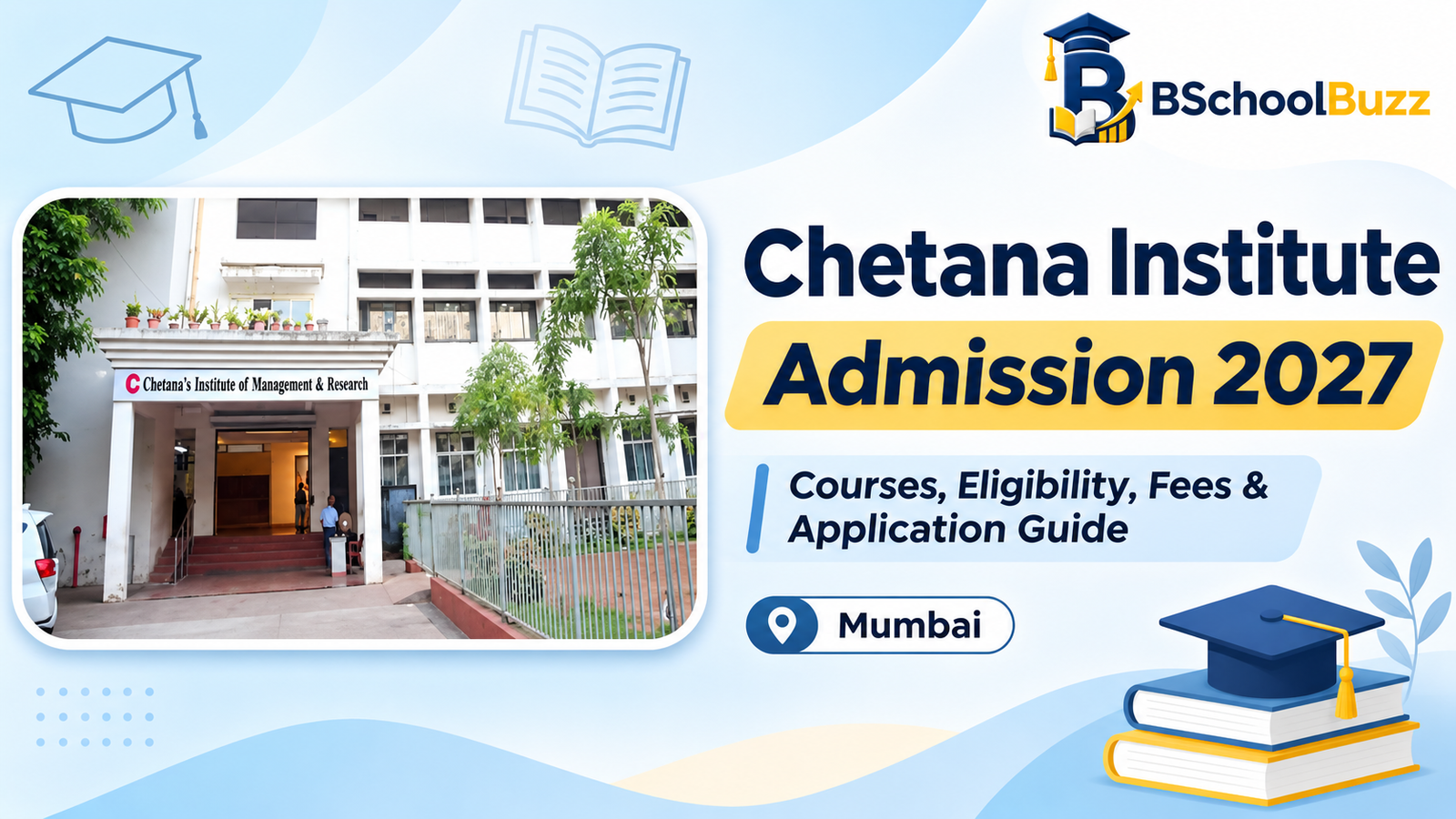
- Chetana Institute of Management and Research is a management education institution located in Bandra East, Mumbai, Maharashtra.
- The institute offers PGDM, PGDM Marketing and Fellow Programme in Management (FPM).
- PGDM and PGDM Marketing are two-year, full-time postgraduate programmes divided into four semesters.
- The general PGDM programme offers five specialisations: Marketing, Finance, Human Resource Management, Operations and Systems.
- PGDM Marketing focuses on digital marketing, consumer behaviour, brand management, marketing research and sales.
- The FPM programme is designed for candidates interested in advanced management research and academic careers.
- The first year of PGDM focuses on core management subjects, while the second year provides specialisation-based learning.
- Students undertake an approximately eight-to-ten-week summer internship after completing the first year.
- The 2026–28 PGDM fee is ₹9.50 lakh, with a separate refundable deposit of ₹10,000.
- Admission requires a recognised bachelor's degree, an accepted entrance examination score and participation in the institute's selection process.
- The institute publishes AICTE approval, NBA accreditation and AIU MBA equivalence information for its PGDM programmes.
- Students should verify the latest admission prospectus, fee structure, curriculum and recognition documents before applying.
Chetana Institute of Management and Research Courses & Programs 2026: MBA/PGDM Specialisations, Duration & Eligibility
1. Introduction to Chetana Institute of Management and Research
Chetana's Institute of Management and Research (CIMR) is a management education institution located in Bandra East, Mumbai, Maharashtra. Established in 1996 under the Chetana Educational Trust, the institute focuses on developing management professionals with business knowledge, leadership abilities and ethical decision-making skills.
The institute offers postgraduate management education through programmes such as Post Graduate Diploma in Management (PGDM) and PGDM Marketing. It also offers a Fellow Programme in Management (FPM) for candidates interested in advanced management research.
Students exploring Chetana Institute of Management and Research courses can choose programmes according to their academic interests and professional objectives. The general PGDM programme provides exposure to different management functions, while PGDM Marketing focuses on marketing-related business activities.
The institute's location in Mumbai provides access to a major commercial and financial centre. Its teaching approach includes classroom lectures, case studies, group discussions, presentations, practical assignments, projects and industry interactions.
This guide explains the available programmes, specialisations, course duration, eligibility requirements, curriculum, admission process, fees and career opportunities.
2. Overview of Chetana Institute Courses and Programs
Chetana Institute offers management programmes designed to prepare students for professional responsibilities across different business functions.
The institute's academic offerings include postgraduate management education and research-oriented management studies.
Chetana Institute Course Overview
| Programme | Course Level | Duration | Learning Focus |
|---|---|---|---|
| PGDM | Postgraduate | 2 years | General management and functional specialisations |
| PGDM Marketing | Postgraduate | 2 years | Marketing strategy and marketing management |
| Fellow Programme in Management (FPM) | Doctoral / Research | 4 years for the advertised 2026–2030 batch | Advanced management research |
| PGDM Retail | Published programme information | Confirm current intake | Retail management and retail operations |
The PGDM and PGDM Marketing programmes are full-time courses divided into four semesters. The first year builds management fundamentals, while the second year provides advanced learning in selected specialisation areas.
The FPM programme follows a different academic structure because it is research-oriented rather than a conventional classroom-based postgraduate diploma.
Students should distinguish between programmes currently advertised for admission and older programme information that may remain on institutional webpages. For the 2026–28 admission cycle, the official prospectus identifies PGDM and PGDM Marketing as the principal two-year programmes.
3. Courses Offered at Chetana Institute of Management and Research
Students interested in Chetana Institute of Management and Research courses should understand the academic focus of each programme before applying.
3.1 Post Graduate Diploma in Management (PGDM)
The PGDM programme is a two-year, full-time management course designed for graduates who want to develop knowledge across different business functions.
The programme introduces students to marketing, finance, human resources, operations, information systems and other management disciplines.
During the first year, students develop an understanding of general management principles. In the second year, they study advanced subjects related to their selected specialisation.
The programme is suitable for graduates interested in corporate management, business development, finance, marketing, human resources, operations and technology-related business functions.
3.2 PGDM Marketing
PGDM Marketing is a specialised management programme for candidates interested in marketing strategy, customer behaviour, branding, digital marketing, sales and business development.
The course combines general management subjects with marketing-focused learning.
Students develop an understanding of how businesses identify customer needs, analyse markets, position products, build brands and develop promotional strategies.
This programme may be suitable for candidates interested in marketing departments, advertising agencies, sales organisations, brand management and digital business functions.
3.3 Fellow Programme in Management (FPM)
The Fellow Programme in Management is a doctoral-level research programme.
It is designed for individuals interested in conducting research into management problems, developing academic knowledge and exploring research-oriented career opportunities.
The programme focuses on research methodology, specialised management knowledge, academic investigation and the development of research proposals.
3.4 PGDM Retail
CIMR's published programme information also describes a Retail Management programme.
Retail management education focuses on store operations, merchandising, customer experience, retail technology, inventory and supply chain activities.
The programme information discusses practical exposure through field projects, industrial visits, live projects and retail assignments.
Candidates should confirm whether a separate PGDM Retail intake is being offered for their intended admission batch before treating it as an active admission option.
4. Post Graduate Diploma in Management (PGDM)
The PGDM programme is one of the principal management courses offered by Chetana Institute of Management and Research.
It is structured to provide students with an understanding of business management principles and their practical applications.
Programme Objectives
The programme aims to develop students' ability to understand organisational problems, evaluate business situations and make informed management decisions.
Its academic approach focuses on the following areas:
Managerial Knowledge: Students understand important business functions and their relationship with organisational performance.
Analytical Thinking: Students develop the ability to interpret information, examine business problems and identify possible solutions.
Communication Skills: Presentations, discussions, assignments and teamwork help students improve professional communication.
Leadership Development: Students develop confidence, responsibility and the ability to work effectively with different teams.
Entrepreneurial Thinking: The programme encourages students to identify business opportunities and approach challenges creatively.
Ethical Management: Students develop awareness of responsible business practices and the wider impact of managerial decisions.
Main Learning Areas
| Learning Area | What Students Study |
|---|---|
| Marketing | Customer behaviour, market research, sales and branding |
| Finance | Accounting, financial management and investment concepts |
| Human Resources | Recruitment, employee development and performance management |
| Operations | Production, quality, logistics and supply chain management |
| Systems | Information systems, databases and business technology |
| Economics | Economic environment and managerial economics |
| Business Research | Research methods, data interpretation and analysis |
| Communication | Professional communication, negotiation and presentations |
The multidisciplinary structure helps students understand how departments work together within an organisation.
For example, a marketing decision can influence sales forecasts, production requirements, inventory planning and financial performance. A management student therefore needs a broader understanding of business operations rather than knowledge of only one department.
5. PGDM Specialisations and Subjects
An important feature of the general PGDM programme is the availability of five specialisation areas.
According to the institute's published programme structure, students can develop deeper knowledge in their selected management area during the second year.
5.1 Marketing Management
Marketing Management is concerned with understanding customers, identifying market opportunities and developing strategies to promote products and services.
Students learn how businesses position their products, communicate with customers, build brands and generate sales.
Important Subjects
Digital Marketing
Marketing Research and Analytics
Services Marketing
Consumer and Industrial Buying Behaviour
Managing Products and Brands
Integrated Marketing Communications
Marketing of Banking and Financial Services
E-commerce and Retail
B2B Marketing
Rural Marketing
Media Management
Skills Developed
Market analysis
Customer relationship management
Brand communication
Sales planning
Digital campaign understanding
Marketing strategy development
Career Opportunities
Marketing Executive
Brand Management Executive
Digital Marketing Executive
Sales Manager
Business Development Executive
Market Research Analyst
Product Marketing Executive
Students interested in advertising, consumer behaviour, digital campaigns and brand development may find this specialisation relevant.
5.2 Finance Management
Finance Management focuses on the financial activities that support organisational growth and business decisions.
Students learn how businesses manage money, evaluate investment opportunities, understand financial risks and analyse financial performance.
Important Subjects
Corporate Valuations
Mergers and Acquisitions
Security Analysis and Portfolio Management
Banking and Insurance
Financial Regulations
Derivatives and Risk Management
Credit Research Analysis
Wealth Management
Financial Analytics
Behavioural Finance
Financial Modelling
International Finance
Skills Developed
Financial statement analysis
Investment evaluation
Risk assessment
Financial planning
Analytical reasoning
Understanding of financial markets
Career Opportunities
Financial Analyst
Credit Analyst
Banking Executive
Investment Research Associate
Corporate Finance Executive
Financial Planning Associate
Risk Management Analyst
Finance can be a suitable specialisation for students who enjoy working with financial information, numbers, investment concepts and business analysis.
5.3 Human Resource Management
Human Resource Management focuses on people management and organisational development.
Employees are an important part of every organisation. HR professionals support recruitment, training, performance management, compensation and employee engagement.
The specialisation introduces students to the processes and responsibilities involved in managing an organisation's workforce.
Important Subjects
Training and Development
Compensation and Benefits
Competency-Based HRM
Performance Management
Industrial Relations
Labour Laws
HR Analytics
Organisational Structure Theories and Design
Strategic HR Management
Talent Acquisition
HR Audit
Leadership and Team Management
Employer Branding
Skills Developed
Recruitment and selection
Employee engagement
Training coordination
Performance evaluation
HR policy understanding
Workforce planning
Conflict management
Career Opportunities
HR Executive
Talent Acquisition Specialist
HR Operations Executive
Learning and Development Executive
HR Business Partner
Employee Engagement Specialist
HR Analyst
This specialisation is appropriate for students interested in employee development, organisational behaviour, recruitment and workplace management.
5.4 Operations Management
Operations Management focuses on planning, organising and improving the processes through which organisations produce products or deliver services.
It involves managing resources, improving efficiency, maintaining quality and ensuring that business activities run effectively.
Important Subjects
Manufacturing Resource Planning and Control
Materials Management
Service Operations Management
Operations Analytics
Supply Chain Management
World Class Manufacturing
Strategic Sourcing in Supply Management
International Logistics
Business Process Re-engineering and Benchmarking
Strategic Operations Management
Skills Developed
Process improvement
Supply chain coordination
Inventory planning
Quality management
Resource management
Operational analysis
Logistics planning
Career Opportunities
Operations Executive
Supply Chain Analyst
Procurement Executive
Logistics Coordinator
Inventory Analyst
Production Planner
Operations Manager
This specialisation may suit students interested in manufacturing, logistics, procurement, process management and supply chain activities.
5.5 Systems Management
Systems Management focuses on the relationship between business operations and information technology.
Modern organisations use information systems to manage data, support decisions, improve efficiency and coordinate different departments.
This specialisation helps students understand the role of technology in business management.
Important Subjects
Database Management Systems and Data Warehousing
Enterprise Management Systems
Big Data and Business Analytics
Knowledge Management
Software Engineering
Data Mining for Business Intelligence
Managing Technology Business
Information Systems Security and Audit
IT Governance and Compliance
Skills Developed
Business systems understanding
Database concepts
Business analytics
Information management
Technology coordination
IT governance awareness
Data-driven decision-making
Career Opportunities
Business Analyst
Systems Analyst
IT Business Analyst
Business Intelligence Analyst
Technology Management Executive
Information Systems Executive
Data Analyst
Systems Management may be suitable for students interested in business technology, enterprise systems, information management and analytics.
Comparison of PGDM Specialisations
| Specialisation | Main Focus | Suitable Career Interests |
|---|---|---|
| Marketing | Customers, sales and brand strategy | Marketing, advertising and sales |
| Finance | Financial management and investment | Banking, finance and analysis |
| HR | Employee and organisational management | Recruitment and HR operations |
| Operations | Processes, logistics and supply chain | Operations and procurement |
| Systems | Business technology and information systems | Business analysis and IT management |
The best specialisation depends on the student's interests, strengths and long-term career plans. Students should also review the actual elective subjects available for their batch.
6. PGDM Marketing Programme
PGDM Marketing is designed for students who want to develop specialised knowledge of marketing functions while understanding the wider business environment.
Marketing professionals are responsible for understanding customer needs, analysing markets, developing promotional strategies and supporting organisational growth.
The programme provides exposure to important areas of marketing management and business communication.
Programme Structure
The programme is divided into four semesters over two academic years.
The first year focuses on management fundamentals and marketing concepts. The second year provides advanced marketing subjects, electives and project-based learning.
Semester-Wise Learning Areas
| Semester | Major Learning Areas |
|---|---|
| Semester 1 | Marketing fundamentals, accounting, economics, organisational behaviour, operations and communication |
| Semester 2 | Marketing management, consumer behaviour, sales and distribution, business research and managerial economics |
| Semester 3 | Digital marketing, marketing research, brand management, services marketing and integrated marketing communication |
| Semester 4 | Marketing trends, project management and industry-oriented project |
Marketing Subjects
The official programme structure identifies subjects such as:
Digital Marketing
Marketing Research and Analytics
Services Marketing
Consumer and Industrial Buying Behaviour
Managing Products and Brands
Integrated Marketing Communications
Media Management
B2B Marketing
Marketing of Banking and Financial Services
Retail and E-commerce
These subjects introduce students to both traditional marketing functions and contemporary business practices.
Career Opportunities After PGDM Marketing
Graduates may explore careers in digital marketing, brand management, sales management, market research, product marketing, advertising, business development, customer relationship management and marketing analytics.
The actual career path depends on the student's skills, internship experience, projects and employer requirements.
7. Fellow Programme in Management (FPM)
The Fellow Programme in Management (FPM) is a research-oriented programme offered by Chetana Institute of Management and Research.
Unlike the PGDM programme, which focuses on professional management education, FPM is designed for individuals who want to develop advanced research capabilities and contribute to management knowledge.
The programme can be relevant for aspiring academics, management researchers, experienced professionals and individuals interested in investigating business and organisational challenges.
FPM Programme Duration
The institute advertises its FPM Admission Batch 2026–2030 as a four-year doctoral programme.
| Particular | Details |
|---|---|
| Programme | Fellow Programme in Management |
| Programme Level | Doctoral / Research |
| Advertised Batch | 2026–2030 |
| Duration | 4 years |
| Mode | As specified in the current programme brochure |
| Approval | AICTE approval stated by the institute |
| Primary Focus | Advanced management research |
Areas of Research
The institute's published FPM information identifies the following management disciplines:
Marketing: Research into consumer behaviour, digital marketing, brand strategy and market development.
Finance: Research into financial markets, investments, banking and corporate finance.
Human Resources: Research into leadership, employee engagement, organisational behaviour and talent management.
Operations: Research into supply chain management, process improvement, logistics and operational efficiency.
General Management: Research into business strategy, organisational development and leadership.
FPM Eligibility Criteria
The institute's published FPM eligibility information specifies a master's degree or equivalent qualification in relevant disciplines, including:
Engineering and Technology
Management
Economics
Social Sciences
Biological Sciences
Pure Sciences
Commerce
Humanities
The published eligibility information specifies a first-class master's qualification. Candidates appearing for their final examinations may also apply subject to the applicable completion conditions.
Because admission conditions can change between batches, applicants should obtain the current FPM admission brochure before applying.
FPM Selection Process
The published selection framework includes three important components.
Academic Qualification and Work Experience: The institute evaluates the candidate's educational background and relevant professional experience.
Research Proposal: Candidates are expected to demonstrate their proposed research interests and ability to identify a meaningful management research problem.
Personal Interview: The interview assesses research interest, academic understanding and suitability for the programme.
Career Opportunities After FPM
After completing an FPM, candidates may explore opportunities such as:
Management Faculty
Business School Researcher
Academic Researcher
Research Consultant
Corporate Research Professional
Management Development Specialist
Actual career opportunities depend on the research area, academic performance, publications, experience and institutional requirements.
8. Course Duration and Academic Structure
Understanding the course duration and academic structure is important when comparing Chetana Institute of Management and Research courses.
The PGDM and PGDM Marketing programmes follow a two-year academic structure divided into four semesters.
The academic design combines foundational management subjects, specialisation-based learning, projects and practical exposure.
PGDM Duration
| Particular | Details |
|---|---|
| Programme Duration | 2 years |
| Total Semesters | 4 |
| Programme Mode | Full-time |
| First Year | Core management subjects |
| Second Year | Specialisation subjects and advanced learning |
| Internship | Approximately 8–10 weeks |
| Project Work | Academic and industry-oriented projects |
First Year: Management Fundamentals
The first year develops students' understanding of different business functions.
Students study subjects related to finance, marketing, economics, operations, human resources, organisational behaviour, information systems and communication.
This structure helps students develop a broad understanding of how organisations operate.
For example, a business expansion decision requires financial planning, marketing research, human resource allocation and operational preparation. Understanding these relationships is important for future managers.
Second Year: Specialisation-Based Learning
The second year focuses on the student's chosen specialisation.
Students study advanced subjects related to their selected area and may choose electives according to the programme structure.
The institute's published programme structure includes subjects related to strategic management, international trade and global management, project management and industry-oriented projects.
Summer Internship
A summer internship is an important part of the PGDM academic structure.
After completing the first year, students undertake an internship lasting approximately eight to ten weeks in a commercial or social organisation.
The internship helps students understand workplace practices and apply classroom knowledge to professional assignments.
9. Detailed PGDM Curriculum
The PGDM curriculum is structured to provide students with knowledge across different business disciplines.
The first two semesters establish a management foundation, while the third and fourth semesters provide advanced and specialisation-focused learning.
Semester 1 Subjects
| Subject | Learning Focus |
|---|---|
| Innovative Management Practices and Business Ethics | Management approaches and ethical decisions |
| Fundamentals of Financial Accounting | Accounting concepts and financial records |
| Economic Environment of Business | Economic factors affecting organisations |
| Fundamentals of Production and Operations Management | Production processes and operations |
| Organisational Behaviour | Individual and group behaviour at work |
| Quantitative Techniques | Mathematical and statistical decision tools |
| Managerial Communication | Professional communication |
| Fundamentals of Marketing Management | Marketing principles and strategies |
| Information Systems for Business | Business technology and information systems |
| Selling and Negotiation Skills | Sales communication and negotiation |
Semester 2 Subjects
| Subject | Learning Focus |
|---|---|
| Managing Business Research | Research methods and business investigation |
| Marketing Management – Concepts and Cases | Marketing applications and business cases |
| Fundamentals of Financial Management | Financial decisions and planning |
| Operations Research | Analytical approaches to operational decisions |
| Fundamentals of Human Resource Management | Workforce and employee management |
| Analysis of Financial Statements | Financial performance evaluation |
| Entrepreneurship Management | Business creation and entrepreneurial thinking |
| Managerial Economics | Economic principles for management |
| Legal and Tax Aspects of Business | Legal and taxation concepts |
| Specialisation-Related Subject | Introduction to the chosen management function |
The institute's published structure identifies specialisation-related subjects such as Financial Markets, Institutions and Services for Finance; Sales and Distribution Management for Marketing; HR Labs for HR; Total Quality Management for Operations; and IT Enabled Business Strategies for Systems.
Semester 3: Advanced Specialisation Learning
The third semester introduces advanced subjects and specialisation-focused electives.
Common learning areas include:
International Trade and Global Management
Strategic Management
Summer Internship Project
Students then study subjects according to their selected specialisation.
For example, Marketing students study digital marketing, marketing research and analytics, services marketing and brand management.
Finance students study corporate valuations, investment analysis, financial regulations and risk management.
HR students study training, compensation, HR analytics and organisational design.
Operations students study supply chain management, materials management and operations analytics.
Systems students study database management, enterprise systems, business analytics and data mining.
Semester 4: Final Academic Learning
The fourth semester focuses on advanced applications and project-based learning.
Common subjects include:
Project Management
Industry-Oriented Project
Specialisation-related subjects
Students use their academic knowledge to understand business challenges and prepare projects connected to their chosen management area.
Importance of the Curriculum
The curriculum is designed to develop both functional knowledge and general management capabilities.
A student specialising in finance still needs to understand marketing, operations and human resources because financial decisions affect the wider organisation.
Similarly, a marketing professional needs to understand financial budgets, sales operations and customer data.
This multidisciplinary approach is useful for students preparing for managerial responsibilities.
The institute may revise its course structure, so students should refer to the curriculum issued for their batch.
10. Eligibility Criteria for Admission
Candidates planning to apply for Chetana Institute of Management and Research courses must satisfy the academic and entrance examination conditions specified for the relevant admission year.
The 2026 admission prospectus provides the eligibility conditions for its two-year full-time PGDM programmes.
Academic Eligibility
Applicants must have:
A recognised bachelor's degree of at least three years' duration.
A minimum of 50% aggregate marks for general-category applicants.
A minimum of 45% aggregate marks for candidates belonging to applicable reserved categories.
A non-zero positive score in an accepted entrance examination for the relevant admission year.
Final-Year Students
Candidates appearing for their final-year bachelor's degree examination can also apply.
However, admission remains subject to fulfilling the prescribed eligibility requirements and submitting the required graduation documents within the institute's stated deadline.
PGDM Eligibility Table
| Eligibility Parameter | Requirement |
|---|---|
| Minimum Qualification | Bachelor's degree |
| Degree Duration | At least 3 years |
| General Category | 50% aggregate |
| Applicable Reserved Categories | 45% aggregate |
| Final-Year Students | Eligible to apply provisionally |
| Entrance Examination | Accepted management entrance examination |
| Personal Interview | Required as part of selection |
Important Eligibility Conditions
The percentage is calculated according to the applicable rules of the university or institution awarding the bachelor's degree.
Candidates should check whether their qualification is recognised and whether the percentage calculation meets the institute's requirements.
Students with an equivalent CGPA should refer to the conversion method prescribed by their university.
Documents Required
Applicants should keep the following documents ready, as applicable:
Class 10 mark sheet or certificate
Class 12 mark sheet
Graduation mark sheets
Graduation degree certificate, if available
Entrance examination scorecard
Government-issued identity proof
Nationality and date-of-birth proof
Passport-size photographs
Work experience documents, where applicable
Sports or extracurricular activity certificates, where applicable
The institute may request additional documents during application or counselling.
11. Entrance Examinations Accepted
Entrance examination scores form an important part of the PGDM admission process.
The 2026 admission prospectus lists the following examinations:
| Entrance Examination | Conducting Authority |
|---|---|
| MAH-MBA/MMS CET | Maharashtra State CET Cell |
| CAT | Indian Institutes of Management |
| MAT | All India Management Association |
| XAT | XLRI |
| ATMA | Association of Indian Management Schools |
| CMAT | National Testing Agency |
Candidates should obtain a valid score in an examination accepted for their admission cycle.
Importance of Entrance Examination Scores
Management entrance examinations evaluate different abilities, including:
Quantitative aptitude
Logical reasoning
Data interpretation
Verbal ability
Reading comprehension
General awareness, depending on the examination
A strong entrance examination performance can improve a candidate's competitiveness during the selection process.
However, entrance examination scores are not the only component of selection.
How to Prepare for Entrance Examinations
Quantitative Aptitude: Practise arithmetic, algebra, percentages, ratios, averages and other mathematical topics.
Logical Reasoning: Solve puzzles, arrangements, logical sequences and analytical reasoning questions.
Verbal Ability: Improve reading comprehension, vocabulary and grammar.
Data Interpretation: Practise interpreting tables, graphs, charts and numerical information.
Mock Tests: Attempt timed mock examinations to improve speed and accuracy.
Candidates should follow the examination-specific syllabus and preparation requirements.
12. Admission Process and Selection Criteria
The admission process at Chetana Institute generally includes application submission, entrance examination evaluation, personal interaction and final merit-list preparation.
The 2026 prospectus and institute admission information describe the following stages.
Step 1: Check Eligibility
Before applying, candidates should verify their graduation percentage, entrance examination score and other eligibility conditions.
Step 2: Online Application
Visit the official CIMR admissions website.
Register using valid contact information and complete the application form.
Provide accurate academic details, entrance examination information and other required information.
Step 3: Upload Supporting Documents
Upload the required certificates, mark sheets, photographs and entrance examination scorecard.
Ensure that the information entered in the application matches the supporting documents.
Step 4: Entrance Examination Evaluation
The institute considers scores from its accepted entrance examinations.
Eligible applicants are shortlisted for the next stage of the selection process.
Step 5: Comprehensive Discussion and Personal Interview
Shortlisted candidates participate in the Comprehensive Discussion and Personal Interview (CDPI).
The institute evaluates candidates on different parameters, including:
Clarity of career goals
Communication skills
Personality and general bearing
Attitude
General awareness
Balanced and thoughtful consideration of issues
Subject knowledge
The purpose is to assess the candidate's overall suitability for management education.
Step 6: Merit List Preparation
The institute prepares the merit list based on the applicable selection criteria.
The 2026 prospectus describes a 200-mark evaluation framework.
| Selection Component | Maximum Marks |
|---|---|
| Entrance Test Score | 70 |
| Personal Interview / CD / GD | 70 |
| Past Academic Record | 30 |
| Sports / Extracurricular Activities | 20 |
| Work Experience | 10 |
| Total | 200 |
Candidates should refer to the current prospectus for the precise scoring methodology and selection conditions.
Step 7: Admission Offer
Selected candidates receive admission-related communication through the institute's official channels.
The merit list and waitlisted candidates' information are published according to the admission schedule.
Step 8: Fee Payment
Candidates who receive an admission offer must pay the applicable programme fee within the prescribed deadline.
Step 9: Document Verification
Selected students attend the counselling and verification process with the required original documents.
The institute may also require gap affidavits and anti-ragging affidavits.
Important Admission Dates for the 2026–28 Cycle
The 2026 prospectus published the following schedule:
| Admission Activity | Published Date |
|---|---|
| Application Form Availability | 5 March 2026 |
| Last Date for Application | 31 May 2026 |
| Personal Interview | To be announced on the institute website |
| Merit List | As per institute notification |
| Final Admission | As per the admission schedule |
These dates belong to the 2026–28 prospectus and should not be assumed to apply to later admission cycles.
13. PGDM Fee Structure for 2026–28
Course fees are an important consideration when selecting a management institute. Students should understand the complete programme fee rather than comparing only tuition charges.
According to CIMR's official admission information, the fee structure for the PGDM and PGDM Marketing programmes for the 2026–28 batch is as follows.
Programme-Wise Fee Structure
| Programme | First Year | Second Year | Total |
|---|---|---|---|
| PGDM | ₹4,80,000 | ₹4,70,000 | ₹9,50,000 |
| PGDM Marketing | ₹4,80,000 | ₹4,70,000 | ₹9,50,000 |
Refundable Deposit
The institute lists a refundable library/computer laboratory deposit of ₹10,000, payable in the first year.
This deposit is separate from the programme fee. Students should read the applicable refund conditions before making payment.
Detailed Fee Components
| Fee Component | First Year | Second Year |
|---|---|---|
| Tuition Fees | ₹3,36,500 | ₹3,33,500 |
| Development Fees | ₹66,500 | ₹66,500 |
| Examination Fee | ₹11,000 | ₹11,000 |
| Computer Lab Fee | ₹11,000 | ₹11,000 |
| Instruction Material / Aid Fee | ₹11,000 | ₹11,000 |
| Library Fee | ₹10,000 | ₹10,000 |
| Placement Facility Fee | ₹10,000 | ₹10,000 |
| Alumni Association Fee | Not separately charged | ₹3,000 |
| Convocation Fee | Not separately charged | ₹1,000 |
| Co-curricular, Sports and Cultural Activities | ₹5,000 | ₹5,000 |
| Student Insurance | ₹3,000 | ₹3,000 |
| Internet Facility | ₹6,000 | ₹5,000 |
| Refundable Deposit | ₹10,000 | Not applicable |
| Total | ₹4,80,000 | ₹4,70,000 |
Understanding the Total Programme Cost
The two-year programme fee is ₹9.50 lakh for both PGDM and PGDM Marketing.
The refundable deposit is an additional payment of ₹10,000 in the first year.
Students should also consider personal expenses such as accommodation, food, commuting, books and other individual requirements when preparing their education budget.
The above figures relate specifically to the 2026–28 admission batch. They should not automatically be applied to future batches because the institute may revise its fee structure.
Fee Payment and Refund Considerations
Candidates should check the official payment instructions, confirm the applicable payment deadline, retain payment receipts, review the refund policy and understand the cancellation conditions before accepting admission.
14. Teaching Methodology and Practical Learning
Management education requires more than understanding theoretical concepts. Students must also learn how to apply management principles to actual business situations.
Chetana Institute's academic approach includes different teaching and learning activities designed to improve students' analytical, communication and professional skills.
Classroom Lectures
Classroom lectures introduce students to management concepts, theories, frameworks and business practices.
Faculty members explain different subjects and help students understand the relationship between management principles and organisational activities.
Case Study Method
Case studies introduce students to business situations involving management decisions.
Students examine the available information, identify the main challenges and discuss possible solutions.
For example, a case study may involve a company experiencing declining sales. Students may investigate customer behaviour, pricing, competitors, distribution and marketing strategies before suggesting improvements.
Group Discussions
Group discussions help students develop communication and teamwork abilities.
They encourage students to express opinions, listen to different perspectives and support their arguments with relevant information.
Presentations
Presentations help students develop professional communication and confidence.
Students learn to organise information, explain business concepts and present recommendations clearly.
Role Plays
Role-play activities allow students to practise professional situations.
These may involve sales conversations, negotiation exercises, customer interactions, leadership situations and workplace communication.
Projects and Assignments
Academic projects encourage students to investigate business problems and apply theoretical knowledge.
Students may work individually or in groups depending on the assignment requirements.
Industry Interaction
Guest lectures and professional interactions help students understand business expectations and industry developments.
Such activities can introduce students to practical challenges faced by organisations and different career paths.
15. Summer Internship and Industry Exposure
The Summer Internship Programme is an important component of the PGDM academic structure.
It allows students to gain practical exposure after completing their first year of management education.
According to the institute's published student handbook, students undertake an internship of approximately eight to ten weeks in a commercial or social organisation.
Objectives of the Internship
Practical Business Understanding: Students observe how organisations operate and how different departments perform their responsibilities.
Application of Classroom Knowledge: Students apply concepts learned in marketing, finance, HR, operations or systems to practical assignments.
Professional Communication: Internship activities help students interact with managers, colleagues and other professionals.
Problem-Solving Skills: Students may be required to understand business problems, collect information and prepare recommendations.
Industry Awareness: Students become familiar with organisational culture, workplace expectations and professional responsibilities.
Types of Internship Assignments
| Specialisation | Possible Internship Activities |
|---|---|
| Marketing | Market research, sales analysis, digital marketing and customer surveys |
| Finance | Financial analysis, reporting, market research and investment-related assignments |
| HR | Recruitment coordination, training support and employee engagement |
| Operations | Inventory analysis, process improvement and supply chain coordination |
| Systems | Business reporting, database-related analysis and information systems projects |
These are illustrative examples of assignments associated with the respective management functions, not guaranteed internship allocations.
Why Internship Experience Matters
Internship experience gives students an opportunity to understand the practical side of management.
It can also help students identify their professional interests before completing the programme.
Students should use the internship period to improve their communication, analytical thinking, professional discipline and ability to work within an organisation.
16. Accreditation and Recognition
Before selecting a management institute, candidates should understand the programme's approval and accreditation status.
Chetana Institute publishes information about its AICTE approval, NBA accreditation and AIU MBA equivalence.
AICTE Approval
The institute identifies its PGDM programmes as approved by the All India Council for Technical Education (AICTE).
AICTE approval is an important consideration when evaluating a management education programme.
NBA Accreditation
The institute publishes NBA accreditation information for its PGDM programmes.
Its published PGDM information identifies NBA accreditation through 31 December 2028.
Candidates should verify the programme-specific accreditation documents and their validity for the intended admission batch.
AIU MBA Equivalence
CIMR also publishes Association of Indian Universities (AIU) MBA equivalence information for its PGDM programmes.
This is relevant for students who may require recognition of their PGDM qualification for further education or other academic purposes.
Students should check the exact AIU equivalence document, its applicable programme and validity conditions before relying on it for a particular purpose.
Accreditation Overview
| Recognition / Approval | Institute-Published Information |
|---|---|
| AICTE | Approval stated for PGDM programmes |
| NBA | Accreditation published for PGDM programmes |
| AIU | MBA equivalence published |
| ISO | Institute identifies ISO 21001:2018 certification |
Accreditation, approval and equivalence are different forms of recognition. Students should not treat them as interchangeable.
17. Career Opportunities After PGDM
A PGDM qualification can prepare students for management-related career opportunities across different industries.
The type of career a student pursues generally depends on the chosen specialisation, academic performance, internship experience, communication skills and employer requirements.
Marketing Career Opportunities
Marketing graduates can explore roles involving sales, branding, advertising, market research and digital marketing.
Potential job roles include:
Marketing Executive
Brand Management Executive
Digital Marketing Specialist
Sales Executive
Business Development Executive
Marketing Research Analyst
Product Marketing Executive
Industries include FMCG, retail, advertising, banking, technology, media and consumer services.
Finance Career Opportunities
Finance graduates may explore opportunities in financial services, banking, corporate finance and investment-related functions.
Potential job roles include:
Financial Analyst
Credit Analyst
Finance Executive
Banking Associate
Investment Research Associate
Risk Analyst
Corporate Finance Executive
Students interested in finance should develop analytical skills and a strong understanding of financial statements and business mathematics.
Human Resource Career Opportunities
HR graduates may explore roles involving recruitment, employee development, workforce planning and organisational management.
Potential job roles include:
HR Executive
Talent Acquisition Specialist
HR Operations Executive
Learning and Development Executive
HR Analyst
Employee Engagement Executive
HR Business Partner
Professional communication and an understanding of workplace policies are important for these careers.
Operations Career Opportunities
Operations graduates may work in logistics, manufacturing, procurement, supply chain management and business process improvement.
Potential job roles include:
Operations Executive
Supply Chain Analyst
Procurement Executive
Logistics Coordinator
Inventory Analyst
Production Planner
Process Improvement Executive
Students interested in operations should understand business processes, quality management and resource planning.
Systems Career Opportunities
Systems graduates may pursue roles connecting business requirements with information technology.
Potential job roles include:
Business Analyst
Systems Analyst
IT Business Analyst
Business Intelligence Analyst
Information Systems Executive
Technology Management Associate
Data Analyst
Knowledge of databases, enterprise systems, data analysis and business communication can support these career paths.
Career Opportunities After PGDM Marketing
PGDM Marketing graduates can explore positions in digital marketing, brand management, marketing communications, sales and distribution, market research, product management, advertising, customer relationship management and e-commerce marketing.
The selection of a career depends on the candidate's strengths, experience and professional interests.
Factors That Influence Career Development
A management qualification alone does not guarantee a particular salary or job position.
Career development depends on several factors:
Academic performance
Specialisation
Internship experience
Communication skills
Technical knowledge
Analytical ability
Interview performance
Industry demand
Professional networking
Students should review the latest official placement reports and actual role descriptions when evaluating employment opportunities.
18. How to Select the Right Specialisation
Selecting a specialisation is one of the important decisions during a management programme.
Students should consider their academic background, interests, strengths and future career objectives before making a choice.
Choose Marketing if You Enjoy Customer and Market Activities
Marketing may be suitable for students who enjoy communication, understanding customer needs, sales, advertising and brand development.
Candidates interested in digital marketing, consumer behaviour and business development can explore this area.
Choose Finance if You Enjoy Numbers and Financial Analysis
Finance may be suitable for students interested in financial statements, banking, investments, financial planning and analytical work.
A strong interest in quantitative analysis can be useful in this field.
Choose HR if You Enjoy Working with People
Human Resource Management may be suitable for students interested in recruitment, employee engagement, training, workplace culture and organisational development.
Communication and interpersonal skills are particularly important.
Choose Operations if You Enjoy Process Management
Operations may suit students interested in production, logistics, supply chains, procurement and process improvement.
It is relevant to industries that depend on efficient operational planning.
Choose Systems if You Are Interested in Business Technology
Systems may suit students who enjoy information technology, business analysis, data management and enterprise systems.
It provides an opportunity to understand how technology supports organisational decisions.
Specialisation Selection Comparison
| Your Interest | Recommended Specialisation |
|---|---|
| Branding, advertising and customer behaviour | Marketing |
| Banking, investments and financial analysis | Finance |
| Recruitment, training and employee management | HR |
| Logistics, production and process improvement | Operations |
| Technology, data and business systems | Systems |
The best specialisation is not necessarily the one with the most popular job title. It is the one that matches a student's interests, capabilities and professional goals.
19. Important Factors to Consider Before Applying
Before submitting an application, candidates should carefully review the programme and its admission requirements.
Check the Exact Programme Name
CIMR offers different management programmes. Students should understand the distinction between general PGDM, PGDM Marketing and FPM.
Review the Curriculum
Compare the subjects offered in each programme.
Check whether the specialisation subjects match your academic and career interests.
Confirm the Eligibility Criteria
Review graduation requirements, category-related relaxation and accepted entrance examinations.
Understand the Fee Structure
Check tuition fees, development charges, examination fees, deposits and payment deadlines.
Verify Recognition
Read the official AICTE approval, NBA accreditation and AIU equivalence documents applicable to the intended programme.
Review Internship Opportunities
Understand the duration, academic requirements and internship process.
Check Placement Information
Review official placement reports, job roles, recruiting organisations and placement statistics for the relevant batch.
Consider the Mumbai Location
Students should account for accommodation, transport, food and other living expenses when planning their education budget.
Review Admission Deadlines
Admission schedules may change every year. Use the current prospectus rather than relying on old application dates.
Prepare for the Selection Process
Candidates should prepare to discuss their academic background, career objectives, general awareness, communication abilities and reasons for choosing management education.
20. Conclusion
Chetana Institute of Management and Research provides management education opportunities through its PGDM, PGDM Marketing and Fellow Programme in Management. Its academic programmes cover different areas of business management, including Marketing, Finance, Human Resources, Operations and Systems.
The two-year PGDM programmes combine management fundamentals with specialisation-based learning, projects and internship exposure. Students interested in marketing can consider the dedicated PGDM Marketing programme, while candidates interested in advanced academic research can explore the Fellow Programme in Management.
Before choosing among Chetana Institute of Management and Research courses, applicants should carefully compare programme structures, eligibility requirements, entrance examinations, fee details, accreditation and career opportunities.
The final decision should be based on individual academic interests, professional goals and financial considerations. Candidates should always refer to the latest official prospectus and admission notifications for accurate information.
Key Takeaways
Chetana Institute of Management and Research offers management education through postgraduate and doctoral-level programmes.
PGDM is a two-year full-time management programme designed to develop business and managerial knowledge.
PGDM Marketing is a separate programme for students interested in marketing-related careers.
The five major PGDM specialisations are Marketing, Finance, HR, Operations and Systems.
The first year provides a foundation in different management disciplines.
The second year focuses on advanced specialisation subjects and projects.
The FPM programme provides a research-oriented academic pathway.
The PGDM curriculum includes case studies, assignments, projects, presentations and practical learning activities.
The summer internship provides students with exposure to professional working environments.
The 2026–28 PGDM programme fee is ₹9.50 lakh, excluding the refundable ₹10,000 deposit.
Candidates generally require 50% graduation marks, with 45% applicable for reserved categories under the published admission criteria.
Accepted entrance examinations for the 2026 admission cycle include CAT, XAT, MAT, CMAT, ATMA and MAH-MBA/MMS CET.
The selection process includes entrance examination scores, academic performance and personal interaction.
Candidates should verify the latest admission conditions and programme-specific approvals before completing their applications.
Choosing the right specialisation should depend on personal interests, professional strengths and long-term career objectives.
Frequently Asked Questions
What courses are offered by Chetana Institute of Management and Research?
Chetana Institute of Management and Research offers PGDM, PGDM Marketing and the Fellow Programme in Management (FPM). The institute's programme pages also provide information about its Retail Management programme.
Is Chetana Institute of Management and Research a good choice for PGDM?
The institute offers AICTE-approved PGDM programmes, practical learning activities, industry-oriented projects and management specialisations. Students should compare its curriculum, fees, faculty, placement information and career objectives before making a decision.
What is the duration of PGDM at Chetana Institute?
The PGDM and PGDM Marketing programmes are two-year, full-time programmes divided into four semesters.
What are the PGDM specialisations available at Chetana Institute?
The general PGDM programme offers Marketing, Finance, Human Resource Management, Operations and Systems specialisations.
What is the eligibility criteria for Chetana Institute PGDM admission?
Candidates generally need a recognised bachelor's degree of at least three years with 50% aggregate marks. The minimum requirement is 45% for candidates belonging to applicable reserved categories. Final-year graduation students can also apply subject to the prescribed conditions.
Which entrance examinations are accepted by Chetana Institute?
The 2026 admission prospectus lists MAH-MBA/MMS CET, CAT, MAT, XAT, ATMA and CMAT. Candidates should check the admission notification for the applicable academic year.
Does Chetana Institute offer a separate PGDM Marketing course?
Yes. PGDM Marketing is a separate two-year programme focusing on marketing management, digital marketing, consumer behaviour, branding, sales and marketing research.
What is the duration of the FPM programme at Chetana Institute?
The institute's current FPM programme information advertises a four-year doctoral programme for the 2026–2030 batch.
Is Chetana Institute PGDM equivalent to an MBA?
The institute publishes AIU MBA equivalence for its PGDM programmes. Students should verify the applicable equivalence documentation for their programme and admission batch.
What is the admission process at Chetana Institute of Management and Research?
The admission process generally includes online registration, entrance examination scores, application review, Comprehensive Discussion and Personal Interview (CDPI), merit-list preparation, fee payment and document verification.
Ask a question
Still confused? Leave your question and our team will help you.