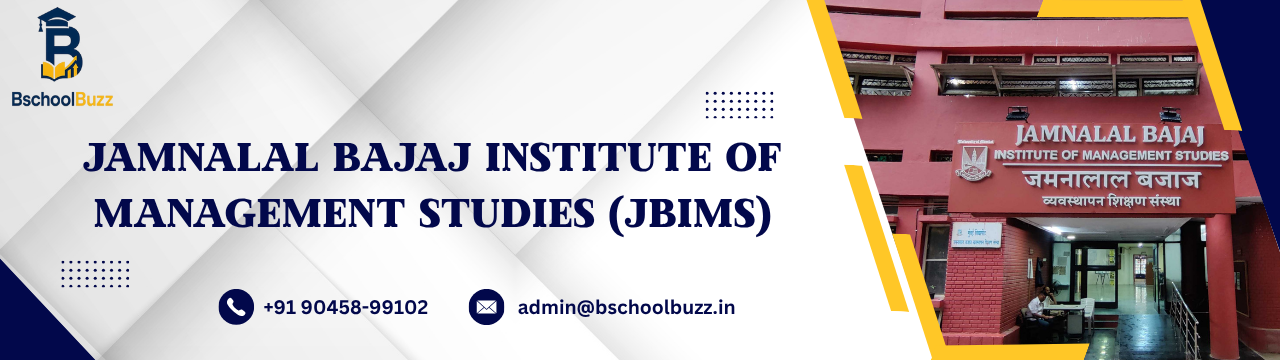
About Jamnalal Bajaj Institute of Management Studies (JBIMS)
Know the institute, its legacy and what makes it stand out.
Jamnalal Bajaj Institute of Management Studies (JBIMS) — Description
Jamnalal Bajaj Institute of Management Studies (JBIMS) is a management education institute of the University of Mumbai, established in 1965. Located in Mumbai, the institute functions as an autonomous department of the University of Mumbai and offers postgraduate management programmes through its full-time and part-time academic offerings. JBIMS identifies the two-year Master of Management Studies (MMS) as its flagship programme. The MMS is designed around the major functional areas of management and combines classroom learning with practical and industry-oriented exposure.
The flagship MMS is a two-year, full-time postgraduate management programme divided into four semesters. Students study common management subjects during the first year and select a specialization for the second year. The officially listed specialization areas are Finance, Marketing, Operations and Supply Chain Management, Human Resources, and Systems & Digital Business. The curriculum includes subjects covering management theory, business research, economics, accounting, corporate finance, marketing, operations, organisational behaviour, information systems, entrepreneurship, analytics and strategy. A summer internship is also incorporated into the programme structure.
For students researching JBIMS admission, the primary entrance route for the flagship MMS is the MAH-MBA/MMS CET. JBIMS also states that applicants may be considered through national-level examinations including CAT and CMAT. Admission to the MMS is conducted through the Maharashtra State Common Admission Process (CAP), rather than through a separate institute-level MBA entrance examination. The State CET Cell's 2026 information brochure specifies the eligibility framework for full-time MBA/MMS admissions, including a bachelor's degree with at least 50% aggregate marks, with the applicable relaxation for eligible Maharashtra reserved categories.
JBIMS admission is particularly relevant to students searching for MAH-MBA/MMS CET-based management programmes in Mumbai. The latest officially published 2025 CAP data available for comparison shows extremely high admission percentiles for JBIMS MMS; however, the 2026 final cutoff should be treated separately when officially released. The institute itself publishes current 2026–27 admission and reporting notices through its official website.
Academically, JBIMS also offers M.Sc. Finance, MHRD, Part-Time MMS and doctoral-level management education. These programmes should not be confused with the flagship two-year full-time MMS when comparing JBIMS fees, seats, admissions or placements.
JBIMS has also received an A++ grade with a CGPA of 3.65 in the NAAC accreditation context reflected in University of Mumbai/JBIMS official documentation. The institute's current website identifies JBIMS as an autonomous institution and as the University of Mumbai's Department of Management Studies.
The latest available JBIMS MMS placement report is for the 2024–26 batch. According to the reported placement figures, the MMS programme recorded a highest CTC of ₹80 LPA, a mean CTC of ₹26.67 LPA and a median CTC of ₹26.15 LPA. The official placement page lists the Unified Final Placement Report 2024–26 under MMS and separates it from the placement reports of M.Sc. Finance and MHRD.
For students evaluating JBIMS MBA-equivalent options, it is important to note that the flagship programme is formally called Master of Management Studies (MMS), not MBA. The programme nevertheless serves as JBIMS's principal full-time postgraduate management course. Its location in Mumbai also places students close to the city's financial, consulting, technology, consumer, manufacturing and corporate ecosystem.
College Highlights
Important Dates 2026
Key deadlines and upcoming events
JBIMS Important Dates 2026
For JBIMS MMS admissions for the Academic Year 2026–27, the admission process is linked to the Maharashtra State Common Entrance Test Cell and the centralized admission process (CAP). The MAH-MBA/MMS CET 2026 examination cycle was conducted before the institute-level reporting and CAP admission stages. Candidates should distinguish the entrance-test schedule from JBIMS's subsequent CAP allotment and reporting schedule.
The State CET Cell's final extension notice for MAH-MBA/MMS CET 2026 recorded the online registration period from January 10 to February 25, 2026. The first attempt of the examination was scheduled from April 6 to April 8, 2026, while the second attempt was scheduled for May 9, 2026. The CET Cell subsequently declared the MAH-MBA/MMS CET 2026 results, and the centralized admission process followed for eligible candidates.
Key MAH-MBA/MMS CET 2026 Dates
| Admission milestone | 2026 date |
|---|---|
| MAH-MBA/MMS CET registration started | January 10, 2026 |
| Extended registration deadline | February 25, 2026 |
| MAH-MBA/MMS CET first attempt | April 6–8, 2026 |
| MAH-MBA/MMS CET second attempt | May 9, 2026 |
| MAH-MBA/MMS CET 2026 result | Declared in 2026 |
| CAP registration/admission process | 2026 |
| JBIMS MMS CAP Round I reporting | August 3–5, 2026 |
| JBIMS MMS CAP Round II reporting | August 13–17, 2026 |
| JBIMS MMS CAP Round III reporting | August 25–27, 2026 |
| JBIMS MMS CAP Round IV reporting | September 4–7, 2026 |
JBIMS subsequently published its own 2026–27 MMS reporting and payment instructions. For candidates allotted the flagship MMS through CAP, the institute specified reporting windows for four CAP rounds. These dates covered document verification, admission formalities and payment of the applicable programme fee.
The JBIMS 2026–27 reporting document specifies August 3–5 for CAP Round I, August 13–17 for CAP Round II, August 25–27 for CAP Round III and September 4–7 for CAP Round IV. The document also records the applicable fee categories and payment instructions for selected MMS students.
As of the current 2026 admission cycle, JBIMS has also published further institutional counselling and vacant-seat related notices on its website. Therefore, candidates should not assume that the CAP Round IV reporting window represents the end of every possible admission activity. Later institutional counselling notices may apply only to specific vacant seats, categories or supernumerary arrangements.
The admission dates for JBIMS should therefore be read in two stages: first, the MAH-MBA/MMS CET examination and CAP process administered by the Maharashtra State CET Cell; second, JBIMS's institute-specific reporting, document verification and payment schedule. The exact dates applicable to an individual candidate depend on the round, seat category and allotment status.
For future admission cycles, dates should not be carried forward from 2026 without an official notification. JBIMS and the Maharashtra State CET Cell publish admission notices separately, so applicants should verify the latest announcement before completing any payment or reporting requirement.
See college life in action
Explore the campus, student life and placement stories.
Campus Tour
Life at Campus
Placements & Alumni
Student Experiences
Courses Offered 2026
Programs and specializations available
JBIMS Courses Offered 2026
Jamnalal Bajaj Institute of Management Studies (JBIMS) offers several postgraduate and research programmes, with the two-year full-time Master of Management Studies (MMS) serving as the institute's flagship management programme. Students searching for JBIMS MBA courses should note that the principal full-time programme is formally titled MMS rather than MBA.
Master of Management Studies (MMS)
The full-time MMS is a two-year postgraduate management programme divided into four semesters. The first two semesters provide a common foundation across core management disciplines. Students then select their intended specialization for the second year. The programme also includes a summer internship project of approximately 8–12 weeks between the second and third semesters.
JBIMS officially lists the following second-year specialization areas:
Finance
Marketing
Operations and Supply Chain Management
Human Resources
Systems and Digital Business
The Finance curriculum includes areas such as corporate valuation, financial modelling, derivatives and risk management, investment banking, security analysis, portfolio management, banking, mutual funds and insurance. The Marketing specialization covers consumer behaviour, sales management, product management, brand management, digital marketing, marketing analytics, retail marketing and marketing strategy.
Operations and Supply Chain Management includes logistics, warehouse management, supply chain management, demand forecasting, inventory management, lean management, operations analytics and production planning. The Human Resources specialization includes HR analytics, compensation, employer branding, learning and development, strategic HR and performance management. Systems and Digital Business covers digital business, enterprise systems, big data, business analytics, FinTech, cybersecurity, cloud computing, data mining and information systems.
For the flagship MMS, JBIMS states that candidates are admitted through the applicable entrance-examination and centralized admission framework. The institute identifies MAH-MBA/MMS CET as an entrance route and also states that CAT and CMAT are considered. The Maharashtra State CET Cell's 2026 brochure provides the broader eligibility framework for full-time MBA/MMS admissions.
Other JBIMS Programmes
JBIMS also lists the following academic offerings:
M.Sc. Finance — two-year full-time programme
MHRD — two-year management programme focused on Human Resource Development
Part-Time MMS — three-year postgraduate management programme for working individuals
Ph.D. in Management Studies
Management Development Programmes
These programmes have different eligibility, admission routes, fee structures and placement reports. They should therefore not be combined with the flagship MMS when comparing JBIMS admission, fees, seats or placements.
The official JBIMS MMS course page currently lists an intake of 150–160 students. Separate Maharashtra CET Cell CAP documentation for earlier admission cycles has reported sanctioned/CAP seat figures under the centralized process, so candidates should rely on the applicable 2026–27 seat matrix for their specific category and round.
The MMS syllabus combines general management education with functional specialization. Core areas include management theory, statistics, economics, accounting, finance, marketing, operations, organisational behaviour, information technology, business analytics, entrepreneurship, communication, strategy and business research. This structure allows students to develop a broad management foundation before undertaking specialized second-year coursework.
Admission Process 2026
Eligibility, selection process and how to apply
JBIMS MMS Admission Process 2026
Admission to the flagship two-year full-time MMS at JBIMS is conducted through the Maharashtra centralized admission framework. JBIMS states that candidates seeking the MMS can appear for MAH-MBA/MMS CET and that CAT and CMAT are also considered. The final admission process is conducted through CAP rounds administered under the Maharashtra admission system. JBIMS
1. Check eligibility:
For the 2026 MAH-MBA/MMS CET framework, candidates must have a minimum three-year bachelor's degree from a recognized university in any discipline with at least 50% aggregate marks. The State CET Cell specifies 45% for eligible backward-class, EWS and PwD candidates belonging to Maharashtra State, subject to the applicable rules. Final-year bachelor's students may also appear under the prescribed conditions. State Common Entrance Test Cell
2. Appear for an accepted entrance examination:
MAH-MBA/MMS CET is the primary examination associated with the flagship MMS admission route. JBIMS also states that CAT and CMAT candidates may be considered. JBIMS
3. Complete the centralized admission process:
After the entrance-examination stage, eligible candidates participate in the Maharashtra CAP process. Candidate registration, document verification, merit lists, seat allotment and acceptance are handled according to the State CET Cell's applicable rules.
4. Monitor JBIMS allotment and reporting notices:
JBIMS publishes programme-specific reporting instructions for candidates allotted seats in its MMS programme. For A.Y. 2026–27, the institute published reporting windows for CAP Rounds I–IV and separately published later institutional counselling notices. JBIMS
5. Complete document verification:
Candidates must produce the documents specified in the admission instructions, including educational records and other applicable category or eligibility documents.
6. Pay the prescribed fee:
After allotment and verification, the selected candidate must complete the required fee payment within the applicable reporting window. The 2026–27 JBIMS fee notice specifies different amounts according to category. JBIMS
JBIMS MAH-MBA/MMS CET Cutoff
JBIMS does not publish a simple fixed “minimum CAT/MAH-CET cutoff” on its flagship MMS course page. The relevant admission benchmark is determined through the centralized CAP process and category-wise merit/allotment.
The latest officially accessible CAP data used for a verified cutoff reference is from 2025–26. In the Maharashtra State CET Cell's CAP Round II All-India data, JBIMS MMS had candidates at the 99.99 percentile level, while the CAP documentation identified the programme as a University Department-Autonomous institution. MBA 2025
Accordingly, 99.99 percentile should be identified as the latest verified 2025 CAP cutoff reference, not as an officially announced 2026 final cutoff. A 2026 final cutoff should only be reported after the relevant official CAP cutoff/allotment document is available.
Fees Structure 2026
Program fee and other expenses
JBIMS Fees 2026–27
The latest official JBIMS fee document for the flagship two-year MMS programme gives the fee for Academic Year 2026–27. For the Open and J&K Migrant category, the total fee payable is ₹4,34,289 for the academic year 2026–27. The document separately lists category-specific amounts for other candidates. JBIMS
| Category | Official fee for A.Y. 2026–27 |
|---|---|
| Open / J&K Migrant | ₹4,34,289 |
| ST / SC | ₹10,000 |
| OBC / EWS / SEBC — Female | ₹2,63,664 |
| OBC / EWS / SEBC — Male | ₹3,48,977 |
| VJ/DT-NT(A)/NT(B)/NT(C)/NT(D)/SBC/Orphan — Male/Female | ₹2,63,664 |
| TFWS Category | ₹2,68,914 |
The same JBIMS document states that additional eligibility-cum-enrolment charges can apply depending on the student's previous university. It lists ₹0 for students from the University of Mumbai, ₹400 for students from other universities within Maharashtra, ₹500 for students from autonomous/deemed/other universities outside Maharashtra, and ₹3,000 for students from international universities. JBIMS
For the Open category, the two-year fee is not presented by JBIMS as a simple annual tuition charge. Therefore, the safest representation for website content is the official total fee rather than treating the amount as a conventional annual MBA tuition fee. If an annual equivalent is required strictly for comparison, ₹4,34,289 divided over two academic years gives approximately ₹2.17 LPA, but this is an arithmetic annual equivalent and not an independently published annual fee.
JBIMS's 2026–27 reporting document also specifies that the applicable fee must be paid using the institute's prescribed payment mechanism. It notes that candidates should preserve original fee receipts relating to library deposit and caution money for refund after completion of the programme. JBIMS
Students should also distinguish the flagship full-time MMS fee from the fees for M.Sc. Finance, MHRD and Part-Time MMS. JBIMS publishes separate programmes and separate placement reports for these courses, so their costs should not be combined with MMS fees. JBIMS
No verified 2026–27 JBIMS document located in the official sources reviewed provides a single consolidated hostel-and-mess figure that can safely be added to the MMS fee. Therefore, an exact hostel or mess amount should not be presented as an official 2026 figure without a separate JBIMS notification.
Placements 2026
Recruiters, packages and placement highlights
JBIMS Placements 2026
The latest official placement page of Jamnalal Bajaj Institute of Management Studies lists the Unified Final Placement Report 2024–26 under the MMS placement reports. This is the relevant placement cycle for the flagship two-year MMS programme and should be distinguished from the separate M.Sc. Finance and MHRD reports. JBIMS
For the MMS 2024–26 batch, the reported placement figures are:
- Highest CTC: ₹80.00 LPA
- Mean CTC: ₹26.67 LPA
- Median CTC: ₹26.15 LPA
- Total recruiters: 70+
- New recruiters: 21+
- PPO/PPI offers: 93
The latest placement data therefore shows a mean compensation figure of ₹26.67 LPA for the flagship MMS batch. The highest CTC reached ₹80 LPA, while the median stood at ₹26.15 LPA. These figures relate specifically to MMS 2024–26 and should not be combined with the M.Sc. Finance or MHRD placement statistics. JBIMS
The 2024–26 MMS placement cycle included hiring opportunities across several major sectors. Reported areas of recruitment included consulting, BFSI and investment banking, technology and e-commerce, manufacturing and conglomerates, FMCG and pharma, and other corporate functions. Recruiters associated with the placement cycle included organisations such as Accenture Strategy & Consulting, Boston Consulting Group, Citi, Deloitte, EY, HDFC Bank, HSBC, ICICI Bank, Infosys, JPMorganChase, KPMG, McKinsey & Company, Morgan Stanley, PwC India and Reliance Retail. LinkedIn
JBIMS's official placement page describes a corporate engagement model involving permanent and visiting faculty, industry sessions, contextual training and continuing interaction with recruiters and alumni. The placement reports are organized programme-wise, which is important when comparing JBIMS MMS placements with the institute's other management programmes. JBIMS
The placement report also records 93 PPO/PPI offers for the MMS 2024–26 batch. PPO and PPI figures should not be interpreted as an additional placement percentage because they represent pre-placement offers/interview opportunities rather than a separate placement-rate measure. LinkedIn
For students researching JBIMS placements, the most relevant figures are therefore the MMS-specific 2024–26 numbers: ₹26.67 LPA mean CTC, ₹26.15 LPA median CTC and ₹80 LPA highest CTC. The institute's official website confirms that this is the latest MMS final placement report currently listed on its placement-report page.
Frequently Asked Questions
Important answers about Jamnalal Bajaj Institute of Management Studies (JBIMS).
1. What is JBIMS?
Jamnalal Bajaj Institute of Management Studies (JBIMS) is an autonomous Department of the University of Mumbai, established in 1965.
2. What is the flagship course at JBIMS?
The flagship programme is the two-year full-time Master of Management Studies (MMS).
3. Does JBIMS offer an MBA?
The principal full-time programme is formally called MMS rather than MBA. It is a postgraduate management programme offered by JBIMS.
4. Which exams are accepted for JBIMS MMS?
JBIMS states that MAH-MBA/MMS CET is used for MMS admission and also mentions CAT and CMAT as accepted national-level examination routes.
5. What is the JBIMS MAH-MBA/MMS CET cutoff?
The latest officially accessible CAP reference is from 2025–26, where JBIMS MMS recorded a 99.99 percentile level in the All-India CAP data. A final 2026 cutoff should be reported separately once the applicable official 2026 CAP cutoff document is available.
6. What is the JBIMS MMS fee for 2026–27?
For the Open and J&K Migrant category, JBIMS's official 2026–27 reporting document lists a total fee of ₹4,34,289. Category-specific fees are different.
7. How many students does the MMS programme admit?
JBIMS's official MMS course page currently lists an intake of 150–160 students.
8. What specializations are offered in JBIMS MMS?
The officially listed specialization areas are Finance, Marketing, Operations and Supply Chain Management, Human Resources, and Systems & Digital Business.
9. What is the duration of JBIMS MMS?
The flagship MMS is a two-year full-time programme divided into four semesters, with a summer internship between the second and third semesters.
College Reels & Shorts
Ratings & Reviews
Real experiences shared by students of Jamnalal Bajaj Institute of Management Studies (JBIMS).
Your review can help future students make a better decision.
Studied here?
Tell students about your experience.