
Quick Summary
- TAPMI offers seven postgraduate MBA programmes.
- The MBA programmes have a duration of two years.
- MBA Core focuses on general management and leadership.
- MBA-BKFS focuses on banking and financial services.
- MBA-HRM focuses on human resource management and HR technology.
- MBA Marketing focuses on branding, sales and digital marketing.
- MBA-IB focuses on international business and global markets.
- MBA-Tech focuses on technology management, FinTech, e-commerce and healthcare.
- MBA-AI&DS combines management education with artificial intelligence and data science.
- TAPMI offers BBA Honours, a four-year undergraduate programme.
- The Integrated Programme in Management (IPM) has a five-year duration.
- MBA Technology Management is offered at the Bengaluru campus.
- MBA-AI&DS is jointly offered with Manipal School of Information Sciences.
- Indian MBA applicants generally require 50% marks in Class 10, Class 12 and graduation.
- MBA-AI&DS has additional undergraduate qualification requirements.
- TAPMI also offers doctoral and executive education programmes.
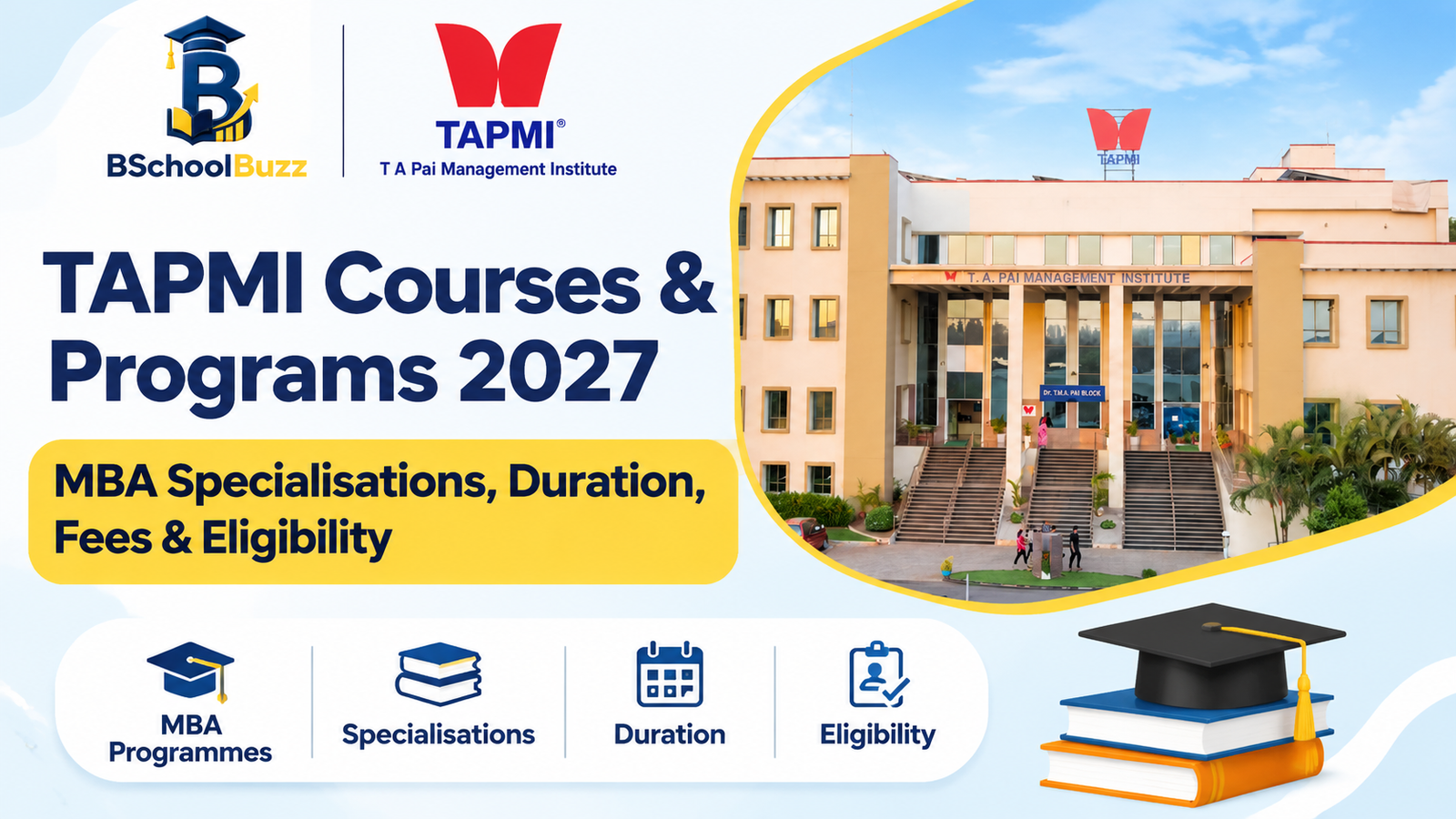
TAPMI Courses & Programs: MBA Specialisations, Duration & Eligibility
Introduction to TAPMI Courses and Programs
T A Pai Management Institute (TAPMI), Manipal, is a management education institution and a constituent unit of Manipal Academy of Higher Education (MAHE). Established in 1980, the institute offers postgraduate management programmes, undergraduate business education, an integrated management programme, doctoral opportunities and executive education.
Students exploring TAPMI courses will find several options designed around different academic interests and professional goals. These include the flagship MBA programme, specialised MBA programmes in Banking and Financial Services, Human Resource Management, Marketing, International Business, Technology Management, and Artificial Intelligence and Data Science.
TAPMI also offers undergraduate pathways through its Bachelor of Business Administration (BBA) Honours and Integrated Programme in Management (IPM). These programmes are relevant to students who want to enter the management education system immediately after completing Class 12.
One important distinction is that TAPMI's current official programme catalogue identifies its postgraduate management qualifications as MBA programmes rather than separate PGDM programmes. Therefore, students searching for TAPMI MBA or PGDM courses should understand the actual qualifications offered before applying.
The right programme depends on several factors, including academic background, career interests, preferred industry, campus location, curriculum and admission eligibility.
This article explains the programmes offered by TAPMI, their major academic areas, duration, eligibility requirements, learning opportunities and the differences between the available management pathways.
TAPMI Courses: Important Highlights
Before examining individual programmes, students should understand the overall academic structure of the institute.
| Particulars | Details |
|---|---|
| Institute name | T A Pai Management Institute |
| Popular name | TAPMI |
| Location | Manipal, Karnataka |
| Additional campus | Bengaluru, Karnataka |
| Parent institution | Manipal Academy of Higher Education |
| Established | 1980 |
| Main postgraduate qualification | MBA |
| MBA programmes | Seven listed programmes |
| Undergraduate programmes | BBA Honours and IPM |
| Doctoral education | Ph.D. programmes |
| Executive education | Available |
| MBA duration | Two years |
| BBA Honours duration | Four years |
| IPM duration | Five years |
| MBA academic structure | Six terms/trimesters in the published programme structures |
| Accreditations | AACSB and AMBA |
TAPMI's official website provides separate programme pages for its MBA, undergraduate and other academic offerings. <Cite refs={["turn885922view0","turn885922view1","turn885922view2"]}/>
List of TAPMI Courses and Programs
The institute offers different programmes for students at different stages of their academic and professional journeys.
The following table summarises the principal programmes listed on TAPMI's official website.
| Programme category | Course or programme | Duration |
|---|---|---|
| Postgraduate | MBA – Core | 2 years |
| Postgraduate | MBA – Banking and Financial Services | 2 years |
| Postgraduate | MBA – Human Resource Management | 2 years |
| Postgraduate | MBA – Marketing | 2 years |
| Postgraduate | MBA – International Business | 2 years |
| Postgraduate | MBA – Technology Management | 2 years |
| Postgraduate | MBA – Artificial Intelligence and Data Science | 2 years |
| Undergraduate | BBA Honours | 4 years |
| Integrated | Integrated Programme in Management (IPM) | 5 years |
| Doctoral | Ph.D. | As prescribed by the doctoral regulations |
| Professional development | Executive Education | Depends on the programme |
The two-year duration applies to the listed MBA programmes. The undergraduate and integrated programmes have different academic structures.
Students should not confuse a specialised MBA with an individual elective or a short-term certificate course. Each MBA listed above is presented as a distinct programme on the institute's website. <Cite refs={["turn885922view0","turn885922view2","turn105550view2","turn105550view3"]}/>
TAPMI MBA Courses and Specialisations
The postgraduate MBA programmes are the main focus for graduates seeking management education.
TAPMI offers seven MBA pathways covering general management, finance, people management, marketing, international business and technology-oriented management.
Each programme has its own academic focus. Although the programmes share management foundations, their specialised subjects and applied learning activities differ.
1. MBA – Core (General Management)
<escape> </escape>
<text weight="semibold">Programme:</text> Master of Business Administration – Core
<text weight="semibold">Campus:</text> Manipal
<text weight="semibold">Duration:</text> 2 years
The MBA Core is TAPMI's flagship management programme. It is designed for students who want broad business knowledge rather than concentrating on one specialised industry from the beginning.
The programme develops an understanding of the major functional areas of business, including finance, marketing, operations, strategy, economics and human resource management.
Students learn how different business departments work together and how managerial decisions affect organisational performance.
Major subjects covered
The published curriculum includes subjects such as:
Financial Accounting
Managerial Statistics
Marketing Management
Managerial Economics
Financial Management
Operations Management
Management Accounting and Control
Organisational Behaviour
IT for Business
Strategic Management
Business Research Methods
Sustainability and Managerial Ethics
The curriculum also provides elective opportunities across different management domains.
Learning approach
The MBA Core programme uses a combination of classroom teaching, case discussions, simulations, projects and practical learning activities.
Students can develop their understanding of business problems by analysing situations, evaluating alternatives and presenting managerial recommendations.
The programme also includes experiential learning initiatives such as BrandScan, SEVA and the Student Managed Investment Course, where applicable to the programme and learning activities.
Who should choose MBA Core?
This programme may suit candidates who:
Want a broad management qualification.
Are interested in consulting or corporate management.
Want to explore different business functions.
Have not yet decided on a specific management specialisation.
Want to develop leadership and strategic decision-making skills.
Career opportunities
Depending on their electives, skills and recruitment opportunities, graduates may pursue roles in:
Management consulting
Business analysis
Corporate strategy
Sales management
Marketing management
Financial management
Operations
Business development
The MBA Core is particularly relevant for students who prefer flexibility across management functions.
Official programme: https://www.tapmi.edu.in/programs/mba-core/
2. MBA in Banking and Financial Services (MBA-BKFS)
<escape> </escape>
<text weight="semibold">Programme:</text> Master of Business Administration – Banking and Financial Services
<text weight="semibold">Campus:</text> Manipal
<text weight="semibold">Duration:</text> 2 years
The MBA-BKFS programme is designed for students interested in banking, financial markets and the broader financial services industry.
Unlike a general management programme, this course places greater emphasis on finance-related knowledge and industry applications.
Students develop an understanding of financial institutions, banking operations, investment management, financial products, risk management and financial decision-making.
Major academic areas
The programme covers subjects and areas such as:
Commercial and Retail Banking
Financial Accounting
Financial Management
Financial Markets
Investment Management
Risk Management
Financial Statement Analysis
Banking Operations
Financial Derivatives
Portfolio Management
Security Valuation
Financial Analytics
The precise elective options may be revised between academic batches.
Professional certification alignment
One of the distinguishing features of MBA-BKFS is its curriculum alignment with professional finance qualifications.
TAPMI identifies connections with:
Chartered Financial Analyst (CFA)
Financial Risk Manager (FRM)
Chartered Market Technician (CMT)
Curriculum alignment should not be confused with automatic professional certification. Students must satisfy the separate requirements of the respective certification bodies.
Practical learning opportunities
The programme includes the Student Managed Investment Course (SMIC), through which students gain exposure to portfolio-related activities under faculty supervision.
TAPMI also describes industry partnerships and training opportunities involving financial institutions.
The institute's Finance Lab provides access to professional financial information resources, including Bloomberg Terminals and Refinitiv Workspace.
These resources help students understand financial data, market movements and investment-related analysis.
Who should choose MBA-BKFS?
This programme may be suitable for:
Graduates interested in banking.
Candidates interested in investment management.
Students targeting financial services careers.
Aspirants interested in financial risk management.
Candidates who enjoy working with financial information and analytical problems.
Career opportunities
Possible career areas include:
Banking relationship management
Credit analysis
Financial analysis
Investment banking
Risk management
Portfolio management
Treasury operations
Financial consulting
Wealth management
The actual role available to a graduate depends on recruitment requirements, individual performance, skills and professional qualifications.
Official programme: https://www.tapmi.edu.in/programs/mba-bkfs/
3. MBA in Human Resource Management (MBA-HRM)
<escape> </escape>
<text weight="semibold">Programme:</text> Master of Business Administration – Human Resource Management
<text weight="semibold">Campus:</text> Manipal
<text weight="semibold">Duration:</text> 2 years
The MBA-HRM programme focuses on managing people, improving employee performance and developing effective organisational systems.
Human resource management is no longer limited to recruitment and employee administration. Modern HR teams also work with workforce analytics, organisational development, employee experience, technology and business strategy.
TAPMI's MBA-HRM curriculum combines a compulsory HR generalist foundation with major-minor pathways in HR Technology and HR Consulting.
Major subjects and learning areas
The programme covers areas such as:
Human Resource Management
Organisational Behaviour
Talent Acquisition
Performance Management
Learning and Development
Compensation and Benefits
Employee Relations
Labour Laws
HR Analytics
Digital Transformation in HR
Employer Branding
Employee Experience
Diversity, Equity and Inclusion
HR Technology pathway
HR Technology focuses on the use of digital systems and data in people management.
Students gain exposure to areas such as:
Digital HR transformation
AI and machine learning applications in HR
HR data visualisation
People analytics
HR technology systems
Workforce-related analytics
This pathway is relevant for organisations adopting technology to improve recruitment, employee engagement and workforce planning.
HR Consulting pathway
The HR Consulting pathway focuses on helping organisations solve people-related business problems.
Students explore areas such as:
HR business partnering
Employee experience
Employer branding
Organisation development
Workforce effectiveness
Human capital consulting
Practical learning
TAPMI includes industry-relevant workshops, summer internships, live projects and leadership development activities.
The Leadership Assessment and Development Centre (LADC) is one of the learning initiatives associated with leadership development.
Who should choose MBA-HRM?
The programme may suit candidates who:
Enjoy working with people.
Have an interest in organisational behaviour.
Want to pursue recruitment or talent management.
Are interested in HR analytics and HR technology.
Want to work in employee development or organisational consulting.
Career opportunities
Graduates may explore positions such as:
HR Business Partner
Talent Acquisition Specialist
HR Consultant
Learning and Development Manager
Compensation and Benefits Analyst
People Analytics Specialist
Employee Relations Specialist
HR Technology Consultant
Official programme: https://www.tapmi.edu.in/programs/mba-hrm/
4. MBA in Marketing
<escape> </escape>
<text weight="semibold">Programme:</text> Master of Business Administration – Marketing
<text weight="semibold">Campus:</text> Manipal
<text weight="semibold">Duration:</text> 2 years
The MBA Marketing programme is designed for candidates interested in understanding customers, developing brands and managing business growth.
Marketing involves much more than advertising. It includes customer research, product planning, pricing, sales, distribution, digital channels and revenue management.
TAPMI's MBA Marketing programme combines a general management foundation with specialised market-facing learning.
Major subjects and learning areas
Students explore areas such as:
Marketing Management
Consumer Behaviour
Brand Management
Digital Marketing
Sales and Distribution Management
Product Management
Market Research
Marketing Analytics
Retail Management
Business-to-Business Marketing
Customer Relationship Management
Integrated Marketing Communications
The curriculum also addresses contemporary areas such as AI-enabled marketing, digital performance measurement and omnichannel retailing.
BrandScan: Applied marketing experience
BrandScan is a distinctive learning initiative associated with TAPMI's marketing programme.
Students work on practical brand and market-related challenges. Activities may involve collecting consumer information, analysing market conditions, developing insights and presenting recommendations.
This gives students an opportunity to apply marketing concepts to business situations.
Fieldwork and industry interaction
The programme also includes activities such as:
Live business projects
Market research assignments
Sales and distribution fieldwork
Retail immersion
Marketing presentations
Industry workshops
Corporate interactions
Such activities help students understand how marketing decisions operate in real business environments.
Who should choose MBA Marketing?
This programme may suit students who:
Enjoy understanding customer behaviour.
Are interested in brands and advertising.
Want to work in digital marketing.
Have an interest in sales and business development.
Prefer market-facing and customer-facing roles.
Career opportunities
Graduates may pursue roles such as:
Brand Manager
Marketing Manager
Product Manager
Digital Marketing Manager
Sales Manager
Market Research Analyst
Category Manager
Customer Relationship Manager
Business Development Manager
Official programme: https://www.tapmi.edu.in/programs/mba-marketing/
5. MBA in International Business (MBA-IB)
<escape> </escape>
<text weight="semibold">Programme:</text> Master of Business Administration – International Business
<text weight="semibold">Campus:</text> Manipal
<text weight="semibold">Duration:</text> 2 years
The MBA International Business programme is designed for students interested in global markets, multinational organisations and cross-border business activities.
Companies operating internationally need managers who understand different markets, regulatory environments, cultures, supply chains and business practices.
This programme combines general management education with a specialised international business perspective.
Major academic areas
The curriculum includes:
International Economics
International Marketing
International Strategy
International Law and Global Governance
International Business Management
Finance
Operations Management
Business Analytics
Organisational Behaviour
Sustainability and Ethics
These subjects help students understand how organisations plan and manage business operations across different countries.
International exposure
The programme includes international immersion opportunities and study-abroad possibilities through approved academic arrangements.
Students can gain exposure to international markets, business practices and different cultural environments.
The exact destination, duration, eligibility and credit arrangements depend on the available programme opportunities.
Who should choose MBA-IB?
This programme may be appropriate for candidates who:
Have an interest in global business.
Want to work with multinational organisations.
Are interested in international marketing.
Want to understand cross-border operations.
Enjoy working in multicultural environments.
Career opportunities
Potential career areas include:
International Business Development
Global Marketing
Supply Chain Management
International Consulting
Business Strategy
Export and Import Management
International Operations
Corporate Finance
Official programme: https://www.tapmi.edu.in/programs/mba-ib/
6. MBA in Technology Management (MBA-Tech)
<escape> </escape>
<text weight="semibold">Programme:</text> Master of Business Administration – Technology Management
<text weight="semibold">Campus:</text> Bengaluru
<text weight="semibold">Duration:</text> 2 years
The MBA Technology Management programme is intended for students interested in the relationship between business management and technology.
Organisations increasingly need professionals who can understand technical systems and translate technology capabilities into business outcomes.
This programme combines management fundamentals, technology management and an industry vertical specialisation.
Available industry verticals
TAPMI identifies three major vertical choices:
FinTech
E-Commerce and Retail
Healthcare
Students develop an understanding of how technology supports business processes and industry-specific operations.
Major subjects and learning areas
The programme covers areas such as:
IT Product Management
IT Consulting
Business Analysis
Agile Development
Project Management
Data Engineering
Big Data
Cybersecurity
Digital Transformation
Emerging Technologies
Business Transformation with AI
Technology and practical exposure
The programme places emphasis on hands-on learning.
TAPMI states that at least 30% of the coursework in every course involves practical work using industry-standard software.
Students work with tools and technologies such as:
Power BI
Python
SQL
JIRA
Generative AI development tools
Enterprise technology platforms
Industry professionals also participate in programme delivery.
Students undertake projects and a twelve-week summer internship carrying nine credits, jointly assessed by the host organisation and faculty.
Who should choose MBA-Tech?
This programme may suit:
Engineering graduates.
IT professionals.
Candidates interested in technology consulting.
Students interested in product management.
Aspirants targeting digital transformation roles.
Candidates interested in FinTech, retail technology or healthcare technology.
A technical degree may be useful, but candidates should check the current programme's admission requirements rather than assuming that every technology-oriented MBA requires an engineering qualification.
Career opportunities
Graduates may explore:
IT Product Management
Technology Consulting
Business Analysis
Digital Transformation
IT Project Management
FinTech Management
Technology Strategy
Healthcare Technology Management
E-Commerce Management
Official programme: https://www.tapmi.edu.in/programs/mba-in-technology-management/
7. MBA in Artificial Intelligence and Data Science (MBA-AI&DS)
<escape> </escape>
<text weight="semibold">Programme:</text> Master of Business Administration – Artificial Intelligence and Data Science
<text weight="semibold">Campus:</text> Manipal
<text weight="semibold">Duration:</text> 2 years
The MBA-AI&DS programme combines management education with artificial intelligence, machine learning and data science.
It is jointly offered by TAPMI and Manipal School of Information Sciences (MSIS).
The programme is intended for students who want to understand both the technical and managerial sides of data-driven businesses.
Major academic areas
The curriculum includes subjects such as:
Data Science Fundamentals
Probability and Statistics
Data Visualisation
Machine Learning
Data Engineering
Big Data Analytics
Database Management Systems
Deep Learning
Natural Language Processing
Generative AI
AI for Management
Cybersecurity
Cloud Computing for Business
The programme also covers traditional MBA subjects, including finance, marketing, strategy, operations and human resource management.
Technology tools and platforms
Students receive exposure to different analytical and technology tools.
These include:
Python
R
SQL
Tableau
Power BI
Microsoft Copilot
Amazon Web Services
Cloud-based AI and machine learning platforms
The exact tools used may vary with curriculum updates and course requirements.
Industry projects and internship
A notable component of MBA-AI&DS is its six-month industry internship.
The programme also includes concurrent projects through which students apply machine learning, data engineering, analytics, natural language processing and deep learning concepts to practical problems.
This structure gives students opportunities to understand how technical solutions connect with business needs.
Who should choose MBA-AI&DS?
This programme may suit candidates who:
Have an interest in artificial intelligence.
Enjoy working with data.
Have a technical or quantitative academic background.
Want to combine management and analytics.
Are interested in AI-enabled business transformation.
Career opportunities
Possible career areas include:
Business Analytics
Data Science
AI Product Management
AI/ML Solutions Management
Analytics Consulting
Digital Transformation
Data Engineering Management
Technology Strategy
The programme is not simply a general MBA with a few AI subjects. Its technical curriculum and specific undergraduate eligibility requirements make it a more specialised choice.
Official programme: https://www.tapmi.edu.in/programs/mba-in-artificial-intelligence-and-data-science/
Comparison of TAPMI MBA Specialisations
Choosing between the different MBA courses requires more than comparing programme names.
Students should examine the subjects, intended career paths, learning activities and campus locations.
The following table provides a practical comparison.
| MBA programme | Main academic focus | Suitable interests | Campus |
|---|---|---|---|
| MBA Core | General management | Consulting, leadership, business strategy | Manipal |
| MBA-BKFS | Banking and finance | Banking, investments, financial services | Manipal |
| MBA-HRM | Human resource management | HR, talent, people analytics | Manipal |
| MBA Marketing | Marketing and brand management | Sales, marketing, branding | Manipal |
| MBA-IB | International business | Global markets, international operations | Manipal |
| MBA-Tech | Technology management | IT, FinTech, e-commerce, healthcare technology | Bengaluru |
| MBA-AI&DS | AI and data science | Analytics, AI, machine learning | Manipal |
All seven programmes are two-year MBA programmes according to the institute's published programme information. Their academic emphasis and practical learning opportunities differ. <Cite refs={["turn267690search26","turn885922view3","turn885922view4","turn885922view5","turn897070view0","turn897070view1","turn105550view1"]}/>
TAPMI Courses: Duration and Academic Structure
Course duration is an important consideration when planning higher education.
The duration of a programme affects the time students spend in formal education, internships, projects and other academic activities.
Duration of TAPMI MBA Programmes
TAPMI's MBA programmes are structured as two-year postgraduate management programmes.
The published 2026–28 prospectus describes the postgraduate programmes as two-year courses.
The MBA academic structure uses multiple terms or trimesters, with core management learning followed by specialised coursework and practical components.
| Programme | Duration | Academic level |
|---|---|---|
| MBA Core | 2 years | Postgraduate |
| MBA-BKFS | 2 years | Postgraduate |
| MBA-HRM | 2 years | Postgraduate |
| MBA Marketing | 2 years | Postgraduate |
| MBA-IB | 2 years | Postgraduate |
| MBA-Tech | 2 years | Postgraduate |
| MBA-AI&DS | 2 years | Postgraduate |
What Happens During the First Year?
The first year generally develops the management foundation required for the selected MBA programme.
Depending on the programme, students study areas such as:
Accounting
Economics
Statistics
Marketing
Finance
Organisational Behaviour
Operations
Business Communication
Business Technology
Management Ethics
The purpose of the foundation stage is to develop a broad understanding of business functions.
Even students enrolled in specialised MBA programmes need this foundation because business decisions usually involve multiple departments.
What Happens During the Second Year?
The second year provides deeper exposure to specialised subjects, electives and applied learning.
Students may undertake:
Specialised coursework
Domain electives
Live projects
Industry assignments
Research activities
Summer internship-related work
Leadership development
The exact structure differs between programmes.
For example, the AI and Data Science programme has a six-month internship component, while the Technology Management programme describes a twelve-week summer internship.
Students should therefore compare the actual programme curriculum instead of assuming that every MBA has identical internship arrangements.
TAPMI Undergraduate Courses
TAPMI also provides undergraduate business education for students who have completed Class 12.
The institute's undergraduate offerings include BBA Honours and the Integrated Programme in Management.
These programmes are different from the two-year MBA courses.
1. BBA Honours
Programme: Bachelor of Business Administration Honours
Campus: Bengaluru
Duration: 4 years
The BBA Honours programme is designed for students interested in business and management education immediately after school.
It provides an undergraduate foundation in management, business functions and related disciplines.
The programme follows an industry-aligned and experiential learning approach.
Programme structure
The four-year programme is designed to progress from foundational business education to more specialised learning.
Students develop an understanding of different areas of business while gaining exposure to projects and industry interactions.
The programme includes:
Multidisciplinary learning
Business and management subjects
Industry-oriented curriculum
Three internships
Live projects
Industry workshops
Access to specialised laboratories
TAPMI also provides flexibility for students to exit with a BBA degree after completing three years, subject to the programme's applicable requirements.
Who should choose BBA Honours?
This programme may suit students who:
Have completed Class 12.
Want to pursue management education early.
Are interested in business and entrepreneurship.
Want to develop a foundation before pursuing postgraduate education.
Prefer a structured undergraduate management pathway.
Official programme: https://www.tapmi.edu.in/programs/bba-honors/
2. Integrated Programme in Management (IPM)
Programme: Integrated Programme in Management
Campus: Manipal
Duration: 5 years
The Integrated Programme in Management is a five-year programme combining undergraduate and postgraduate management education.
It leads to a BBA degree after the first three years and an MBA degree after the final two years.
This structure is intended for students who want to enter a longer management education pathway directly after Class 12.
Academic structure
| Stage | Qualification | Duration |
|---|---|---|
| First stage | BBA | 3 years |
| Second stage | MBA | 2 years |
| Total | BBA + MBA | 5 years |
The curriculum combines different academic areas, including:
Humanities
Social Sciences
Psychology
Sociology
Business Management
Technology
Analytics
Ethics
Research
Experiential Learning
Practical learning opportunities
The IPM includes social and management internship opportunities, project-based learning, workshops and industry interaction.
Students also participate in multidisciplinary learning activities designed to develop communication, problem-solving and leadership capabilities.
Who should choose IPM?
The programme may suit students who:
Have completed Class 12.
Want to pursue an integrated management qualification.
Prefer a continuous BBA-to-MBA academic pathway.
Are interested in multidisciplinary education.
Want to build management knowledge over a longer period.
Official programme: https://www.tapmi.edu.in/programs/ipm/
TAPMI Doctoral and Executive Education Programmes
Apart from full-time MBA and undergraduate courses, TAPMI also lists doctoral and executive education offerings.
These programmes serve different academic and professional audiences.
Ph.D. Programmes
TAPMI offers doctoral research opportunities for candidates interested in advanced research and academic careers.
A doctoral programme differs significantly from an MBA.
Its focus is on developing research capabilities, conducting original investigations and contributing to management knowledge.
Research interests may cover different management disciplines depending on the faculty and doctoral opportunities available.
Students interested in a Ph.D. should review the current research admission notification for eligibility, selection requirements, funding and programme regulations.
Executive Education
Executive education is intended for working professionals and organisations seeking management development.
These programmes may include specialised learning, leadership development and professional training.
Unlike a regular two-year MBA, executive education programmes can have different durations, delivery formats and entry requirements.
Working professionals should review the individual course description before enrolling.
Official programme information: https://www.tapmi.edu.in/programs/
TAPMI Courses Eligibility Criteria
Eligibility is one of the most important factors when selecting a programme.
A candidate may be interested in a particular specialisation but still need to satisfy the academic requirements specified by TAPMI.
The eligibility requirements differ between postgraduate and undergraduate programmes.
MBA Eligibility Criteria
For Indian applicants, the official MBA admissions page specifies the following minimum educational requirements:
| Qualification | Minimum requirement |
|---|---|
| Class 10 | 50% aggregate marks |
| Class 12 | 50% aggregate marks |
| Graduation | 50% aggregate marks |
| University | Recognised university |
| Final-year graduation students | Eligible to apply, subject to conditions |
Applicants should understand that these are minimum academic eligibility requirements. Meeting them does not guarantee selection.
Eligibility for Final-Year Students
Candidates who are pursuing the final year of their undergraduate degree can also apply.
However, their admission offer is provisional.
Selected candidates must:
Secure at least 50% aggregate marks in the qualifying undergraduate degree before joining.
Complete the degree requirements.
Submit all required documents by 30 September 2027 for the 2027–29 admission cycle.
Students should monitor official admission communication for document submission requirements.
MBA-AI&DS Specific Eligibility
The MBA in Artificial Intelligence and Data Science has an additional qualification requirement.
Applicants must hold one of the following degrees:
B.E./B.Tech.
Bachelor of Computer Applications (BCA).
Bachelor of Science (B.Sc.).
The degree should have a specialisation in Computer Science, Information Technology, Artificial Intelligence/Machine Learning, Data Science or a related discipline.
Candidates from unrelated academic backgrounds should not assume that the general MBA eligibility criteria automatically make them eligible for this programme.
Do All MBA Programmes Require an Engineering Degree?
No. The published general MBA eligibility requirements do not specify an engineering degree as a universal requirement.
Candidates from different undergraduate academic backgrounds can apply if they meet the applicable eligibility requirements.
The MBA-AI&DS programme is the important exception because it has a specific undergraduate qualification requirement.
Entrance Examination Requirements for TAPMI MBA Courses
Apart from academic qualifications, candidates must satisfy the entrance examination requirements applicable to their selected programme.
TAPMI accepts CAT 2026, XAT 2027 and GMAT scores.
NMAT 2026 is accepted for specified specialised MBA programmes.
Accepted Entrance Examinations
| Entrance examination | MBA Core | Specialised MBA programmes |
|---|---|---|
| CAT 2026 | Accepted | Accepted |
| XAT 2027 | Accepted | Accepted |
| GMAT | Accepted | Accepted |
| NMAT 2026 | Not accepted | Accepted |
The specialised programmes covered by the NMAT acceptance include MBA-BKFS, Marketing, HRM, IB, Technology Management and AI&DS.
For GMAT, TAPMI specifies examinations taken between 1 January 2022 and 31 January 2027.
Candidates can submit more than one eligible examination score. The highest applicable score is considered for shortlisting.
Why Entrance Examination Requirements Matter
Students should not select an MBA programme based only on the name of the specialisation.
For example, a candidate planning to apply for MBA Core using NMAT should reconsider the examination requirement because TAPMI does not accept NMAT for that programme.
Similarly, an applicant interested in MBA-AI&DS must satisfy the additional academic qualification requirement.
The correct approach is to check both the entrance examination and educational eligibility before applying.
How to Choose the Right TAPMI Course
Selecting the right programme requires a realistic assessment of your academic interests and career objectives.
A specialisation should be selected because it matches your intended career direction, not simply because a particular programme sounds popular.
The following comparison can help.
Choose MBA Core if You Want Broad Management Exposure
MBA Core is suitable for candidates who want a general management foundation.
It provides flexibility to explore different business functions and develop capabilities across finance, marketing, operations and strategy.
It can be considered by students who are interested in management consulting, corporate strategy and general business roles.
Choose MBA-BKFS if You Are Interested in Finance
Candidates interested in banking, investment management, financial analysis and financial services may prefer MBA-BKFS.
The programme offers specialised finance coursework and practical exposure through its financial learning resources.
Students should also consider whether they enjoy quantitative analysis and financial markets.
Choose MBA-HRM if You Prefer People Management
MBA-HRM is appropriate for students who want to work in human resource management and organisational development.
Candidates interested in talent acquisition, HR consulting, people analytics and employee experience may find this pathway relevant.
Choose MBA Marketing if You Enjoy Customer and Brand Management
Marketing is relevant for students who enjoy understanding customers, building brands, managing sales channels and developing market strategies.
Candidates interested in digital marketing, product management, sales and brand management can explore this programme.
Choose MBA-IB if You Want Global Business Exposure
MBA-IB may be appropriate for students interested in international markets, multinational organisations and cross-cultural management.
Candidates should be comfortable learning about international economics, global strategy and cross-border business activities.
Choose MBA-Tech if You Want Business and Technology
MBA-Tech is relevant for candidates who want to work at the intersection of business management and technology.
Students interested in IT consulting, product management, FinTech, healthcare technology and e-commerce can consider this programme.
The Bengaluru campus location is an important consideration.
Choose MBA-AI&DS if You Have a Strong Technology or Quantitative Interest
MBA-AI&DS is suited to candidates interested in data science, AI and management.
However, the specific undergraduate eligibility requirements must be checked before applying.
Students should be prepared for quantitative subjects, programming exposure, analytics projects and technical learning.
TAPMI Campus Locations and Programme Availability
Campus location matters because it affects the student's academic environment and daily experience.
TAPMI has programme offerings associated with its Manipal and Bengaluru campuses.
| Campus | Location | Programmes |
|---|---|---|
| TAPMI Manipal | Manipal, Karnataka | MBA Core, MBA-BKFS, MBA-HRM, MBA Marketing, MBA-IB, MBA-AI&DS, IPM |
| TAPMI Bengaluru | Bengaluru, Karnataka | MBA Technology Management, BBA Honours |
The campus allocation should be checked against the latest official programme and admission information before applying.
Candidates should not assume that all MBA courses are offered at both campuses.
Learning Methodology Across TAPMI Courses
The teaching approach is an important factor when evaluating a management programme.
TAPMI describes its academic approach as a combination of classroom learning, applied projects, industry engagement and experiential activities.
Although the exact curriculum differs between programmes, several learning methods appear across its academic offerings.
Case-Based Learning
Case studies help students examine business situations and understand managerial decisions.
Students may analyse problems involving finance, marketing, strategy, operations and organisational behaviour.
The objective is to develop the ability to evaluate business challenges rather than simply memorise theoretical concepts.
Industry Projects
Live projects allow students to apply academic knowledge to practical problems.
These projects may involve analysing business data, understanding customer behaviour, studying organisational processes or developing technology-based solutions.
Internships
Internships provide exposure to organisational environments.
The duration and structure of internship components vary by programme.
For example, the AI and Data Science programme includes a six-month internship, while Technology Management specifies a twelve-week summer internship.
Students should review the individual curriculum rather than assume a common internship duration.
Simulations and Presentations
Management simulations and presentations help students practise decision-making, teamwork and communication.
These activities are particularly relevant in business environments where managers must explain recommendations and coordinate with different departments.
Industry Interaction
TAPMI's programmes include interactions with industry practitioners and professional organisations.
Such exposure can help students understand the expectations of employers and the skills required in different sectors.
TAPMI Course Curriculum: What Students Should Expect
The curriculum of a management programme determines the knowledge and skills students develop during their studies.
The seven MBA programmes share a management foundation but differ in their specialised subjects.
Core Management Knowledge
Students in management programmes generally develop knowledge across areas such as:
Accounting and Finance
Financial accounting, management accounting, financial management and business finance help students understand the financial implications of business decisions.
Marketing
Marketing subjects introduce customer behaviour, brand strategy, product management, market research and sales.
Operations
Operations-related subjects help students understand processes, efficiency, supply chains and resource management.
Economics
Managerial and macroeconomic subjects provide a foundation for understanding markets and business environments.
Human Resource Management
People management subjects examine employee behaviour, organisational design and workforce-related decisions.
Business Analytics and Technology
Technology and analytical subjects help students understand how information systems and data support management decisions.
Specialised Learning
After developing foundational knowledge, students pursue deeper learning in their selected programme.
For example:
MBA-BKFS focuses on financial services and investment-related subjects.
MBA-HRM focuses on people management and HR technology.
MBA Marketing focuses on customer, brand and market-related subjects.
MBA-IB focuses on global business.
MBA-Tech focuses on technology management.
MBA-AI&DS focuses on artificial intelligence and data science.
The precise course list and elective availability can change between academic batches.
TAPMI Courses and Career Opportunities
A management qualification can lead to different career paths depending on the student's specialisation, academic performance, internship experience and skills.
Students should understand that the programme name alone does not guarantee a specific job title or salary.
Career Opportunities After MBA Core
Possible roles include:
Business Analyst
Management Consultant
Strategy Analyst
Operations Manager
Business Development Manager
Corporate Management Trainee
Career Opportunities After MBA-BKFS
Potential career areas include:
Financial Analyst
Banking Relationship Manager
Credit Analyst
Risk Analyst
Investment Management
Treasury and Financial Services
Career Opportunities After MBA-HRM
Possible roles include:
HR Business Partner
Talent Acquisition Specialist
HR Consultant
People Analytics Specialist
Learning and Development Professional
Compensation Analyst
Career Opportunities After MBA Marketing
Students may explore:
Brand Management
Product Management
Digital Marketing
Sales Management
Market Research
Category Management
Customer Relationship Management
Career Opportunities After MBA-IB
Potential roles include:
International Business Analyst
Global Business Development
Supply Chain Consultant
International Marketing
Business Strategy
Cross-Border Operations
Career Opportunities After MBA-Tech
Graduates may explore:
Technology Consultant
IT Product Manager
Business Analyst
Digital Transformation Consultant
IT Project Manager
FinTech Business Analyst
Career Opportunities After MBA-AI&DS
Potential roles include:
Business Analyst
AI Product Manager
Analytics Consultant
Data Science Professional
AI/ML Solutions Manager
Digital Transformation Manager
These are potential career areas, not guaranteed placement outcomes.
Is TAPMI Suitable for Fresh Graduates?
Yes. TAPMI's MBA programmes are designed for postgraduate management applicants, and the published eligibility criteria permit fresh graduates to apply.
A candidate does not necessarily need full-time work experience to meet the basic academic eligibility requirements.
However, work experience can form part of the overall applicant profile during shortlisting.
Fresh graduates should focus on:
Academic consistency
Entrance examination preparation
Internships
Academic projects
Extracurricular activities
Communication skills
Career clarity
Candidates with relevant internships and practical experience may be better prepared to explain their interests during the interview process.
Is TAPMI Suitable for Working Professionals?
Working professionals may consider the full-time MBA programmes if they are planning a career transition or want to develop management capabilities.
For candidates with experience in banking, IT, finance, marketing or HR, a specialised programme may provide a relevant academic direction.
For example:
Finance professionals may explore MBA-BKFS.
IT professionals may explore MBA-Tech.
HR professionals may consider MBA-HRM.
Marketing professionals may consider MBA Marketing.
Technology and analytics professionals may consider MBA-AI&DS if they satisfy its academic eligibility.
Candidates should consider the opportunity cost of leaving employment for a full-time programme, including tuition, living expenses and foregone salary.
Executive education may be another option for professionals who want targeted development without enrolling in a full-time MBA.
TAPMI Courses: Important Factors Before Applying
Before choosing a programme, students should examine more than the course title.
1. Check the Actual Degree
TAPMI's current postgraduate programme catalogue lists MBA programmes.
Students searching for PGDM should verify the exact qualification being awarded rather than assuming that an MBA and PGDM are interchangeable programme names.
2. Check the Campus
MBA Technology Management is associated with the Bengaluru campus, while several other MBA programmes are based in Manipal.
This distinction may affect relocation, accommodation and personal expenses.
3. Review the Curriculum
Read the programme-specific course structure.
A student interested in AI and Data Science should examine the quantitative and technical subjects, while a student interested in HR should review the people-management and organisational development curriculum.
4. Understand the Internship Structure
Internship arrangements differ across programmes.
Check the duration, credit structure and assessment method before making a final decision.
5. Compare Career Objectives
Choose a programme based on the type of work you want to pursue.
A finance-oriented programme may not be the best fit for someone primarily interested in brand management.
6. Review Admission Eligibility
Check academic marks, degree requirements and entrance examination acceptance.
MBA-AI&DS has a specific undergraduate qualification requirement.
7. Examine the Financial Commitment
Review tuition, hostel, mess and other charges separately.
Do not make a decision based solely on a headline programme fee or expected salary package.
How to Apply for TAPMI Courses
Candidates interested in postgraduate admission should follow the official application process.
The MBA admission process for the 2027–29 cycle is conducted online.
Step 1: Visit the Official Admissions Website
Open:
https://www.tapmi.edu.in/admissions/
Review the programme list and the applicable admission requirements.
Step 2: Select Your Preferred Programme
Choose the MBA programme that matches your academic background and career objectives.
Applicants can select multiple programmes under the applicable admission rules.
Step 3: Check Eligibility
Review Class 10, Class 12 and graduation requirements.
Applicants for MBA-AI&DS should also verify the specialised undergraduate qualification requirement.
Step 4: Provide Entrance Examination Details
Enter the relevant CAT, XAT, GMAT or NMAT information according to the programme selected.
Step 5: Complete the Online Application
Provide the personal, academic and professional information requested by the portal.
Step 6: Pay the Application Fee
Complete the non-refundable application fee payment through the official application portal.
Step 7: Attend Selection Rounds
Shortlisted candidates participate in Group Discussion and Personal Interview rounds.
Step 8: Final Selection
The institute evaluates the overall candidate profile and selection performance before issuing admission decisions.
Official admissions page: https://www.tapmi.edu.in/admissions/
TAPMI Courses: Frequently Confused Terms
Students researching management education sometimes confuse different qualifications and programme structures.
Understanding these terms helps avoid application mistakes.
MBA vs PGDM
MBA stands for Master of Business Administration.
PGDM stands for Post Graduate Diploma in Management.
TAPMI's current programme catalogue identifies its postgraduate management offerings as MBA programmes. It does not list a separate PGDM programme alongside these MBA courses.
Specialised MBA vs General MBA
A general MBA provides broad management education.
A specialised MBA gives greater emphasis to a particular management area, such as finance, HR, marketing, international business or technology.
However, specialised MBA programmes still include management foundation subjects.
MBA vs BBA
BBA is an undergraduate business qualification, while MBA is a postgraduate management qualification.
Students generally pursue BBA after Class 12 and MBA after completing an undergraduate degree.
BBA vs IPM
BBA Honours is an undergraduate programme.
IPM is a five-year integrated programme combining BBA and MBA education.
The programme structure and qualification milestones are different.
Frequently Asked Questions About TAPMI Courses
1. What courses does TAPMI offer?
TAPMI offers seven listed MBA programmes, BBA Honours, the Integrated Programme in Management, doctoral programmes and executive education. The MBA options include Core, Banking and Financial Services, HRM, Marketing, International Business, Technology Management, and Artificial Intelligence and Data Science.
2. How many MBA specialisations are available at TAPMI?
TAPMI lists seven MBA programmes: MBA Core, MBA-BKFS, MBA-HRM, MBA Marketing, MBA-IB, MBA Technology Management and MBA-AI&DS.
3. What is the duration of TAPMI MBA courses?
The MBA programmes are two-year postgraduate courses. Their curriculum includes management foundation subjects, specialised coursework and practical learning components.
4. Does TAPMI offer PGDM courses?
TAPMI's current official programme catalogue lists postgraduate management qualifications as MBA programmes. It does not separately list a PGDM programme among its current MBA offerings.
5. What is the eligibility for TAPMI MBA courses?
Indian applicants generally need at least 50% aggregate marks in Class 10, Class 12 and graduation from a recognised university. Final-year graduation students can also apply subject to the institute's conditions.
6. Is an engineering degree compulsory for TAPMI MBA admission?
No. An engineering degree is not a universal requirement for the general MBA programmes. However, MBA-AI&DS has specific undergraduate degree requirements involving Computer Science, IT, AI/ML, Data Science or related disciplines.
7. Which TAPMI course is best for finance?
MBA-BKFS is the specialised programme for candidates interested in banking, financial services, investments and risk management. The best choice depends on the candidate's career interests and academic strengths.
8. Which TAPMI course is best for IT professionals?
MBA Technology Management may suit candidates interested in IT consulting, technology product management, FinTech and digital transformation. MBA-AI&DS may be relevant for candidates with the required academic background who want to work in AI and analytics.
9. Does TAPMI offer undergraduate courses?
Yes. TAPMI offers BBA Honours at its Bengaluru campus and the Integrated Programme in Management at Manipal. BBA Honours is a four-year programme, while IPM is a five-year integrated BBA and MBA programme.
10. What is the duration of TAPMI IPM?
The Integrated Programme in Management is five years. Students complete the BBA stage during the first three years and the MBA stage during the final two years.
11. Does TAPMI offer an MBA in Artificial Intelligence and Data Science?
Yes. TAPMI offers MBA-AI&DS jointly with Manipal School of Information Sciences. The curriculum combines management education with AI, machine learning, data science and practical industry learning.
12. Where is TAPMI MBA Technology Management offered?
MBA Technology Management is offered at TAPMI's Bengaluru campus. Students should check the current programme and admission information for campus-specific details.
13. Can fresh graduates apply for TAPMI MBA programmes?
Yes. Fresh graduates can apply if they meet the applicable academic and entrance examination requirements. Work experience is considered as part of the overall profile but is not a universal mandatory requirement for Indian applicants.
14. Does TAPMI provide internships as part of its MBA programmes?
Yes. Internship and practical learning components are included in the MBA programmes, although their duration and structure vary. For example, MBA-AI&DS includes a six-month internship, while MBA Technology Management specifies a twelve-week summer internship.
15. How can students check the latest TAPMI course details?
Students should visit https://www.tapmi.edu.in/programs/ and open the relevant programme page. The official admissions website should also be checked for current eligibility, application requirements and academic-year updates.
Conclusion
TAPMI offers a range of management education pathways for students interested in different business functions and industries. Its seven MBA programmes cover general management, finance, human resources, marketing, international business, technology management, and artificial intelligence and data science.
The institute also provides undergraduate options through BBA Honours and the five-year Integrated Programme in Management. Doctoral and executive education offerings serve students and professionals with different academic objectives.
All seven listed MBA programmes have a two-year duration, but their subjects, learning activities, internship arrangements and campus locations differ. MBA Technology Management is associated with Bengaluru, while several other MBA programmes are offered at Manipal.
For Indian MBA applicants, the general academic requirement is at least 50% in Class 10, Class 12 and graduation. MBA-AI&DS has an additional undergraduate qualification requirement that applicants must examine carefully.
The most suitable programme is not necessarily the one with the most attractive title. Students should compare curriculum, eligibility, campus, internship structure, career interests and total financial commitment before making a decision.
For accurate programme information, always refer to TAPMI's official website and the relevant academic-year handbook.
Key Takeaways
Seven MBA options: TAPMI offers seven distinct MBA programmes covering different management domains.
Two-year duration: All seven listed MBA programmes have a two-year duration.
Different career pathways: Each specialisation focuses on a different business or technology area.
Finance specialisation: MBA-BKFS is designed for students interested in banking and financial services.
Technology specialisation: MBA-Tech and MBA-AI&DS provide different approaches to technology-oriented management education.
Undergraduate options: Students after Class 12 can explore BBA Honours and the five-year IPM programme.
Academic eligibility: General Indian MBA applicants need at least 50% marks in Class 10, Class 12 and graduation.
Special eligibility: MBA-AI&DS requires a relevant undergraduate qualification.
Campus selection: MBA Technology Management is offered at Bengaluru, while several other programmes are offered at Manipal.
Check official information: Review the latest curriculum, admission requirements and programme handbook before applying.
Frequently Asked Questions
What are the different courses offered by TAPMI?
TAPMI offers seven MBA programmes, BBA Honours, the Integrated Programme in Management, doctoral programmes and executive education. Its MBA programmes cover general management, finance, HR, marketing, international business, technology management, and AI and data science.
How many MBA programmes does TAPMI offer?
TAPMI lists seven MBA programmes: MBA Core, MBA-BKFS, MBA-HRM, MBA Marketing, MBA-IB, MBA Technology Management and MBA-AI&DS.
What is the duration of TAPMI MBA courses?
The duration of TAPMI's seven listed MBA programmes is two years. The programmes include management foundation subjects, specialised coursework and practical learning activities.
Does TAPMI offer PGDM or MBA?
TAPMI's current official programme catalogue lists its postgraduate management programmes as MBA qualifications. It does not separately list a PGDM programme among its current MBA offerings.
What is the eligibility for TAPMI MBA courses?
Indian applicants generally require at least 50% aggregate marks in Class 10, Class 12 and graduation from a recognised university. Final-year graduation students can also apply subject to the institute's conditions.
Which TAPMI MBA course is best for finance?
MBA in Banking and Financial Services (MBA-BKFS) is the specialised option for students interested in banking, financial markets, investments, portfolio management and financial risk.
Does TAPMI offer an MBA in Artificial Intelligence and Data Science?
Yes. TAPMI jointly offers MBA-AI&DS with Manipal School of Information Sciences. The programme combines business management, artificial intelligence, machine learning, data engineering and analytics.
What is the duration of TAPMI BBA Honours?
TAPMI BBA Honours is a four-year undergraduate programme offered at its Bengaluru campus. Students also have the flexibility to exit with a BBA degree after three years, subject to programme requirements.
What is the duration of TAPMI Integrated Programme in Management?
The Integrated Programme in Management (IPM) is a five-year programme. Students complete a BBA degree during the first three years and an MBA during the final two years.
Where can I find the latest TAPMI courses and eligibility details?
Visit the official website at https://www.tapmi.edu.in/programs/ to explore programme descriptions, curriculum and course details. For admission eligibility and entrance examination requirements, visit https://www.tapmi.edu.in/admissions/.
Ask a question
Still confused? Leave your question and our team will help you.